Leaving the Scene of an Accident Florida: Penalties and Defenses
Understand the penalties for leaving the scene of an accident florida, your duties, defenses, and how to obtain expert legal guidance.
Leaving the scene of an accident in Florida is a criminal offense, not just a simple traffic ticket. It’s a serious charge, and the consequences can escalate in a hurry. Under Florida law, failing to stop after a crash can lead to anything from a second-degree misdemeanor for property damage all the way up to a first-degree felony if someone is killed. The law makes one thing crystal clear: every driver has a duty to stay put.
What Happens When You Leave an Accident Scene in Florida
Getting into a car crash is a jarring, stressful experience. But the steps you take in those first few moments are spelled out by Florida law and carry serious legal weight. The state legislature has laid out a driver's specific duties in Statutes § 316.027 and § 316.061, making it a crime to leave the scene without fulfilling your obligations.
The core of the law is simple: you must stop, provide your information, and render aid if it’s needed. The complexity comes in the consequences, which are directly tied to how serious the crash was.
How Penalties Escalate
It’s a common—and dangerous—misconception that leaving the scene is a minor issue, especially if the damage looks minimal. That’s flat-out wrong. The law draws a very sharp line between different types of incidents:
Property Damage Only: If the accident only involves damage to a vehicle or other property (like a mailbox or a fence), leaving the scene is classified as a second-degree misdemeanor.
Injury Involved: The second someone in the crash suffers an injury, the charge jumps to a felony. The severity can climb even higher depending on how serious that injury is.
Fatality Involved: In the tragic event that an accident results in a death, leaving the scene becomes a first-degree felony, which carries some of the most severe penalties under Florida law.
Your legal duties apply to every single incident, from a major collision on the highway to what might seem like a minor issue like a parked car hit and run with no witnesses. The obligation to stop and share your information is always the same.
A Statewide Issue with Local Impact
This isn’t some small problem happening in a few isolated areas. Hit-and-run crashes are a massive issue across Florida. In one recent year, there were a staggering 91,164 hit-and-run cases, which made up over 25% of all crashes in the state. Busy tourist-heavy areas like Orange County see a huge number of these incidents, where a driver fleeing the scene makes an already bad situation even worse.
The legal system is built to hold drivers accountable, and the first step in protecting yourself is understanding the potential outcomes. If you want to dig deeper into the specific legal challenges, our guide on Florida hit and run charges is a great place to start.
For a quick, scannable overview, the table below breaks down the potential penalties you could be facing. Our goal is to give you clear information, not to cause alarm.
Florida Penalties for Leaving an Accident Scene at a Glance
This table provides a snapshot of the maximum penalties for leaving the scene of an accident in Florida, categorized by the type of damage or injury.
Type of Incident | Crime Classification | Maximum Jail/Prison Time | Maximum Fine |
|---|---|---|---|
Property Damage Only | Second-Degree Misdemeanor | Up to 60 Days | Up to $500 |
Injury (Non-Serious) | Third-Degree Felony | Up to 5 Years | Up to $5,000 |
Serious Bodily Injury | Second-Degree Felony | Up to 15 Years | Up to $10,000 |
Fatality | First-Degree Felony | Up to 30 Years | Up to $10,000 |
As you can see, the consequences get severe very quickly. Understanding these potential outcomes is the first step in building a strong defense and protecting your future.
What the Law Demands After a Florida Collision
In Florida, the rules for what to do after a car accident aren't just suggestions; they’re legal commands. These laws are in place for a good reason: to ensure everyone is safe, accountable, and gets help if they need it. The second a crash happens, a driver's legal duties kick in. Failing to follow them is exactly what leads to a charge for leaving the scene of an accident in Florida.
Your absolute first responsibility is to stop your vehicle immediately. It doesn't matter if it's a multi-car pileup on I-95 or a minor fender bender in a Broward County mall parking lot. The law is clear: you have to stop as close to the scene as you safely can, without blocking traffic any more than necessary.
Your Core Responsibilities at the Scene
Once you've stopped, Florida Statute § 316.062 lays out several critical actions you must take. These are not optional steps. If this part is handled incorrectly, a simple traffic incident can quickly turn into a serious criminal matter.
You are legally required to:
Provide Information: You must give your name, address, and vehicle registration number to the other driver or anyone who was injured.
Show Your License: If an officer or the other driver asks to see your driver's license, you have to show it.
Render Reasonable Assistance: This is a huge one, especially if someone is hurt. It doesn’t mean you need to be a paramedic, but you are legally obligated to take reasonable steps to get them help.
Getting these steps right is vital. We cover this topic in more detail in our guide on the legal obligations after a car accident in Florida.
"Rendering Aid": What Does That Actually Mean?
The duty to "render reasonable assistance" is where a lot of people get tripped up. It's a critical part of the law designed to make sure a treatable injury doesn't become worse—or fatal—because of a delay in getting medical help. For most drivers, this boils down to one simple, crucial action: calling 911.
By simply picking up your phone and calling for police and an ambulance, you are actively fulfilling your duty to render aid. That single phone call can be the difference between life and death, and it satisfies your legal requirement to get help for an injured person.
You're also expected to help get an injured person to a hospital if it's clearly necessary and they ask for it. But in nearly every situation, calling for professional medical help is the smartest and most effective way to meet this duty.
The infographic below really drives home why this is so important, showing how the consequences escalate based on the severity of the crash.
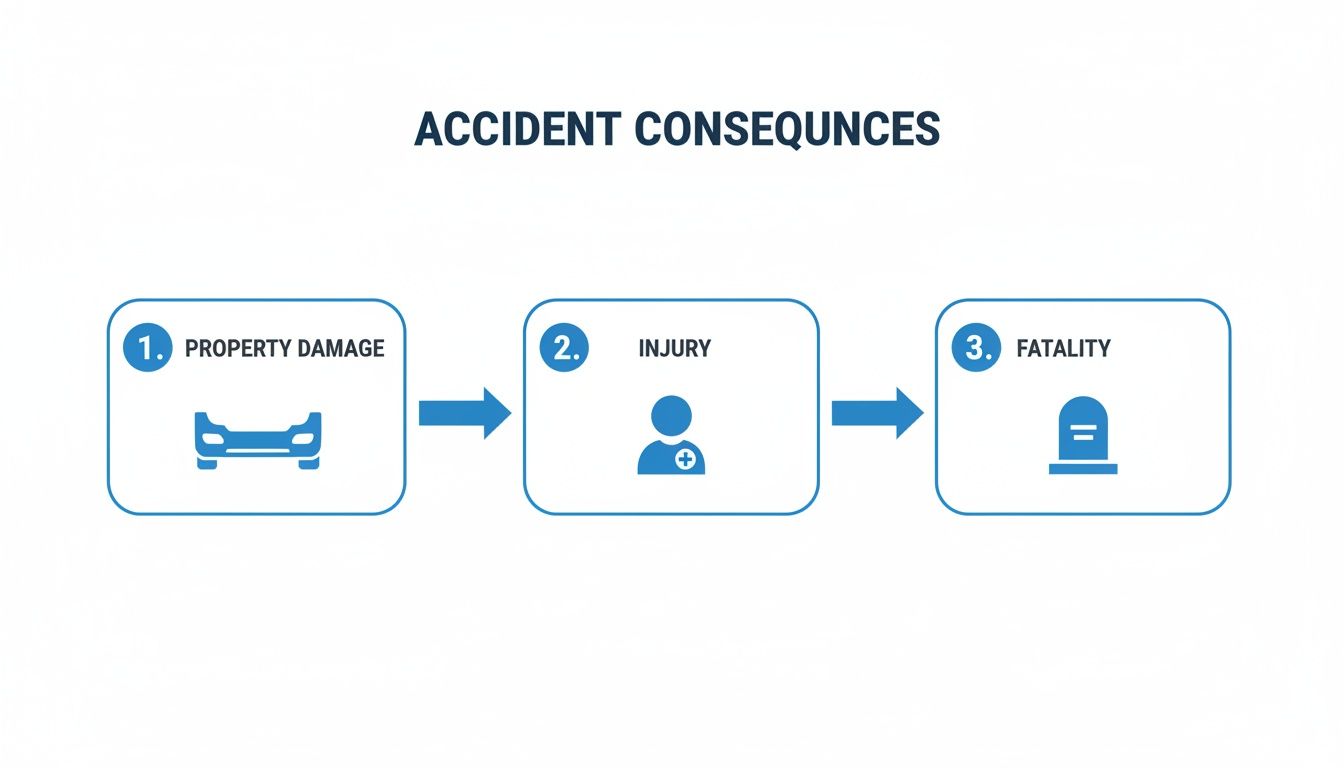
As you can see, the law draws a very clear line between a simple property damage incident and one involving injury or, tragically, a fatality. This is precisely why the penalties become so much more severe when people are hurt.
The One Exception: When You Must Move Your Vehicle
While "stop and stay" is the main rule, there's one important exception. If the accident only involves property damage and your car is blocking traffic, you are legally required to move it. This is a practical rule designed to prevent a bad situation from getting worse by causing a secondary pileup.
But this rule goes right out the window if someone is injured or killed. In those serious situations, the vehicles must not be moved until law enforcement arrives and gives the all-clear. The final position of the cars is critical evidence for their investigation. Knowing when to move and when to stay put is a key part of navigating Florida's traffic laws and keeping yourself out of deeper trouble.
Comparing Misdemeanor and Felony Hit and Run Penalties

When a driver leaves the scene of an accident in Florida, the consequences hinge almost entirely on one single factor: what happened to the other person or their property. The line between a misdemeanor and a felony isn't just a legal technicality; it's a massive leap in penalties, potential prison time, and the permanent impact it will have on your life.
Understanding this progression is absolutely essential. The journey from a relatively minor criminal charge to a life-altering felony conviction happens in an instant, and it all comes down to whether someone was hurt.
The Misdemeanor Level: Property Damage Only
The most common type of hit and run involves only damage to another car or property—a dented bumper in a parking lot, a scraped fence, you name it. Under Florida Statute § 316.061, leaving the scene of an accident with only property damage is a second-degree misdemeanor.
While that might be the least severe classification, it’s crucial to remember this is still a criminal charge, not a simple traffic ticket.
A conviction can lead to:
Up to 60 days in county jail.
A maximum fine of $500.
Points added to your driver's license.
A permanent criminal record that shows up on background checks.
Even at this level, the consequences can interfere with your job opportunities and insurance rates. The charge isn't about causing the accident; it’s about the decision to drive away.
The Felony Threshold: When an Injury Occurs
The moment an accident causes any physical injury to another person, the legal landscape changes dramatically. Leaving the scene is no longer a misdemeanor. It immediately becomes a felony, a much more serious category of crime.
From there, the severity of the felony charge climbs based on how badly the person was hurt.
Any Injury: If someone suffers an injury, the charge jumps to a third-degree felony. This is punishable by up to five years in state prison and a $5,000 fine.
Serious Bodily Injury: If the victim has what the law calls "serious bodily injury," the offense becomes a second-degree felony. This carries a potential sentence of up to 15 years in prison and a $10,000 fine.
This huge jump in penalties shows how seriously the law views the duty to stop and help someone who is hurt. Failing to render aid is a grave offense.
It's a tough pill to swallow, but a driver can face these serious felony charges even if they weren't at fault for the accident. The crime isn’t about who caused the crash; it’s about the decision to flee afterward, especially when another person is injured and needs help.
The Most Severe Charge: A Fatality
In the most tragic cases, where an accident results in a death, a driver who leaves the scene faces a first-degree felony. This is one of the most serious charges in Florida's criminal justice system.
The penalties reflect the irreversible loss of life. A conviction carries a mandatory minimum prison sentence and can result in up to 30 years in prison, along with a $10,000 fine. It also triggers a mandatory, long-term revocation of the driver's license.
To put this in perspective, the Florida Department of Highway Safety and Motor Vehicles reported nearly 100,000 hit-and-run incidents in one recent year alone. These staggering numbers are exactly why the state comes down so hard on these cases, especially when someone is injured or killed.
The legal concepts behind leaving the scene can sometimes get tangled with other driving offenses. For instance, if you’re interested, you can check out our guide on what constitutes fleeing and eluding in Florida, which involves intentionally running from law enforcement.
To make the differences crystal clear, we've put together a table that breaks down the penalties side-by-side.
Misdemeanor vs Felony Hit and Run Penalties in Florida
The table below outlines the escalating consequences based on the outcome of the accident. Notice how quickly the penalties ramp up from a misdemeanor to a first-degree felony.
Penalty Aspect | Property Damage Only (Misdemeanor) | Injury Involved (Felony) | Fatality Involved (Felony) |
|---|---|---|---|
Crime Classification | Second-Degree Misdemeanor | Third-Degree Felony (any injury) or Second-Degree Felony (serious bodily injury) | First-Degree Felony |
Maximum Jail/Prison | Up to 60 days in county jail | Up to 5 years (any injury) or 15 years (serious injury) in state prison | Up to 30 years in state prison (with a mandatory minimum) |
Maximum Fine | Up to $500 | Up to $5,000 (any injury) or $10,000 (serious injury) | Up to $10,000 |
License Consequences | Points on license | Long-term suspension or revocation | Mandatory long-term revocation |
Criminal Record | Permanent misdemeanor record | Permanent felony record | Permanent felony record |
As you can see, the stakes are incredibly high. The decision to stay at the scene is one of the most important a driver can ever make. A few moments of panic can lead to years, or even decades, of legal and personal hardship.
How to Approach a Leaving the Scene Charge
Finding out you're under investigation for leaving the scene of an accident is a gut-wrenching moment. It's not a simple traffic ticket you can just pay online and forget about. This is a criminal charge, and the steps you take right now—and the ones you avoid—can dramatically change the outcome.
Before you say a single word to a law enforcement investigator or an insurance adjuster, you need to understand your rights and the legal fight ahead. Your first move should be to take a deep breath and get strategic.
Your Immediate Priorities
Panic and fear are normal, but they can lead to impulsive decisions that make a bad situation much worse. Once you know you're being investigated, your focus has to shift entirely to protecting yourself.
Here's what to do immediately:
Do Not Speak to Investigators Alone: Police officers are trained to gather evidence to build a case against you. Anything you say will be used for that purpose. You have the right to remain silent, and you should politely decline to give any statement until you have legal counsel.
Gather Your Own Evidence: Your memory is freshest right now. As soon as you can, write down every single detail you remember about the incident. Note the time, date, location, weather, and exactly what happened. If it's safe, take photos of your vehicle from every angle.
Preserve All Communications: Don't delete anything. Keep any letters, voicemails, or official notices you get from the police or insurance companies. Save every text message or email related to what happened.
These first steps are all about preservation—preserving your rights and any evidence that might be critical to your defense. This is the foundation for building a strong case.
Exploring Potential Defense Strategies
Every case is different, but there are several common defense strategies we explore when fighting a leaving the scene charge in Florida. An attorney can dissect the specifics of your situation to find the best path forward. Our goal is always to protect your license and your record.
The prosecution has to prove that the driver knew or should have known that an accident even happened. Florida courts have been clear: just being in a collision isn't enough. The state has to prove you knew about the crash and intentionally decided to flee.
That "knowledge" requirement is often the entire case. Here are some of the avenues a lawyer might explore:
Lack of Knowledge: Did you genuinely have no idea an accident occurred? This is a perfectly valid defense, especially in minor incidents with very little impact, loud road noise, or bad weather where a slight bump might go completely unnoticed.
Incorrect Identification: The state has to prove you were the one driving the car. If their evidence is weak—maybe a blurry security camera image or a witness who isn't sure—this can be a powerful defense. They can't convict the car; they have to convict the driver.
Fleeing Due to an Immediate Threat: While it's rare, sometimes a driver leaves a scene because they have a legitimate fear for their safety, like being threatened by an enraged or aggressive driver. This defense requires a very careful and factual presentation of what happened.
When you're up against these charges, understanding the specific legal category of Hit and Run Accidents is crucial for mounting an effective defense. An experienced attorney can pick apart the prosecution's case, find the weak spots, and build a counter-narrative based on the evidence. Past results do not guarantee future outcomes, but a proactive defense is always the best way to start. Your freedom and your ability to drive are far too important to leave to chance.
Special Considerations for CDL Holders and Out-of-State Drivers
For the average driver, a charge for leaving the scene of an accident in Florida is a huge problem. But if you’re a commercial driver or just visiting from out of state, the stakes get a whole lot higher.
A conviction can trigger some uniquely devastating consequences, threatening your career or following you hundreds of miles back home.
CDL Disqualification: A Career-Ending Consequence
If you hold a Commercial Driver's License (CDL), your entire livelihood is on the line. Even a misdemeanor conviction for leaving an accident with only property damage can lead to a one-year disqualification of your CDL. A second conviction? That’s a lifetime ban.
This isn’t just a fine or a few points on your license; it’s a direct threat to your ability to put food on the table.
The Federal Motor Carrier Safety Administration (FMCSA) sets incredibly strict rules for CDL holders, and Florida enforces them to the letter. It doesn't matter if you were on the clock or driving your personal car on a day off—the law treats the conviction the same.
Leaving the scene is considered a "major offense" under federal regulations, putting it in the same serious category as a DUI.
First Offense: A conviction triggers an automatic one-year CDL disqualification.
Second Offense: Get a second conviction for any "major offense," and you're facing a lifetime disqualification of your commercial driving privileges.
One bad decision can literally end a professional driving career overnight. Our goal is to protect your license and your record, because we know that for a CDL holder, a conviction isn't an inconvenience—it's a professional catastrophe.
How a Florida Charge Follows Tourists Home
Millions of tourists flock to Florida every year, and it’s easy to think a traffic violation is just a local issue that vanishes once you cross the state line. That is a dangerously wrong assumption, especially for a criminal charge like leaving the scene of an accident in a tourist hotspot like Orange County.
Florida is a member of the Driver's License Compact, which is an agreement between most states to share driver information.
Think of the compact as a nationwide reporting system. When you're convicted of leaving an accident scene in Florida, the DHSMV reports it to your home state's DMV. Your home state will then usually apply its own penalties, just as if the offense happened right there.
This means you can’t just drive away from the consequences. The points, the license suspension, and the mark on your criminal record will be waiting for you when you get home. You might find our guide helpful, as it explains in more detail how out-of-state tickets can impact your insurance.
The numbers show just how big this problem is in Florida. Out of the hundreds of thousands of crashes statewide, a staggering 91,164 were hit-and-runs. That’s a massive 25.2% of all crashes, meaning more than 250 drivers flee the scene every single day, with a huge number of these incidents happening in tourist-heavy areas. You can find more details in these Florida accident statistics on injurylawyers.com.
Whether you’re a professional driver or a visitor, understanding these heightened risks is the first step toward building a strong defense and protecting your future.
Navigating the Legal System with an Experienced Attorney

When you're facing a charge for leaving the scene of an accident in Florida, the legal system can feel like a maze. This isn't just a traffic violation; it's a criminal offense, and trying to handle it on your own is a huge risk. Think of an experienced traffic defense attorney as your guide and advocate through this complicated process.
Our practice focuses on traffic and criminal traffic matters across Florida. From our office in Broward, we handle cases from the moment an investigation begins all the way to a final resolution. The first step is always a deep dive into your case, where we pick apart police reports, witness statements, and every piece of evidence to find the weaknesses in the prosecution's argument.
The Role of a Defense Attorney
A knowledgeable attorney does a lot more than just show up for court. We build a defense strategy tailored to the specific facts of your case. That involves a few key moves:
Challenging Evidence: We scrutinize everything the state plans to use against you. Was the driver identified correctly? Does the evidence actually prove you knew a crash even happened?
Negotiating with Prosecutors: Many cases get resolved through smart negotiation. An attorney can open a line of communication with the state prosecutor to discuss alternatives, like getting a felony reduced to a misdemeanor or finding a diversion program that could lead to a full dismissal.
Protecting Your Rights: We make sure your constitutional rights are protected at every turn. That includes strongly advising you against making any statements to investigators that could be twisted and used against you later on.
The goal is simple: protect your license and your record. We understand how much a conviction can interfere with your job, your insurance rates, and your freedom. To see how we tackle these situations, you can read our detailed guide on what a hit-and-run defense attorney does to protect clients.
An arrest is not a conviction. The state must prove every single element of the crime beyond a reasonable doubt. An attorney's job is to hold them to that high standard and frame the facts in a way that defends your interests.
If you've been accused of leaving the scene of an accident, the single most important thing you can do is get professional legal help right away. Contact us for a free, confidential consultation to go over the details of your case. Attorney Advertisement. Office in Broward. Past results do not guarantee future outcomes.
Frequently Asked Questions About Florida Hit and Run Cases
Getting accused of leaving the scene of an accident throws your life into a tailspin. Suddenly, you're facing a flood of questions and a lot of uncertainty. Let's clear up some of the most common concerns people have when they find themselves in this stressful spot.
What Should I Do if I Panicked and Left a Minor Accident Scene?
First, take a breath. Panicking is a completely human reaction, but what you do in the hours and days that follow is what truly matters. Your absolute first step should be to contact an attorney—before you speak to anyone else.
An experienced lawyer can guide you on how to proceed, which might involve proactively reaching out to law enforcement or the other party through legal counsel. Self-reporting under the guidance of a lawyer is a world away from just waiting for the police to track you down. Our goal is to get ahead of the situation and protect your license and your record.
Can I Still Be Charged if I Only Hit an Object Like a Fence?
Yes, absolutely. Florida law doesn't care if you hit another car or a stationary object. Under Florida Statute § 316.061, your legal duties kick in for any crash that results in property damage. That includes mailboxes, fences, light poles, or even someone's prize-winning rose bushes.
If you damage someone's property, the law says you have to make a reasonable effort to find the owner and give them your information. If you can't track them down, you're required to leave a note with your details in a visible spot and report the accident to the police.
How Do Police Typically Investigate Hit and Run Accidents?
Law enforcement takes leaving the scene of an accident very seriously and they have a standard playbook for tracking down the driver. A typical investigation will include:
Witness Interviews: Talking to anyone who saw the crash happen or saw the vehicle drive away.
Searching for Surveillance Footage: Canvassing nearby businesses and homes for security cameras that might have caught the incident.
Debris Analysis: Collecting paint chips or broken car parts left at the scene to help identify the vehicle's make, model, and year.
Body Shop Alerts: Putting local auto repair shops on notice to watch for vehicles coming in with damage that matches the accident.
Will My Insurance Rates Be Affected if I Am Charged?
A charge for leaving the scene can do serious damage to your insurance. If you're convicted, your insurer will almost certainly see you as a much higher-risk driver. This can lead to a massive spike in your premiums, or they might just decide to drop your policy altogether at renewal time.
To an insurance company, a criminal conviction for leaving the scene is far more alarming than a simple at-fault accident. It signals a disregard for legal responsibilities, which is a major red flag for them.
Navigating a charge for leaving the scene of an accident demands a smart, strategic approach. At Ticket Shield, PLLC, our practice focuses on criminal traffic defense across Florida. For a free consultation to talk about your specific situation, contact us today. Attorney Advertisement. Office in Broward. Past results do not guarantee future outcomes.