Hiring a Hit and Run Defense Attorney in Florida
Facing a hit and run charge? A skilled hit and run defense attorney can protect your rights. Learn how a lawyer builds a defense in Florida.

If you've been accused of leaving the scene of an accident in Florida, you're facing a serious charge. The first few moves you make are crucial and can dramatically change the outcome. This is where a hit and run defense attorney comes in—a legal professional whose practice focuses on criminal traffic law. Our goal is to protect your rights, your license, and your record by digging into the details of the incident and analyzing the prosecution's case.
What a Florida Hit and Run Charge Really Means

When you hear "hit and run," you probably imagine a major, high-speed crash. But in the eyes of Florida law, the definition is much wider. Legally, it’s called "Leaving the Scene of an Accident," and it applies anytime a driver doesn't meet their legal obligations after a crash.
It could be something as simple as dinging a car door in a tight grocery store parking lot and just driving off. Or it could be a more serious collision involving another moving car or, worse, a pedestrian. The key isn't how bad the damage is; it's about the failure to stop, share your information, and offer help if someone needs it.
Distinguishing Between Property Damage and Injury
The penalties for a hit and run in Florida all come down to one critical factor: did the accident only involve property damage, or was someone hurt? This is the line that separates a misdemeanor from a felony.
Property Damage Only: If the accident just damaged another car or object (like a mailbox or a fence), the charge is usually a second-degree misdemeanor.
Injury to Another Person: If someone suffers any kind of physical injury, the charge jumps to a felony. The level of that felony—from third-degree all the way to first-degree—is tied directly to how badly the other person was hurt.
Key Takeaway: A conviction for leaving the scene is not just a traffic ticket. It's a criminal offense that can result in jail time, significant fines, license suspension, and a permanent criminal record.
To give you a clearer picture of what you could be up against, here's a quick breakdown of the potential penalties under Florida law.
Florida Hit and Run Penalties at a Glance
Type of Accident | Classification | Potential Penalties |
|---|---|---|
Property Damage | Second-Degree Misdemeanor | Up to 60 days in jail, $500 fine, 6 points on license |
Injury | Third-Degree Felony | Up to 5 years in prison, $5,000 fine, license revocation |
Serious Bodily Injury | Second-Degree Felony | Up to 15 years in prison, $10,000 fine, license revocation |
Death | First-Degree Felony | 4-year mandatory minimum, up to 30 years in prison, $10,000 fine |
As you can see, the stakes get incredibly high, very quickly. This isn't something you should handle on your own.
Why Legal Representation Is Critical
Trying to navigate these charges by yourself is a massive gamble. The law is complex, and prosecutors are often looking to make an example out of these cases. An experienced hit and run defense attorney knows the ins and outs of Florida traffic law and can identify potential weaknesses in the state's case that you would almost certainly miss.
Our practice focuses on criminal traffic defense across Florida. Our goal is to protect your license and your record. While past results do not guarantee future outcomes, our experience can be a valuable asset. To get a better handle on the process, take a look at our detailed guide on what to expect with hit and run charges.
Your First Moves After a Hit and Run Allegation
It often starts with a phone call from a detective or an unexpected knock at your door. When law enforcement contacts you about a hit and run, your world can feel like it's shrinking, and a sense of panic can set in fast.
The first instinct for most people is to start explaining. You want to tell your side of the story, to clear up what you're sure is just a simple misunderstanding.
This is exactly what you should not do.
Speaking to investigators without a lawyer is one of the biggest and most damaging mistakes you can make. Anything you say, no matter how innocent you think it sounds, can be twisted, taken out of context, and used to build a criminal case against you. Your first move—and your most important one—is to protect your rights.
Invoke Your Right to Remain Silent
The moment an investigator starts asking questions, you need to remember you have the right to remain silent. You have zero legal obligation to give them a statement, and you should politely but firmly refuse to answer questions.
A simple, clear response is all you need:
"Officer, I want to cooperate, but I will not be answering any questions at this time. I am invoking my right to remain silent and I would like to speak with my attorney."
Saying this is not an admission of guilt; it's you exercising a right guaranteed by the Constitution. It stops you from accidentally saying something that could incriminate you, like confirming where you were or discussing the condition of your vehicle.
Do Not Speak to Insurance Adjusters
It’s not just the police you need to be wary of. Soon after, you might get a call from an insurance adjuster looking to gather information. Remember, their job is to protect their company’s bottom line, not to help you.
These conversations are almost always recorded, just like police interviews. Politely tell any adjuster that your attorney will contact them directly, and don't give them any details about what supposedly happened. Understanding your duties here is critical; you can learn more about what the legal obligations are after a car accident in Florida in our detailed guide.
Preserve Evidence and Document Everything
While you shouldn't be talking to investigators, you should immediately start documenting everything on your own. Your memory is a crucial piece of evidence, and it can fade faster than you think.
Write It All Down: As soon as you can, write down every single detail you can recall about where you were and what you were doing around the time of the alleged incident. Be specific about the date, time, and location.
Photograph Your Vehicle: Before you even think about repairs, take clear, well-lit pictures of your entire car from every angle. Document any existing damage—or the lack of damage—that could be relevant.
Collect Proof: Gather anything that can help establish an alibi. This includes things like store receipts, credit card statements, or even GPS data from your phone that proves where you were.
Taking these proactive steps gives your hit and run defense attorney the raw materials they need to start building a defense strategy. The whole point is to protect your license and your record, and that process starts the very second you're accused.
How Your Attorney Builds a Strong Defense
Building a defense against a hit and run charge isn't about just reading the police report. That report is the prosecution's version of events, and a skilled defense attorney knows the real work starts with an independent investigation. We have to uncover the facts, find the evidence police might have missed, and challenge the state's story from every angle.
Think of the police report as the opening chapter. It's often one-sided. Our job is to dig in and find the rest of the story—the details that don't quite fit the prosecution's narrative.
Independent Scene and Evidence Analysis
First things first, we often go back to the scene of the alleged incident. Even long after the police have cleared out, crucial evidence can still be there. An attorney might be looking for skid marks, debris, or other physical clues that paint a completely different picture of what happened.
A deep dive into the vehicle itself is just as critical. The location and severity of any damage—or sometimes, the lack of damage—can be incredibly powerful evidence. If the scuffs on your bumper don't match the other party's story, it can create some serious doubt.
One of the most common defenses is that the impact was so minor that a reasonable person wouldn't have even known an accident occurred. Detailed photos and analysis of paint transfer, dents, and scratches can either support or challenge this claim, making a thorough vehicle inspection absolutely essential.
This methodical analysis is the bedrock of a solid defense strategy.
Locating Witnesses and Surveillance Footage
Let's be honest: police investigators are swamped. They don't always have the time or resources to track down every single witness or piece of video evidence. That's where a defense investigation can be beneficial. We pick up where law enforcement left off.
Here's what that often looks like:
Canvassing the Area: We systematically go door-to-door, checking nearby businesses, homes, and apartment buildings for security cameras. You'd be surprised how often a Ring doorbell or a private CCTV system captures the exact moment that can change a case.
Interviewing Witnesses: Finding and speaking with anyone who saw what happened can bring a fresh perspective. A witness might confirm that you weren't the one driving, or that the circumstances weren't at all what the other person claimed.
Gathering Digital Evidence: This is a race against the clock. We need to get our hands on traffic camera footage or recordings from nearby businesses before they get deleted. This kind of evidence can be the key to proving you weren't the driver or that no collision even happened.
By gathering our own evidence, we're not stuck relying on what the prosecution decides to share. Our practice, with an office in Broward, handles criminal traffic matters across Florida.
This whole process isn't about manufacturing a story—it's about uncovering the full story. It gives your attorney the ammunition to challenge the prosecution on key points like driver identification, knowledge of the accident, and the actual extent of the damage. While past results do not guarantee future outcomes, a thorough defense is always the best way to protect your license and your record.
Defending Your Case in the Florida Court System
Facing a hit-and-run allegation can throw you into the deep end of the Florida criminal court system. It’s a confusing place, and every step, from your first court date to the final outcome, has its own set of rules. This is where having an experienced hit-and-run defense attorney becomes absolutely critical to steer you through the process.
Your journey through the court system usually kicks off with an arraignment. This is your first official appearance in front of a judge, where they'll formally read the charges against you. At this hearing, you’ll enter a plea. We almost always enter a "not guilty" plea at this stage because it protects all your legal rights and gives us the time we need to dig into the evidence.
The Role of Motions and Plea Negotiations
With the "not guilty" plea entered, the real strategic work begins. A big part of this involves filing legal motions to challenge the prosecutor's case. For instance, if the police found evidence against you through an illegal search or messed up the process of identifying you as the driver, we can file a "motion to suppress." If successful, this can get that key piece of evidence thrown right out of court.
At the same time, we're almost always talking with the prosecutor. These conversations are called plea negotiations, and the goal is to work out a favorable deal for you without the all-or-nothing risk of a trial.
Depending on the specific facts of your case, we might push for:
Reduced Charges: Getting a serious felony charge knocked down to a much less severe misdemeanor.
Diversion Programs: Arguing for you to enter a special program. If you complete it successfully, the charges could be dropped completely.
Avoiding Conviction: We often aim for a "withhold of adjudication." This means you aren't formally convicted, helping to keep your record clean.
Negotiations can be complex. You need to know exactly what you’re getting into, which is why we’ve broken down what happens if you plead guilty in a separate, detailed guide.
The Investigation and Discovery Process
While negotiations are happening, our defense team is running its own parallel investigation. We can't just rely on what the police give us. We have to dig for ourselves—finding security footage, tracking down witnesses, and closely examining any physical evidence.
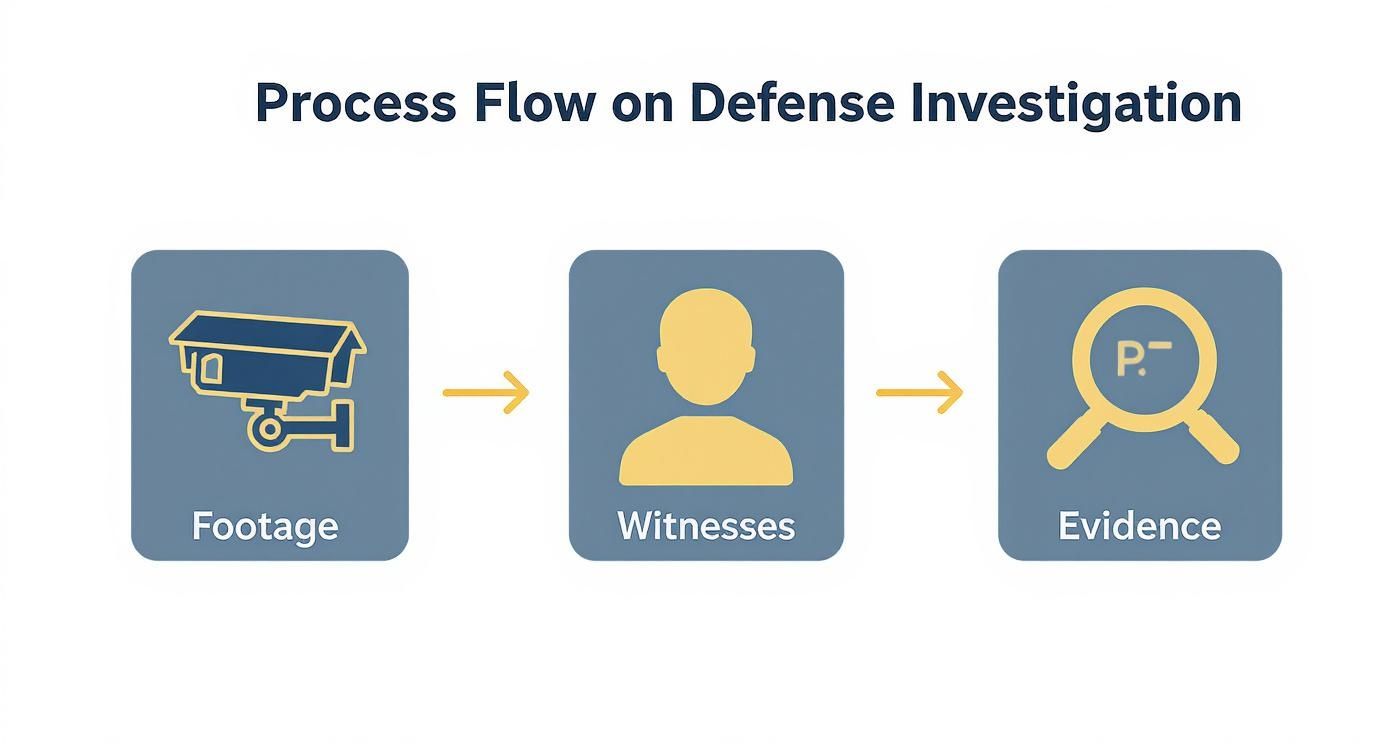
This process is about building the full story. A strong defense is built on details that law enforcement might have overlooked or misinterpreted.
Our goal is to protect your license and your record. While no attorney can guarantee a specific result, a proactive legal strategy is key. We handle criminal traffic matters across Florida.
If we can't reach a plea agreement that's in your best interest, the case might head to trial. That's when we present all the evidence we've gathered to a judge or jury, who will make the final call. No matter which path your case takes, our commitment is to keep you informed, explain your options in plain English, and advocate for you every step of the way.
Proven Defense Strategies for Hit and Run Cases

Just because you've been accused of a hit and run doesn't mean you'll be convicted. The state carries the entire burden of proving every single element of the crime beyond a reasonable doubt—and that's an incredibly high legal bar to clear. A sharp defense attorney knows how to dismantle the prosecution's case by creating that doubt and presenting a credible, alternative version of events.
Success in these cases almost always comes down to a meticulous investigation and an intimate knowledge of Florida's traffic laws. No two cases are ever the same, so the right strategy is built entirely around the specific facts and whatever evidence is available. It’s important to remember that past results do not guarantee future outcomes.
Challenging the Element of Knowledge
One of the most effective defenses is arguing a simple lack of knowledge. To get a conviction, the prosecutor has to prove you knew or should have reasonably known that you were in an accident causing damage or injury. That’s not always as easy as it sounds.
Think about a common parking lot scenario: you're backing out of a tight spot, your radio is on, and the corner of your bumper lightly scrapes another car. It's entirely plausible you were genuinely unaware any contact even happened. In situations like these, we can argue you didn't "willfully" leave the scene by pointing to the minor damage or the lack of any obvious impact.
An accusation is just the beginning of the legal process, not the end. A strong defense explores every angle to demonstrate that the state cannot meet its burden of proof. Our goal is to protect your license and record by carefully examining all evidence and circumstances.
Questioning the Driver's Identity
Another key pillar of a solid defense is casting doubt on who was actually behind the wheel. Eyewitness testimony is notoriously unreliable, especially when an incident happens fast, at night, or from a distance. A witness might get the make and model of the car right but be completely wrong about the driver.
An experienced attorney can attack this element from several angles:
Presenting a solid alibi: We can use receipts, witness testimony, or even GPS data to show you were somewhere else entirely.
Challenging witness credibility: We can highlight inconsistencies in their story or point out poor visibility conditions that made a positive ID nearly impossible.
Proving someone else was driving: We can show that a friend, family member, or someone else had access to your vehicle at the time.
In some cases, like proving the vehicle was stolen, information about modern car security systems can be useful. The reality is that the clearance rate for hit and run cases in the U.S. is surprisingly low—only about 20% of cases are ever solved. This means prosecutors are often working with very limited evidence.
Ultimately, building a defense is about methodically taking apart the state's case piece by piece. You can learn more about how we build a strong defense by reviewing our guide on what to do if you’re accused of leaving the scene of an accident.
Your Top Questions About Florida Hit and Run Charges Answered
When you're accused of leaving the scene of an accident, your mind starts racing. The questions and the "what ifs" can be overwhelming. Getting straight answers is the first step to taking back control. Let's break down some of the most common concerns we hear from people in your exact situation.
This information is for educational purposes and should not be taken as legal advice. Submitting information via any form on our website does not create an attorney-client relationship.
What Should I Do If Police Contact Me?
If an investigator calls or knocks on your door about a hit and run, what you do next is absolutely critical. You have the right to remain silent—use it.
Don't try to explain yourself or answer questions about where you were, who was driving, or the state of your car. Anything you say can be twisted and used against you. All you need is one simple, firm statement: "I am invoking my right to remain silent and will not be answering any questions without my attorney present." This isn't an admission of guilt; it's you using a constitutional right to protect yourself from accidentally saying the wrong thing.
Can I Be Charged If I Didn't Know I Hit Something?
Yes, you can still be charged, but your lack of knowledge could be your strongest defense. The prosecutor has to prove, beyond a reasonable doubt, that you knew an accident happened (or that you should have known).
This is where an experienced hit and run defense attorney can assist. We challenge that element of "knowledge." Was the impact just a minor scrape in a loud, busy parking lot? It's perfectly believable that a reasonable person wouldn't even notice. Evidence like minimal vehicle damage or the lack of a loud crash can help analyze the state's case.
What Is the Difference Between Misdemeanor and Felony Hit and Run?
The line between a misdemeanor and a felony hit and run charge in Florida is drawn based on one simple factor: whether someone was hurt. The difference in penalties is anything but simple.
Misdemeanor: If the accident only caused damage to another car or property (like a mailbox or a fence), it's a second-degree misdemeanor.
Felony: If any person is injured, the charge is immediately a felony. The level of felony, from third-degree all the way to first-degree, depends entirely on how badly the person was hurt. A hit and run that results in a death is a first-degree felony, and it comes with a mandatory minimum prison sentence.
Will a Hit and Run Charge Affect My Driver's License?
Absolutely. A conviction for leaving the scene of an accident brings its own set of administrative penalties from the Florida DHSMV, completely separate from whatever the criminal court decides.
You can expect consequences like:
Points on Your License: A conviction will add points to your record, which almost always means higher insurance premiums.
License Suspension or Revocation: Depending on how serious the offense is, your license could be suspended for months or even permanently revoked.
Protecting your ability to drive is one of our top priorities. While no attorney can guarantee a specific outcome, our team will seek a resolution that minimizes the impact on your license.
You don't have to face these charges alone. If you've been accused of a hit and run, contact Ticket Shield, PLLC for a free, confidential consultation to go over your rights and legal options. Call us at (561) 821-6189 or submit your ticket online to get started.
Attorney Advertisement. Office in Broward. Past results do not guarantee future outcomes. Prospective clients may not obtain the same or similar results.