How Much Is a Ticket for a Hit and Run? Florida Penalties
Learn exactly how much is a ticket for a hit and run in Florida for 2026. Understand fines, felony charges, & license penalties. Protect your record.

You may be staring at a court date, a police call, or a notice that says you left the scene. Your stomach drops because you think this is “just a ticket.” In Florida, it often isn't. A hit and run accusation can put your license, your insurance, and your record in danger fast.
If you're asking how much is a ticket for a hit and run, the honest answer is simple. The posted fine is only the front edge of the problem. The actual cost comes from what follows if you handle this wrong.
Table of Contents
What Happens After a Hit and Run Accusation
In Florida, a hit and run involving only property damage can mean up to 60 days in jail and a $500 fine. If injury is involved, the case can become a felony with prison time, major fines, and license consequences.
You usually don't get much time to process this. One moment you're replaying the crash in your head. The next, you're dealing with law enforcement, a court notice, or an accusation from the other driver. That's when people make the mistake that hurts them most. They start explaining.
Don't.
A hit and run allegation is rarely just about a fine. It's about what the State thinks it can prove about your conduct after the crash. Your words can fill in the gaps for them. If you admit you were there, guess about what happened, or try to sound cooperative, you may hand prosecutors evidence they didn't have before.
Practical rule: If you've been accused, stop talking about the facts with police, the other driver, and even your insurance company until a defense lawyer reviews the case.
The first few days matter because the case starts forming immediately. Officers write reports. Witnesses lock into a version of events. Video, photos, and call logs become important. If your case lands in a courthouse like the Broward County Judicial Complex or another major Florida criminal courthouse, the paper trail will matter more than your panic.
You need a clear head and a disciplined response. That starts with understanding what you're charged with and what Florida law requires after any crash. If you need a broader breakdown of your first moves, review what to do if you're accused of a hit and run.
What Does Florida Law Consider a Hit and Run
Florida law doesn't treat hit and run as a vague moral failure. It treats it as a specific violation of Florida Statute § 316.027. The issue is whether you stopped, stayed, and provided the required information after a crash.
What duties does Florida law impose after a crash
Under Florida Statute § 316.027, a driver involved in a crash must stop as close to the scene as possible and remain there until identifying information is provided. For property-damage-only cases, leaving the scene is a second-degree misdemeanor punishable by up to 60 days in jail and a $500 fine, as described in this summary of what constitutes a hit and run in Florida.
That's the legal baseline. It doesn't matter that you were scared, embarrassed, late for work, or convinced the damage was small. Those facts may matter to a defense strategy later, but they don't erase the statutory duty to stop.
Why minor damage still creates criminal exposure
Many drivers think a scrape in a parking lot, a tapped bumper, or a damaged mailbox can be handled informally later. That thinking gets people charged. Florida treats the act of leaving as the problem.
The charge can also develop before you ever see the full evidence. Police may rely on plate readers, witness statements, body shop photos, or neighborhood cameras. Once the accusation exists, the case becomes less about what you meant and more about what the State can tie to you.
Even in a property-damage case, you're dealing with a criminal allegation. Treat it that way from the first phone call.
If you want a closer look at classifications and filing deadlines, review this breakdown of Florida hit-and-run charges. It's especially useful if you're trying to understand where your accusation fits under Chapter 316.
How Do Penalties Escalate from Misdemeanor to Felony
The difference between a misdemeanor and a felony in a hit and run case is brutal. The case changes the moment someone claims physical injury. What looked like a county-level offense can turn into a felony record and state prison exposure under Florida Statute § 316.027.
What is the baseline penalty for property damage only
For property damage only, Florida treats the offense as a second-degree misdemeanor. That means the exposure starts at the lower end of the scale, but it's still criminal. Jail is possible. Probation can be ordered. A conviction still follows you.
Here is the comparison graphic that shows how fast the stakes rise.
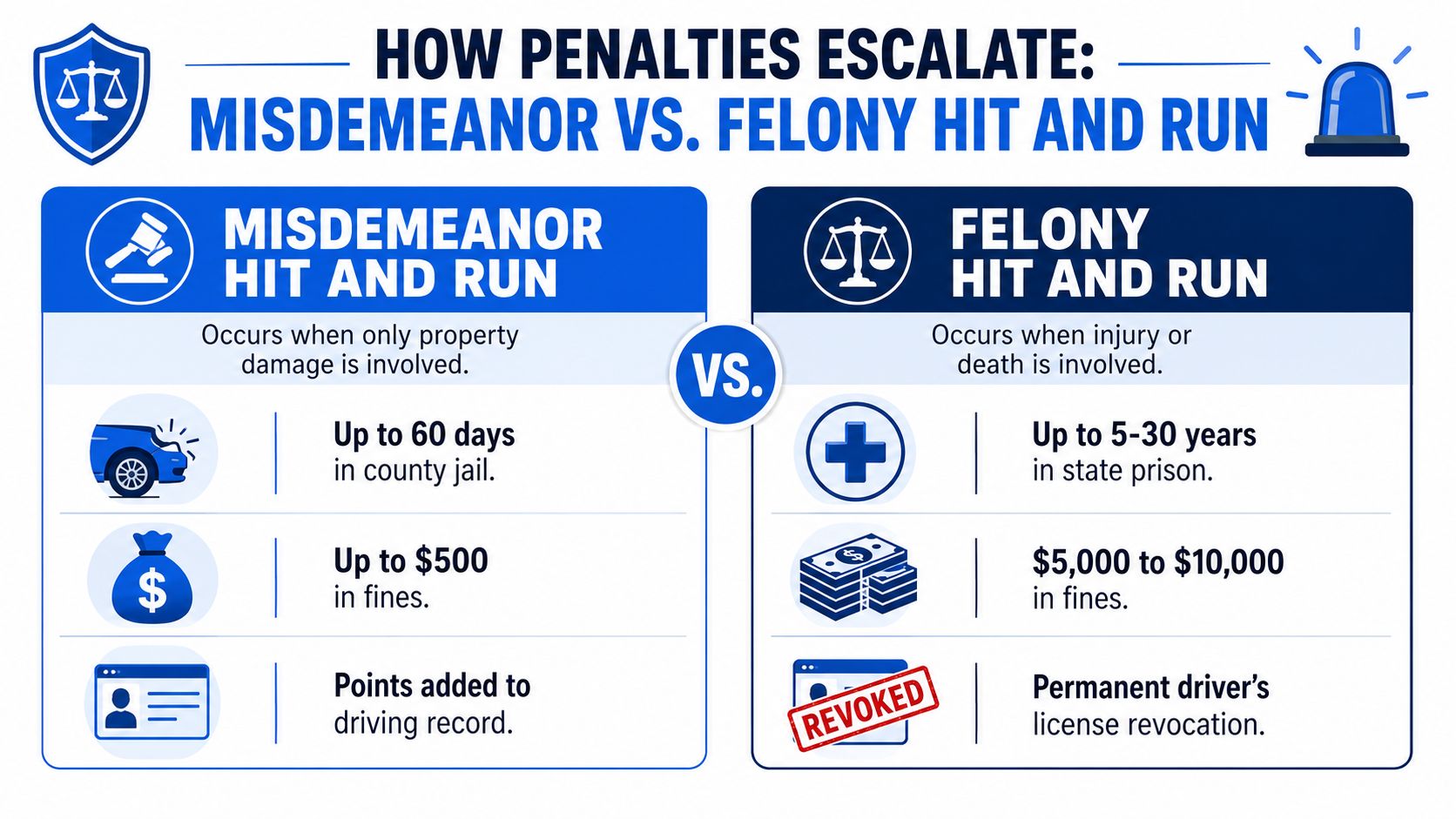
What changes when someone is hurt
If the crash involves personal injury, the offense becomes a third-degree felony. Florida materials summarizing § 316.027 state that a hit-and-run crash causing personal injury is punishable by up to five years in prison, a mandatory $5,000 fine, and a mandatory driver's license revocation for at least three years, as explained in this discussion of the penalty for a hit and run in Florida.
If the crash results in death, the exposure becomes far more severe. Florida law can impose a mandatory minimum prison term of 4 years, a maximum of 30 years, and a $10,000 fine, according to this overview of hit-and-run ticket consequences in Florida. The same source notes that if the driver was under the influence and left the scene of an injury or death crash, an additional mandatory minimum prison term of 2 years applies.
That's why the phrase “ticket” is misleading in serious cases. You may have started with a traffic event, but the prosecution may now be treating it as a felony offense with life-changing consequences.
A lot of drivers also confuse hit and run with related offenses. They aren't the same. If police are stacking allegations, this page on fleeing and eluding in Florida helps clarify the distinction.
A short video can help if you need the issue explained plainly before court.
Florida Hit-and-Run Penalties at a Glance
Scenario | Crime Classification | Maximum Jail/Prison Time | Maximum Fine |
|---|---|---|---|
Property damage only | Second-degree misdemeanor | Up to 60 days in jail | $500 |
Personal injury | Third-degree felony | Up to 5 years in prison | $5,000 |
Fatality | Highest felony tier described here | Up to 30 years in prison, with a 4-year mandatory minimum | $10,000 |
What Are the Hidden Costs Beyond the Fines
The court fine often becomes a focal point because it's easy to picture. That's a mistake. The long-term damage usually comes from the financial and personal fallout after a conviction.
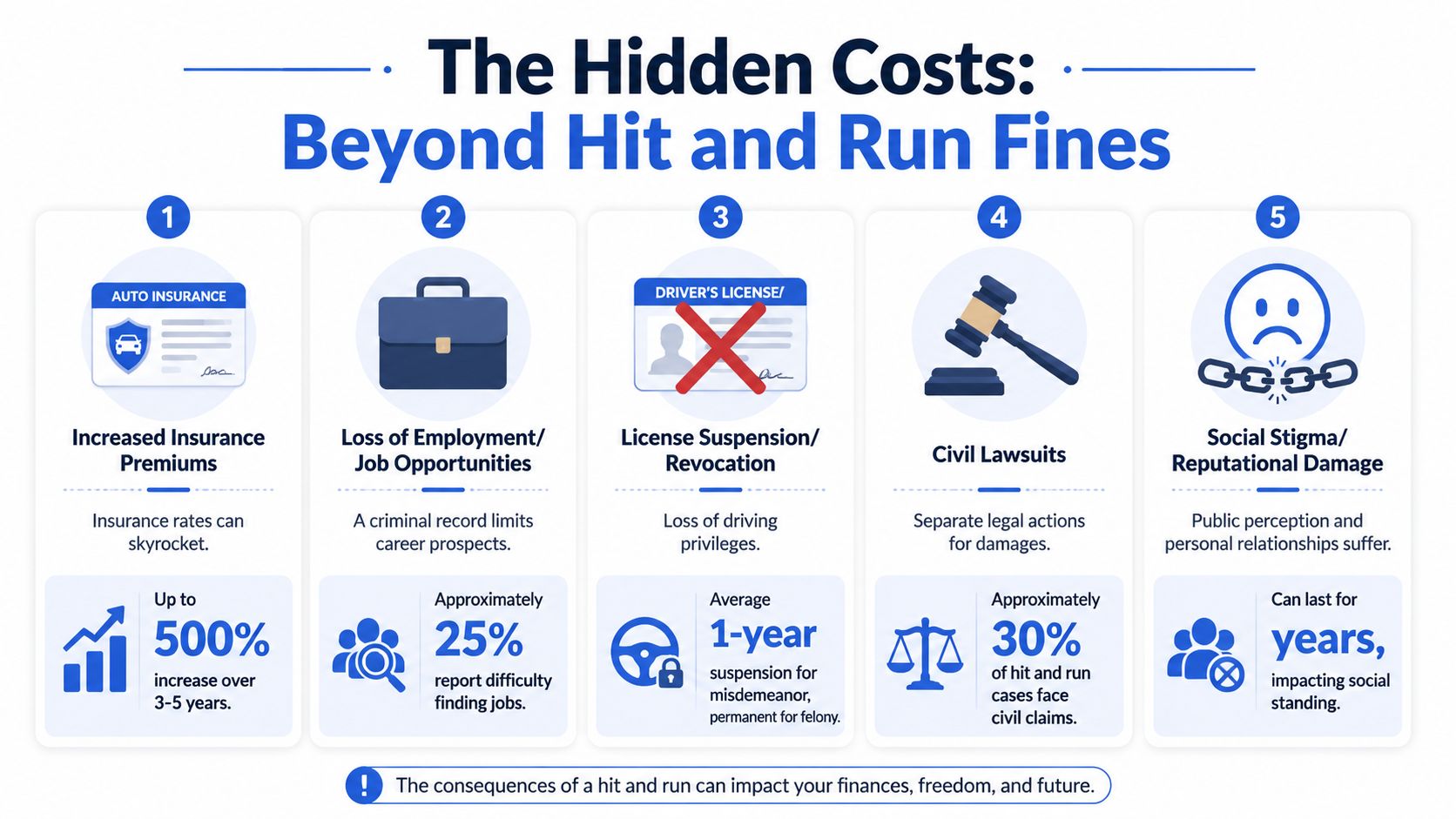
Why insurance is often the most expensive part
A conviction can drive your premiums sharply higher. One Florida-focused review states that insurance premiums can increase by an average of 95% following a conviction, which is why the true cost often dwarfs the courtroom fine, according to this analysis of how fighting Florida tickets helps protect insurance rates.
That kind of increase doesn't feel like one bad month. It follows you. If you drive for work, commute long distances, or carry commercial exposure through app-based driving, the pressure gets worse.
Your court case ends on paper. Your insurance carrier may keep charging you for it long after that.
What a record and license issue can do to your life
The money isn't the only issue. A criminal conviction can affect hiring, professional licensing, housing applications, and any situation where someone runs a background check. If your case involves injury, Florida also allows for mandatory license revocation, which can disrupt every part of your routine.
That means a hit and run case can hit four separate areas at once:
Driving privilege: You may lose the ability to drive legally for a meaningful period.
Income stability: Delivery drivers, rideshare drivers, and field employees can lose work quickly.
Reputation: A criminal record changes how employers and insurers evaluate you.
Advantage in related claims: Once there's a conviction, your position gets weaker everywhere else.
People who treat this as “just paying the ticket” often regret it later. The fine is visible. The rest shows up over time.
What Are Your Immediate Steps If Charged
If you've been charged, your next moves matter more than your explanations. You need to protect your rights before the State locks in its version of events. That's especially true if you're headed toward a first appearance or hearing in a courthouse like the Richard E. Gerstein Justice Building in Miami.
Immediate Steps to Take
Stop giving statements: If police, investigators, or the other driver contact you, keep it short. Tell them you want counsel before discussing the facts.
Preserve your evidence: Save photos, text messages, call logs, rideshare app records, receipts, dashcam footage, and repair documents. Don't assume something is too minor to matter.
Write a private timeline: Record where you were, when the contact happened, what you noticed, and who spoke to you. Do this for your lawyer, not for police.
Check every court date: Missing a hearing creates a second problem fast. Read every citation, notice to appear, and bond document carefully.
Protect your vehicle records: Don't destroy repair estimates, body shop receipts, or insurance paperwork. Those details may become central.
Get a defense lawyer involved early: Early intervention can prevent avoidable damage, especially before you speak again or enter a plea.
What to avoid in the first day
Some mistakes are almost automatic because people want to “fix” the situation. Don't call the complaining witness to apologize. Don't post about it. Don't ask a friend to contact anyone for you. Don't try to write your own explanation letter to the court.
The first clean move is silence, document preservation, and legal review.
You also shouldn't assume officers already know everything. Sometimes the State's case has holes. Sometimes identification is weak. Sometimes the timeline is wrong. Those weaknesses disappear if you volunteer facts that patch the prosecution's case.
How a Lawyer Defends You Against These Charges
A real defense starts with pressure-testing the accusation, not with begging for mercy. The State has to prove identity, operation, the nature of the crash, and your failure to meet legal duties under Chapter 316. Each one of those points can become a fault line.

Where strong defenses usually start
A defense lawyer reviews the basics first. Was the driver identified correctly? Does the video clearly show the vehicle? Is the witness sure, or guessing? Was there actual injury, or only a later complaint? Did officers document the scene properly?
Then the review gets more technical. Filing deadlines matter. According to this summary of hit-and-run defense timing in Florida, misdemeanor hit-and-run has a one-year filing window, and felony cases involving injury or death have 3 to 4 years, which means a late-filed case can be challenged.
That issue gets ignored far too often by people using automated apps or volume-based ticket services. Those systems process files. They don't build strategy. They don't spot timing problems, witness contradictions, or evidentiary gaps with the same care as a lawyer who is handling your case.
Why direct lawyer access matters
Representation style matters. You want a lawyer-led defense where you can speak directly with your attorney by phone or text. You do not want middlemen summarizing your case, bots answering procedural questions, or an intake chain that keeps your lawyer at arm's length.
A serious traffic crime needs quick answers. If police call again, if a bond condition changes, or if the prosecutor makes an offer, you need legal judgment immediately. That doesn't happen well in a ticket mill.
A good defense isn't just about trial. It's about identifying weaknesses early, controlling your exposure, and pushing for outcomes that protect your record and license whenever possible.
Why Your First Call Is the Most Important One
A hit and run charge can cost you far more than a posted fine. It can threaten your license, inflate your insurance, and put a criminal record in your path. If injury is involved, the risk rises fast and the case can move like a felony from the start.
You don't get points for handling this alone. You take on risk.
The right first call protects you from the mistakes people make when they panic. It helps you stop damaging statements, preserve evidence, evaluate deadlines, and build a defense before the case hardens against you. That's the difference between reacting and protecting yourself.
If your goal is no points, less damage to your record, and the strongest available defense, act now.
Visit Ticket Shield, PLLC for a free consultation. It's a lawyer-led Florida defense firm where you speak directly with your attorney by phone or text, not a chatbot or middleman. Protect your record. Protect your license. Fight for no points.