Hit and Run in Miami: Your Immediate Defense Guide
Charged with a hit and run in Miami? Understand Florida laws, penalties, and your defense options. Our guide explains what to do now to protect your record.

If you're accused of a hit and run in Miami, stop talking and get counsel now. Florida Statute Chapter 316 makes leaving the scene a crime, not a ticket. One panicked mistake can cost your license, your job, and your freedom.
Your phone is buzzing. Maybe the police called. Maybe an officer came to your door. Maybe you saw damage later and now you're replaying every second, trying to convince yourself it was nothing.
This is when people wreck their defense.
Panic makes drivers talk too much, text the wrong person, delete the wrong thing, or go explain themselves without protection. In a hit and run in miami case, that instinct can hand the State exactly what it needs. You need control, not confession. You need a strategy before anyone gets another word out of you.
Table of Contents
You Are Accused of a Hit and Run in Miami What Happens Now

A hit and run accusation lands hard because the law treats it like a criminal act from the start. This isn't a routine citation you can casually deal with later. It can become a misdemeanor or a felony, depending on what the State claims happened and what damage or injury was involved.
In Miami-Dade, prosecutors see these cases constantly. In 2025, Miami-Dade County saw 13,122 hit-and-run incidents, making up 31% of all crashes. These are not minor events; they led to 20 fatalities and 2,242 injuries according to Miami hit-and-run crash data. That volume is exactly why the system reacts aggressively when your name surfaces.
Why panic is your first legal threat
Most bad outcomes start with one sentence. "I didn't think I hit anyone." "I was scared." "I left because traffic was crazy." Those statements may feel human. In court, they become evidence.
Your first move is silence.
Practical rule: If police want your side of the story, they are gathering evidence, not clearing your name.
Don't call the investigating officer back to "clear this up." Don't message the other driver. Don't post online. Don't ask friends what they think the cops can prove. If you need background on the broader legal risk, review Florida hit and run basics, then stop researching and start protecting yourself.
Why Miami prosecutors move fast
A hit and run in miami case often comes together through fragments. A tag number. A witness. A traffic camera. Vehicle damage. A tip from someone who knows your car. Drivers underestimate how quickly those fragments get organized.
The actual danger is what happens in the aftermath. You are anxious. The State is methodical. That imbalance is where people get trapped.
A lawyer changes the temperature immediately. Instead of you reacting emotionally, someone steps in, controls communication, evaluates exposure, and starts making decisions based on law, not fear. That's how you stop the spiral.
What Legally Defines a Hit and Run in Florida
Florida law is direct on this point. Under Florida Statute § 316.061, a driver involved in a crash with property damage must stop and provide required information. Under Florida Statute § 316.027, a driver involved in a crash with injury or death must stop, remain at the scene, provide identifying information, and comply with duties tied to aid and reporting.
What Florida law actually requires
The law focuses on what you did after the crash. It doesn't start with who caused it.
If you're involved in a crash, Florida law generally requires you to:
Stop at or near the scene: Leaving before handling your legal duties creates the core problem.
Give identifying information: That includes the information required by law after a crash.
Remain when injury is involved: If someone is hurt or killed, leaving creates far more serious criminal exposure.
Address aid obligations: Injury cases trigger duties beyond a simple exchange of information.
For a more focused breakdown of those charges, see Florida hit and run charge definitions.
Why fault and leaving the scene are different issues
Drivers make a major mistake here. They think, "The crash wasn't my fault, so leaving shouldn't matter." That's wrong.
You can dispute fault for the collision and still be charged for leaving the scene.
Those are separate issues. A driver who didn't cause the impact can still face criminal exposure by failing to stop and perform the duties required by Chapter 316. That's why casual advice from friends is dangerous. People collapse everything into one question. The law doesn't.
What matters in the first analysis is this:
Legal question | Why it matters |
|---|---|
Were you the driver? | The State must connect you to the vehicle and the scene |
Was there property damage, injury, or death? | That affects the charge level |
Did you stop and remain as required? | This is the heart of the accusation |
Did you provide required information and aid? | Missing duties can support the case |
The legal definition sounds simple. The proof issues are not. That's where defense work begins.
What Are the Criminal and Civil Penalties
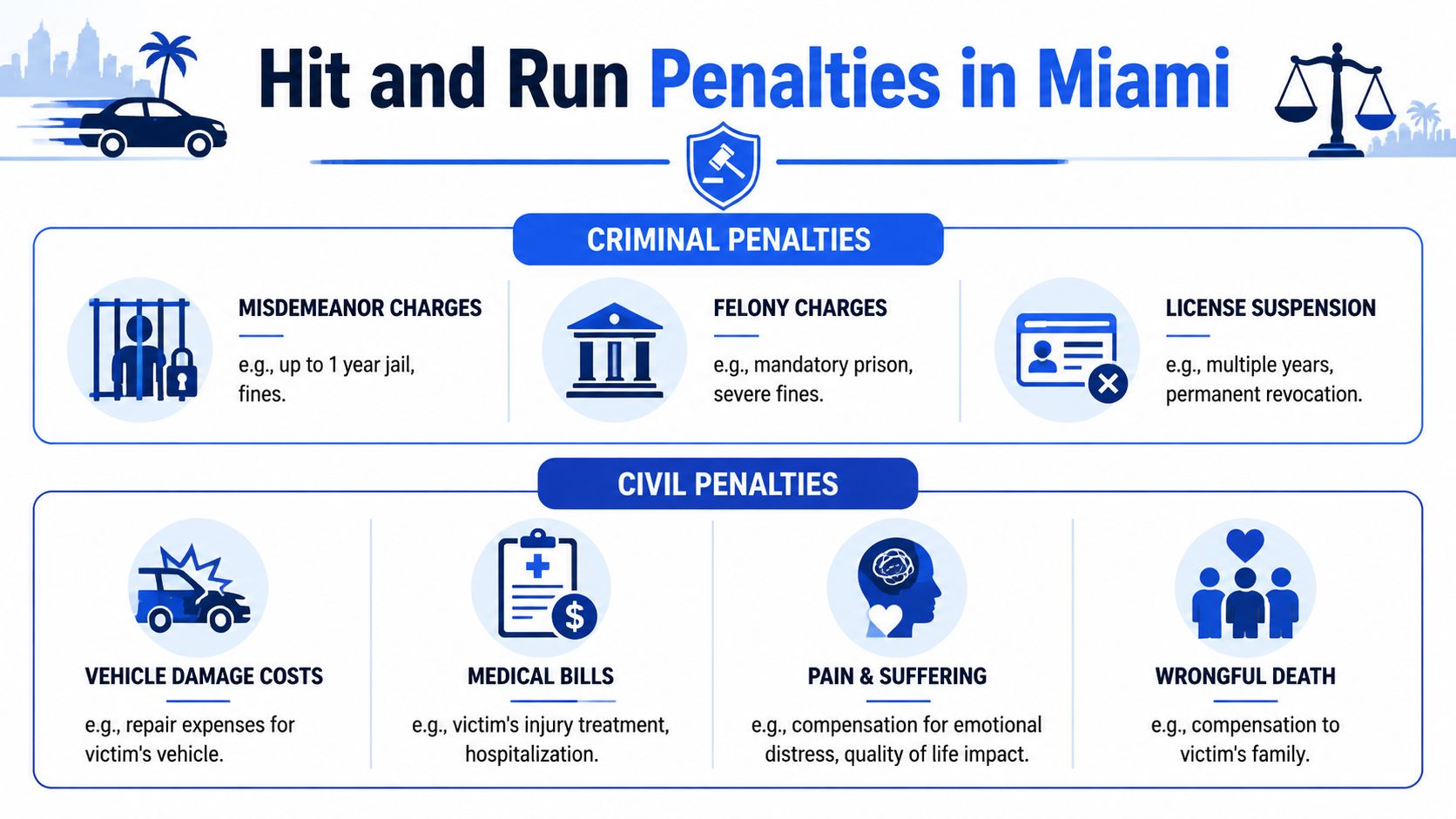
The penalties for a hit and run in miami case can escalate fast because Florida Statute Chapter 316 treats these crashes by outcome. Property damage exposure is one thing. Injury or death is another category entirely. Your criminal record, your driver's license, and your finances can all take a hit at once.
How the charge escalates under Florida Statute 316
Here is the clean version.
Type of Accident | Criminal Charge | Maximum Penalties |
|---|---|---|
Property damage only | Misdemeanor under Florida Statute 316 | Criminal prosecution, possible jail exposure, fines, court costs, and a record risk |
Crash involving injury | Felony under Florida Statute 316 | Prison exposure, major fines, license consequences, and a felony record |
Crash involving death | Felony under Florida Statute 316 | Severe prison exposure, major fines, and long-term license consequences |
That chart is a starting point, not a comfort. The exact consequences depend on the charge filed, the facts alleged, and what your lawyer can do before the case hardens.
If you're also trying to understand insurance fallout after a serious driving case, this guide on finding Fr 44 insurance coverage helps explain one of the financial consequences that can follow major Florida driving violations.
Why the money problems don't stop with court
Criminal court is only one front. A hit and run accusation can also trigger civil exposure. The other side may pursue payment for vehicle damage, medical bills, and other claimed losses. Even when the criminal case is still developing, the financial pressure starts early.
Court fines are only part of the damage. Insurance problems, towing, repairs, missed work, and civil claims often hit at the same time.
If the case involves injuries, everything becomes more expensive and more dangerous. If it involves a death allegation, the stakes become life-altering. That's why waiting to "see what happens" is a weak plan.
You also need to think past the hearing date. Employers run background checks. Professional licenses can be affected. Drivers who rely on a clean record for income can lose earning power quickly. For a broader look at these consequences, review leaving the scene of an accident in Florida.
What Are the First 5 Steps You Must Take
This is the part where discipline matters. If you're under investigation or already charged, your next few hours matter more than your next few weeks.

Your immediate protection checklist
Stop talking about the incident
That includes police, the other driver, your passengers, your coworkers, and your group chat. Every version of your story becomes something that can be compared, twisted, or misunderstood.
Preserve the vehicle and your phone
Don't repair the car yet if the condition matters to the case. Don't delete messages, call logs, photos, location history, or app data. Preservation gives your lawyer something to work with.
Write down your memory privately
Do it while it's fresh. Time, location, weather, traffic, what you felt, what you heard, who was with you. Keep it for your lawyer. Don't publish it anywhere.
Do not consent to a casual interview
Officers often make contact in a calm tone. That doesn't reduce the danger. If they want to speak, tell them you want counsel first.
Get legal guidance before your next move
Review your legal obligations after a Florida car accident so you understand the framework, then let a lawyer take over communication and planning.
If you're also dealing with the physical aftermath of a crash, this post-accident guide by MedAmerica Rehab Center is useful for the medical side. Just keep the legal side separate and protected.
The right first step is rarely an explanation. It's usually containment.
How Can an Experienced Lawyer Defend a Hit and Run Charge
A charge is not proof. An accusation is not the end of the case. In Miami-Dade, strategic defense work can change outcomes when it starts early enough.

In Miami-Dade, strategic legal action can be highly effective. According to 2025 clerk data, 25% of hit-and-run cases that secured early legal representation resulted in dismissal or reduction through pre-trial interventions as noted in this report discussing a recent Miami hit-and-run arrest.
What the State still has to prove
The prosecution still has work to do. A real defense starts by testing every assumption in the case.
Key questions include:
Identity: Can they prove you were the driver?
Knowledge: Can they prove you knew a crash occurred, or knew damage or injury happened?
Causation: Is the damage they point to tied to this incident?
Statements: Did police obtain statements lawfully, or did they pressure a panicked driver into talking?
Evidence chain: Are the witness accounts, photos, and video consistent?
Those are not technicalities. Those are the bones of the case.
What a real defense looks like in practice
A defense lawyer doesn't just show up for court and argue. The lawyer controls damage early, reviews the charging theory, challenges weak assumptions, and looks for exits before the State locks in its narrative.
That may include:
Intervening before filing decisions harden
Positioning the case for reduction
Scrutinizing whether the facts fit the charge level
Using pre-trial options where available
Protecting your license and record while the criminal case unfolds
If you're evaluating representation from the broader client side, this discussion on choosing the best injury attorney is useful because it highlights what serious legal clients should look for in communication and case handling. For hit and run defense specifically, you also need someone who knows the criminal traffic side and local court practice.
One Florida-based option is a hit and run defense attorney resource from Ticket Shield, which explains how these cases are approached from the defense side. The point is simple. You need a lawyer who sees the weaknesses in the State's case before the State turns your panic into proof.
Why a Lawyer-Led Firm Is Your Only Choice in Miami
When your case is headed into the Richard E. Gerstein Justice Building, you don't need a middleman. You don't need an intake funnel pretending to be legal strategy. You need direct access to the lawyer handling your defense.
Why direct attorney access matters at the Richard E. Gerstein Justice Building
A hit and run in miami case moves through pressure. Police contact. bond conditions. filing decisions. court dates. insurance fallout. If you're routed through staff, delayed by apps, or stuck waiting for someone to "relay a message," you're losing control at the exact moment control matters most.
That's why the lawyer-led model matters. You should be able to text or call your attorney directly, get a straight answer, and make decisions quickly. Automated apps and ticket mills are built for volume. A criminal traffic case involving leaving the scene needs judgment, not automation.
Fast access to your attorney isn't a luxury in this kind of case. It's protection.
Why gig drivers need a different level of defense
If you drive for work, the risk is even more immediate. For the 50,000+ gig economy drivers in Florida, a hit-and-run charge is a career-ending event. 2025 FDOT data shows a 22% rise in incidents involving delivery vehicles in Miami-Dade, according to this report on delivery driver hit-and-run trends.
That matters because gig drivers don't just face court consequences. They face deactivation, lost income, and a fast collapse of financial stability. The same is true for professionals with clean-record requirements, veterans protecting career paths, and Spanish-speaking drivers who need direct, clear communication without confusion.
In this situation, impersonal service is a liability. You need a defense relationship where the lawyer actually knows your facts, your job risk, your deadlines, and your pressure points.
Your Next Move Determines Your Future
You can't undo the moment. You can still control what happens next.
The worst thing you can do now is drift. Waiting feels safe because it delays the stress. In reality, it gives investigators time to shape the case while you stay exposed. A hit and run accusation gets heavier, not lighter, when you ignore it.
What you do today changes what happens next
Act like every word matters, because it does. Act like every hour matters, because it can. The right response is immediate legal protection, disciplined silence, and a plan built around your license, your record, and your freedom.
If you've been accused of a hit and run in miami, don't let panic decide your future. Let a lawyer take control of the process before the process takes control of you.
Visit Ticket Shield, PLLC now for a free consultation and start fighting for the outcome that matters most. No Points.