What To Do If You're Accused of a Hit and Run in Florida
Hit and run in florida - Understand your legal options and strong defense strategies if you're facing charges. Protect your rights with expert guidance in 2026.

A hit and run accusation in Florida is a criminal offense, not a traffic ticket. If you've been accused, do not speak to anyone. Your first and only move is to contact an experienced attorney. The state must prove you knowingly left the scene.
If you are accused of a hit and run in Florida, you are facing a serious criminal charge. This can directly impact your freedom, your driver's license, and your future.
Before you speak to anyone—especially police or insurance adjusters—you must understand the severity of the situation. You need a plan to protect yourself. Remember, an accusation is not a conviction.
What happens after a hit-and-run accusation in Florida?
Once you are accused of leaving the scene of an accident, the clock starts ticking. The State of Florida is building its case against you. Your very first move must be to hire an experienced lawyer. Do not wait.
A hit-and-run charge is one of the most severe traffic-related crimes in Florida. The penalties can be life-altering. You need a strategic defense immediately. You cannot handle this with a DIY approach or an automated app. You need a real attorney in your corner.
Are the charges a misdemeanor or a felony?
The severity of a hit-and-run charge in Florida depends entirely on the accident's outcome. The law creates a clear line between accidents with only property damage and those where someone is injured.
Property Damage Only: If you leave the scene of a crash where only a vehicle or property was damaged, you face a second-degree misdemeanor.
Injury or Death: Leaving the scene of an accident where a person was injured is a felony. If someone dies, the charge becomes a first-degree felony with harsh mandatory penalties.
This distinction is critical. A misdemeanor can mean jail time and a criminal record. A felony conviction carries the weight of state prison, devastating fines, and the permanent loss of your civil rights. Learn more in our guide on hit and run charges.
A hit-and-run charge is defensible. The state must prove you knew an accident happened and willfully left the scene. An experienced attorney knows how to challenge the prosecutor's evidence on these key points.
At Ticket Shield, PLLC, you speak directly with your lawyer. You can call or text to get immediate answers. This is the access you deserve when so much is at stake. We are not a "ticket mill" or an automated app that uses middlemen or chatbots. This direct communication is vital as law enforcement cracks down on these incidents. Hit and Run Accidents have surged in recent years, with Florida seeing almost 100,000 annually.
Whether your case is heard at the Edgecomb Courthouse in Tampa or another Florida county, the legal principles are the same. The prosecution must prove its case beyond a reasonable doubt. Your job is to stay silent and hire a lawyer. Our job is to build the shield that protects you.
Your next decision is critical. Contact TicketShield.com now for a free, confidential consultation to start building your defense and keep your record clean.
What does Florida Statute Chapter 316 say about penalties?
In Florida, there is no "minor" hit-and-run. The moment your vehicle makes contact with another car, person, or object, a strict set of duties begins. Panicking and driving away is one of the worst mistakes you can make.
The entire framework for these offenses is in Florida Statute Chapter 316. This is the rulebook. Specifically, § 316.061 covers your duties after a crash involving only property damage. § 316.027 deals with the much more serious scenarios involving injury or death.
These are not suggestions. They are absolute commands. Failing to follow them puts your freedom, finances, and future on the line.
What are your legal duties at an accident scene?
After any crash in Florida, the law demands specific actions. It does not matter who was at fault. Even if another driver hit you, leaving the scene turns you into the one committing a crime.
You are legally required to do three things:
Stop Immediately: You must stop your vehicle as close to the scene as possible without blocking more traffic. Driving off is the act that triggers a criminal hit-and-run investigation.
Render Aid: The law requires you to provide "reasonable assistance" to anyone who is hurt. This almost always means calling 911 for medical professionals.
Provide Information: You must give your name, address, and vehicle registration number to the other driver, anyone injured, or the police. You must also show your driver's license upon request.
Failing any one of these steps can lead to a criminal charge.
How do penalties escalate from misdemeanor to felony?
The consequences for leaving the scene are not uniform. They escalate dramatically based on the crash's outcome. A dented bumper and a serious injury are worlds apart in the eyes of the law and the courts, like the Broward County Judicial Complex in Fort Lauderdale, where these cases are heard daily.
This chart breaks down the two main categories for hit-and-run charges.
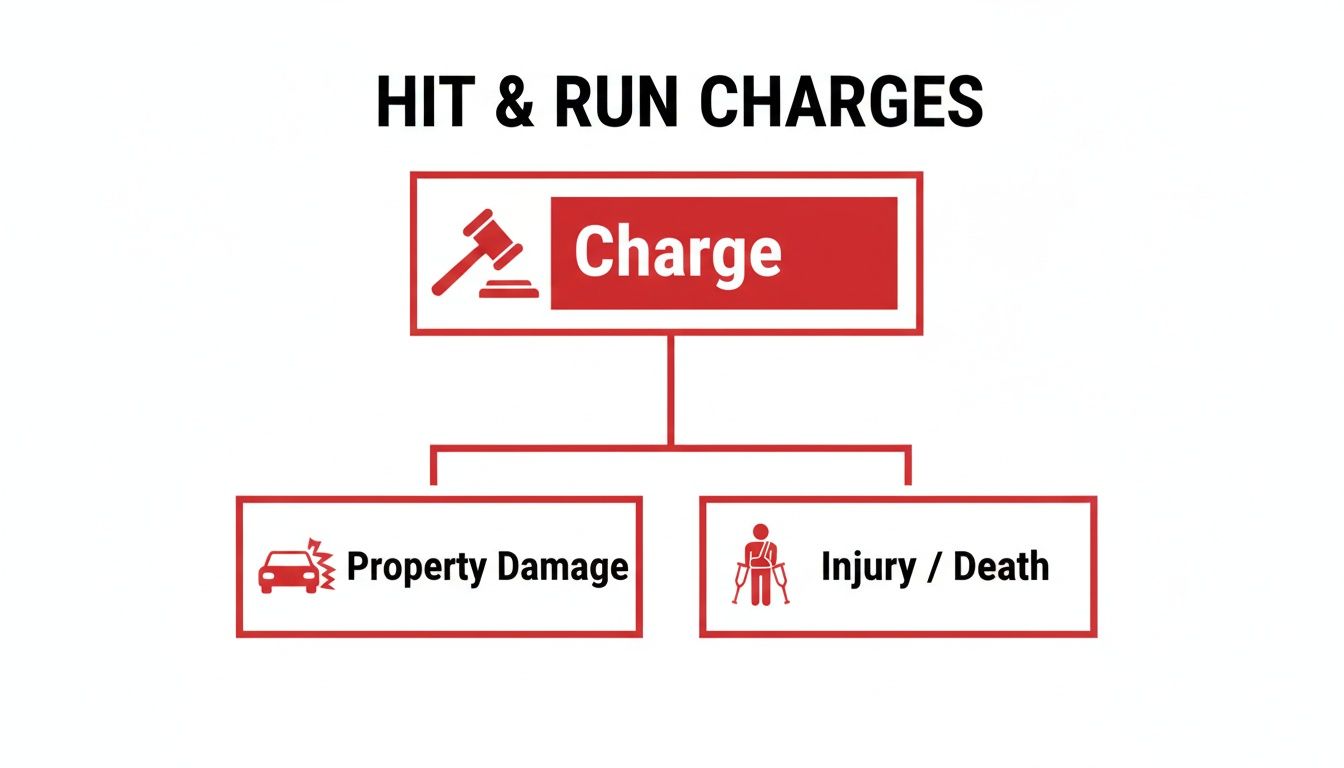
As you can see, the line is drawn between property damage and human injury. Crossing that line separates a misdemeanor from a life-altering felony.
This is not a simple traffic ticket. A minor fender-bender can quickly become a criminal case with devastating penalties, as this table makes brutally clear.
Florida Hit and Run Penalties at a Glance (Florida Statutes § 316.027 & § 316.061)
The table below shows how quickly the stakes rise. Note the potential prison time and mandatory license revocation.
Type of Incident | Criminal Charge Level | Potential Imprisonment | Potential Fines | License Revocation |
|---|---|---|---|---|
Property Damage Only | 2nd Degree Misdemeanor | Up to 60 days | Up to $500 | None (but points issued) |
Injury | 3rd Degree Felony | Up to 5 years | Up to $5,000 | Minimum 3-year revocation |
Serious Bodily Injury | 2nd Degree Felony | Up to 15 years | Up to $10,000 | Minimum 3-year revocation |
Fatality | 1st Degree Felony | 4-year minimum mandatory, up to 30 years | Up to $10,000 | Minimum 3-year revocation |
This data shows that leaving the scene is one of the most serious traffic-related crimes in Florida. Our detailed guide on leaving the scene of an accident in Florida offers more insight into these classifications.
A hit-and-run involving any injury—even a minor one—is an automatic felony. The State does not need to prove the injury was "serious" to charge you with a third-degree felony, which carries up to five years in prison.
Understanding these statutes is the first step. Building a defense is the critical next one. The prosecutor must prove you knew you were in an accident and willfully failed to fulfill your duties. This is where a dedicated lawyer's strategy becomes essential.
Unlike an automated app or a "ticket mill" that uses chatbots and paralegals as middlemen, Ticket Shield, PLLC gives you a direct line to your attorney. You can call or text your lawyer with questions. When facing charges this serious, direct communication is a necessity, not a luxury.
What are the critical first steps after an accident?
If you are reading this because you may have been involved in an accident, stop. Your choices from this moment forward will define the outcome. What you do—and what you do not do—is absolutely critical.
Police may already be looking for you. The other driver could have your license plate number. Every second you wait to build a defense is another second the State gets to build its case against you.
What is your protective action plan?
This is not the time for guesswork. Your freedom depends on the discipline you show right now.
Remain Silent. You have a constitutional right to remain silent. Use it. Do not speak to law enforcement, insurance adjusters, or the other party. Any statement you make can and will be used against you.
Do Not Contact the Other Party. Fight the urge to call the other driver to "make things right." This is a huge mistake. Contacting them can be seen as an admission of guilt or an attempt to tamper with a witness. All communication must go through your attorney.
Stay Off Social Media. Do not post anything about the accident online. Do not post pictures of your car or vague updates. Investigators will dig through your social media, searching for any information they can use.
Preserve All Evidence. Do not wash your car or get it repaired. Your vehicle's current condition is crucial evidence. Take detailed photos of your car from every angle. Keep any receipts or records that show where you were at the time of the incident.
This is not a traffic ticket. A hit-and-run in Florida is a criminal charge. Do not trust your future to an automated app or a "ticket mill" that uses chatbots and non-lawyer middlemen. You need an experienced lawyer you can actually speak to.
How should you document everything for your attorney?
While you must remain silent with investigators, you need to document everything for your lawyer. Your memory is critical evidence. It must be preserved immediately before details fade.
Write down a complete account of what happened. Include every detail you remember: where you were, the time of day, the weather, and what you saw and heard. This document is for your attorney's eyes only and is protected by attorney-client privilege.
Whether your case is near the Richard E. Gerstein Justice Building in Miami or the Orange County Courthouse in Orlando, these steps are your first and most important line of defense. The State must prove you knowingly left the scene. Your defense starts by controlling the narrative and protecting your rights. For a deeper dive, learn more about the legal obligations after a car accident in Florida.
At Ticket Shield, PLLC, you speak directly with your lawyer by phone or text. There are no barriers. We provide the immediate, direct counsel you need in a crisis.
When you're facing a hit-and-run charge, remember this: Don't talk to the police. A hit-and-run in Florida is a serious criminal offense. The state must prove you knowingly and willfully left the scene. An experienced attorney knows how to challenge their evidence to protect your record.
How can an attorney defend you against a hit and run charge?

Being charged with leaving the scene of an accident feels overwhelming. But a charge is just an accusation. It is not a guaranteed conviction. The state carries the heavy burden of proving every element of the crime against you beyond a reasonable doubt.
A dedicated traffic defense attorney does not just show up to court. We build a strategic shield around you from day one. Our job is to dismantle the prosecution's case and create that crucial doubt.
How do we challenge the State's evidence?
Prosecutors often build their cases on shaky evidence. A dedicated attorney knows exactly where to apply pressure to expose weaknesses.
We start by meticulously scrutinizing every document. Police reports can be filled with errors, inconsistencies, or opinions presented as fact. Witness statements are often unreliable, biased, or contradictory.
Our investigation digs into:
Scrutinizing Police Reports: We examine reports for procedural missteps, inaccurate timelines, or conclusions not supported by physical evidence.
Questioning Witness Credibility: Eyewitness testimony is notoriously flawed. We investigate the witness’s vantage point, potential biases, and any conflicting accounts.
Analyzing Physical Evidence: We challenge the State’s interpretation of paint transfer, vehicle damage, and other forensic evidence used against you.
The objective is simple. We aim to show the judge or jury that the state's case is not as solid as it appears.
What are common and effective defense strategies?
Every hit-and-run case is unique. A successful defense demands a strategy built for your specific facts. This is where automated apps and "ticket mill" services fail. They cannot provide the personalized defense you need. We can.
A core principle of Florida law is that the state must prove you had actual knowledge of the accident. If you were unaware that contact occurred or that it resulted in damage or injury, you may not be guilty of willfully leaving the scene. This is a powerful defense.
Here are some of the most effective defense strategies we employ:
Lack of Knowledge This is a frequent and powerful defense. Did you know an accident happened? A minor impact in a loud, busy environment might go unnoticed. If you were unaware of any damage or injury, you could not have willfully failed to remain at the scene as required by Florida Statute § 316.027.
Mistaken Identity Were you actually driving the vehicle? The state may have a license plate number, but that does not prove who was behind the wheel. We can work to establish an alibi, showing you were somewhere else when the incident took place.
Fulfillment of Duties Perhaps you did stop. Maybe you tried to find the property owner or waited a reasonable amount of time before leaving. If you took steps to comply with the law, even if imperfectly, it can be a strong argument against a criminal conviction.
At Ticket Shield, PLLC, you communicate directly with your attorney via phone or text. This direct line is crucial for building a strong, personalized case. When your freedom is on the line, you deserve to speak with the lawyer you hired, not a chatbot or a paralegal. Whether your case is pending at the Edgecomb Courthouse in Tampa or anywhere else in Florida, our goal is the same.
We work to get your charges dismissed or reduced to protect your record and avoid points. Learn more about how a hit-and-run defense attorney builds a winning strategy.
A charge is just an accusation. Take the first step to protect yourself. Visit TicketShield.com for a free consultation to start building your defense and fighting for no points.
Why is a lawyer better than an app for your hit and run defense?
When you face a criminal charge for a hit and run in Florida, your future is on the line. At this critical moment, you must decide who you trust to protect you. Will it be a dedicated lawyer who knows the system, or an impersonal algorithm?
The choice is stark. Automated apps and "ticket mill" services treat your case like just another number. But a serious criminal charge is not a simple transaction. It requires strategic thinking, personalized advice, and a deep understanding of Florida law—things an app cannot deliver.
You would not use an app to perform surgery on yourself. You should not trust one to defend your freedom.
What are the dangers of an impersonal, automated defense?
When you choose an automated service, you give up the most important part of a strong defense: a direct relationship with a dedicated attorney. These services often use chatbots or non-lawyer "case managers" as gatekeepers. They filter your questions and create dangerous delays.
Your case has a unique story and set of facts. You have urgent questions. An app cannot help with what really matters.
It won't listen to your side of the story to find the crucial details that could get your case dismissed.
It can't answer your panicked phone call or text when you need a straight answer.
It won't craft a custom defense strategy based on the specific evidence and circumstances.
It can't negotiate directly with prosecutors, using years of experience to argue for reduced charges or a dismissal.
An automated system follows a script. A dedicated lawyer builds a shield around you. We've written more about this in our guide on why choosing a local lawyer over apps is so critical.
What is the Ticket Shield difference?
At Ticket Shield, PLLC, we built our firm on direct attorney access. Simple as that. When you hire us, you hire a lawyer, not a faceless service. You get your attorney's direct cell phone number. You can call or text with any questions.
That direct line is your biggest advantage. It keeps your defense agile, responsive, and tailored specifically to you. When facing a serious charge like a hit and run, getting the right expert legal representation is everything. If you need more information, there are helpful resources explaining how to choose a personal injury attorney that can guide you.
With a hit-and-run charge, the details are everything. A comment in a police report or a witness’s shaky memory can be the key to your entire defense. An app will not find that weakness—an experienced attorney will.
Whether your case is at the Richard E. Gerstein Justice Building in Miami or any other courthouse in Florida, our commitment is unwavering. We deliver a strategic, lawyer-led defense focused on one thing: protecting your record and achieving the best possible outcome. A criminal charge is a fight for your future. Do not go into it with anything less than a dedicated lawyer by your side.
What happens to your license and insurance after a conviction?
A hit-and-run conviction in Florida is not a one-time event. It is the beginning of a long, costly chapter that impacts your freedom and finances for years. While the criminal penalties are daunting, the administrative consequences are just as devastating.
The Florida Department of Highway Safety and Motor Vehicles (FLHSMV) will take its own, separate action against your driving privileges. These penalties are not up for negotiation. They are automatic and severe.
Will your license be revoked?
Under Florida Statute § 316.027, a conviction for leaving the scene of an accident with any injury means one thing: your driver's license will be revoked for a minimum of three years. This is not a temporary suspension.
A suspension is a timeout. A revocation means your driving privilege has been erased. You must start from scratch to earn it back after the revocation period ends. The state makes that process incredibly difficult.
A felony hit-and-run conviction is not something you just put behind you. For at least 1,095 days, you are legally barred from driving in Florida. This cripples your ability to work, care for your family, and live your life.
Getting your license back is an uphill battle. You will be forced to complete advanced driver improvement courses, pay significant reinstatement fees, and may even have to install an ignition interlock device on your car. It is a grueling process reserved for those convicted of the most serious traffic crimes.
How will your insurance be affected?
The moment a felony hit-and-run conviction hits your record, every insurance carrier brands you a high-risk driver. The financial fallout is immediate and often catastrophic.
Your current insurer will almost certainly drop your policy at renewal. They have no obligation to insure a driver with this level of risk. This leaves you scrambling to find new coverage from a very small, very expensive pool of providers.
You will be forced to get "high-risk" or SR-22 insurance. The premiums are punishing.
Skyrocketing Premiums: Expect your insurance rates to triple, quadruple, or more.
Limited Coverage Options: You will likely only qualify for the bare-minimum liability coverage.
Long-Term Impact: This high-risk label can follow you for three to five years, costing you thousands in extra premiums.
For anyone who drives for a living—truck drivers, delivery drivers, rideshare operators—a felony hit-and-run conviction is a career-ending event. It can also jeopardize security clearances and other professional licenses. The cost of a powerful legal defense now is a fraction of the financial and professional damage a conviction will cause.
At Ticket Shield, PLLC, you speak directly with your attorney. No chatbots, no middlemen. We provide a cost-effective, aggressive defense to prevent these devastating long-term consequences.
Do not risk your future. Visit TicketShield.com now for a free consultation and let us build the defense you need to protect your license and achieve our No Points goal.
Frequently Asked Questions About Florida Hit and Run Cases
A hit and run accusation brings a flood of urgent questions. We hear them every day from people across Florida. Getting clear, honest answers based on real-world courtroom experience is the first step toward protecting your freedom.
I only hit a parked car and left a note. Is that still a hit and run?
It absolutely can be. Leaving a note shows good intentions, but it does not automatically satisfy your legal duties under Florida law.
Florida Statute § 316.061 is clear: if you cannot find the owner of the unattended vehicle, you are required to report the crash to the nearest police department. Simply leaving a note and driving away is not enough. The State can argue that you failed to complete your legal obligation, opening the door for a criminal charge.
What if I panicked and drove off but want to report it now?
Stop. Before you do anything else, your first and only call should be to an experienced criminal defense attorney. Do not call the police or go to a station on your own.
Anything you say to law enforcement now is a direct admission of guilt. It will be used to build a case against you. A strategic lawyer can step in on your behalf, navigating the reporting process in a way that safeguards your constitutional rights and works to minimize penalties. This situation requires a careful, calculated approach, not a panicked confession.
Never assume the State has no evidence. Prosecutors are masters at building cases with circumstantial evidence. This can include paint transfer, pieces of your car left at the scene, or surveillance footage from a nearby business. A conviction is possible even without a single direct witness.
Can I be convicted if there were no witnesses?
Yes. The lack of an eyewitness is not a get-out-of-jail-free card. Prosecutors routinely build cases using other forms of evidence to prove you were the driver who left the scene.
This evidence often includes:
Video Surveillance: Footage from traffic lights, Ring doorbells, and security cameras on nearby homes or businesses.
Forensic Evidence: Paint chips from the other vehicle or property that match damage on your car.
Damage Analysis: Expert testimony arguing that the damage on your vehicle is a match for the reported accident.
A powerful defense is about challenging every piece of the prosecution's puzzle.
How much does it cost to hire an attorney for a hit and run?
Facing a serious criminal charge like a hit and run in Florida requires a focused, aggressive defense. At Ticket Shield, PLLC, we believe in providing exceptional value through a clear, flat-fee structure.
During your free, confidential consultation, we will review the details of your case and provide the exact cost. Protecting your license, your record, and your future is a critical investment. This is not the time to rely on an automated app or a "ticket mill" that passes your case to a middleman. You need a dedicated lawyer you can speak to directly by phone or text. That is the service our firm guarantees.
Do not face a Florida hit and run charge alone. Contact Ticket Shield, PLLC now for a free, confidential consultation to start building your defense and fighting for our No Points goal. Visit TicketShield.com immediately.