Leaving the Scene of an Accident in Florida: A Legal Guide
Charged for leaving the scene of an accident in Florida? Understand the penalties, your duties, and potential defenses. Get clarity on how to proceed.

Leaving the scene of an accident in Florida isn't just a simple traffic ticket—it's a serious criminal offense. The consequences are steep, ranging from a second-degree misdemeanor for hitting a parked car to a first-degree felony if someone is tragically killed. These penalties can include significant jail time, crippling fines, and mandatory driver's license revocation.
Attorney Advertisement. Office in Broward.
Understanding the Stakes of a Florida Hit and Run Charge
A charge for leaving the scene of an accident, commonly known as a "hit and run," carries serious weight in the Florida justice system. Unlike a standard speeding ticket, this is a criminal traffic violation with penalties that can put your freedom, your finances, and your future in jeopardy.
The severity of the charge is directly tied to the outcome of the crash—specifically, whether it resulted in property damage, an injury, or a fatality.
This escalating scale of penalties means that what might seem like a minor fender-bender can quickly morph into a major legal nightmare if you don't handle it correctly. Florida law requires specific actions from every driver involved in a collision, and failing to meet those duties is what triggers the criminal charge.

Classifications and Penalties
Florida law breaks down leaving the scene into different levels of severity, each with its own statute and potential consequences. Understanding these distinctions is the first step to grasping how serious the situation is.
To give you a clear, straightforward overview, the table below lays out the crime classifications and the maximum penalties you could be facing.
It’s crucial to remember that these are the maximum penalties allowed by law. The actual outcome of any case depends on many different factors, including the specific details of the incident, your prior record, and the strength of your legal defense. Our goal is to protect your license and record. Past results do not guarantee future outcomes.
Florida Penalties for Leaving an Accident Scene at a Glance
This table provides a quick summary of the potential consequences you could face under Florida law, broken down by the severity of the accident.
Type of Accident | Florida Statute | Crime Classification | Maximum Penalties (Jail/Prison & Fines) | Driver's License Impact |
|---|---|---|---|---|
Property Damage Only | § 316.061 | 2nd Degree Misdemeanor | Up to 60 days in jail & a $500 fine | Points assessed; potential suspension |
Injury | § 316.027(2)(a) | 3rd Degree Felony | Up to 5 years in prison & a $5,000 fine | Minimum 3-year license revocation |
Serious Bodily Injury | § 316.027(2)(b) | 2nd Degree Felony | Up to 15 years in prison & a $10,000 fine | Minimum 3-year license revocation |
Fatality | § 316.027(2)(c) | 1st Degree Felony | Up to 30 years in prison, a $10,000 fine & mandatory minimum 4 years | Minimum 3-year license revocation |
Because the consequences are so incredibly severe, you need a careful and informed approach to navigate these charges. You can learn more about the specifics of hit and run charges in our detailed guide.
Remember, an accusation is not a conviction. But building a strong defense from the very beginning is absolutely essential to protect your rights and work toward a favorable resolution. The complexities involved make experienced legal guidance a critical asset in a situation like this.
Understanding Your Legal Duties After a Florida Crash
After any car accident in Florida, you’re legally required to follow a specific set of steps. These aren't just helpful suggestions; they are a mandatory checklist laid out in Florida Statutes § 316.061 and § 316.027. Getting even one of these steps wrong can be the difference between a simple insurance claim and a criminal charge for leaving the scene.
Think of these duties as a legal "first aid" kit for a crash. The moments after a collision are chaotic and stressful, but knowing your obligations is the key to protecting yourself. The law requires you to take immediate, specific actions to handle the situation responsibly.
The core principle couldn't be simpler: you must stop, and you must stay. Driving away for any reason is what kicks off a criminal investigation.
The Three Core Duties After an Accident
Florida law is crystal clear about what you need to do. Once you've stopped your car as close to the scene as is safely possible, you have three main responsibilities. Following through on these isn't just about avoiding a hit-and-run charge; it’s about making sure everyone is safe and getting the legal and insurance process started correctly.
Provide Your Information: You must give your name, address, and vehicle registration number to the other driver or anyone who was injured. If a police officer is there, you'll need to provide it to them and show your driver's license if they ask.
Render Reasonable Assistance: This just means you have to help anyone who is hurt. It doesn’t mean you need to be a paramedic. Usually, it's as simple as calling 911 for an ambulance or, if it makes sense, helping get an injured person to a hospital.
Remain at the Scene: You have to stay put until you’ve done everything else required of you. Leaving too soon, even if you’ve already exchanged a few details, can still be considered leaving the scene.
It's critical to understand that your intentions don't always matter in these cases. The prosecution will focus on one thing: did you meet your legal duties? Panicking and driving off, even if you planned to call the police later, is often enough to get you charged with leaving the scene of an accident in Florida.
Navigating High-Pressure Environments Like Miami-Dade
The chaotic traffic in packed urban areas can easily lead to bad decisions. This is especially true in places like Miami-Dade County, where a mix of commuters, tourists who don't know the roads, and constant congestion makes accidents all too common.
In an environment like that, even a minor fender-bender can feel overwhelming, causing a driver to react out of fear instead of logic. It's no surprise that South Florida counties often top the charts for these incidents. Recent data shows Miami-Dade had 131,225 total crashes and 286 fatalities, making it a hotspot where hit-and-runs are a major problem.
When Leaving a Note Is Not Enough
There’s a common myth about accidents involving parked cars. A lot of people think that if they hit an unattended vehicle, all they need to do is stick a note with their contact info on the windshield and drive off. Unfortunately, Florida law demands more.
If you hit a parked car, you must:
Try your best to find the owner and tell them what happened.
If you can't find them, leave a note in a secure, obvious place on their vehicle.
The note has to include your name, address, and vehicle registration number.
Crucially, you must also report the crash to the nearest law enforcement agency right away.
That last step—calling the police—is where so many drivers go wrong and end up with a criminal charge. The law sees it as a failure to fulfill all your duties. You can get a more in-depth look in our guide on the legal obligations after a car accident in Florida.
The Escalating Penalties for a Hit and Run Conviction
Getting a conviction for leaving the scene of an accident in Florida means you’re facing consequences that go far beyond a simple fine. The penalties are designed to get worse depending on what happened in the crash, quickly turning a bad situation into a life-altering legal fight. To really understand how serious a hit-and-run charge is, you have to know how this tiered system works.
The law treats these offenses with increasing severity. What starts as a misdemeanor for bumping a parked car can quickly jump to a serious felony if someone gets hurt. Florida law has zero patience for drivers who don't stick around to do the right thing, and the penalties make that perfectly clear.
Misdemeanor Penalties for Property Damage
The most common kind of hit-and-run is when there's only damage to another car or property, and nobody is injured. Think hitting an empty, parked car and then driving off.
Under Florida law, leaving the scene of a crash with only property damage is a second-degree misdemeanor. Even though this is the lowest-level charge, the penalties are no joke. They can include:
Up to 60 days in county jail.
A maximum fine of $500.
Six points on your driver's license.
These penalties cause immediate headaches, but the long-term pain is often worse. A misdemeanor conviction means you now have a permanent criminal record, which can pop up and cause problems during background checks for jobs, apartments, and professional licenses.
Felony Charges for Accidents with Injuries
The entire legal landscape shifts the second an injury is involved. If you leave the scene of a crash where someone is hurt, the charge skyrockets from a misdemeanor to a felony, and the consequences get much, much tougher.
The penalties climb fast and without mercy. A simple misdemeanor for property damage becomes a third-degree felony with up to 5 years in prison and a $5,000 fine if there are even minor injuries. For crashes involving a death, the penalties become even more severe. It’s a harsh reminder of why every driver needs to know their responsibilities at the scene of an accident. As you can find in this analysis of Florida's auto accident surge, the points and license suspensions tied to these charges can destroy careers and finances, especially for CDL holders or parents with teen drivers.
A felony conviction changes your life forever. It can take away fundamental civil rights, like the right to vote or own a firearm, and put up permanent walls to professional and personal opportunities.
When an accident leads to serious bodily injury, the charge is bumped up to a second-degree felony. This is a major distinction because it carries a potential prison sentence of up to 15 years. To get a better handle on how the law defines this, our firm has a page explaining serious bodily injury cases.
Finally, if someone is killed in the crash and the driver takes off, the charge becomes a first-degree felony. This is one of the most serious crimes in Florida's entire traffic code, punishable by up to 30 years in prison with a mandatory minimum sentence of four years.
The Cascading Collateral Consequences
The penalties written in the law books are just the beginning. A conviction for leaving the scene sets off a chain reaction of other consequences that can mess with your life for years. These aren't just "what ifs"—many are mandatory actions the state will take against you.
Mandatory Driver's License Revocation: A felony conviction for leaving the scene of an accident with an injury or death triggers a mandatory license revocation for at least three years.
Crippling Insurance Costs: Insurance companies see a hit-and-run conviction and immediately label you as an extremely high-risk driver. Your premiums will go through the roof, and many insurers will just drop your coverage completely. That makes finding new insurance incredibly difficult and expensive.
Barriers to Employment: A criminal record, especially a felony, is a huge obstacle to finding a job. For anyone with a commercial driver's license (CDL), a conviction like this is almost always a career-ender.
These penalties are enforced the same way everywhere in the state, from rural backroads to busy city centers. The combination of criminal charges, administrative penalties from the state, and the financial fallout makes a hit-and-run charge one of the toughest legal battles a Florida driver can face. Our goal is to protect your license and your record, but it's crucial to understand just how severe the potential outcomes are.
Building a Defense Against a Hit and Run Charge
Being accused of leaving the scene of an accident is frightening. But an accusation isn't a conviction. It’s important to remember that the burden of proof falls squarely on the prosecution—they have to prove every single element of the charge beyond a reasonable doubt. A strong defense is all about poking holes in their story and challenging the evidence.
Depending on the unique facts of your case, several defense strategies might be on the table. These are not loopholes; they are legitimate legal arguments designed to question whether the state can actually meet its high burden. Building that defense means digging into police reports, witness statements, and every shred of available evidence.
The goal here is simple: protect your rights and work toward the best possible outcome. Our practice focuses on traffic and DUI defense, so our team knows exactly where to look for weaknesses in the prosecution's case.
Common Defense Angles Explored
It’s crucial to understand that the information below is for educational purposes only and is not legal advice. The best strategy for you can only be determined by an attorney who has evaluated the specific details of your situation.
In hit and run cases, the defense often focuses on three key areas:
Lack of Knowledge: A core part of the state's case is proving you knew a crash happened. If you were genuinely unaware of any impact, you can't be guilty of intentionally fleeing.
Mistaken Identity: The state has to prove you were the one behind the wheel. If they can't definitively place you in the driver's seat, their case falls apart.
Substantial Compliance: Sometimes, a driver tries to do the right thing but can't follow the law to the letter because of the circumstances. This can be a valid defense.
Lack of Knowledge as a Defense
Imagine you're driving a large truck down a busy, noisy highway. A small sedan clips your rear bumper, leaving a tiny scratch on your truck and a small dent on their car. Between the road noise, the radio, and the sheer size of your vehicle, it's entirely plausible you wouldn't feel a thing.
If that's the case, you didn't have the required "knowledge" that an accident even occurred. The Florida Supreme Court is very clear on this: the state must prove a driver knew, or should have reasonably known, about the collision. Without that knowledge, the key element of intentionally leaving the scene is completely missing.
Key Takeaway: Just being involved in an accident isn't enough to be convicted. The prosecutor has to show you were aware of the crash and then made the conscious choice to leave without doing what the law requires.
Challenging Driver Identification
Another pillar of the prosecution's case is proving who was driving. Just because your car was involved doesn't automatically mean you were the one driving it.
Think about a scenario where your car is identified in a hit-and-run, but three different family members had access to your keys that day. If there are no eyewitnesses who can positively identify you and no clear surveillance footage showing you in the driver's seat, your attorney has a powerful angle to challenge the state's case. To learn more about how these challenges work, you can read our guide on how to defend against a leaving the scene of an accident charge.
Steps to Take Immediately After an Accident
The easiest way to avoid a criminal charge for leaving the scene of an accident is to know exactly what to do before a crash ever happens. In the chaos and stress right after a collision, having a clear mental checklist can stop you from making a massive, costly mistake. Think of this guide as a practical roadmap for every Florida driver, laying out the legally required actions you must take.
Navigating the aftermath of an accident on the packed roads of Orange County, especially on notorious stretches like I-4 or near tourist-heavy areas, adds a whole other layer of pressure. Adrenaline is pumping, and the instinct to just "get out of the way" can be powerful. But knowing and following these steps is your absolute best defense against turning a traffic incident into a serious criminal matter.
1. Stop Your Vehicle Immediately and Safely
Your very first legal duty is to stop your vehicle as close to the scene as you can without blocking traffic more than absolutely necessary. If you're on a major highway in Orange County, this might mean carefully pulling over to the shoulder. The most important thing is to stop and not drive away.
2. Check for Injuries and Call for Help
Once you're stopped, check on yourself and your passengers. Then, only if it's safe, check on the people in the other vehicle. If anyone is hurt, your immediate priority is to call 911.
The law also requires you to render "reasonable assistance." For most people, this simply means calling for medical help. You should never try to move an injured person unless they are in immediate danger, like from a fire.
3. Exchange All Legally Required Information
Florida law is very specific about the information you have to exchange with the other driver. Just swapping phone numbers isn't enough. You are legally required to provide your:
Name and address
Vehicle registration number
Driver's license information (if the other driver or a police officer asks for it)
Failing to provide all of this information can be seen as failing to comply with your duties. Keep a pen and paper in your glove box, or just use your phone to snap pictures of the other driver's documents to make sure everything is accurate.
The flowchart below shows some of the key defense ideas an attorney might use when a driver is accused of not following these steps correctly.
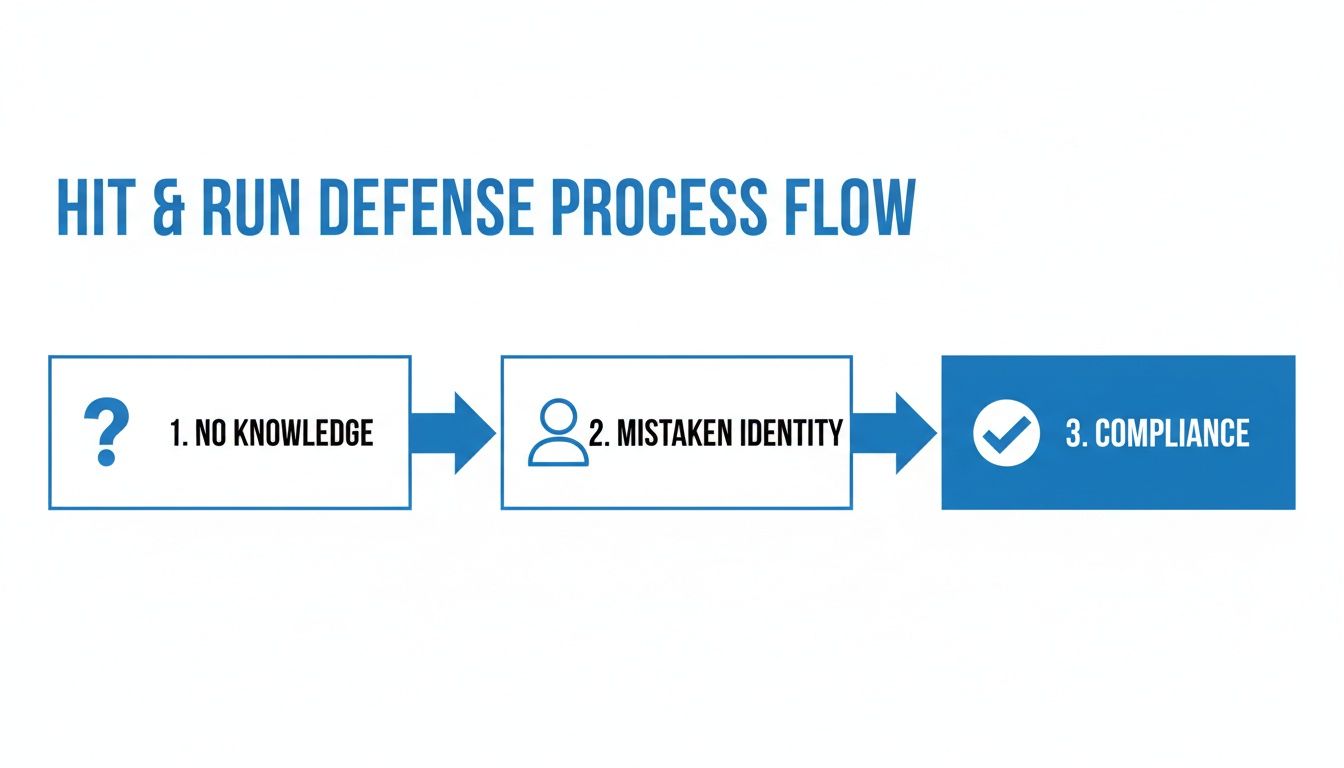
This process highlights how a lawyer can challenge the state's case by questioning if the driver even knew a crash happened, proving it was a case of mistaken identity, or showing that the driver made a reasonable attempt to comply.
4. Document the Scene Thoroughly
While you wait for the police to show up, use your phone to document everything. Your memory of the event will fade, but photos and notes won't.
Take pictures of:
The final positions of the cars
Damage to all vehicles involved, from several different angles
Any skid marks on the road
Nearby traffic signs or signals
The other driver's license plate and insurance card
Also, jot down the time, location, weather conditions, and a quick summary of what happened. This documentation is gold for both insurance claims and any potential legal fight down the road.
5. Report the Accident to Law Enforcement
Even if an accident seems minor, you are often required to report it. Florida law requires a police report for any crash that involves an injury, a death, or apparent property damage of $500 or more. With the cost of modern car repairs, pretty much any fender bender will hit that number.
The sheer number of hit-and-run incidents shows why this step is so vital. In a recent year, Florida had 362,063 car accidents, and an unbelievable 91,164 of them were hit-and-runs—that's over 25% of the total. High-traffic areas like Orange County, which saw 25,106 crashes with significant hit-and-run numbers, are hotspots for these events. You can learn more about the accident statistics in Florida and see why staying on scene and making a report is so important. An official police report creates an objective record of what happened, protecting you from false accusations later on.
How Can a Traffic Defense Firm Help?
Facing a charge for leaving the scene of an accident in Florida is a heavy weight to carry, but it’s not something you should ever face alone. A law firm that lives and breathes traffic defense can offer the legal muscle you need to protect your rights and steer your case toward a better outcome. The process is straightforward, and it starts the moment you decide to reach out for help.
It all begins with a confidential, completely free consultation. This first conversation is the most important one we'll have, as it lets us get a handle on the unique details of your situation without any pressure or commitment. We’ll listen to your side of the story, look over any paperwork you have, and give you a clear, honest assessment of the road ahead.
From that point on, we get to work. While our office is in Broward, we handle criminal traffic matters across the entire state of Florida, and we've built a solid process for managing cases no matter where the incident occurred.
Building a Strong Defense Strategy
Once we have the full story, we dive into a detailed analysis of every piece of evidence. This means we're scrutinizing police reports for mistakes, picking apart witness statements for inconsistencies, and examining every photo or piece of physical evidence available. Our mission is to find the weak points in the prosecution's case.
Based on what we find, we build a defense strategy designed specifically for you. That might mean challenging the state’s ability to prove you knew a crash even happened, or it could involve questioning their identification of you as the driver. We meticulously prepare your case to put you in the strongest possible position for a fight.
Attorney Advertisement: Please be aware that this is an attorney advertisement. Submitting information through our website does not create an attorney-client relationship. Our office is located in Broward, Florida.
Our Goals in Every Case
When we're defending someone against a leaving the scene charge, our objectives are crystal clear. We want to shield you from the toughest penalties and keep this one incident from derailing your future.
Here’s what we’re always aiming for:
Seeking a full dismissal of the charges whenever the evidence isn’t there.
Negotiating for reduced charges to minimize the long-term damage to your criminal record.
Protecting your driving privileges by fighting to avoid a license revocation or suspension.
Reducing your stress by handling all court appearances and legal communications for you.
We understand—the anxiety that comes with these charges is immense. That’s why we make sure you can always reach your attorney by phone, text, or email. While past results don't guarantee future outcomes, a powerful defense is absolutely essential. To get a better feel for our approach, you can learn more about our role as a hit and run defense attorney and how we can help. Our entire firm is dedicated to providing the experienced legal representation you need to protect your license and your record through this tough process.
Frequently Asked Questions
When you're dealing with a charge for leaving the scene of an accident in Florida, it's natural for your mind to be racing with questions. The legal system can feel overwhelming, and you know the stakes are high. Here are some of the most common questions we hear from clients in your exact situation.
Keep in mind, these answers are for general information. The best advice always comes from a confidential conversation about the specific details of your case.
What if I Hit a Parked Car and the Owner Wasn't There?
This is a really common scenario, and Florida law is very specific about it. You are legally required to make a reasonable effort to find the owner right then and there. If you can't, you absolutely must leave a note in a secure, visible place on their car.
That note needs to include your name, address, and vehicle registration number. But here's the part people often miss: you must also report the crash to the nearest police department immediately. Failing to do both of these things can lead to a second-degree misdemeanor charge.
Is Jail Time Mandatory for Leaving the Scene?
Jail time is not automatic, especially if it’s a first offense and only involved property damage. However, it is absolutely a possible penalty. The likelihood of incarceration goes up significantly if someone was injured, if it was a fatal accident, or if you have a prior criminal history.
An attorney’s primary objective is to fight for a resolution that avoids jail. We often negotiate for alternatives like probation, fines, or diversion programs designed to protect your freedom and keep a conviction off your permanent record.
I Panicked and Drove Off, but Now I Want to Do the Right Thing. What Should I Do?
If you’ve already left an accident scene, the very first thing you need to do is contact a criminal traffic defense attorney. Do it now. It is critical that you do not speak with law enforcement or the other driver on your own. Any statement you make can, and will, be used against you.
An attorney can provide confidential legal advice and act as your shield. They can communicate with the authorities on your behalf in a way that protects your rights and works to minimize the potential fallout.
A charge for leaving the scene of an accident in Florida demands an immediate and strategic defense. At Ticket Shield, PLLC, our practice is focused on handling these serious criminal traffic matters across all 67 counties. We are here to protect your license, your record, and your future. Call us 24/7 for a free, confidential consultation. https://www.ticketshield.com