Handicap Parking Laws in Florida
Understand handicap parking laws in florida for 2026. Learn about fines, placard misuse, and how a lawyer can help you fight a ticket and protect your record.

A handicap parking ticket in Florida is serious. Under Florida Statute 316.1955, you can face substantial fines, and private-property cases often turn on technical enforcement issues that many drivers miss. Don't just pay it. Review the location, signage, and permit facts immediately.
You walked back to your car, saw the citation on the windshield, and probably had the same first thought most drivers have: “It's just a parking ticket.”
That's the wrong instinct.
In Florida, handicap parking laws are enforced under a detailed legal framework, not a casual courtesy rule. If you were cited, you need to treat it like a real legal problem right now. The location matters. The signage matters. The permit status matters. And if the ticket was issued on private property, the analysis may be very different from what the officer or parking enforcement officer assumed.
If you're trying to figure out your next move, start with a practical first-response checklist in this guide on what to do when you get a ticket. Then keep reading, because Florida handicap parking laws can create defenses that aren't obvious at first glance.
Table of Contents
What Happens After a Florida Handicap Parking Ticket
The first thing that happens is simple. You're put on the defensive, and the clock starts running.
Florida Statute 316.1955 makes it unlawful to stop, stand, or park in a specially designated accessible parking space unless the vehicle displays a valid disabled parking permit or qualifying disabled license plate and is transporting the permit holder. The same statute also prohibits obstructing access aisles, curb cuts, or the path of travel to an accessible space, while allowing only temporary standing for loading or unloading a person with a disability under Florida Statute 316.1955.
That means your case may not be limited to “Was I in the blue-marked space?” It can also turn on whether your vehicle blocked the access aisle, whether the permit holder was being transported, and whether what you thought was a quick stop legally counts as unauthorized parking.
Why you can't treat this like a minor nuisance
A handicap parking citation is often written like a straightforward violation. Many aren't.
When I review these cases, I look at the exact place where the car was parked, the wording on the citation, the markings on the pavement, and whether the officer described the violation correctly. Drivers lose good defenses because they assume the ticket speaks for itself. It doesn't.
Practical rule: Never pay first and investigate later. Payment usually ends the fight before the facts are fully reviewed.
If your ticket came from a public street, courthouse lot, airport area, or municipal garage, the enforcement path may be direct. If it came from a shopping center, apartment complex, hospital, or mixed-use lot, the legal issues often become more technical. That's where mistakes by enforcement can matter.
What you should do before you say anything
Take a breath. Then lock down the facts.
Photograph the space: Get the stall, access aisle, curb cuts, signage, and approach route.
Photograph your vehicle position: Small placement details can matter in obstruction cases.
Preserve permit details: If a placard or plate applied, document it immediately.
Check the citation language: Officers sometimes cite broadly when the actual facts are narrower.
Act fast: Delay makes evidence disappear, especially in commercial lots where repainting, restriping, or sign changes happen.
If your case is headed toward a courthouse like the Richard E. Gerstein Justice Building in Miami-Dade, you want a clean factual record before the first appearance is even discussed. That's how you protect yourself instead of reacting late.
Who Qualifies for a Florida Disabled Parking Permit
You can have a real medical issue and still lose this fight if the permit did not belong to a legally qualified person. That is the first line of analysis. Under Florida Statute 320.0848, Florida limits disabled parking permits to people who meet specific medical standards, including legal blindness or a condition that prevents walking 200 feet without stopping to rest.
Florida also covers people who cannot walk without a brace, cane, crutch, prosthetic device, wheelchair, or similar assistive device, unless that device substantially restores the person's ability to walk. The state is looking for a documented functional limitation. Convenience does not qualify. Age by itself does not qualify. A hard day, a sore knee, or a family assumption that someone "needs the spot" does not qualify either.
That matters in ticket cases.
Officers and hearing officers often collapse separate issues into one accusation. They treat eligibility, permit display, and actual use as if they are all the same. They are not. A careful defense starts by separating those questions, especially if the citation came from a private lot where enforcement authority is often misunderstood.
What the legal standard actually covers
The permit belongs to an eligible person, not to a vehicle and not to a family.
If the qualified person was not in the car, not entering the car, and not being transported, the placard can become the center of the case. That is true even where the driver had good intentions. Good intentions do not fix unauthorized use. On the other hand, if the qualified person did meet the legal standard and the officer wrote a sloppy citation on private property, that split between legal eligibility and valid enforcement can create room to attack the ticket.
Use this breakdown to check the facts fast:
Issue | Florida rule |
|---|---|
Walking limitation | The person must be unable to walk 200 feet without stopping to rest |
Blindness | Legal blindness can qualify |
Temporary permit | Issued for a limited period and subject to a separate expiration date |
Standard permit | Valid longer, but still expires and must be current at the time of use |
Where drivers make expensive mistakes
Family members get this wrong all the time. A spouse uses the placard to run inside first. An adult child parks in the blue space before picking up a parent. A caregiver leaves the qualified person at home and uses the placard "just for a minute." Those facts invite a citation.
Another common mistake is assuming a valid condition automatically ends the case. It does not. The permit holder may have fully qualified, but the permit could have been expired, misused, or displayed incorrectly. The reverse is also true. A driver may be accused of misuse even though the qualified person was present and the underlying problem is that the ticket came from a shopping center, apartment complex, or hospital lot where enforcement rules are more technical than officers admit.
That public street versus private property split matters more than drivers realize.
What to verify if your ticket involved a placard
Check the permit holder first, then check the scene.
Medical qualification: Did the permit holder meet Florida's disability standard?
Current validity: Was the permit active on the date of the citation?
Authorized use: Was the qualified person in the vehicle or being transported?
Type of allegation: Is the ticket really about eligibility, display, expiration, or misuse?
Location of enforcement: Did the citation come from a public street or from private property such as a mall, apartment complex, or medical lot?
That last point can decide the case. A legally qualified permit holder does not excuse misuse. But a weak citation written in the wrong place, by the wrong authority, or without proper statutory footing can still be beaten. If you do not sort out qualification and jurisdiction separately, you miss defenses that should have been raised from the start.
How Do You Correctly Obtain and Use Your Placard
Getting the permit is only half the job. Using it correctly is what keeps you out of trouble.
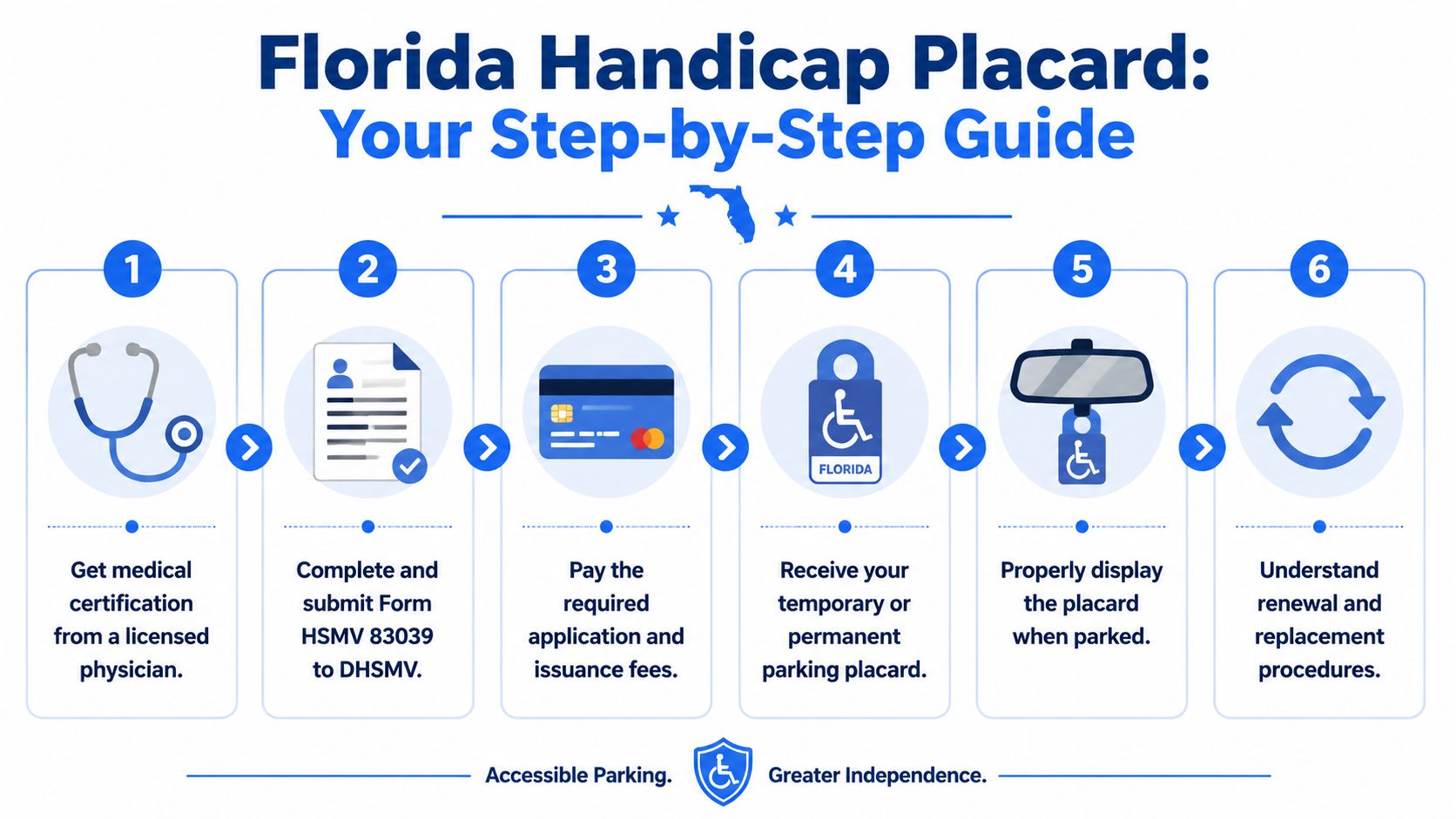
Florida's process starts with medical certification and ends with proper display and lawful use. Drivers usually focus on approval. Enforcement focuses on compliance. If you miss that difference, you can still get cited even with a legitimate placard.
What the application process requires
Start with certification from an authorized medical professional. Then submit the required state paperwork through the proper channel. The key point is simple: the state doesn't issue these permits on self-reporting alone.
You also need to understand the time limits attached to the permit. Florida law provides that temporary permits are limited to 6 months and cost $15, while standard disabled parking permits can be issued for up to 4 years and end on the applicant's birthday under Florida Statute 320.0848.
That expiration detail matters more than people think. A permit that was valid last month may not protect you today.
How to use the placard without creating a citation
Most avoidable tickets happen after the permit is issued.
Use this checklist:
Get the certification right. If the medical section is incomplete or inaccurate, the permit can become vulnerable later.
Submit the correct form. Administrative mistakes create avoidable disputes.
Track the expiration date. Don't assume a prior approval carries forward automatically.
Display it properly when parked. If enforcement can't readily see it, you may still get cited.
Remove assumptions about family use. The placard doesn't authorize solo errands when the permit holder isn't present.
Attorney view: A valid placard can still lead to a ticket if it wasn't displayed properly or if the qualifying person wasn't being transported.
Where use goes wrong in real life
The common mistakes are ordinary. The legal consequences aren't.
A driver borrows a parent's placard for a quick pharmacy stop. Someone forgets to hang the permit after parking. A temporary permit expires and no one checks the date. Another driver assumes apartment complex enforcement is looser than street enforcement and stops caring about details.
Those are exactly the kinds of facts that turn a manageable situation into a costly one.
If your permit was valid but the citation still issued, preserve evidence of the permit, the vehicle, and the way it was displayed. If the permit had expired or wasn't being used with the permit holder present, you need legal advice before you make any statement that locks you into a bad record.
What Are the Real Penalties for a Violation
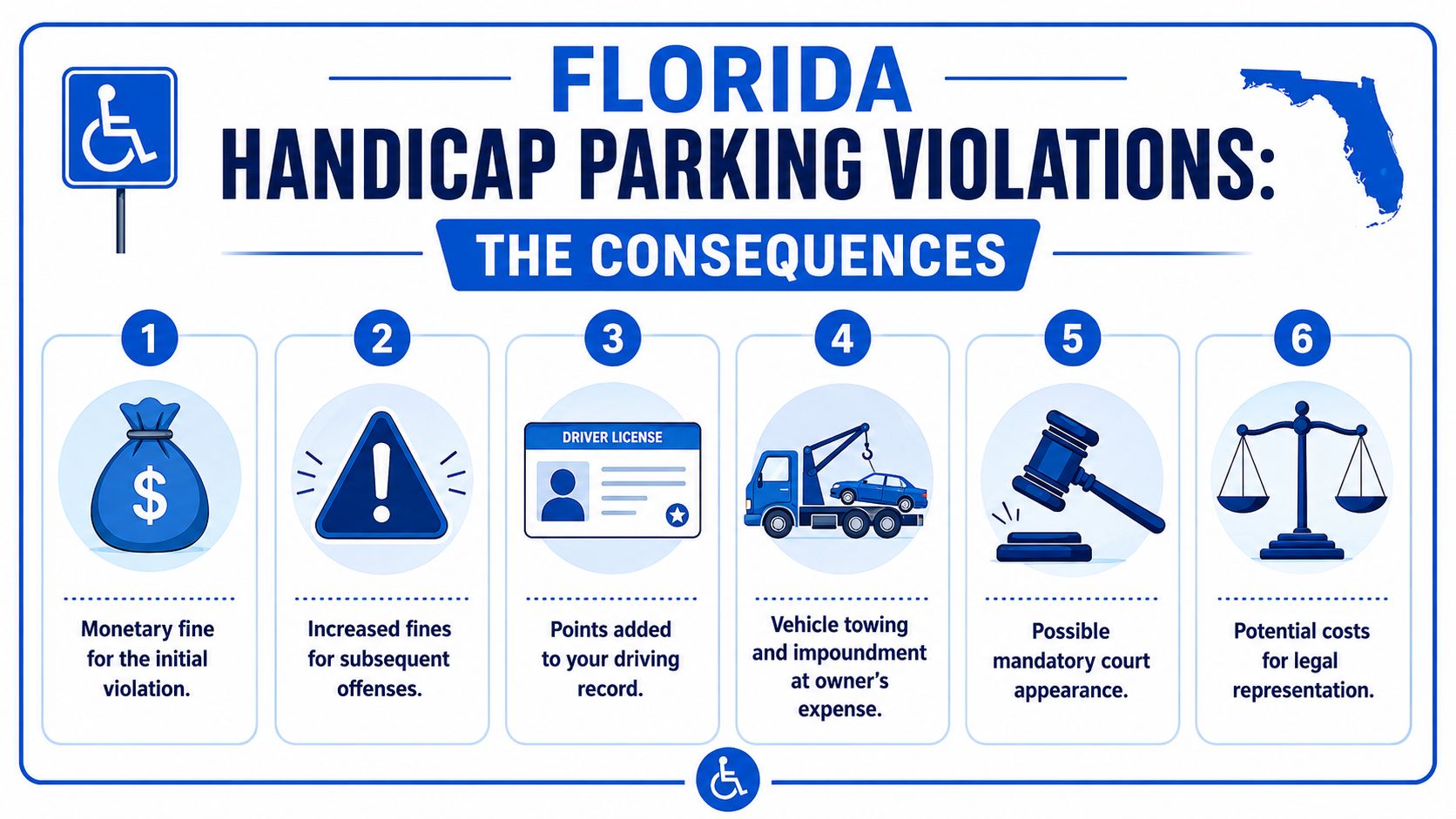
The penalties are harsher than most drivers expect. That's why paying quickly just to “get it over with” is often a mistake.
Florida's enforcement system puts real money at risk from the start. The statutory minimum fine for illegally parking in a handicapped space is $100, many local jurisdictions commonly set the fine at $250, and courts can impose a civil penalty of up to $500 depending on the circumstances, as summarized in this Florida handicap parking fine discussion.
If you want a quick explanation of the fine range before deciding whether to contest the case, review this breakdown of the parking in a handicapped spot fine.
Why the listed fine isn't the whole problem
Drivers fixate on the ticket amount. That's too narrow.
A handicap parking case can become expensive because of how it's handled, where it's filed, and what facts surround it. If the citation suggests misuse of a placard rather than simple unauthorized parking, the exposure becomes more serious. Even when the case remains civil, court involvement can create pressure that leads people to admit things they shouldn't.
At places like the Broward County Judicial Complex, the issue is not just what the fine says on paper. The central issue is whether the record created in court helps you or hurts you.
What these penalties should tell you
You should treat the citation like a file that needs to be audited, not a bill that needs to be paid.
Consider the practical consequences:
Base fine exposure: It may begin at $100 under the Florida framework summarized in the linked source.
Common local amount: Many jurisdictions commonly use $250.
Court-imposed civil penalty risk: The amount can rise to $500 depending on the facts.
Permit misuse danger: Some cases stop being simple parking matters and become much more serious.
If the facts involve someone else's placard, an absent permit holder, or a disputed location, stop trying to explain it informally. You may talk yourself into a worse case.
A strategic response beats a rushed payment
A rushed payment closes off options. A strategic review looks at whether the violation was charged correctly, whether the location supports the citation, and whether the evidence proves unlawful use.
That matters in handicap parking laws in Florida because enforcement often appears simple on the surface while hiding technical defects underneath. You won't spot those defects if your plan is just to mail in the fine and move on.
Are the Rules Different on Private Property
Yes. This is one of the most misunderstood parts of handicap parking laws in Florida, and it creates real defense opportunities.
A driver gets cited in a shopping plaza, apartment complex, hospital garage, or mixed-use lot and assumes the same rules apply the same way they would on a city street. That assumption is dangerous. The legal framework changes when private property is involved, even though state law still matters.
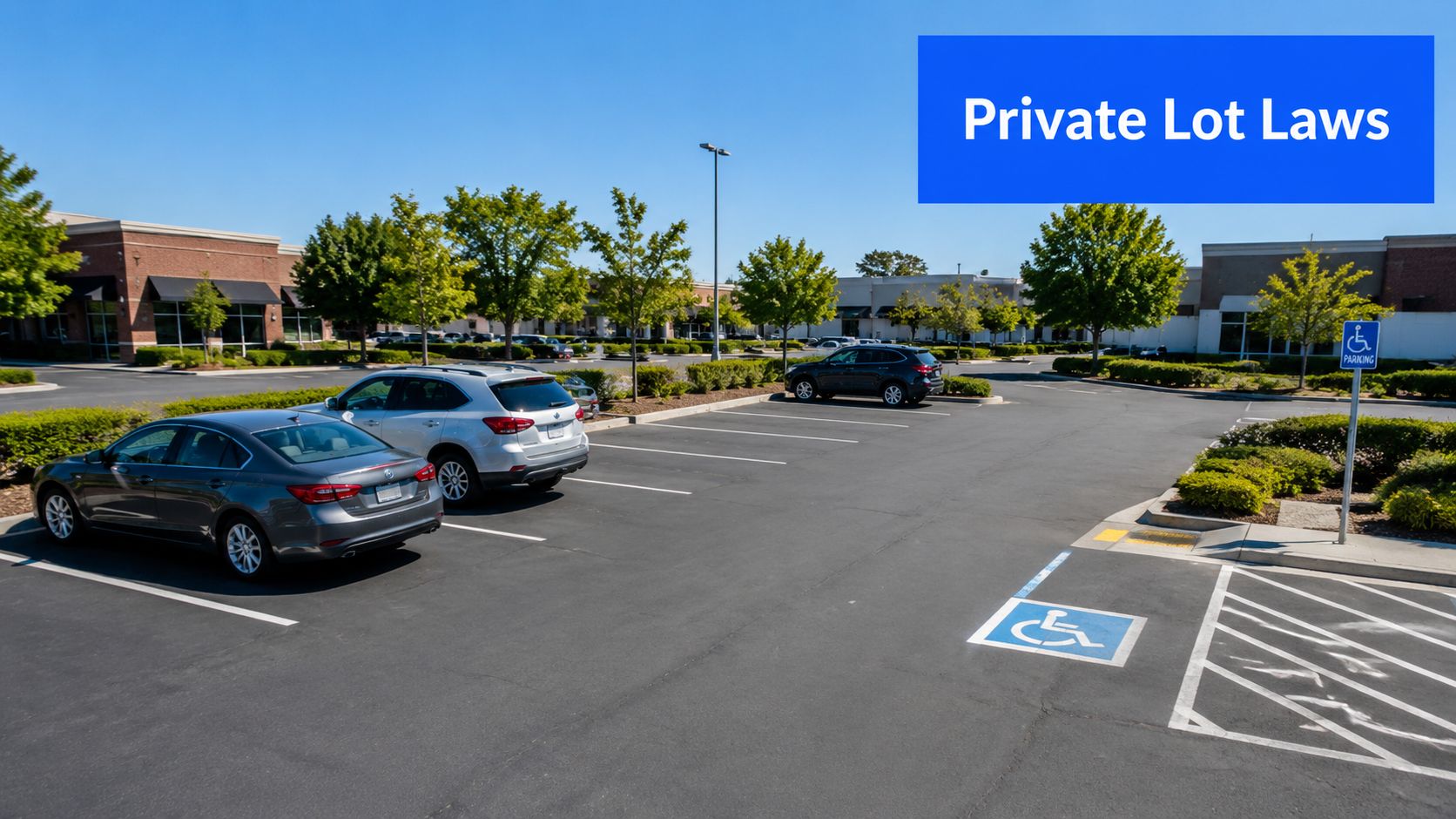
Florida's Attorney General has opined that the state preempted local regulation of disabled parking on private property, which means municipalities can't create their own ordinances on that subject even though state penalties may still apply, as explained in the Florida Attorney General opinion on handicapped parking on private property.
If you need a quick refresher on how these citations can fit into the larger traffic-enforcement system, read this explanation of a non-moving traffic violation.
Why location changes the legal analysis
Private property cases often turn on details that public-street cases don't.
The questions include who issued the citation, what authority they had, how the space was marked, whether the location was part of a public access route, and whether the property setup complied with accessibility requirements. A shopping center lot isn't analyzed the same way as a metered street space outside a government building.
That's why a driver cited near the Edgecomb Courthouse area in Tampa might have a very different defense than a driver cited in a private hospital lot across town.
What to examine in a private lot case
Don't assume the ticket is valid because the paint was blue.
Check these issues carefully:
Ownership and control: Is the lot publicly owned, privately owned, or mixed-use?
Enforcement authority: Who issued the citation, and under what authority?
Signage and markings: Was the accessible space properly designated?
Access route details: Was the allegation about the stall itself, the access aisle, or the path of travel?
Property type: Retail centers, apartment complexes, hospitals, and entertainment-adjacent lots often raise different issues.
A private-property handicap parking ticket is often won or lost on jurisdiction and physical layout, not on broad moral arguments.
That's the point many generic guides miss. You don't fight every handicap ticket the same way. The ground under the tires matters.
How Can You Fight a Handicap Parking Citation in Florida
You fight it by acting quickly, preserving evidence, and refusing to guess about the law.
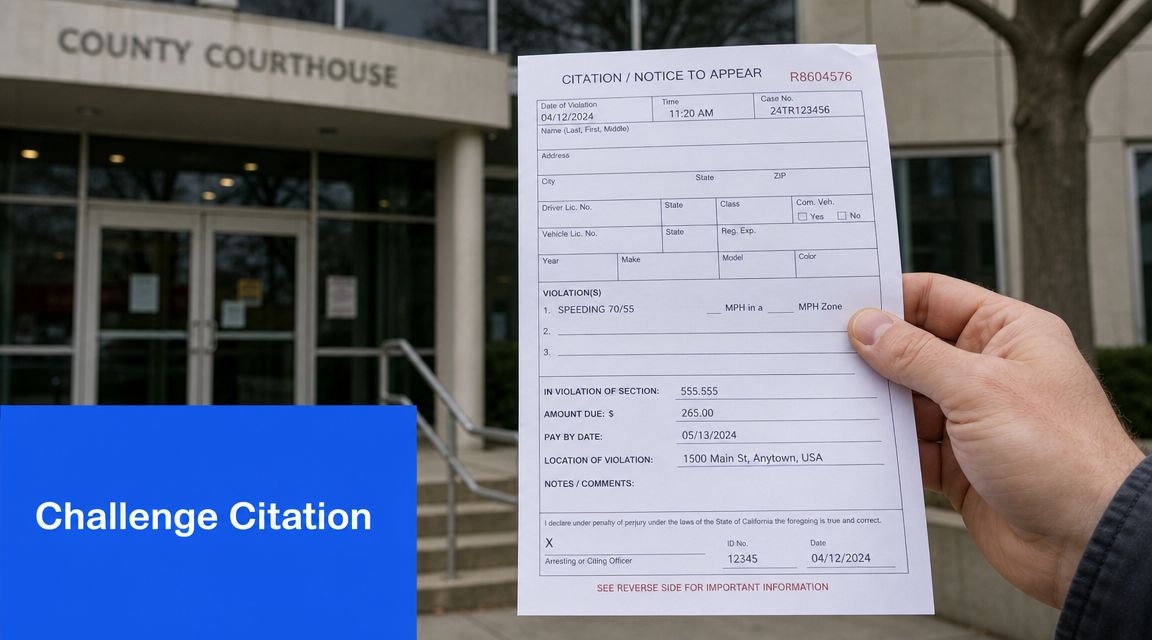
The first mistake is paying the citation before the facts are reviewed. The second is trying to “explain” the situation in a way that fills the record with harmful admissions. If you were cited, your job is to document everything and protect your options.
For a broader overview of contesting citations, this guide on how to fight a traffic ticket in Florida is a useful starting point.
What should you do in the first hours
Start building your defense immediately.
Florida guidance says a vehicle displaying a valid disabled placard or license plate may park free at on-street metered spaces for up to four hours, but that exemption is conditional and doesn't apply if a posted sign imposes a shorter time limit, according to the City of Hollywood handicap parking rules. Drivers get cited because they assume the placard gives unlimited protection. It doesn't.
Take these steps in order:
Secure photos at once: Capture the space, signage, meter, curb cuts, aisle markings, and your plate.
Preserve permit evidence: Photograph the placard or plate exactly as it existed that day.
Identify the property type: Public street and private lot cases need different analysis.
Read the citation carefully: Check the location, code section, and description of the alleged conduct.
Do not admit misuse casually: Texts, emails, and online disputes can become harmful evidence.
Which defense angles actually matter
Strong defenses are usually concrete, not emotional.
You may have a valid challenge if the permit holder was being transported, if the citation misdescribes the location, if the space or aisle was marked improperly, or if the case involves a private-property enforcement problem. Metered parking cases also need careful review because posted time limits can override assumptions that drivers commonly make.
A lawyer-led review can also compare the physical layout against Florida's accessible parking design rules. Those rules require accessible spaces to be at least 8 feet wide with an adjacent access aisle at least 5 feet wide, and they require at least 1 van-accessible space for every 6 accessible spaces, as summarized in this explanation of Florida handicapped parking design requirements. In some cases, the layout itself becomes part of the defense analysis.
Here's a short video that helps frame the issue from a defense perspective:
Immediate steps to take
Request review before paying: Once you pay, your options for recourse usually diminish quickly.
Organize documents: Citation, permit records, photos, witness names, and any receipts showing why you were there.
Separate facts from assumptions: “I thought it was allowed” is weak. Physical evidence is better.
Get legal analysis early: Firms such as Ticket Shield, PLLC handle Florida citation defense with direct attorney communication by phone or text, which is very different from automated apps or ticket mills that push drivers through middlemen.
If your case is heading toward the Orange County Courthouse or another major Florida venue, don't walk in with a story. Walk in with evidence and a strategy.
Why You Must Protect Your Record with an Attorney
A handicap parking case looks simple until it isn't.
If your citation involves a private lot, a disputed placard issue, or a misunderstanding about metered parking limits, the legal analysis gets technical fast. That's not where you want an automated intake system, a chatbot, or a volume-based ticket mill handling your case. You need a real attorney reviewing the location, the statute, the permit facts, and the enforcement authority.
That matters even more if the citation paperwork or surrounding facts suggest misconduct rather than a basic parking mistake. Once a record starts forming around allegations of misuse, cleanup becomes harder. If you're worried about what public records can mean for your reputation or online footprint, this internet public record removal guide is a useful resource for understanding the broader issue.
What a lawyer does that drivers often don't
A good defense starts by narrowing the case to what the law requires. Was the statute applied correctly? Was the property public or private? Did the officer charge obstruction, unauthorized parking, or something else? Was the permit holder present? Those details decide outcomes.
For a useful primer on how attorneys approach dismissal strategy, read how lawyers dismiss traffic tickets.
You're not just paying to answer a ticket. You're protecting your record from a preventable mistake.
You also want direct communication. Not layers of intake staff. Not canned updates. Not software pretending to be legal strategy. When your case touches handicap parking laws in Florida, especially in a gray-area private-property setting, direct access to counsel is the difference between informed action and expensive guessing.
If you got a handicap parking ticket in Florida, don't just pay it and hope it goes away. Get the citation reviewed, protect your record, and fight for the outcome that matters most: No Points. Visit Ticket Shield, PLLC for a free consultation.