Parking in a Handicapped Spot Fine Florida: Your Guide
Received a parking in a handicapped spot fine in Florida? Learn the costs, penalties, and how a lawyer can protect your record. Free consultation.
In Florida, a handicapped parking ticket can start at $100 under Florida Statute section 318.18, rise to $500 in civil penalties, and become a misdemeanor with up to 6 months in jail and $1,000 in fines if placard misuse is involved.
You're probably looking at the citation right now, annoyed, embarrassed, or worried that this was just a quick stop and shouldn't be a big deal. In Florida, it can be a big deal fast. I tell drivers this every day. The mistake is not just parking there. The bigger mistake is assuming the paper in your hand is minor.
If the officer believed you were in the space without authorization, that is one problem. If the officer believed you used a placard the wrong way, used someone else's permit, or displayed a permit without the qualified person tied to it, that is a different level of exposure. That distinction matters. It can change the case from an expensive citation into something much more serious.
Florida courts deal with these cases seriously. In places like the Orange County Courthouse in Orlando, the issue isn't only the posted fine. It's whether your actions created extra legal risk that follows you into court, background checks, and license-related trouble. You need to respond like the stakes are real, because they are.
Table of Contents
How Severe is a Handicapped Parking Ticket in Florida?
You walk back to your car, see the citation, and assume this is a minor parking problem. That assumption can cost you. In Florida, a handicapped parking ticket can start as a civil penalty and, if the facts suggest placard misuse, grow into a case that threatens your record, your money, and your options in court.

What does Florida law actually allow
Start with the statute, not the amount printed on the sign. Under Florida Statute section 318.18, the fine for parking in a space reserved for disabled persons carries a minimum $100 penalty. Florida law also gives the court room to treat the matter more seriously depending on how the citation was written and whether the issue was simple unauthorized parking or suspected misuse of disabled parking credentials under Chapter 316.
Here is the distinction that matters:
Issue | Florida exposure |
|---|---|
Basic handicapped space citation | Minimum $100 |
Higher civil penalty exposure in some cases | More than the base amount |
Fraudulent placard or permit misuse | Can trigger a criminal misdemeanor allegation |
That distinction is where drivers get hurt. A simple mistake is one category. Fraud is another. If the officer wrote this as unauthorized parking only, you are usually dealing with a civil ticket. If the officer focused on who owned the placard, whether the permit holder was present, or whether the permit was being used outside lawful limits, you may be facing far more than a routine citation.
Do not assume payment makes the problem disappear.
Florida courts look at how the conduct is classified, and that classification affects exposure beyond the fine itself. If you are already concerned about your prior record or how Florida handles traffic violations generally, review the Florida license point system so you understand how courts and agencies track violation history.
Why the number on the sign is not the full story
The posted amount is only the floor. The actual risk lies in the wording of the citation and the facts behind it. Judges in busy courthouses such as the Richard E. Gerstein Justice Building see these cases as access and public compliance issues, not harmless parking slipups, especially when a disabled placard is part of the story.
That is why I tell clients to treat this ticket seriously from day one. If your citation mentions a placard, permit holder, or improper display, you need a lawyer to read every line before you say a word, pay online, or try to explain yourself in writing.
Can You Go to Jail for Parking in a Handicapped Spot?
Yes, in the right facts, you can. Not for every ticket. But this stops being “just parking” when the allegation involves fraudulent use of a disabled parking permit.
When a parking citation turns into a criminal problem
Florida draws a hard line between simple noncompliance and dishonest use of disability credentials. If the accusation is that you used a placard you weren't entitled to use, borrowed someone else's permit, or displayed a permit outside lawful use, the case can move into misdemeanor territory. That puts your record at risk in a way many drivers never expect.
The key legal point is this. A civil citation punishes the parking act. A misdemeanor allegation punishes the misuse of the permit itself. Those are not the same thing, and you should never respond to them the same way.
If the officer mentioned the placard, permit holder, or who was being transported, treat the case as potentially larger than the ticket window amount.
What facts usually matter most
Courts and prosecutors usually focus on details like these:
Who the placard belongs to and whether that person was lawfully connected to the trip
How the permit was displayed, including whether it was visible and valid
What you told the officer at the scene
Whether the citation language suggests misuse, not just unauthorized parking
A lot of drivers hurt themselves by talking too much after the stop or by trying to “clear things up” with an online form. That can lock in a version of events before a lawyer has reviewed the facts.
This short video gives useful general context on the issue:
If there is any hint that the state thinks this was intentional misuse, your goal is no longer just minimizing a fine. Your goal is protecting your record, your employment, and your future options.
What Are the Other Hidden Consequences of the Ticket?
The number printed on the citation is often the smallest part of the problem. Drivers focus on the fine because it's visible. The expensive part is what can happen around it.
Why enforcement risk matters
Florida enforcement is active, and officers are not treating handicapped parking misuse as rare. In Mount Dora, police confiscated more than 30 handicap placards and issued 70 citations during a two-day crackdown, with local reporting noting a state fine of $183 and a possible city fine of $250 in that enforcement setting, according to WFTV's report on the central Florida crackdown.
That matters because it shows officers are looking for more than a car sitting in the wrong space. They're checking placards. They're writing citations. They're confiscating permits when they believe misuse is happening.
What can cost you beyond the listed fine
The hidden costs usually fall into a few buckets:
Towing risk: A vehicle in an accessible space can be removed, which turns one citation into a retrieval problem.
Storage charges: If the car hits an impound lot, each day adds pressure.
Court and administrative fees: Even when the base fine gets the attention, extra processing costs can follow.
Record-related fallout: A citation involving dishonesty allegations can create broader concerns if your employer reviews court activity or if you work in a regulated field. If that worries you, review how traffic tickets can appear on background checks.
Don't measure this case by the amount written in the box. Measure it by everything that can attach to it after you respond the wrong way.
This is why paying immediately isn't always the cost-effective move. It may close the file quickly, but it can also lock in the worst interpretation of what happened.
What Should You Do Immediately After Getting a Ticket?
Panic wastes time. Evidence saves cases.
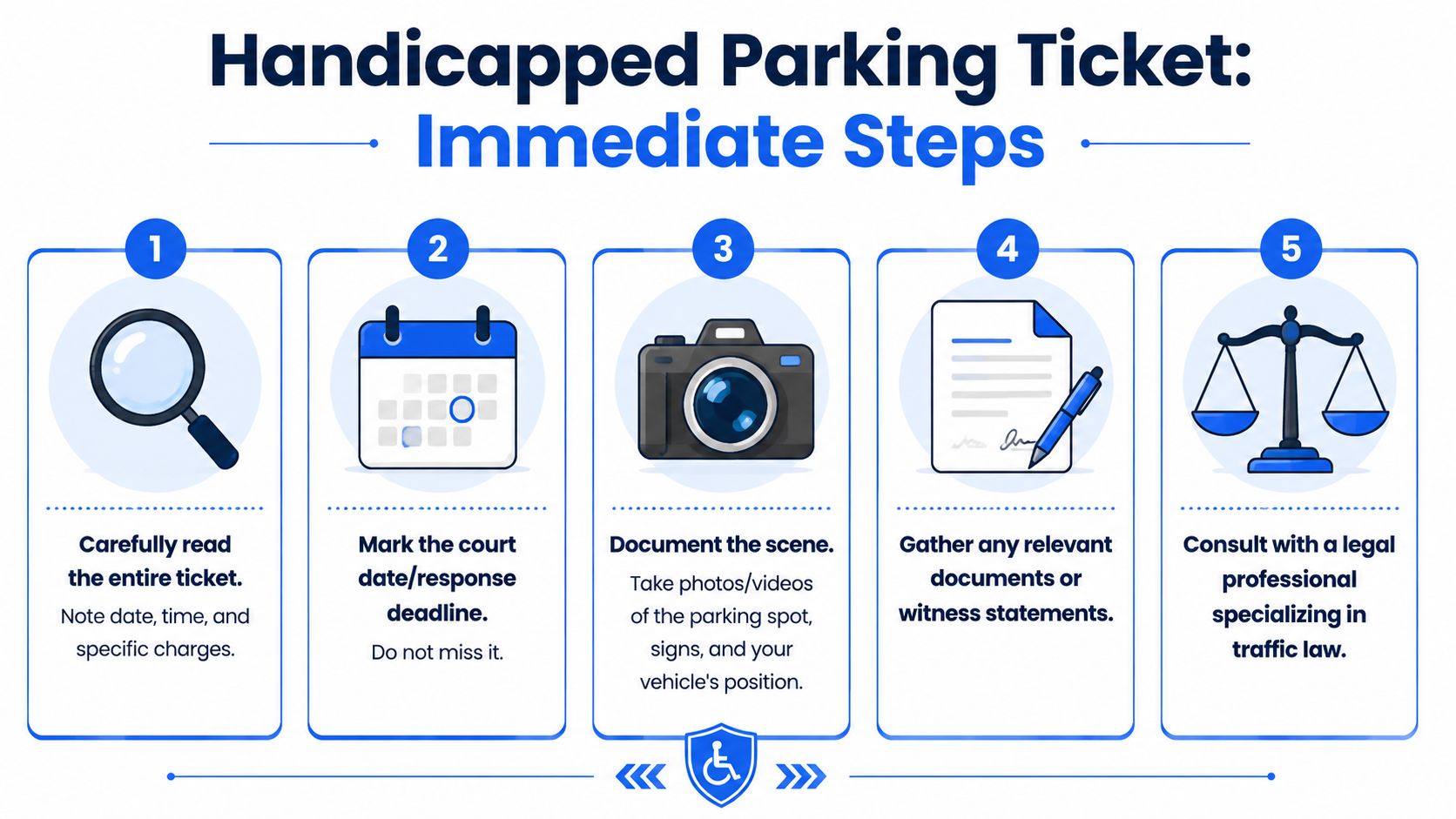
Immediate Steps to Take
Read every line of the citation. Don't guess what you were charged with. Look for wording about a handicapped space, placard misuse, or any note suggesting fraud or unauthorized use.
Calendar the response date immediately. Missing the deadline makes a bad situation worse. Put it in your phone, your email, and anywhere else you won't ignore it.
Photograph the scene now if you can. Get the sign, the pavement markings, the access aisle, the curb paint, and your vehicle position. If weather or traffic later changes the appearance, you want the original condition preserved.
Preserve the placard and related documents. If you had a placard, don't toss it in the glove box and forget about it. Keep the permit, registration details, and anything showing why it was in the vehicle.
Write down exactly what happened. Do it while your memory is fresh. Who was with you. What was said. Why you parked there. Whether the qualified person was being transported. Small facts matter in these cases.
Do not pay before getting legal advice. Payment can function like surrender. Before you do anything final, read practical next steps in this guide on what to do when you get a ticket in Florida.
Stop discussing the facts casually. Don't text explanations to friends, post about it, or send a long message to the court. Informal statements become formal problems fast.
A disciplined response in the first day often makes the difference between a manageable defense and an uphill fight.
Can You Successfully Fight This Ticket in Court?
Yes, sometimes you can. A citation is an accusation, not a final judgment. The state still has to prove the violation, and in these cases the details are often more fragile than drivers realize.
What a real defense looks like
A strong defense does not rely on excuses. It relies on proof problems, factual distinctions, and legal precision. In courthouses like the Edgecomb Courthouse in Tampa, the winning issue may be something as simple as whether the signage was clear enough, whether the markings were visible, or whether the officer jumped from a display issue to a misuse conclusion without adequate proof.
Common defense themes can include:
Defective or unclear signage
Faded pavement markings or confusing lot layout
A valid permit that was not properly visible
An officer assumption about who was being transported
Insufficient proof that the permit was used fraudulently
A handicapped parking case often turns on one narrow question. Was this unauthorized parking, a display mistake, or actual misuse?
That's not wordplay. That's defense work.
Why fact specific cases can be defensible
Many drivers think, “I was in the space, so I lose.” That isn't how contested cases work. The court looks at the legal elements and the evidence supporting each one. If the government can't prove the facts it needs, the case becomes negotiable or defensible.
Here's a simple breakdown:
Situation | Defense potential |
|---|---|
Signage or markings were unclear | Stronger argument that notice was inadequate |
Permit existed but wasn't visible | Fact-specific argument, often different from fraud |
Officer assumed misuse without confirming details | Potential challenge to proof |
Driver made damaging admissions | Harder case, but still worth review |
If you want a practical look at contest strategy, this guide on how to beat a traffic ticket in Florida is a useful starting point. But don't confuse general tactics with case-specific analysis. A real review means checking the citation language, your documents, the scene, and any indication that the officer believed this involved dishonesty.
Why You Need a Lawyer-Led Firm and Not an App
Drivers make their second big mistake here. The first is underestimating the ticket. The second is handing it to a system built for speed instead of judgment.
What goes wrong with automated handling
Automated apps and ticket mills treat citations like data entry. They intake, sort, and process. That model breaks down when your case depends on nuance. A handicapped parking ticket can involve permit status, driver identity, transport facts, lot markings, officer observations, and possible criminal implications. That is not a chatbot problem.
If your case touches a courthouse like the Broward County Judicial Complex, you want someone who knows how local practice works and can respond to what's on your citation. Not someone routing your file through a middle layer.

What direct attorney access changes
A lawyer-led firm gives you something automated services can't. Judgment in real time. You need to be able to ask, “Is this just parking, or are they implying placard misuse?” and get an answer from a lawyer, not a script.
Ticket Shield, PLLC handles Florida traffic citations with direct attorney communication by phone or text, which is the right model when the issue may involve both citation defense and record protection. If you're weighing options, use a service where a licensed Florida attorney reviews the actual facts and where you can compare that approach against why a local lawyer can matter more than an app.
You are not buying convenience here. You are protecting your record from a category of ticket that can become much more serious than it first appears.
If your goal is No Points, no unnecessary admissions, and a controlled strategy from the start, treat this ticket like it deserves immediate legal review.
If you were cited for parking in a handicapped space in Florida, don't guess, don't pay blindly, and don't trust an automated shortcut with a record-sensitive case. Visit TicketShield.com for a free consultation and start with a lawyer-led plan focused on the No Points goal.