
Florida School Bus Laws: A Driver's Defense Guide
Cited for passing a school bus? Understand Florida school bus laws, fines, and points. Our attorneys explain your defense options to protect your record.

If you got a Florida school bus ticket, treat it like a threat to your record, not a routine fine. Florida Statute 316.172 is strict, the roadway details matter, and paying fast can cost you the advantage you may need to protect your license.
You saw the bus. You made a split-second call. Then the lights came on behind you, or the ticket arrived, and now you're wondering whether this is just expensive or dangerous to your driving record.
It's dangerous.
A school bus citation in Florida is one of those tickets drivers underestimate. They think it's just another moving violation they can pay online and move on from. That's the wrong move in many cases. If you were cited, you need to look at the roadway, the bus signals, the officer's vantage point, and the exact language of Florida Statute 316.172 before you decide anything.
If your case is headed to a courthouse like the Orange County Courthouse in Orlando, the court won't care that you were confused. The legal question is narrower than that. Either the stop was legally required under the statute, or it wasn't. Either the state can prove the violation cleanly, or it can't.
Table of Contents
Why Is a School Bus Ticket So Serious in Florida
You can get this ticket in seconds. The consequences stay with you much longer.
This isn't like a minor parking issue or a routine non-moving citation. A school bus case carries a strong safety stigma, and judges, officers, and prosecutors often treat it that way. If you walk in casually, you're already behind.
Why this ticket hits harder than most moving violations
Florida built its school bus stop law around a bright-line rule. When a bus is stopped with its red lights flashing and stop arm extended, traffic generally has to stop in both directions unless the roadway fits a narrow divided-highway exception under Florida Statute 316.172. That structure gives the state a simple story to tell in court.
The financial stakes are real too. Passing a stopped school bus in Florida carries a minimum $225 fine for a first offense, according to this Florida school bus enforcement summary. That's only the visible part of the problem.
The bigger issue is what a conviction can do to your record and your insurance profile. If you drive for work, commute long distances, hold a commercial position, or need a clean record for background checks, a school bus citation can become much more than a traffic annoyance. If you're also trying to understand whether your case carries broader exposure, review what counts as a criminal traffic violation in Florida.
Practical rule: Never assume a school bus ticket is something you should just pay online without a legal review.
Why Florida enforces these cases aggressively
Florida has been dealing with illegal school bus passing for decades. A University of South Florida transportation study reported that about 10,600 motorists could be expected to illegally pass stopped school buses in Florida on a typical school day, which helps explain why officers and courts take these allegations seriously. The finding appears in the University of South Florida transportation study summary.
That same body of research also noted that many drivers misunderstood when they were legally required to stop. That matters because confusion is common, but confusion does not erase the citation.
Here's my blunt advice. If you've been charged, stop thinking like a driver and start thinking like a defendant. Your job now is to test the state's proof, preserve your evidence, and avoid careless admissions.
When Must You Legally Stop for a Florida School Bus
You round a bend, see a school bus ahead, and hesitate for one second about whether the road divider changes your duty to stop. That one second is where drivers get cited. If you got a ticket, stop arguing from memory. The case turns on signal status and road design.
Florida's rule is simple in theory and messy in real life. If the bus is displaying its stop signal, traffic usually must stop. The only recurring fight is whether the roadway qualifies for the divided-highway exception. If you need the broader Florida traffic laws that apply to school bus stops and roadway classifications, start there. Then come back to the facts of your road, because that is where defenses are built.
What Florida Statute 316.172 requires
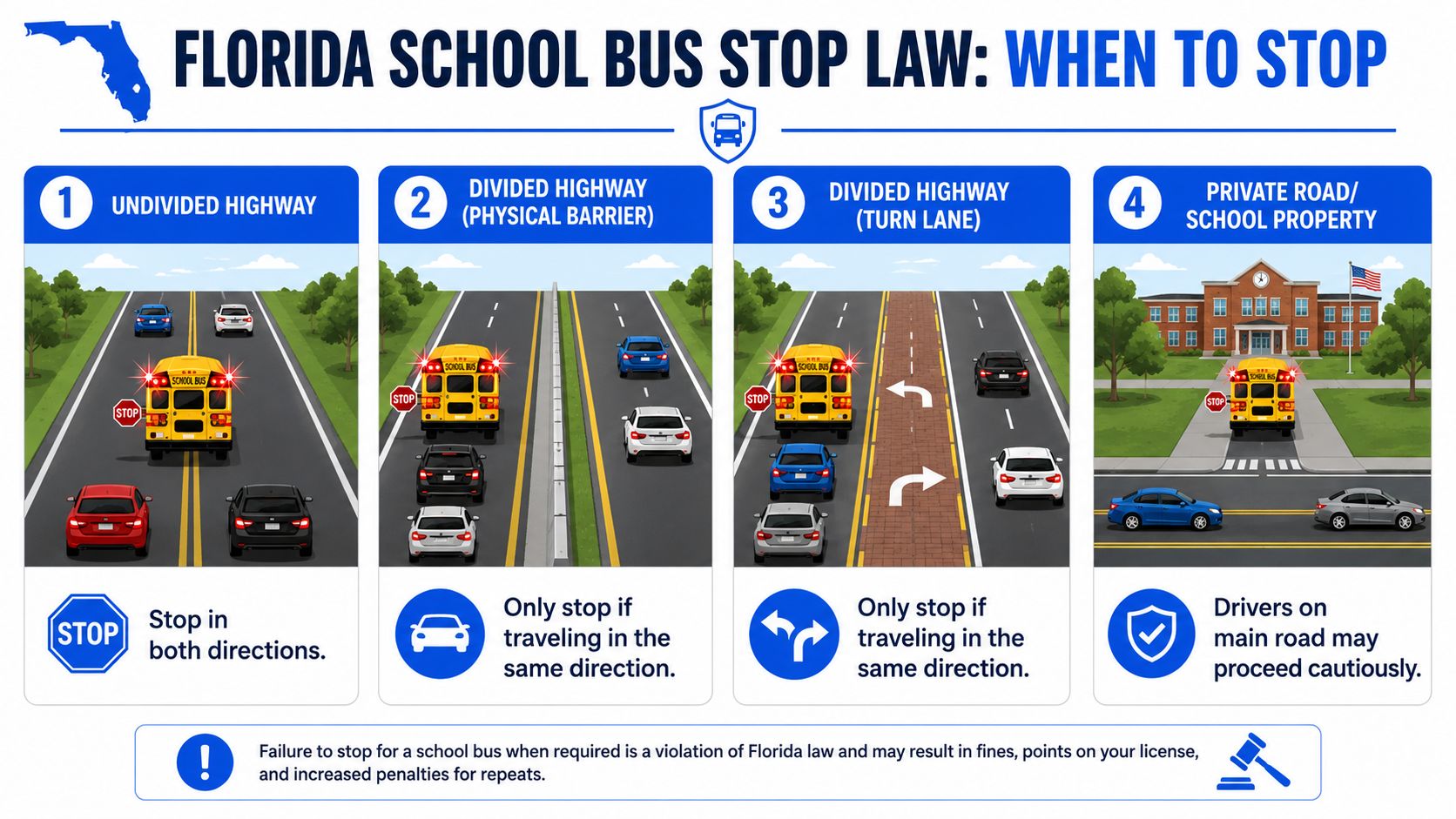
Under Florida Statute 316.172, once a school bus displays its stop signal, drivers must come to a full stop and stay stopped until the signal is withdrawn. The law also expects bus stops to be made where visibility is unobscured in both directions when possible. For a defense case, those details matter. The state still has to prove the signal was active and that your lane was one required to stop.
Here is the working rule:
Road type | Must you stop? |
|---|---|
Two-lane road | Yes, traffic in both directions must stop |
Multi-lane road without qualifying physical divider | Yes, traffic in both directions must stop |
Divided highway with qualifying physical separation | Only traffic following the bus must stop |
What counts as a divided highway and what does not
This is the trap.
A real divided-highway exception requires more than a wide road or extra lanes. The separation must be the kind the statute recognizes, such as a raised median, a physical barrier, or at least 5 feet of unpaved space. Painted lines do not count. A center turn lane does not count. A striped buffer usually does not save you.
That means these common defenses fail fast unless the road supports them:
“It was a wide road.” Width is irrelevant by itself.
“There was a center lane.” A turn lane is not a qualifying divider.
“There were several lanes.” Multiple lanes in each direction still may require both sides to stop.
If there was no true physical separation, expect the prosecutor to argue that every approaching driver had to stop.
A fast way to analyze the road where you were cited
Go back to the scene as soon as possible. Conditions change, memories get softer, and bad assumptions ruin good defenses.
Focus on five questions:
Were the red lights flashing, and was the stop arm out?
Were you traveling behind the bus or in the opposite direction?
Was there a raised median, barrier, or at least 5 feet of unpaved space between directions of travel?
Was the “divider” only paint, striping, or a center turn lane?
Was your view of the bus and its warning signals clear on approach?
Take photos. Take video. Measure the median or unpaved space if that is your defense.
That is the difference between a story and evidence. If the road geometry helps you, prove it. If it does not, your defense has to shift to identification, signal timing, visibility, or the officer's vantage point.
What Are the Penalties for a Violation
The fine on the citation is only the opening number. The true cost is often what follows a conviction.
What the ticket can cost you immediately
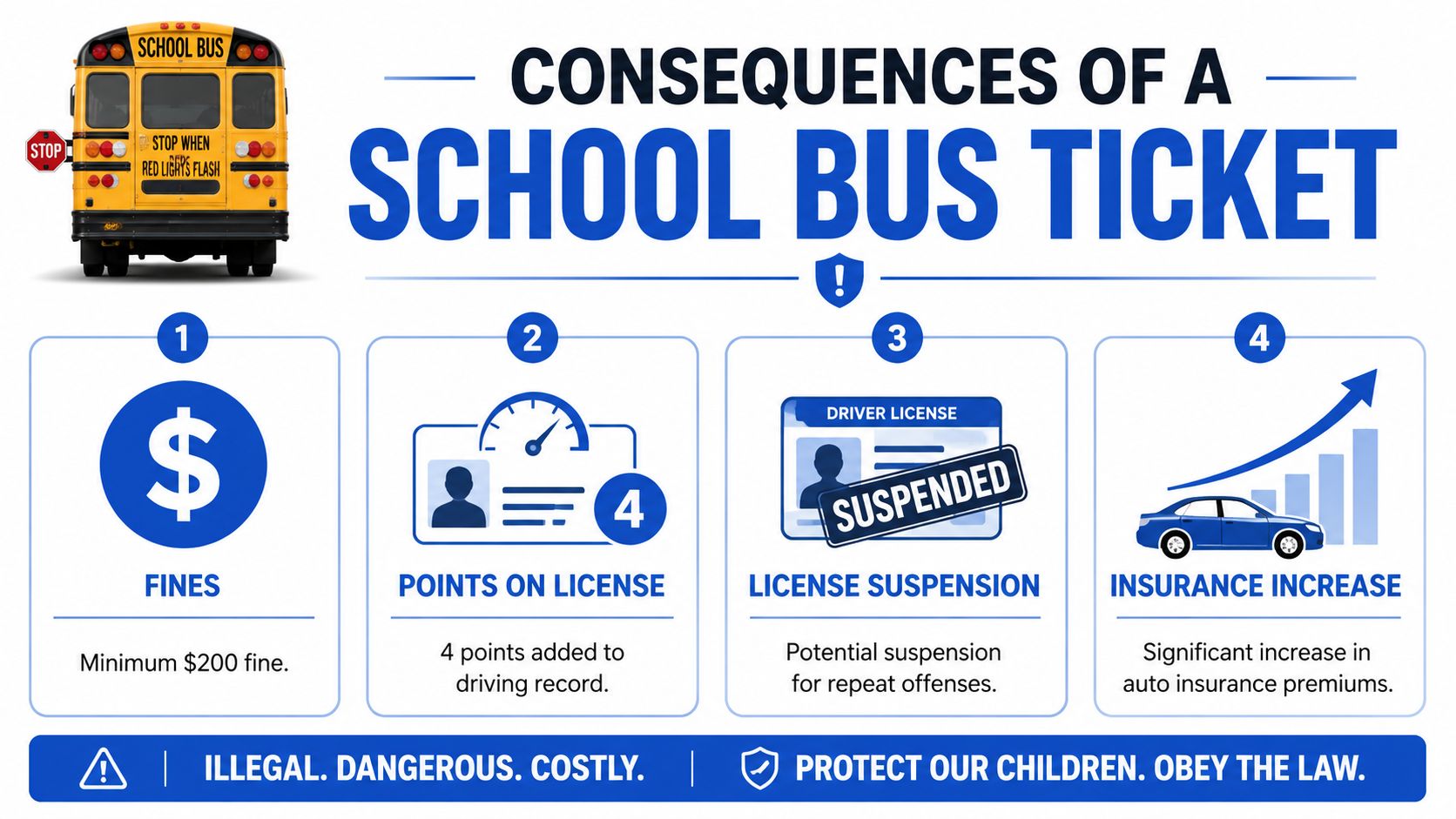
Florida sets a high baseline for this offense. Passing a stopped school bus in Florida carries a minimum fine of $225 for a first offense, and that amount can be higher depending on the circumstances and county, according to this Florida enforcement overview on school bus safety.
That minimum matters because it signals how the state views the violation. Courts do not see this as an ordinary lapse in driving etiquette. They see an allegation involving child safety.
A lot of drivers make the same mistake here. They focus only on the posted fine and ignore the strategic consequences of a conviction.
The hidden damage most drivers miss
The visible penalty is the one printed on paper. The hidden penalties show up later.
Those can include:
Insurance pressure: Carriers often treat school bus violations as serious safety events.
Record damage: A conviction can hurt drivers who rely on clean driving histories for work or background screening.
Court complications: Some cases require more attention than a basic pay-and-close ticket.
Negotiation loss: Once you pay, you may give up options that could have protected your record.
The question isn't just “How much is this ticket?” It's “What does this conviction cost me over time?”
If your citation involves aggravating facts, the court may look at it more harshly. That's one reason you shouldn't build your defense around explanations like “I didn't think I had to stop” or “everyone else kept going.” Those are not legal defenses. They are usually admissions dressed up as excuses.
What Immediate Steps Should You Take After a Citation
Move fast. Evidence gets lost early.
This section is where drivers either protect themselves or make the case harder than it needs to be. The first few decisions matter.
What not to do first
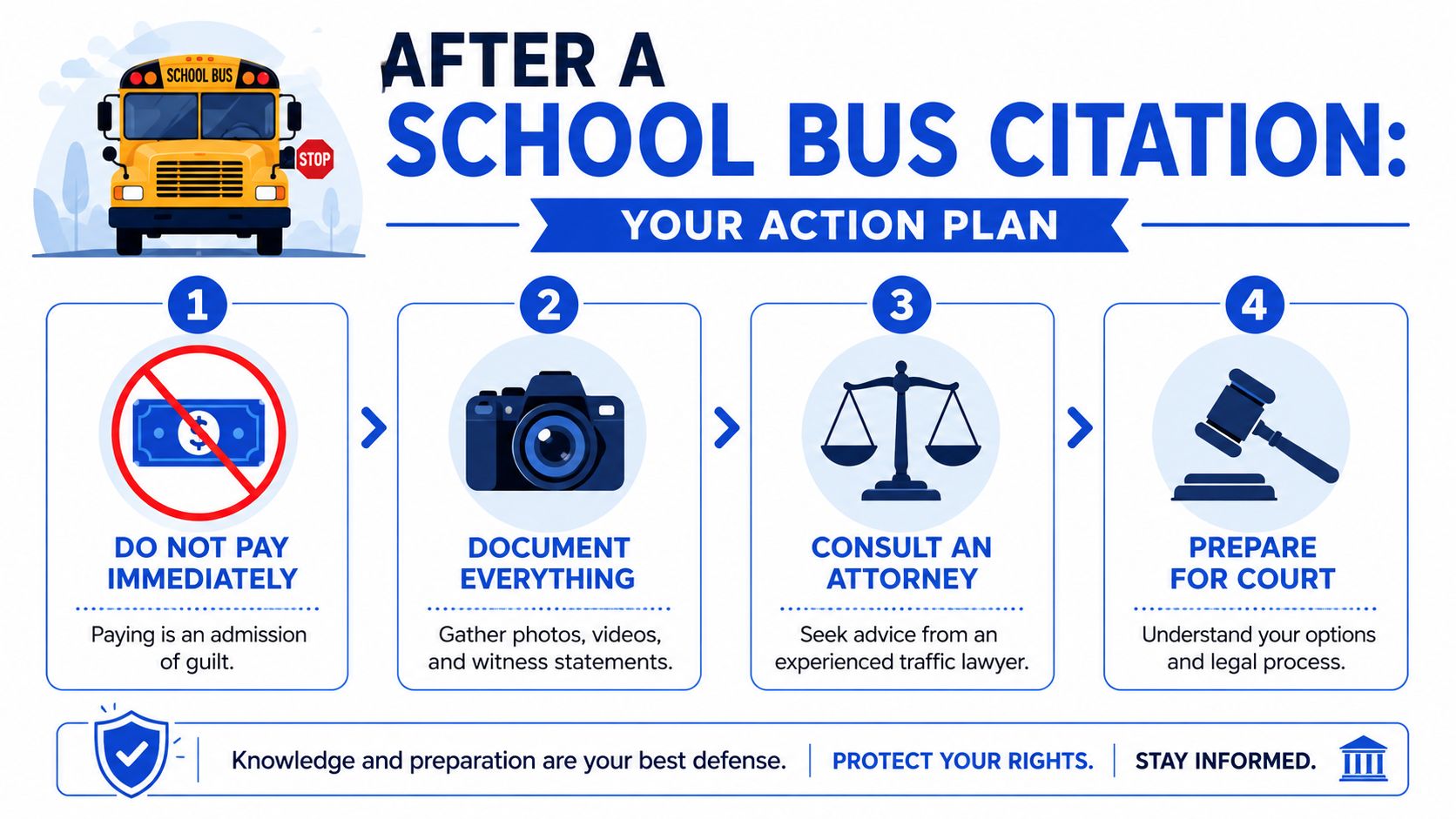
Don't pay the ticket just to get it over with.
Paying may shut down your chance to challenge how the law was applied, whether the roadway qualified for an exception, or whether the state can prove the bus was displaying the required signal. Before you do anything, read a practical breakdown of what to do when you get a ticket in Florida.
This checklist gives you the right sequence.
Immediate steps to take
Save every document: Keep the citation, envelope, notice, and anything the officer handed you.
Write down the facts: Record the time, weather, traffic flow, lane position, and exactly where the bus was located.
Preserve video: Pull dashcam footage immediately. Don't assume it will still be there next week.
Photograph the roadway: Get clear images of medians, lane markings, shoulders, signs, and your direction of travel.
Identify witnesses: If someone was in the car with you, get their account now while details are fresh.
Stop talking casually about fault: Don't text people “I definitely messed up” or post about it online.
What to gather before court gets involved
Video often explains these cases better than memory does.
You also want to collect anything that shows the roadway layout clearly:
Street-level photos: Focus on whether there was a real physical divider.
Approach-angle shots: Show what a driver could see.
Map captures: Use them carefully to preserve orientation and lane structure.
Timeline notes: Write when the bus signal became visible and when you reacted.
Your memory will get weaker. The state's paperwork will get cleaner. Act before that gap widens.
If you've been cited, don't try to charm the clerk's office into legal advice. Don't assume the officer's version is unchallengeable. Build the file now.
How Can You Defend Against a School Bus Ticket
A citation is an allegation. That's all it is.
The defense depends on facts, and school bus cases often turn on very specific facts. Signal status. Sight lines. Road design. Officer location. Timing. Those details decide whether the state has a clean case or a vulnerable one.

Where a real defense usually starts
A serious review starts with the state's proof.
That usually means asking:
Was the bus fully stopped?
Were the red lights flashing?
Was the stop arm extended?
Did the officer have a clear line of sight?
Did the officer identify your vehicle and direction of travel accurately?
If one of those pieces is weak, the state's version may not be as solid as the citation suggests.
How roadway evidence can change the case
The road itself can be the defense.
If the issue is whether the highway was legally divided, your attorney should look beyond casual photos. The right review may include scene photographs, map analysis, and official roadway design materials. Many self-represented drivers fail to provide such evidence, arguing instead from memory. The court prefers proof.
Sometimes the defense is not “I didn't pass the bus.” Sometimes it's “The law did not require my lane of travel to stop under these road conditions.” That is a legal argument rooted in the statute, not an emotional appeal.
One practical option for handling these cases is a lawyer-led defense service such as Ticket Shield, PLLC, where the focus is on reviewing the citation, the roadway facts, and the available strategies to protect the driver's record.
When the goal is damage control instead of trial
Not every case should be tried to the wall.
If the evidence is unfavorable, the smart goal may shift to limiting damage, seeking a resolution that protects your record as much as possible, and avoiding avoidable admissions. That's strategy. Good defense work isn't about pretending every case is perfect. It's about identifying the best path in the case you have.
A strong defense does two things at once. It attacks weak proof, and it prepares a fallback position if the proof survives.
Why Is a Lawyer-Led Defense Your Strongest Shield
This is not the kind of citation you should hand to a middleman and hope for the best.
School bus cases need legal judgment. Not automated intake. Not canned responses. Not a system that treats your file like a tracking number. If your driving record matters, direct access to the lawyer handling the case matters too.
Why direct access to your lawyer matters
You need to be able to ask direct questions and get direct answers.
If your case is headed to a courthouse like the Richard E. Gerstein Justice Building in Miami or the Edgecomb Courthouse in Tampa, your lawyer needs to understand the citation, the road, the court, and the practical options available. That analysis is harder when communication runs through layers of non-lawyers, apps, or support staff who can't make legal decisions.
A lawyer-led defense gives you something more useful than generic reassurance. It gives you a strategy. If you're comparing options, start with firms that focus on Florida traffic ticket lawyers who defend driving records strategically.
What you should demand from your defense
Demand a defense built around your actual facts.
That means:
A statute-based review: Was Chapter 316, and specifically Section 316.172, applied correctly?
A road-layout review: Did the divider legally qualify?
A proof review: Can the state prove the signal status and your vehicle's movement?
A record-protection goal: Is the defense aimed at keeping points off your record if possible?
You don't need a lecture. You need protection. You need someone who will look for mistakes in the state's case, maintain an advantage, and push toward the no-points outcome whenever the facts and court posture allow it.
If you were cited for violating Florida school bus laws, get legal help before you pay anything. Visit Ticket Shield, PLLC for a free consultation and fight for the goal that matters most: No Points.
