
Passing School Bus Fine in Florida: A Defense Guide
Got a Florida passing school bus fine? Our guide explains F.S. 316.172, penalties, and how a lawyer can fight to save your license and avoid points.
A Florida passing school bus fine is a serious offense. Penalties start at $200 for a first offense and include 4 points on your license. You should not just pay it, because paying is a plea that can damage your record and trigger bigger problems.
If you're reading this after getting a citation, you're probably asking one question: can this be fixed without wrecking your license and insurance. In many cases, yes. But only if you treat it like a real legal problem right away.
A Florida passing school bus fine is a serious offense. Penalties start at $200 for a first offense and include 4 points on your license. Do not just pay it. An attorney can challenge the citation to protect your driving record.
Most drivers get bad advice on this issue because online articles are generic or built around other states, not Florida. That confusion matters. It causes people to pay tickets they may have been able to fight, even when the road layout, the bus signals, or the evidence create a real defense.
Table of Contents
What Are Florida's Exact School Bus Passing Laws
Florida school bus cases turn on one statute. That statute is Florida Statute 316.172. If you don't know what it requires, you can't tell whether the officer, camera vendor, or reviewing agency got it wrong.
When do you have to stop
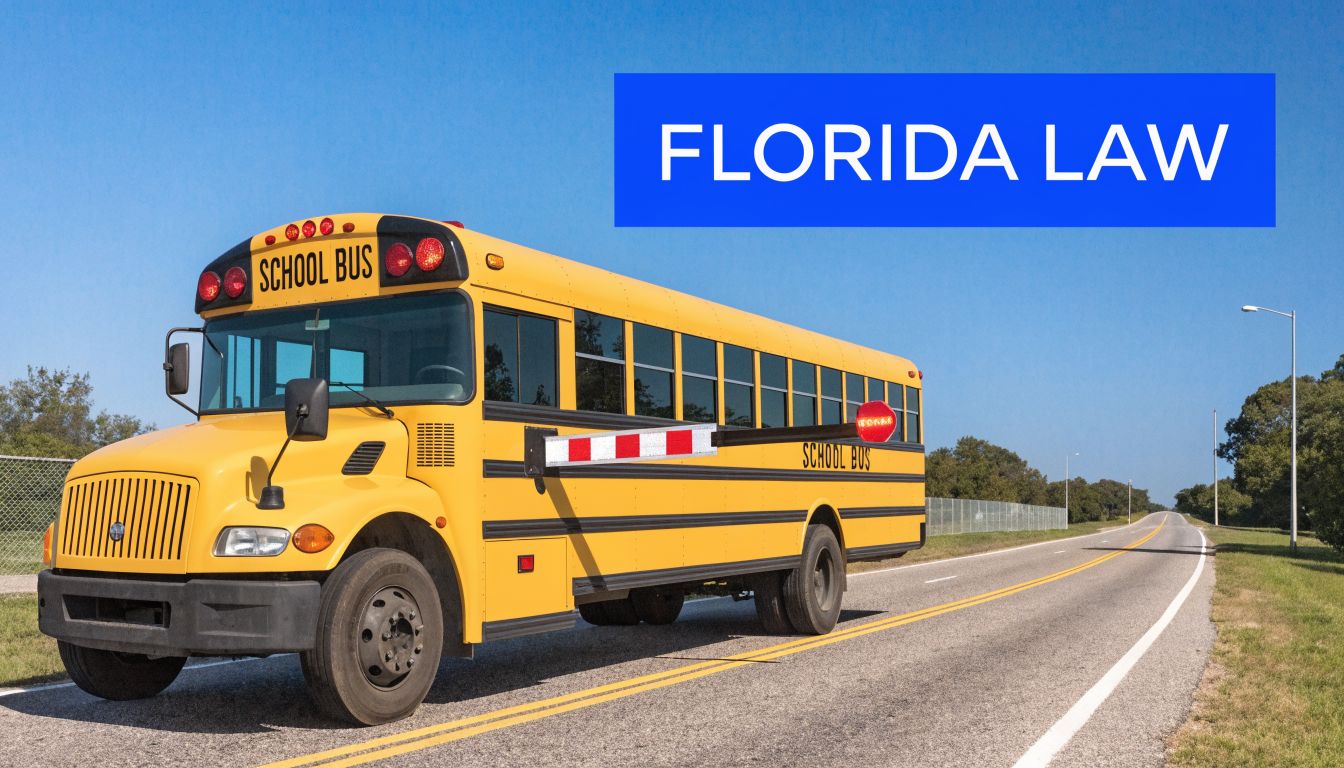
The rule is simple. If a school bus is stopped to load or unload children, and it has its stop arm extended and flashing red lights activated, drivers must stop unless a specific road exception applies under Florida law.
On a typical two-lane road, traffic in both directions must stop. That includes the cars behind the bus and the cars coming toward it.
On a multi-lane road without a physical barrier, you should assume you still need to stop if you're approaching a properly stopped bus. Drivers get in trouble when they treat painted lane lines like a legal divider. They aren't the same thing as a barrier or raised median.
Practical rule: If you can drift across it in a normal turn and nothing physical separates the directions of travel, don't gamble on a passing school bus fine.
A quick mental map helps:
Two-lane road, one lane each direction: both directions stop.
Road with center turn lane only: treat it with caution. A center lane alone is not the same as a protected barrier.
Same direction behind the bus: stop when the bus is displaying red signals and extended stop arm.
If you're also dealing with roadway marking confusion, this breakdown of Florida no passing zone rules helps separate lane-marking violations from school bus stop violations.
When don't you have to stop
The most misunderstood Florida exception involves a divided highway. Under F.S. 316.172, traffic going in the opposite direction may not have to stop when a physical barrier or raised median separates the roadway.
That exception is where many defensible cases begin. Drivers often receive citations even though the road was legally divided. Officers and camera reviewers don't always capture the full roadway layout from the angle they rely on.
Generic online guides often focus on other states, leaving Florida drivers uncertain about F.S. 316.172 and pushing them to accept points they might have avoided, as discussed in this Florida-focused overview of failure to stop for a school bus guidance.
Another common mistake is confusing amber lights with red lights. Amber lights warn that the bus is preparing to stop. Red lights with the stop arm extended trigger the actual stop requirement. If the timing of those signals was unclear, that matters.
The difference sounds small. In court, it isn't.
What Are the Penalties for a Passing School Bus Violation
You get the ticket, see a fine amount that looks manageable, and think paying it will end the problem. That is how drivers talk themselves into a conviction that puts 4 points on the license and creates avoidable risk for the next several years.
What happens if you just pay it
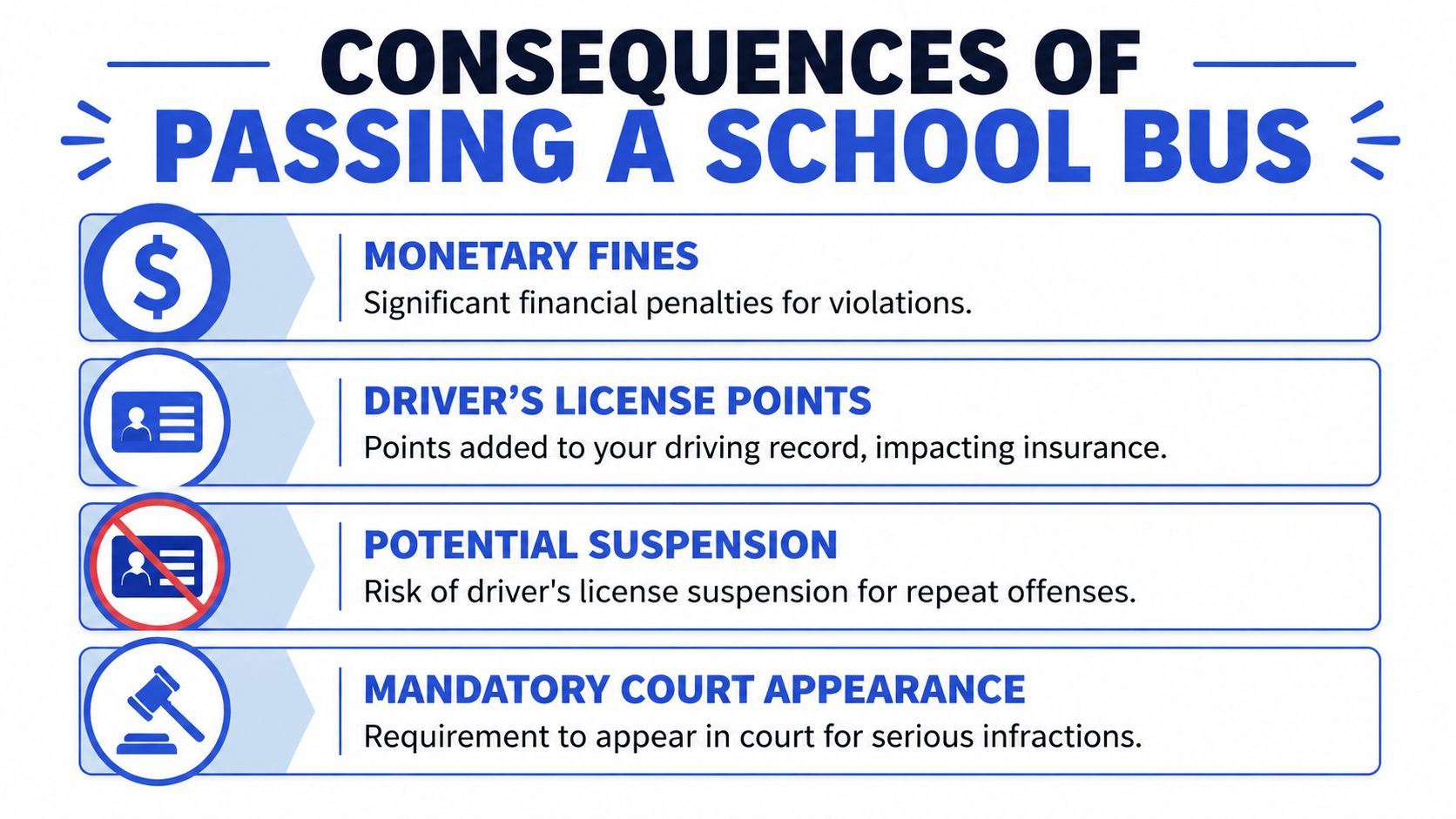
Under Florida law, a first offense for illegally passing a stopped school bus carries a minimum $200 fine and 4 points on your license. A second offense within five years can trigger a mandatory license suspension of at least 190 days. Florida also increased the base penalty from $100 to $200 effective January 1, 2021, according to this Florida-specific summary of illegal school bus passing penalties.
Paying the ticket is a plea. Treat it that way.
Once you pay, the court gets its money, but you keep the record. If you already have points, one more school bus conviction can push you closer to a suspension problem. If your job depends on a clean driving history, the damage is bigger than the fine.
Here is what that usually means in real life:
Immediate cost: at least $200 out of pocket.
License impact: 4 points added to your driving record.
Future risk: less room for error if you get another citation.
Repeat-offense exposure: a second conviction within five years can lead to a long suspension.
That is why quick-pay ticket apps are a bad bet in these cases. An app can process paperwork. It cannot spot a divided-road defense, challenge signal timing, attack bad video, or stand beside you in court and protect your record. A Florida traffic attorney can.
Why this hits working drivers harder
Drivers who use a car for work get hit first and hardest. Rideshare drivers, delivery drivers, home-health workers, sales professionals, contractors, and military members often face employer review, insurance issues, or job restrictions after a school bus conviction. The court may treat the case like a routine traffic matter. Your employer probably will not.
A school-related citation also tends to be judged more harshly than a standard moving violation. If you want context on how aggressively Florida treats these offenses, this guide to Florida school zone speeding ticket penalties shows how fast school-area cases can create record and cost problems.
If your ticket came out of Broward, do not assume anyone will treat it as a small mistake. Judges at the Broward County Judicial Complex see these cases through a child-safety lens. You need a defense strategy built for that reality, not a generic app that files forms and leaves you to handle the rest.
Are School Bus Camera Tickets Legal in Florida
Yes. School bus camera enforcement is increasingly common, and these tickets can be very real legal problems.

How these tickets usually work
A stop-arm camera mounted on or associated with the bus records a vehicle passing while the bus is stopped for students. Instead of an officer stopping you roadside, the case often starts with video, timestamps, plate information, and mailed notice procedures.
That changes the defense strategy. In a hand-issued ticket, the officer's observation is central. In a camera case, the quality of the footage, the timing of the signals, the ownership records, and compliance with the notice process become much more important.
Nationally, camera enforcement has shown low repeat-offender rates. Pilot programs cited by NHTSA reported 1.87% recidivism among nearly 140,000 violators, supporting the idea that automated enforcement deters repeat behavior, according to NHTSA's discussion of reducing illegal passing of school buses.
That statistic matters for policy. It doesn't mean your ticket is automatically valid.
What can still go wrong with a camera case
Camera systems create evidence. They do not create perfect evidence.
The legal fight often turns on questions like these:
Was the bus in the legal loading or unloading position
Were the red lights active at the relevant moment
Was the stop arm fully extended
Does the footage show the road configuration clearly
Was the notice sent and processed correctly
A camera angle can flatten distance. It can miss the median. It can fail to show whether you crossed after the lights changed. Those are not technicalities. They are proof problems.
This short video gives a useful visual on how stop-arm enforcement is discussed in practice:
At the Orange County Courthouse in Orlando, I would rather attack a weak camera packet early than walk in later trying to undo a paid citation. Once you pay, your advantage is gone.
What Are Common Defenses Against a School Bus Ticket
A school bus citation can be beaten. Not in every case. But far more often than drivers think.
The key is to stop thinking like a motorist and start thinking like a defense lawyer. The question isn't whether the allegation sounds bad. The question is whether the state can prove the legal violation cleanly and completely.
Road design and visibility defenses
One of the strongest defenses is that the road itself put you outside the stop requirement under F.S. 316.172. If there was a true divided highway, raised median, or physical barrier, the state has to account for that correctly.
Another defense comes from visibility and timing. If your approach to the bus involved a curve, obstructed sightline, heavy glare, or a sudden signal sequence, those facts matter. A judge wants to know whether the state can show a clear, fair opportunity to comply.
Use the roadway, not your memory alone. Photos, maps, and scene review often expose problems in the citation narrative.
Some of the best defenses come from the road geometry the ticket writer never documented.
If you're dealing with an officer-issued citation, this discussion of whether you can fight a ticket if the officer didn't show up can help you understand one procedural angle that still matters in certain hearings.
Signal and proof problems
The bus must be using the correct warning signals. If the state cannot show flashing red lights and an extended stop arm at the moment you allegedly violated the law, the case weakens fast.
Common defense themes include:
Signal ambiguity: amber warning phase confused the timing.
Stop arm issue: the arm wasn't fully extended or visible.
Premature accusation: the bus was still transitioning into its stop.
Vehicle identification issue: the video or report doesn't cleanly tie the alleged act to your vehicle.
A defense lawyer also looks for internal inconsistencies. Did the written citation describe a road type that doesn't match the photos. Did the reviewer miss the median. Did the report summarize the event in a way the video doesn't support.
At the Edgecomb Courthouse in Tampa, those details can decide the case. Judges hear excuses all day. They pay attention when the evidence itself doesn't line up.
What Immediate Steps Should You Take After Getting a Ticket
Your first move matters more than most drivers realize. Plenty of people lose defensible cases because they panic, pay, or wait too long.

These violations are extremely common. A one-day survey of more than 114,000 bus drivers recorded over 67,000 illegal passings, and that projects to more than 39 million violations in a school year nationwide, according to the 2025 NASDPTS survey summarized by BusPatrol's national school bus illegal passing survey report. That volume means enforcement systems process a huge number of cases. You should not assume yours received careful human scrutiny.
Immediate Steps to Take
Don't pay the ticket: paying usually functions like admitting the violation. Once you do that, your defense options shrink fast.
Check the deadline immediately: missing the response date creates a new problem and removes control from your side.
Write down the facts now: road type, direction of travel, lane position, weather, traffic, the bus location, signal color, and whether a median or barrier separated traffic.
Save every document: keep the citation, mailing envelope, online notice, screenshots, and any bus-camera images.
Go back to the scene if it's safe: photograph the roadway, lane count, median, signs, and sightlines from your approach.
Look for your own footage: dashcam, business fleet camera, rideshare app trip logs, or nearby commercial cameras can help.
Read a practical post on what to do next: this guide on what to do when you get a ticket gives a useful general framework for preserving defenses early.
The worst response is the most common one. Drivers pay first and investigate later.
If your case is in Miami-Dade, the Richard E. Gerstein Justice Building is not where you want to show up unprepared. Bring facts. Bring photos. Bring a strategy.
How Does a Lawyer Beat a Passing a School Bus Ticket
You get the notice, glance at the bus photo, and assume the case is airtight. That is how drivers lose good defenses. A school bus ticket is often beat by slowing the case down, forcing proof, and finding the legal defect before you hand over money or make an admission.
A Florida traffic lawyer does that by building a defense around your exact road, your exact movement, and the exact evidence the state plans to use. That is very different from an app that sorts tickets into broad categories and looks for a few standard flags.
What a real defense looks like
A serious defense starts with the record. The citation. The video or still images. The roadway design. The lane configuration. The officer narrative, if there is one. The charging statute. In Florida, that usually means close review of F.S. 316.172 and whether the facts fit it.
Then the lawyer tests the case where it is weakest:
Did the law require you to stop on that specific roadway?
Do the images clearly show red lights and a deployed stop arm before your vehicle passed?
Is the timing clear, or does the footage leave room for doubt?
Did the officer or camera file leave out facts that help you?
Is there a procedural defect, proof problem, or negotiation path that protects your record?
That is not clerical work. It is legal analysis.
Here is the difference that matters. An app might scan for the word "median" and mark the case as weak or strong. A lawyer will study the actual divider, the lane count, the point where you passed, and whether that roadway feature meets the legal definition that controls your stop duty in your case. That single issue can change everything. The same goes for video timing. Software may see a passing event. A lawyer may catch that the stop arm was not fully deployed when your car entered the frame, which can be the difference between liability and dismissal.
In these cases, small roadway details decide big outcomes.
A good lawyer also knows the right target. Sometimes that target is dismissal. Sometimes it is a result that keeps points off your license and limits the insurance damage. Chasing the wrong outcome wastes time and can make a fixable case worse.
Local practice matters too. A lawyer who regularly handles Florida traffic court knows which objections get heard, which evidence problems draw attention, and when negotiation makes more sense than a hearing. That judgment is what you are hiring.
Ticket Shield Defense vs. Paying the Fine
Outcome | Paying the Fine (Pleading Guilty) | Hiring Ticket Shield |
|---|---|---|
Case posture | You give up your advantage early | A lawyer reviews the facts before any admission |
License points | You risk the points tied to conviction | The defense goal is often no points or dismissal |
Evidence review | You usually never test the state's proof | Your attorney can challenge video, road layout, and procedure |
Court burden | You handle the consequences yourself | A lawyer can often appear for you, as explained in this guide on whether a lawyer can go to traffic court for you |
Communication | You deal with a confusing process alone | You speak directly with your attorney by phone or text |
Long-term impact | You may lock in record and insurance damage | You get a real chance to protect your record |
The lawyer versus app difference is not branding. It is case control.
With automated ticket services, drivers often cannot tell who reviewed the file, whether any lawyer studied the footage, or whether anyone checked the roadway against the statute instead of against a generic checklist. That is a bad bet in a school bus case, where one missed factual detail can sink a defense that should have been raised on day one.
If you depend on driving for work, already carry points, or hold a professional license, treat this ticket like a threat to your record, not a minor inconvenience.
If you got hit with a passing school bus fine in Florida, act now and fight for the outcome that matters most: No Points. Ticket Shield, PLLC is a lawyer-led Florida firm, not an automated app or ticket mill. You speak directly with your attorney by phone or text, and your defense is built around protecting your license, record, and insurance. Visit TicketShield.com for a free consultation.
