Understanding No Passing Zone Penalties and Defense Options in Florida
Facing a no passing zone ticket in Florida? Learn the laws, penalties, and how a skilled traffic attorney can defend your driving record.

In Florida, a no passing zone is a specific stretch of road where the law says overtaking another vehicle is just too dangerous. These zones, common on roads throughout Broward County and the rest of the state, are marked by a solid yellow line on your side of the road, often with a black and white "DO NOT PASS" sign to make it crystal clear. Ignoring this isn't a small mistake; it's a moving violation that can hit you with fines, points on your license, and a nasty surprise on your next insurance bill.
What Exactly Is A Florida No Passing Zone?
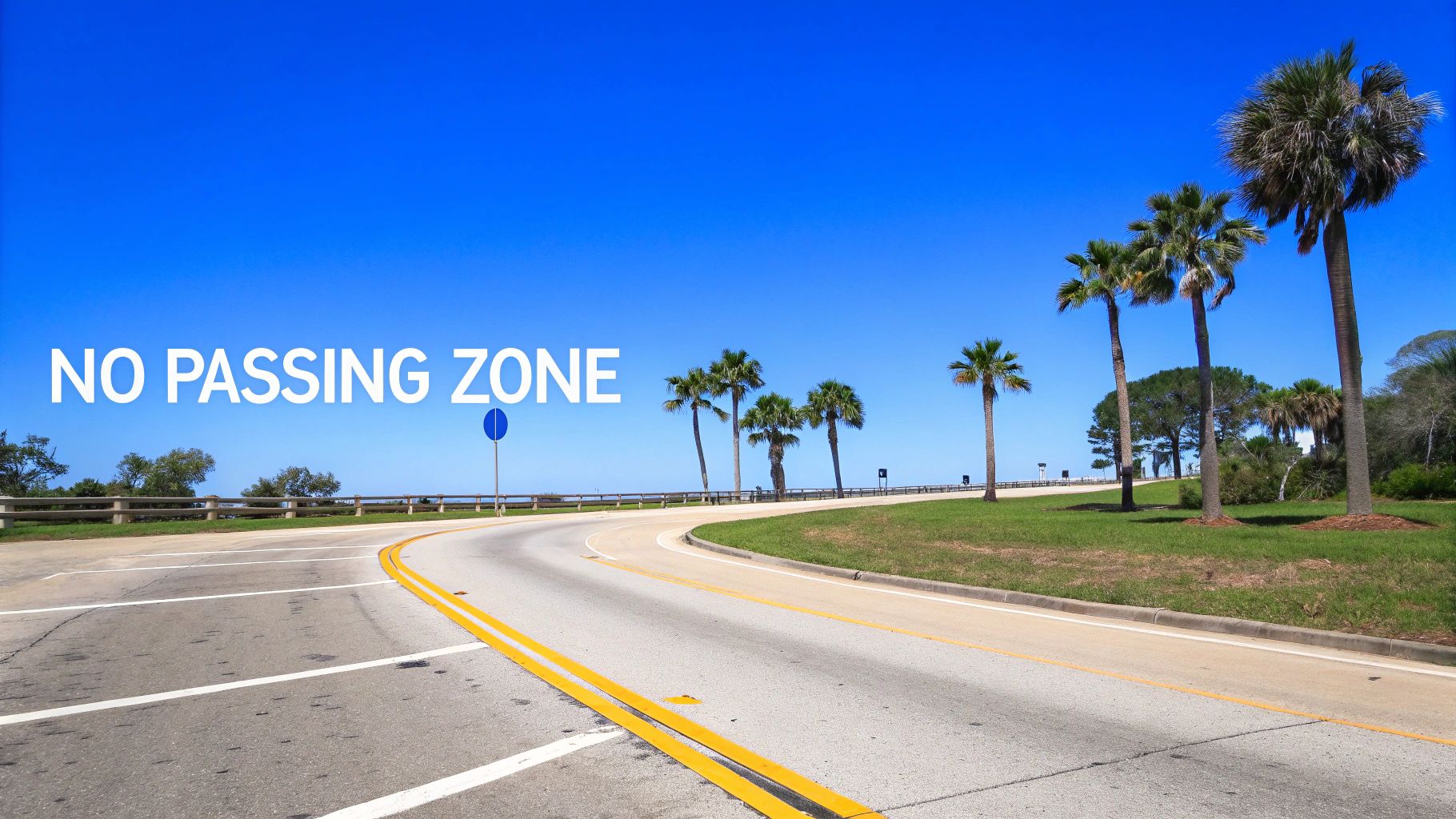
Whether you're driving the scenic curves of Old Cutler Road in Miami-Dade County or a rural two-laner connecting towns, you have to understand one of Florida’s most fundamental safety rules: the no passing zone. These areas aren't just picked at random. They exist for one reason: to prevent the high-risk gambles that lead to devastating head-on collisions.
A no passing zone is always set up in a spot where your line of sight is limited. Think hills, sharp curves, intersections, or railroad crossings. When you enter one, the law is simple—stay in your lane until the zone ends.
It’s helpful to think of that solid yellow line as a temporary wall. It’s a clear signal that it is not safe to pull into the opposing lane of traffic. Law enforcement takes these violations very seriously, precisely because of the immense danger involved.
The Two Clear Indicators Of A No Passing Zone
The Florida Department of Transportation uses two main ways to tell you you're entering a no passing zone. An officer can write you a ticket based on either one, as both carry the full weight of the law.
Solid Yellow Pavement Markings: This is the big one. If the yellow line on your side of the centerline is solid, passing is illegal. If your line is broken but the line for oncoming traffic is solid, you can pass if it's safe. A double solid yellow line? That means nobody is passing from either direction.
Regulatory Road Signs: You’ll also see white rectangular signs with bold black letters stating "DO NOT PASS." Sometimes, you'll get an advance warning from a yellow, pennant-shaped sign on the left side of the road that reads "NO PASSING ZONE."
These signs and lines are official traffic control devices. Failing to obey them can land you a ticket for a violation of a traffic control device, which we cover in detail in another article.
To help you remember what the markings on the road mean, here is a quick guide.
Florida Passing Zone Markings At A Glance
This table breaks down the common road markings you'll see on Florida roads and what they mean for your ability to pass another vehicle.
Road Marking | What It Means For You | Is Passing Allowed? |
|---|---|---|
Broken Yellow Line | The line on your side of the road is broken or dashed. | Yes, when the way is clear and it is safe to do so. |
Solid Yellow Line | The line on your side of the road is a single, unbroken line. | No, this indicates a no passing zone for your lane of traffic. |
Double Solid Yellow Lines | Two solid yellow lines run down the center of the road. | Absolutely Not, passing is prohibited for traffic in both directions. |
Solid and Broken Lines | One line is solid, and the one on your side is broken. | Yes, you may pass if it's safe. Traffic on the other side (with the solid line) cannot. |
Keeping these simple rules in mind will help you stay safe and avoid an unnecessary and expensive ticket.
Why These Zones Are Critical For Safety
The whole point of a no passing zone is simple: to save lives. They're put in place where a driver just can't see far enough ahead to safely get around another car and back into their lane.
A study of rural roads found that sections without designated passing zones had a significantly higher crash rate. This data underscores why law enforcement strictly enforces these rules—they are a proven measure to reduce serious traffic injuries and fatalities.
When a driver crosses a solid yellow line on a blind curve, they aren't just breaking a rule; they're gambling with their life and the lives of everyone else on that road. The few seconds you might save are never worth the risk of a collision. That’s why a ticket for improper passing is more than just a fine—it's a harsh reminder of a critical safety law designed to protect us all.
Decoding Florida's No Passing Zone Law
That traffic ticket you’re holding is more than just a piece of paper—it’s a legal document, and it’s pointing directly at a specific state law. For a no passing zone violation, the law in question is almost always Florida Statute 316.0875. While the legal language can feel a bit dense, the reason for this law is brutally simple: to prevent catastrophic, high-speed head-on collisions.
Think of this statute as the legal muscle behind every solid yellow line and "DO NOT PASS" sign you see on the road. It’s the state's official way of marking off areas where the risk of an accident is just too high to attempt an overtake. Understanding this shifts your perspective. You didn't just "cross a line"; the officer is saying you performed a maneuver in a spot the state has determined is dangerously unsafe.
And the law isn't just making up rules. It specifically targets situations where a driver's view of oncoming traffic is dangerously blocked. These are the classic "blind spots" we all encounter on Florida's roads.
Key Scenarios Covered by Florida Law
Florida Statute 316.0875 doesn't leave much to interpretation. It pinpoints several high-risk areas where passing is strictly off-limits, and these rules apply even if the paint on the road is faded or hard to see.
Approaching the Crest of a Hill: When you're heading up a grade, you have zero idea what's coming over the top from the other side. The law forbids passing here to stop you from meeting another vehicle head-on in your lane.
Navigating a Curve in the Road: Just like a hill, a sharp curve completely obstructs your line of sight. Trying to pass here means you could pull directly into the path of a car you never even saw coming.
Within 100 Feet of an Intersection: Intersections are chaotic, with cars, trucks, and pedestrians coming from multiple directions. Passing this close dramatically increases the risk of T-bone crashes or hitting someone making a turn.
Within 100 Feet of a Railroad Crossing: A train can appear a lot faster than you think. That 100-foot rule is designed to make sure you're not stuck in the opposing lane when the crossing signals light up and the arms come down.
Within 100 Feet of a Bridge, Viaduct, or Tunnel: These structures are bottlenecks. The lanes are often narrower and there's usually no shoulder, which means there's zero room for error. The law keeps traffic flowing in its designated lane to prevent a disaster in a confined space.
For a deeper dive into the state's regulations, you can explore our comprehensive guide on Florida state traffic laws.
Real-World Application on Broward County Roads
Picture yourself driving over the 17th Street Causeway in Fort Lauderdale. The lanes merge, your visibility changes as the bridge climbs, and traffic is almost always heavy. This is a perfect real-world example of why these rules exist. One impatient driver weaving into the oncoming lane could trigger a multi-car pileup with absolutely nowhere for other drivers to escape.
The same logic applies out on rural highways. Think about a two-lane road in Central Florida, where long stretches are marked with solid yellow lines for a reason. A groundbreaking 2025 Penn State University study analyzed over 55,000 year-miles of rural roads—very similar in structure to many of Florida's own state highways. The findings were crystal clear: sections with designated passing zones had 11.2% fewer total crashes compared to no-passing zones. This data proves just how dangerous these restricted areas truly are.
The core idea behind Florida Statute 316.0875 is proactive safety. It’s about taking the guesswork out of a dangerous decision for drivers. The rule is simple: if your view is limited, stay put in your lane. An officer who writes a ticket for this violation is enforcing that exact principle.
Ultimately, the ticket you received is based on an officer's observation that you made a move in a place the state has legally declared unsafe. Grasping this legal foundation is the very first step in figuring out how to handle your citation.
The True Cost Of A No Passing Zone Conviction

A lot of drivers see a no passing zone ticket as a simple problem. They figure the easiest way out is to just pay the fine and put it behind them. Unfortunately, that common mistake is the same as pleading guilty, and it kicks off a chain reaction of consequences that are far more expensive and long-lasting than the amount printed on the citation.
The "true cost" isn't just one payment. It’s a financial ripple effect that can hit your budget for years to come. Once you see all the hidden costs, it becomes clear why addressing the ticket is often the smartest financial decision you can make to protect your driving record.
When you're convicted of a no passing zone violation, the financial pain comes in three waves: the immediate fine, the damaging points on your license, and the painfully slow burn of higher insurance premiums.
The Immediate Hit: The Ticket Fine
The first thing you’ll face is the fine itself, which is set by the county where you got the ticket. In Florida, the base fine for an improper passing violation usually falls somewhere between $150 and over $250, but that number can jump around quite a bit.
Several things can move that number up or down:
The County: A ticket from a busy area like Broward County might have a different price tag than one from a more rural part of the state.
Court Costs and Fees: The amount on the ticket is almost never what you actually end up paying. There are always extra administrative fees and surcharges tacked on.
Your Driving History: While it might not affect the initial fine, a spotty record can definitely influence a judge if you decide to contest the ticket.
This first payment is just the tip of the iceberg. Think of it as the entry fee to a much more expensive problem.
The Lingering Problem: Points On Your License
Here’s where a simple mistake gets serious. When you pay that no passing zone ticket in Florida, you’re admitting guilt. That triggers the Florida Department of Highway Safety and Motor Vehicles (DHSMV) to add points to your driver's license. An improper passing violation will typically slap 3 points onto your record.
These aren't just harmless numbers; they're a direct measure of how risky you are as a driver. Rack up too many points in a certain timeframe, and you're looking at a mandatory license suspension. It’s crucial to understand how this works, and you can get the full breakdown in our guide to the Florida traffic ticket point system.
For some drivers, these points are especially devastating:
Commercial Drivers (CDL Holders): For a professional truck driver, points can be a career killer, potentially leading to getting fired or making it impossible to find a new job.
Parents of Teen Drivers: A conviction on a young driver's record can send the family's insurance rates through the roof, often by thousands of dollars a year.
Drivers with Previous Tickets: If you’re already carrying points, this new conviction could be the one that pushes you over the edge into a license suspension.
Protecting your license is the primary goal. A clean record means lower insurance rates, better job opportunities for professional drivers, and peace of mind on the road. Avoiding points is the most effective way to prevent long-term financial consequences.
The Long-Term Pain: Increased Insurance Premiums
This is where the true, gut-wrenching cost of a no passing zone conviction really hits home. Once that conviction is on your record, your insurance provider sees you as a higher-risk driver. To them, that violation signals a willingness to make dangerous moves on the road.
As a result, your insurance premiums will almost certainly jump at your next renewal. And this isn't a one-and-done fee. That rate hike can stick around for three to five years, depending on your insurance company. A single conviction could end up costing you hundreds, or even thousands, in extra payments over that time, easily dwarfing the original cost of the ticket.
To put it all together, here’s a look at how the costs can stack up from just one ticket.
Potential Financial Impact Of A No Passing Zone Conviction
The table below breaks down the estimated financial fallout from a single no passing zone ticket conviction in Florida.
Penalty Category | Typical Cost And Impact | Important Notes For Drivers |
|---|---|---|
Initial Ticket Fine | $150 - $250+ | This is just the base fine; court costs and administrative fees will increase the total amount you pay upfront. |
Points on License | 3 points | Accumulating 12 points in 12 months triggers a mandatory 30-day license suspension. |
Insurance Rate Hike | $300 - $800+ per year | This increase can last for 3 to 5 years, potentially costing you $900 to $4,000+ over the life of the penalty. |
Total Estimated Cost | $1,050 - $4,250+ | This reflects the total financial impact over 3-5 years, not just the initial fine. |
As you can see, the decision to just pay the fine can turn a $200 problem into a $2,000 headache.
Beyond these direct costs, there's another layer of trouble that can come from mishandling a ticket: failing to show up for court. It's vital to understand what happens if you miss court, because it can add severe penalties to an already expensive situation. Our firm handles these matters correctly from the start to ensure those kinds of complications do not arise.
Common Scenarios And Potential Defense Strategies
Every traffic stop is unique. That little piece of paper charging you with improper passing in a no passing zone might feel cut and dry, but the real story is always in the details. Too many drivers make the mistake of thinking a ticket is an automatic conviction. It’s not. It's simply an accusation, and just like any accusation, it can be questioned and challenged.
The first step is understanding the common situations that lead to these tickets in the first place. A traffic ticket attorney with experience knows how to dissect the specifics of your stop, looking for any weaknesses in the citation. The goal is to get past a simple "he said, she said" and find the factual or procedural issues that can form the foundation of a solid defense.
Challenging The Visibility Of Signs And Markings
One of the most powerful defense strategies comes down to a simple question: could you even tell it was a no passing zone? The state has a responsibility to make sure its road signs and pavement markings are clear and visible to any reasonably careful driver. When they fall short, it can be argued that you should not be held accountable.
This is a significant issue on countless rural roads in Florida, from long stretches of SR-70 to the backroads that crisscross Broward County. Years of blistering sun, torrential rain, and constant traffic can leave pavement markings incredibly faded, chipped, or just plain gone.
Ask yourself these questions about where you got your ticket:
Were the solid yellow lines so worn down they looked broken or were almost impossible to see?
Was the "DO NOT PASS" sign hidden by an overgrown tree branch or bent from an old accident?
Did recent road work or a sloppy asphalt patch cover up the markings that were supposed to warn you?
If the answer is yes to any of these, you may have a strong argument. If the no passing zone wasn't properly marked, it may not have been enforceable at that moment.
Questioning The Officer's Perspective And Observation
Another critical angle is challenging what the law enforcement officer could have actually seen. To make the ticket stick, an officer must be able to state clearly that they witnessed your vehicle cross the solid yellow line and complete the pass while still inside that restricted zone. Their line of sight is a critical piece of the puzzle.
A ticket is based on an officer’s direct observation. If that observation can be reasonably questioned due to distance, obstructions, or the angle of view, the entire basis for the citation may be weakened. Our goal is to protect your license and record by carefully examining every detail. Past results do not guarantee future outcomes.
Think about it. If the officer was parked way down the road, sitting around a curve, or positioned behind a big truck, could they really see exactly where your pass started and where it ended? Did they see your tires physically cross the solid line, or did they just catch a glimpse of you pulling back into your lane after it was all over? That small distinction can make all the difference.
Analyzing The "When" Of The Pass
The timing of your move is everything. It is 100% legal to begin a pass when you're in a legal passing zone (marked by a broken yellow line) and finish it after the solid line has already started. The key is that the maneuver had to be started safely and reasonably.
A classic scenario is when a driver legally starts to pass a slow-moving vehicle, only to realize the no passing zone is starting before they can safely get back over. An officer might only see the tail end of the maneuver—the part that happened in the no passing zone—and write a ticket without ever seeing the legal beginning. A skilled attorney can bring this crucial context to light and challenge the citation on those grounds. Learning the nuances of these situations is a big part of how to beat a traffic ticket in Florida.
The Reality Of Rural Road Safety And Enforcement
On rural roads, no passing zones are vital for safety. They also lead to a lot of tickets when drivers get frustrated with slow farm equipment or tourist traffic. Research from a 2025 Penn State analysis of rural road data found something interesting: passing-permitted sections had 11% fewer total crashes than strict no-passing stretches, especially as traffic got heavier. This just goes to show how risky these areas are, which is why enforcement is so strict.
This data explains why officers patrol these roads so heavily, but it doesn't change the facts. Defenses built on faded lines, a blocked view, or the precise timing of your pass are valid. A deep dive into the facts of your case is the only way to build an effective defense.
Attorney Advertisement. Office in Broward.
What To Do After You Receive A No Passing Zone Ticket
The flash of red and blue lights in the rearview mirror is a feeling no driver wants. When the officer hands you a no passing zone ticket, it's easy to feel overwhelmed, confused, and just want the whole thing to be over with.
But the decisions you make right after that traffic stop are critical. Making a snap judgment—like just paying the fine to put it behind you—is the same as pleading guilty. That single action can trigger points on your license, insurance hikes that last for years, and other penalties you never saw coming.
It's crucial to slow down and approach this situation with a clear head. The goal is to understand what you're up against, gather your facts, and get professional advice before you make any moves that you can't take back.
Your Immediate Action Plan
From the moment an officer signals for you to pull over, your actions are being noted. Always be polite and cooperative, but remember, you don't have to admit you did anything wrong. You can hand over your license, registration, and insurance without launching into a detailed explanation of the drive.
Once that citation is in your hand, a clock starts ticking. Here are the first steps you need to take:
Review the Ticket Carefully: Find the response deadline. Missing that date can snowball into bigger problems, like a suspended license. Double-check that all the information is correct—your name, the location, and the specific law you're accused of breaking.
Do Not Pay the Fine: Paying that ticket is an admission of guilt. It closes the case, but it guarantees points on your license, which is a surefire way to make your insurance rates climb.
Document Everything (If It's Safe): If you can do so safely, go back to where the traffic stop happened. Take pictures and videos of the road. Pay close attention to the pavement markings, any nearby signs (or the lack of them), and the general road conditions. Were the lines faded? Was a sign hidden by an overgrown tree? Make a note of it.
This simple workflow breaks down the core steps to take, turning a stressful moment into a structured plan for your defense.
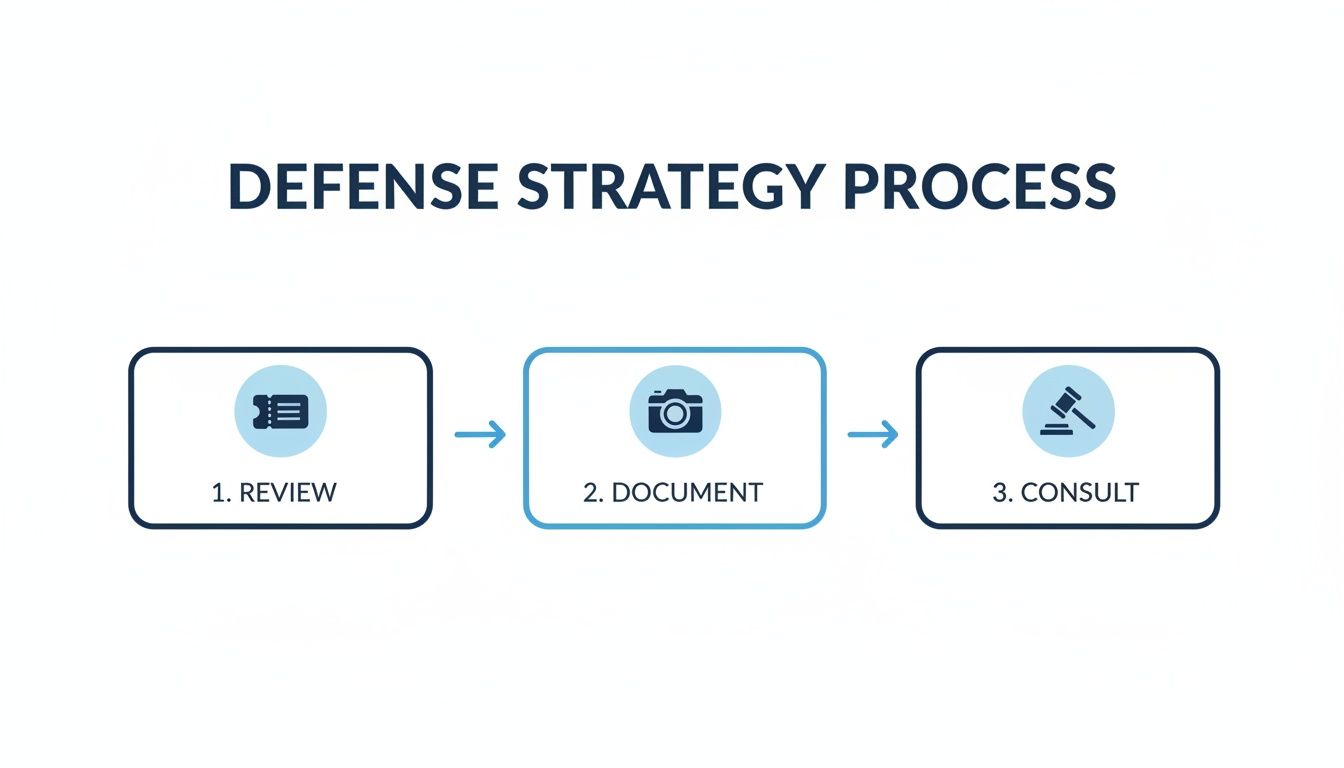
As you can see, your response should be a deliberate, three-part process. You start with a careful review, move on to collecting evidence, and then bring in professional help.
The Most Important Step: Consulting An Attorney
Before you even think about paying the fine or going to court alone, your next call should be to a law firm whose practice focuses on traffic defense. A free consultation can give you a clear picture of your options, potential defense strategies, and what you’re really up against. Submitting information does not create an attorney-client relationship.
An attorney can break down the details of your stop, from the officer's report to the evidence you’ve collected, to find weak spots in the state's case. This professional insight is invaluable when you're trying to make a smart decision that protects your driving record and your wallet.
This consultation should be your top priority. A traffic ticket attorney deals with these cases every single day. They know the court system inside and out and can often handle everything for you—meaning you might not even have to show up in court. They can lay out exactly what's involved in fighting the ticket and how they can help you avoid points and other penalties. If you're curious about what that process looks like, our guide on how to get a ticket off your record breaks it down further.
Remember, a traffic ticket isn't a final judgment. It's the start of a legal process, and you have the right to defend yourself. Taking these measured steps puts you in the strongest possible position to challenge the citation.
How We Defend Florida Drivers
Getting a no passing zone ticket can feel like a done deal, but in our experience, that’s almost never the case. Our practice focuses on traffic and DUI defense across all 67 Florida counties. From our office in Broward, we provide a focused, direct approach to handling these citations.
The whole process is designed to let us handle the legal heavy lifting for you. Our goal is to minimize the stress and keep this from turning into a major disruption in your life.
We are here to protect your license and your record. We start by digging into every piece of evidence tied to your ticket—the citation itself, the officer's report, and any dashcam or bodycam footage we can obtain. We hunt for procedural errors, factual mistakes, or weak spots in the evidence that can become the foundation of a strong defense.
Our Process is Simple and Transparent
We believe in keeping things straightforward. When you call us for a free consultation, you'll talk to someone on our team who can assess your situation and explain your options in plain English. There is no pressure or obligation.
If you decide to retain our firm, we take over immediately. We handle every court filing, every phone call with the clerk, and every negotiation with the state. In many cases, our clients do not have to show up to court. We appear on your behalf, ready to argue the facts with one goal: getting a favorable outcome.
Attorney Advertisement. Past results do not guarantee future outcomes. Our goal is to protect your license and record by working toward a dismissal or a reduction in charges to avoid points and other long-term penalties.
No-passing zones are there for a good reason—safety. They are marked in areas where you just can’t see far enough ahead to pass safely, creating a huge risk for sideswipes and head-on collisions. In 2023 alone, Florida saw over 17,000 head-on crashes, and a lot of them were tied to improper passing on rural roads.
For a CDL holder or a parent trying to keep a teen’s record clean, a conviction means points, a potential license suspension, and insurance premiums that can jump significantly. By finding issues like improper signage or miscalculated zones, we work to stop those consequences in their tracks.
Your case is unique, and it deserves a defense strategy built around its specific facts. We’ll keep you in the loop every step of the way so you know what’s going on without having to deal with the legal legwork. It all starts with a conversation—let us take a look at your ticket and show you how we can help.
Frequently Asked Questions About Florida No Passing Zone Tickets
Getting a no passing zone ticket always brings up a lot of questions. Here are some straight answers to the most common concerns we hear from drivers, helping you figure out your options and the road ahead.
Can I Get A Ticket If The Road Lines Were Faded?
Yes, an officer can still write the ticket, but faded, poorly maintained, or hidden pavement markings can become the foundation of your defense.
A strong case can be made that the no passing zone wasn't clearly marked as Florida law requires, making it unreasonable to expect a driver to have known they were in violation. If this sounds like your situation, taking photos of the road conditions is a critical first step.
What If I Was Passing A Very Slow Vehicle?
It definitely feels unfair, but Florida's statute is strict and doesn't usually make exceptions for passing slow-moving vehicles like tractors, farm equipment, or even cyclists in a designated no passing zone. The law applies to every vehicle, no matter how slow it’s going.
That said, the specific details surrounding the pass still matter. An experienced attorney can bring these mitigating circumstances to the court's attention when negotiating on your behalf, which can sometimes help the outcome.
Is It Worth It To Hire An Attorney For This Ticket?
For most Florida drivers, the answer is a clear yes. When you do the math on the real cost of a conviction—the fine, the 3 points slapped on your license, and the insurance premium hikes that can stick around for years—the one-time fee for a lawyer is often a very sound financial choice.
The main goal is to shield your driving record from the long-term financial damage a conviction causes. Our objective is to work toward a dismissal or an outcome that keeps points off your record. Past results do not guarantee future outcomes.
Don't let a simple ticket snowball into a long-term headache. Ticket Shield, PLLC handles traffic citations across all 67 Florida counties, and in many cases, you won't even need to show up in court. Protect your license and your insurance rates. Get your free, no-obligation consultation today by visiting https://www.ticketshield.com. Submitting information via our forms does not create an attorney-client relationship. All testimonials are genuine; prospective clients may not obtain the same or similar results. Office in Broward. Attorney Advertisement.