Florida Highway Patrol Traffic Ticket Guide 2026
Get a Florida Highway Patrol traffic ticket? Learn FHP citation charges, court process, plea options, and defense strategies to avoid points. Free review.

The trooper hands back your license, gives you a citation, and walks away. You're left looking at the fine, wondering whether paying it will make the problem disappear. Don't make that decision from the driver's seat. A Florida Highway Patrol traffic ticket deserves a record review before it gets a payment.
Table of Contents
What a Florida Highway Patrol Traffic Ticket Really Means
Your immediate concern might be the money. My recommendation is to focus first on what the final disposition will do to your license. The roadside allegation and the outcome recorded against your driving record aren't the same thing.
For an ordinary civil traffic infraction, Florida gives you a choice among payment, driver-improvement school when eligible, and requesting a hearing. You generally must respond within 30 days, and payment is treated as a conviction, with points assessed when applicable, according to Florida's official traffic-citation guidance. Ignoring the citation isn't another defense option.
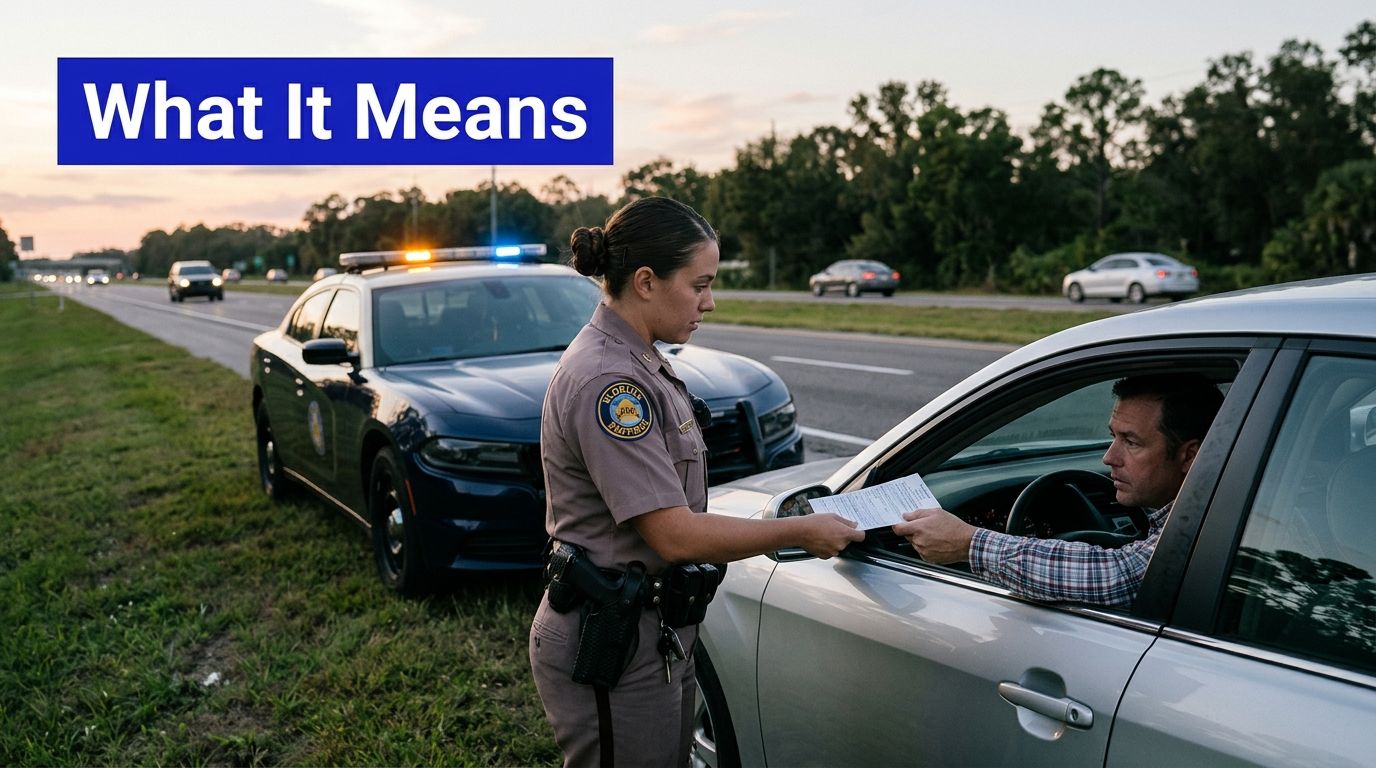
Treat the response as a legal decision
Suppose you're tempted to pay because you can't afford time away from work. Before choosing that route, find out whether the allegation carries points, whether school remains available, and whether an attorney can handle the case without your attendance. Convenience matters, but it shouldn't replace an informed decision.
The same caution applies when someone tells you to contest everything automatically. A useful defense recommendation starts with your actual citation and record, not a slogan. Your attorney should explain the allegation, the available response, and the outcome worth pursuing.
Practical rule: Don't authorize payment until you understand what you're accepting on your driving record.
Gather the records before choosing
You don't need to reconstruct the whole case immediately. Start with documents that let someone evaluate your position:
The complete citation: Include every page, any court instructions, and any accompanying notice.
Your driving record: Don't rely on memory about earlier tickets or their outcomes.
Your school-election history: Locate previous elections and completion records.
Your license information: Make your license class and any existing restrictions clear.
Keep the citation somewhere you'll act on it, not in the glove compartment. Your next move should be a deliberate response, not a rushed payment after discovering the deadline is close.
How FHP Citations Fit Into Florida Enforcement
An FHP citation isn't an unusual exception in Florida traffic enforcement. The agency works within a statewide system that covers speeding, vehicle documents, licensing, and safety requirements. Understanding that scope helps you focus on the allegation rather than the uniform that issued it.
Florida recorded more than 3.4 million traffic tickets in 2016, with FHP issuing approximately 25%, or roughly 850,000 citations, according to the state's agency annual report. That provides historical context, not a prediction about how your case will turn out.
Florida Traffic Citations by Category, 2024 Preliminary
The FLHSMV preliminary figures reported more than 3 million citations statewide, with 15.33% issued by FHP, approximately 460,000 citations; the same report supplies every statewide category count below.
Violation Category | Citations |
|---|---|
Speeding | 741,019 |
Seat-belt or child-restraint violations | 276,644 |
Expired-tag violations | 213,711 |
No-insurance violations | 146,488 |
Invalid-license violations | 80,352 |
Texting violations | 8,964 |
These are statewide category totals, not FHP-only totals. Don't confuse the agency's share of all citations with the number it issued in a particular category.
What those figures mean for your response
The change in FHP's proportional share doesn't establish whether an individual citation is valid. Nor does the volume of speeding citations mean a court should treat your allegation as routine. Your case still requires a document-specific review.
The practical lesson is that FHP enforcement reaches beyond major highway incidents. A registration or insurance allegation deserves careful attention even if nobody alleges dangerous driving. The document you received, not the statewide category, should determine your response.
I recommend separating two questions immediately:
What conduct is alleged? Identify whether the ticket concerns speed, documentation, licensing, or another requirement.
What must you address? Determine whether you need evidence about the driving, records showing compliance, or both.
Don't assume that fixing a vehicle-document problem settles the citation. Ask how the court must receive and resolve that information before treating the matter as finished.
Reading Your FHP Citation Before You Respond
Read the citation as an accusation that needs checking. Don't start with the payment amount. Start with the law, the alleged facts, and the instructions telling you what to do next.
Use this visual checklist while reviewing the document.

Match the statute to the allegation
Florida Statute §316.187 establishes authority for state speed zones, including applicable posting requirements, while the related framework addresses unlawful speed under §316.183 and municipal and county speed zones under §316.189. Review the state-speed-zone statute rather than assuming every speeding citation alleges the same legal violation.
Compare the statute number with the trooper's description. For speeding, identify both the alleged speed and the applicable limit. Check the location carefully, including the road, direction of travel, and any zone designation.
The Florida uniform traffic citation form guide can help you locate fields that are easy to overlook. Verify the issuing agency and officer information, and make sure your copy is readable before sending it for review.
Identify enhanced exposure immediately
A school-zone or construction-zone allegation isn't a detail to leave for later. Under Florida Statute §318.14, an official may impose a civil penalty after a hearing of up to $500, require driver-improvement school, or both; unlawful speed in a school or construction zone can carry a maximum civil penalty of $1,000.
That statute also provides a $1,000 civil penalty and six-month license suspension when a person required to appear under §318.19 is found to have committed the infraction. A mandatory-appearance designation therefore demands immediate attention, not an assumption that ordinary payment options apply.
Complete this review before authorizing a response:
Statute and conduct: Do the printed law and alleged behavior correspond?
Speed and location: Are the alleged speed, posted limit, and road identified correctly?
Zone designation: Is a school or construction zone alleged?
Appearance instructions: Does the ticket require attendance?
Deadline and destination: Which county must receive your response, and when?
Flag discrepancies for your attorney. Don't assume a clerical error automatically defeats the case.
Paying, Traffic School, or Contesting the Ticket
A ticket can cost more than its fine. Paying may result in a conviction and points, while a school election may help an eligible driver avoid points. Contesting gives you a chance to challenge the allegation, but no outcome is guaranteed. Choose after checking the statute number, your prior school elections, current points, and license class.
Payment accepts the conviction consequences. School depends on eligibility. Contesting takes preparation. Do not choose an option before you understand what it means for your record.
Response Options for a Florida Highway Patrol Ticket
Option | Record Impact | Eligibility Limits | Best For |
|---|---|---|---|
Pay | Accepts the conviction consequence described above; applicable points follow | Check whether the citation permits ordinary payment | A driver who has reviewed and knowingly accepts the record consequences |
Elect driver-improvement school | Can avoid points through an authorized election | License class, prior elections, and citation eligibility matter | An eligible driver whose record supports using the election |
Contest through a hearing | Allows a challenge and pursuit of a favorable disposition; no result is guaranteed | Requires a proper response and case-specific review | A driver with disputed facts, substantial exposure, or a reason to protect the record |
Check school eligibility before relying on it
For eligible Class E drivers, Florida allows a school election once in 12 months and no more than five times in a lifetime. Check the state's election rules and compare your history with this traffic-violator school explanation before relying on school to avoid points.
School is not available for every ticket or every driver. Tell your attorney about earlier elections, your license class, and whether the allegation involves a crash. Confirm eligibility before enrolling.
Calculate the actual license risk
Your current point total can change the decision. Under Florida Statute §322.27, unlawful speed not exceeding 15 mph over the limit carries 3 points, speed more than 15 mph over carries 4 points, and speeding resulting in a crash carries 6 points.
The statute sets suspension thresholds at 12 points in 12 months, 18 in 18 months, and 24 in 36 months. Those totals correspond to suspensions of 30 days, three months, and one year, respectively. If your record is near a threshold, the disposition matters beyond the fine.
Choose based on the record you'll have after the disposition, not the amount you can pay today.
Before responding, ask your attorney to assess how the citation, your existing points, prior school elections, and license class affect your options. A recommendation that overlooks any of those factors can leave you exposed to consequences you could have addressed.
The Florida Court Process and Your 30-Day Deadline
A decision to contest isn't complete until you've properly communicated it. Telling a friend you plan to fight the ticket, contacting a lawyer, or saving a draft request doesn't establish that the court received the required response.
Under Florida Rule of Traffic Court Procedure 6.450, a defendant's written request within 30 days after issuance requires assignment of the case to a county judge. Treat that as a filing responsibility, not a reminder to begin thinking about the citation.
The process requires action at each stage.

Confirm the response and hearing instructions
Start by identifying the county handling the citation. Confirm its accepted submission method, provide the requested information, and retain proof of submission. If an attorney handles the response, ask for confirmation that it was filed.
After requesting a hearing, monitor court communications rather than assuming silence means dismissal. Review the notice for location, attendance instructions, and any documents you must provide.
Before the hearing: Give your attorney the citation, relevant records, and an accurate account of the stop.
At the hearing: The allegation and available evidence are evaluated by the judge or authorized hearing official.
After the disposition: Obtain the written outcome and identify every remaining obligation.
For practical preparation, review what to expect in traffic court. Ask your attorney who will appear and whether you must attend personally.
Don't assume representation eliminates attendance
Attorney representation can reduce the burden of handling court yourself, but an appearance requirement needs a case-specific answer. Don't miss work unnecessarily, and don't miss a required hearing because an app suggested attendance wouldn't be needed.
Missing the response deadline can limit procedural options and expose you to additional collection or license-related consequences. If you've already missed it, get the current court status reviewed promptly. Continuing to wait doesn't preserve your ability to contest.
Choosing Between a Lawyer-Led Defense and Automated Apps
Choose the person responsible for your defense, not the easiest upload screen. An automated intake tool may collect a citation efficiently. It doesn't answer whether your prior school election, existing points, or appearance requirement changes the recommendation.
If you're reviewing documents at home, make direct access to the attorney part of your decision.

Compare responsibility, not convenience
You can handle the citation yourself, use an automated service, or retain a Florida traffic-defense attorney. My recommendation is a lawyer-led review when your record, eligibility, or allegation creates uncertainty. You need someone who can explain the legal decision and take responsibility for carrying it out.
Ticket Shield provides Florida traffic-ticket defense with direct attorney communication by phone or text. The service includes reviewing citations, evaluating dismissal or reduction strategies, and handling court appearances where appropriate. Its work includes speeding allegations under the state-speed-zone framework and reckless-driving cases.
That's a meaningful distinction from a service model that routes every question through middlemen, corporate answering services, or automated chatbots. Don't assume every app operates identically, but don't accept a polished interface as proof of attorney access.
Use the comparison of speeding-ticket apps and attorney-led defense to assess the service model before authorizing representation.
Ask questions that reveal who handles the case
A provider should answer these questions plainly:
Attorney access: Can you speak or text directly with the attorney responsible for your matter?
Strategy: Who evaluates your point history and school eligibility before recommending a response?
Hearing responsibility: Who prepares the defense and handles the hearing if needed?
Scope and price: What work does the quoted fee include, and what could require additional work?
Closure: How will you receive the disposition and instructions for any remaining obligations?
Don't accept a promise of dismissal as a substitute for these answers. A responsible attorney explains available strategies without guaranteeing what the court will do.
Watch the firm's video as another opportunity to evaluate its approach.
The useful measure is whether you understand who represents you, how to reach that person, and what happens next. Insist on that clarity before handing over control of your citation.
Defense Strategies That Move an FHP Case
A defense should target a legal or evidentiary weakness in the citation. Don't count on the trooper missing court, and don't assume a paperwork error guarantees dismissal. Ask your attorney to identify the evidence supporting the charge and explain what can realistically be challenged.
Start with the statute number and the conduct it describes. For a state-speed-zone allegation, review the applicable posting requirements and whether the cited zone matches the location. A disputed zone designation can affect the allegation and potential consequences.
Test the measurement and location evidence
Examine how the speed was measured. Ask what records are available about the device, its testing or calibration, and the conditions when the measurement was taken. The radar-gun speeding-ticket defense guide identifies issues to discuss with counsel. Radar evidence is not automatically conclusive, and a possible equipment issue does not automatically defeat the case.
Preserve relevant information safely:
Location evidence: Record where the measurement and stop occurred.
Signage: Keep relevant photographs, but do not stop illegally or put yourself in danger.
Conditions: Write down traffic, visibility, and details that may affect vehicle identification.
Documents: Keep the citation, notices, photographs, and correspondence together.
A potential evidence problem matters only if it applies to the charge and the available proof. Ask your attorney how the facts affect your specific case.
Recognize escalation and choose the disposition strategy
The Chapter 316 framework identifies dangerous excessive speeding under §316.1922 as operation more than 50 mph above the applicable limit. Separately, §316.1926 addresses that threshold under §§316.183, 316.187, or 316.189 as a moving violation punishable under Chapter 318.
Treat an allegation at that level as a serious legal matter, not a routine fine decision. Have the exact statute and charge reviewed before choosing how to respond. A Florida citation requires Florida-specific analysis. For a separate jurisdiction-specific resource, legal help for Connecticut drivers concerns Connecticut, not a defense to an FHP ticket.
Your disposition strategy may involve seeking dismissal, requesting a reduction, or evaluating an authorized point-avoidance option. Choose based on the evidence, your driving record, and your licensing position, not a preset script.
Your Next Step Toward No Points
Put the citation, driving record, and prior election information together now. Check the statute, response deadline, current points, and license class before you authorize a payment or another disposition.
The long-term concern is real: points remain on the driving record for at least five years from the disposition date, according to FLHSMV's points and suspension guidance. Don't confuse finishing the immediate transaction with protecting your record.
Get an answer tied to your citation
Ask the reviewing attorney what outcome is realistic, whether you must attend court, and what actions remain your responsibility. If your license is already suspended, request a review of the current status and the specific steps needed to address it. Don't assume resolving the new citation automatically fixes an existing licensing problem.
Your objective: Pursue No Points through a lawful, case-specific disposition, not an unsupported guarantee.
Direct attorney communication by phone or text lets you raise concerns before authorizing a decision. Act early enough to give counsel time to assess the available options and confirm the required response.
Ticket Shield, PLLC offers lawyer-led review and Florida traffic-ticket defense, with direct attorney communication by phone or text. Visit Ticket Shield, PLLC at TicketShield.com for a free consultation, submit your Florida Highway Patrol traffic ticket before the response deadline, and pursue the goal of No Points on your license.