Your Guide to a First Ticket for Speeding in Broward County
Got your first ticket for speeding in Florida? This guide explains your options, the consequences, and how to protect your driving record without the stress.
Getting your first ticket for speeding can be jarring. The flashing lights are gone, and now you're holding a citation that feels overwhelming, whether you were on a busy highway in Broward County or a quiet local road in Fort Lauderdale. Your immediate actions matter, so take a deep breath and focus on the next steps.
Attorney Advertisement. Office in Broward.
What to Do Right After Getting Your Ticket
The moments after the officer drives away are crucial for setting yourself up for a better outcome. It's easy to feel flustered, but a calm, methodical approach is your best ally. The first thing to do is pull over to a safe location—if you haven't already—and carefully read the entire citation. Don't just glance at the fine amount; look for the details.
This initial review is your first opportunity to spot potential inaccuracies. Check that your personal information—name, address, driver's license number—is correct. Verify the details of your vehicle, including the make, model, and tag number. Most importantly, examine the violation section. Does the statute number look right? Does the officer's description of the location, time, and alleged speed match your memory of the event?
Document Everything Immediately
While the memory is fresh, start documenting the circumstances surrounding the traffic stop. Small details that seem insignificant now could become incredibly important later. Your goal is to create a clear record of the event from your perspective.
Consider these points:
Weather and Road Conditions: Was it raining, foggy, or sunny? Were the roads wet, dry, or torn up from construction?
Traffic Flow: Was traffic heavy or light? Were you just keeping pace with other vehicles around you?
Officer's Conduct: Note anything memorable about your interaction. Were they professional? Did they say anything unusual?
Location Specifics: Were there any visual obstructions, like trees or hills, where the officer was positioned? Could their view have been blocked?
Taking a few minutes to jot down notes or even record a quick voice memo on your phone can provide valuable context if you decide to contest the ticket. This simple step preserves details that are easily forgotten over time.
This personal record is the foundation of a potential defense. To understand how this information fits into the bigger picture, you can explore our detailed guide on what happens when you get a speeding ticket. Being prepared is the first step, and our goal is to help you protect your license and record from the start.
To help you get organized, here’s a quick overview of what you should be thinking about in the days following the citation.
Quick Guide Your First Broward County Speeding Ticket
This table summarizes your immediate options and the key things to consider for each path you might take.
Action or Option | Key Consideration | Common Outcome |
|---|---|---|
Review the Ticket | Check for errors in personal info, vehicle details, location, and the violation itself. | Inaccuracies can sometimes be used as a basis for a dismissal. |
Document the Stop | Record details about weather, traffic, and the officer's position while your memory is fresh. | This creates a personal record that can support your case later. |
Understand Deadlines | You have 30 days in Florida to respond to the ticket. Don't miss this window. | Missing the deadline leads to an automatic conviction and license suspension. |
Choose Your Plea | Decide whether to pay (guilty), elect traffic school, or plead not guilty. | Your choice determines whether you get points, an insurance hike, or a chance at dismissal. |
This initial phase is all about gathering information and understanding your options before you make any decisions that could impact your driving record for years to come.
The True Cost of a Broward County Speeding Ticket
The number printed on that speeding ticket can feel like a gut punch, but here’s the reality: that fine is just the cover charge. The real cost of a speeding ticket in Broward County isn't the initial payment; it's the financial fallout that can follow you for years.
Many drivers make the mistake of just paying it to be done with it. But paying that ticket is the same as pleading guilty. That admission kicks off a chain reaction, starting with points on your Florida driver's license.
Those points are the long-term problem. They’re tracked by the Florida Department of Highway Safety and Motor Vehicles (FLHSMV) and act as a scorecard for how risky of a driver you are. Rack up too many in a short time, and you’re looking at a mandatory license suspension.
Florida's Point System and Your License
How many points you get depends entirely on how fast you were going. A conviction for speeding has immediate consequences that can snowball if you get another ticket down the line.
3 Points: This is for driving 15 mph or less over the speed limit. It’s the most common point value for a first-time speeding ticket.
4 Points: You’ll get this for driving 16 mph or more over the limit.
6 Points: This is a severe penalty reserved for speeding that causes a crash or for leaving the scene of an accident.
Keeping your record clean is everything. For a deeper look into the mechanics, you can learn more about the Florida traffic ticket point system and how it all adds up. The goal is always to avoid getting points in the first place.
Our goal is to protect your license and record. A single conviction might not seem serious, but it establishes a history that can make future violations much more severe. Past results do not guarantee future outcomes, but preventing points is always the primary objective.
The Hidden Financial Impact on Insurance
Here's the part that really stings: the spike in your auto insurance premiums. This is almost always the biggest long-term cost of a speeding ticket.
When you're convicted, your insurance provider flags you as a higher-risk driver. To them, a ticket means you're more likely to get into an accident and file a claim.
That increased risk translates directly into higher rates. Studies consistently show a single speeding ticket can jack up your insurance premiums by 20% to 30%. And that’s not a one-time hit. That increase can haunt your policy for three to five years, costing you hundreds, or even thousands, of dollars over time.
Think about a young driver in Broward County. Their insurance is already sky-high because of their age. Add a speeding conviction to that? Their affordable policy can quickly become a major financial burden.
For a commercial driver (CDL holder), the stakes are even higher. Points on their license can put their entire livelihood on the line, potentially leading to job loss or making it nearly impossible to find work. When you look at it that way, the fine on the ticket is just a tiny fraction of the total financial damage.
Navigating Your Three Legal Options
After getting your first speeding ticket in Florida, you’ve got a big decision to make, and it’s not one you should take lightly. The state gives you three distinct legal paths. The choice you make will ripple through your driving record and your finances for years. Your options are to pay the ticket, elect to attend traffic school, or fight the ticket in court.
Making the right call means weighing short-term convenience against the long-term consequences. Paying the fine might feel like the easiest way out, but it’s an admission of guilt. That guarantees points on your license and an almost certain insurance hike.
Option 1: Pay the Fine and Accept the Points
This is the path of least resistance. You pay the fine on the citation—online, by mail, or at the Broward County clerk’s office. While it gets the ticket off your desk quickly, it's legally the same as pleading guilty.
The second you pay that fine, a conviction is stamped on your driving record. The FLHSMV will then assess points against your license, which is typically three points for a first speeding ticket. As we've discussed, this conviction is what triggers a significant jump in your car insurance premiums for the next three to five years.
Option 2: Elect Traffic School
For a lot of drivers with their first ticket, traffic school seems like a pretty good deal. If you’re eligible, completing a state-approved Basic Driver Improvement course lets you avoid the conviction and the points that come with it.
But eligibility isn’t a given. In Florida, you can only use this option once in any 12-month period and no more than five times in your entire life. You have to formally elect this option with the clerk of court within 30 days and pay the full fine, plus extra court and school fees. Even after you pass the course, the citation still shows up on your driving record, though without the damaging points.
Option 3: Contest the Ticket in Court
Your third option is to plead "not guilty" and take the ticket to court. This means you’re challenging the state’s evidence against you and asking a judge to hear your side. This is the only path that offers a chance to get the ticket completely dismissed, which means no fine, no points, and no hit to your insurance.
This decision tree infographic shows you exactly what happens, financially, when you just pay the fine for your first speeding ticket.
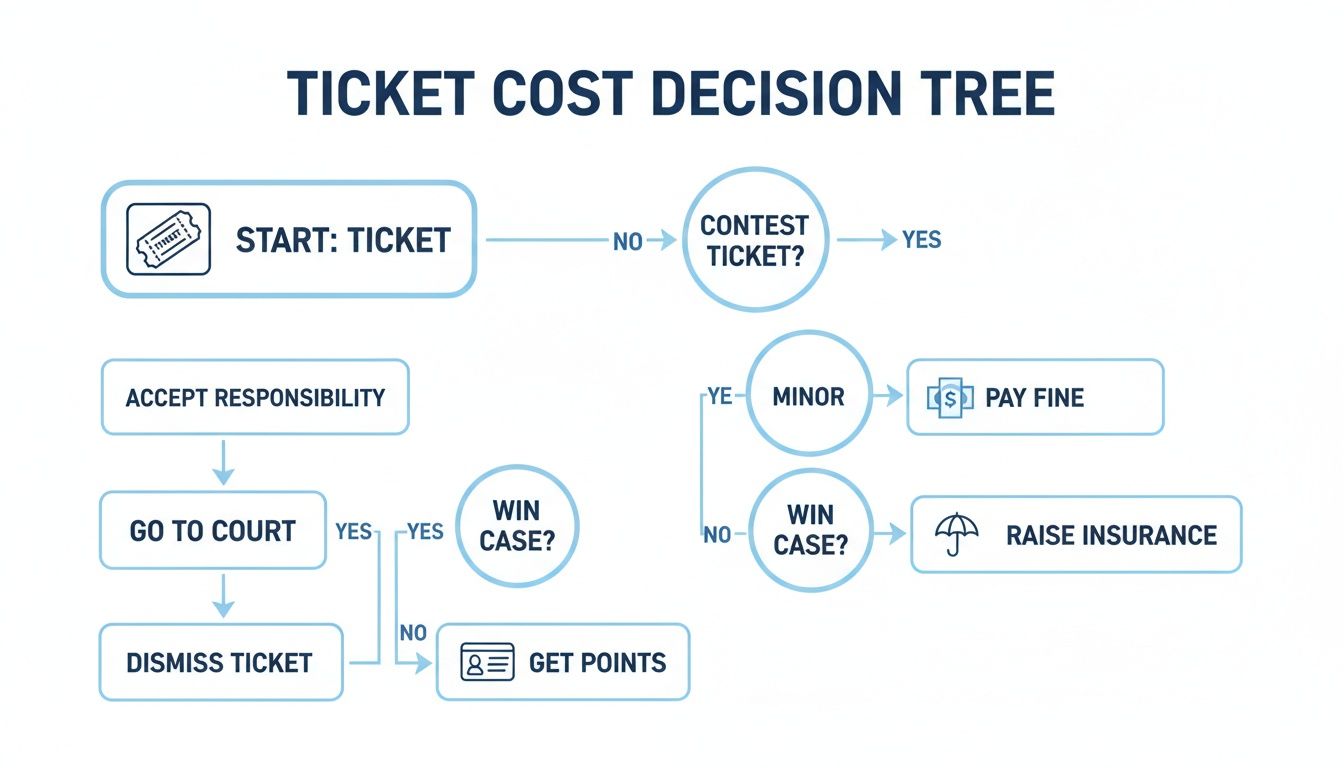
As you can see, that initial fine is just the start. It leads directly to points on your license, which then leads to higher insurance costs. This domino effect is why simply paying the ticket is often the most expensive choice in the long run.
Fighting a ticket might sound intimidating, but it’s a right you have as a Florida driver. You can learn more about the process in our guide on how to fight a speeding ticket in Florida. The history of speeding citations shows a clear trend: the penalties just keep getting worse. The very first ticket in 1896 was for going 8 mph, and the fine was about $15 in today's money. Now, with an average of 41 million tickets handed out each year in the U.S., the financial impact is huge, often including a 21% insurance spike after just one ticket.
Contesting your ticket isn’t about arguing with the officer; it's about holding the state to its burden of proof. An experienced attorney can spot procedural errors or weak spots in the evidence that could lead to a dismissal. Our goal is to protect your license and record.
How a Traffic Attorney Can Help Your Case
Deciding whether to hire a lawyer for your first ticket for speeding can feel like a big step, but it's often the smartest move you can make. Just paying the ticket feels like the easy way out, but it’s a direct admission of guilt. That guarantees points on your license and, almost certainly, higher insurance rates.
An experienced traffic attorney completely changes the game by bringing legal knowledge and courtroom experience to your side.
Instead of trying to figure out the complex court system on your own, a lawyer becomes your advocate. From our office in Broward, we handle traffic cases across all 67 Florida counties, so we understand the specific procedures, clerks, and prosecutors in each local courthouse. That's a home-field advantage you want. Our practice focuses on traffic and DUI defense, which means we spot opportunities and potential defenses that most people would never see.
Going Beyond the Basics of Traffic Defense
The real value of hiring an attorney goes far beyond just having someone show up in court for you. A skilled lawyer will scrutinize every single detail of your citation and the traffic stop itself.
Spotting Procedural Errors: Was the radar or laser device properly calibrated? Did the officer follow the correct legal steps during the stop? Small mistakes made by law enforcement can sometimes be enough to get a ticket dismissed.
Negotiating Better Outcomes: We're constantly negotiating with the state on our clients' behalf. The goal might be to get the charge reduced to a non-moving violation (which has no points) or to secure a result that keeps the conviction off your record entirely.
Saving You Time and Stress: In over 99% of the cases we handle, our clients never have to set foot in a courtroom. We appear for you, saving you from taking time off work and the anxiety of facing a judge by yourself.
Our goal is to protect your license and record. By managing the legal process for you, we aim to minimize the long-term financial consequences of a ticket, from points to insurance hikes. Past results do not guarantee future outcomes, but a professional defense gives you a powerful advantage.
Understanding Your Rights and Protections
Hiring a lawyer also makes sure your rights are protected from start to finish. It’s crucial to understand that your conversations are shielded by understanding attorney-client privilege rules. This protection allows you to be completely open and honest with us, which is essential for building the strongest possible defense for your case.
This is especially important in Florida, where a single speeding conviction can hike your insurance rates by 20-30%. You can get a deeper understanding of the consequences and the value of having a professional on your side by reading our guide on whether you need a lawyer for a traffic ticket. Having an attorney involved early ensures you make informed decisions, not reactive ones driven by stress or confusion.
How We Make Fighting Your Florida Ticket Easy
Dealing with your first speeding ticket feels overwhelming, but getting professional help shouldn't add to the stress. We’ve built our entire process around one simple idea: make it easy and transparent for Florida drivers. From the second you get that citation, our team is ready to step in and handle all the details so you don't have to.
Our entire goal is to protect your license and your record with as little disruption to your life as possible.
The first step is always a free, no-obligation consultation. We make it incredibly simple to get started. You can call us 24/7, or just snap a picture of your ticket and submit your case online. This quick check-in lets us review the specifics of your ticket and explain exactly how we can help.
Straightforward Communication, No Middlemen
Once you decide to move forward, you’ll see our direct approach in action. We use transparent, flat-fee pricing so you know the exact cost upfront—no surprises.
Throughout your case, you'll have a direct line to your attorney via phone, text, or email. You won't get stuck navigating confusing phone trees or dealing with paralegals as middlemen.
Our central office is in Broward, but we handle cases in all 67 Florida counties. It doesn't matter where you got your ticket; you'll have an experienced legal team in your corner.
Legal Notice: Submitting information through our website or calling our office does not create an attorney-client relationship. This relationship is only formed after a formal agreement is signed. All communications are held in confidence. Attorney Advertisement. Office in Broward.
Here’s How We Handle Your Case
From the moment you hire us, our team takes the entire legal process off your shoulders. We handle all the tedious but critical tasks for you.
Filing all necessary court paperwork.
Managing deadlines and communications with the clerk of court.
Appearing in court on your behalf.
That last part is a huge relief for our clients. In over 99% of cases, you never have to step foot in a courtroom. You can go about your daily life while we get to work securing the best possible outcome for your case.
Speeding tickets are a fact of modern life, with around 41 million issued every year in the U.S. Here in Florida, our practice focuses on helping drivers protect their records, fighting to avoid points and reduce fines across all 67 counties.
Common Questions About Broward County Speeding Tickets
When you get your first speeding ticket in Broward County, a flood of questions is completely normal. The whole process can feel confusing and overwhelming, but getting clear answers is the first step toward reducing that stress and making a smart decision. This section tackles some of the most frequent concerns we hear from drivers all across the state.
Keep in mind, this is general guidance. Every single case has its own unique details. For advice that fits your specific situation, a free consultation is always the best way to go.
How Long Do I Have to Respond to the Ticket?
In Florida, you have 30 calendar days from the date the officer handed you the ticket to respond. This is a hard deadline, not a suggestion. Within that 30-day window, you have to officially choose one of your three legal options: pay the fine, elect traffic school, or plead not guilty.
Blowing past this deadline comes with serious consequences. If the clerk's office doesn't hear from you, the state automatically considers you guilty. They'll then notify the FLHSMV to suspend your driver's license, and getting it back involves paying the original fine, late fees, and a separate license reinstatement fee.
What Happens If I Miss My Court Date?
If you plead not guilty and get a court date on the calendar, failing to show up is a massive problem. It's not like missing a regular appointment. A judge will almost certainly issue a bench warrant for your arrest and suspend your license on the spot.
This is one of the biggest reasons people hire a traffic attorney. In over 99% of our cases, we appear in court on behalf of our clients. You get to avoid the hassle, the stress, and the risk of missing your court date, while we handle all the legal legwork for you.
A lot of people mistakenly think a ticket is just a bill you have to pay. The reality is, it's a legal summons. Ignoring it or missing deadlines can turn a simple traffic issue into a much more severe legal headache that involves your license and even a potential arrest.
Can I Just Ask the Judge for Leniency?
While you absolutely have the right to represent yourself and ask a judge for a break, it's rarely that simple. Judges are bound to follow the law, and there will be a prosecutor in the room whose entire job is to prove the state's case against you.
Just asking for leniency, without a solid legal argument grounded in evidence or procedural rules, usually doesn't get you very far. An experienced attorney knows how to challenge the state's evidence—from questioning the officer's testimony to scrutinizing the calibration records of the speed-measuring equipment. That's a far more effective strategy than simply hoping for a favorable mood. The goal is to build a defense that gives the judge a valid legal reason to rule in your favor.
Navigating the ins and outs of your first ticket for speeding is a lot less stressful when you have an experienced team in your corner. At Ticket Shield, PLLC, our practice focuses on protecting your license and your record. Get your free consultation today and let us handle the rest.