
Expired Registration Ticket Cost: Florida Fines & Defense
Florida expired registration ticket cost: Know the fines, fees, and criminal risks. Get legal help from our attorneys to fight your case effectively.

You got stopped. The officer looked at your plate, saw the registration issue, and handed you a ticket that looks minor. It isn't. In Florida, an expired registration citation can turn into a stacked-cost problem fast, and if you handle it the wrong way, you can create record problems that follow you longer than the stop itself.
Most drivers make the same mistake. They look at the ticket and ask, “How much is this going to cost me?” That's the wrong first question. The better question is, “What happens if I pay this without a strategy?”
If you're trying to avoid bigger trouble later, start by understanding the difference between a simple clerical fix and a court case with consequences. If you also want to avoid buying into someone else's registration headache down the road, this guide on buying used cars smarter with registration data is a useful reminder that registration history matters more than people think.
For a broader Florida-specific overview of the issue itself, see this guide on what happens after a ticket for expired tags.
Table of Contents
Your Guide to Florida Expired Registration Tickets
TL;DR: In Florida, your expired registration ticket cost is often more than the citation itself. You may face a court fine, separate delinquent registration fees, and escalating legal risk if you wait. The right move is fast correction and a defense strategy aimed at protecting your record.
You're probably reading this with the citation still sitting on your passenger seat or kitchen counter. Good. Handle it now, not next week.
Florida treats expired registration under Florida Statute § 320.07, and traffic stops like this often overlap with broader traffic enforcement under Chapter 316. That matters because once an officer stops you, the issue isn't just your sticker anymore. It becomes a court file, a deadline, and a risk to your driving record.
At the courthouse level, this is routine for the system. For you, it isn't. If your case lands at the Orange County Courthouse in Orlando or another busy Florida traffic court, the process will move whether you're ready or not.
Immediate truth: An expired registration ticket is rarely just a “pay and forget it” problem.
The hidden trap is timing. Some drivers can still fix the registration and improve their outcome. Others wait, miss deadlines, and end up paying more than they expected while also locking in a conviction they could have avoided.
If your goal is simple, keep this in front of you: don't focus only on the ticket amount. Focus on avoiding the worst legal outcome.
What Is the Total Cost of an Expired Registration Ticket
You get stopped for an expired tag, glance at the amount on the citation, and assume that is the problem. It is not. In Florida, an expired registration ticket's full cost is the total stack you trigger the moment that stop turns into a court case and a registration cleanup.
That stack usually has at least two separate parts. First, the court side. Second, the registration side. Those do not merge into one payment, and treating them like they do is how drivers spend more money than they should.
Why the number on the ticket is misleading
As noted earlier, Florida law allows delinquent registration fees to start shortly after the renewal month begins, and those fees are separate from whatever the court requires on the citation. You can update the registration and still have to deal with the ticket. You can also pay the ticket and still owe money to bring the vehicle into compliance.
That is the financial trap.
The true cost is the citation, the overdue registration, the delinquent fee, and the price of a mistake if you miss a deadline.
The court can assess its own fine and case costs. The state can also require the overdue renewal and related delinquent fee through the registration process. If you budget only for the amount printed on the citation, you are budgeting for the smallest part of the problem.
For a practical breakdown of how these charges add up, review this explanation of the cost of a ticket for expired tags.
What the stacked costs can include
Use this framework.
Penalty Type | Typical Florida Cost Range | Notes |
|---|---|---|
Court-imposed citation amount | Varies by county and court | The listed ticket amount is only one part of the total exposure. |
Delinquent registration fee | May be added separately | This is tied to the overdue registration, not the court case itself. |
Renewal amount due | Varies | You still have to bring the registration current. |
Additional administrative consequences | Varies | Missed deadlines and unresolved court requirements can make the final cost worse. |
There is also a hidden cost many drivers ignore at first. Time. Time off work, another trip to the clerk, another court date, and the risk of turning a fixable case into a more expensive one because you waited too long.
Miss a required court date and the problem can expand fast. If you want a plain-English example of how missed appearances create bigger legal trouble, read how to avoid a Camarillo bench warrant. Different state, same lesson. Ignoring a court deadline is expensive.
Immediate steps to take
Confirm the exact expiration date: The age of the lapse affects your risk and your options.
Renew the registration right away: Showing proof of correction puts you in a stronger position.
Read every deadline on the citation: Court response dates matter as much as the money.
Plan for the full stack of costs: Ticket, renewal, delinquent fee, and any court-related expense.
Fight for an outcome that protects your record: Paying fast is not the same as resolving this well.
Can You Go to Jail for an Expired Tag in Florida
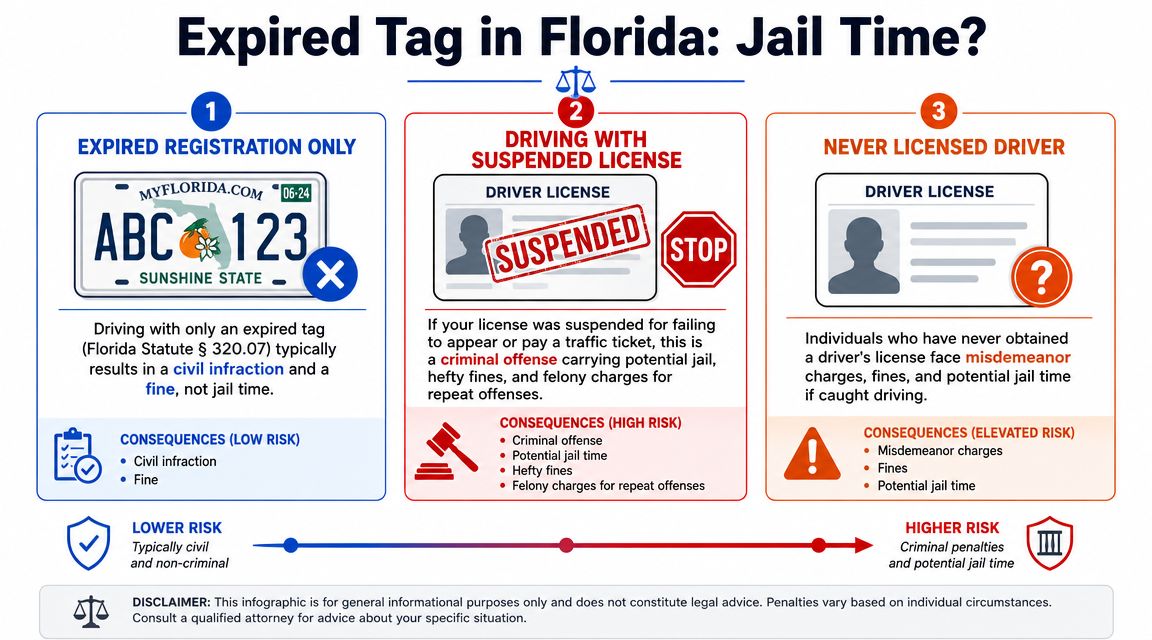
You get stopped for an expired tag, expect a fine, and plan to fix it next week. Then you learn the risk is bigger than the ticket. In Florida, an expired registration can stay a traffic case or become a misdemeanor problem if the lapse is long enough and it is not your first offense.
Florida draws that line based on how long the registration has been expired and whether there is a prior offense, as noted earlier. A shorter lapse is usually handled as a noncriminal traffic infraction. A registration that has been expired for more than 6 months, with a second or later offense, can be charged criminally. That is when jail becomes a real exposure instead of a scare tactic.
When it stays a traffic infraction
Even the lower-level version is not cheap in any meaningful sense. The court fine is only one layer. You still have to cure the registration problem, pay the renewal-related costs, and protect yourself from mistakes that create a record issue or trigger a missed-court mess.
That is the part drivers underestimate. The total stacked cost rises fast when you delay, miss a hearing, or pick up another stop before the first case is cleaned up.
If your case is being handled at the Edgecomb Courthouse in Tampa, do not assume the court will treat this as harmless paperwork. Courts see expired tag cases every day. They also see drivers make them worse by waiting.
When the case gets more dangerous
Jail risk usually shows up after a bad decision. You keep driving on the expired tag. You ignore the citation. You miss court. You already had a prior registration-related case. Now what started as an avoidable expense can turn into a criminal charge or a warrant problem tied to the case.
Read that again. Delay is expensive. Repetition is worse.
A missed court date can multiply the damage far beyond the original ticket amount. If you want a plain-English example of how ignored court deadlines grow into a bigger legal problem, read how to avoid a Camarillo bench warrant. Different state, same lesson. Small traffic cases become custody problems when people stop responding.
Jail exposure also shows up when the expired registration is not the only issue discovered during the stop. A suspended license, no insurance issue, prior unresolved citation, or repeat registration offense changes the stakes. At that point, your goal is not just paying money and moving on. Your goal is containing the legal fallout before it spreads.
If you want a fuller breakdown of the penalty for expired registration in Florida, review it before you decide how to respond.
Why Simply Paying the Ticket Is a Mistake
The first bad instinct is panic. The second bad instinct is paying the ticket just to get it over with.
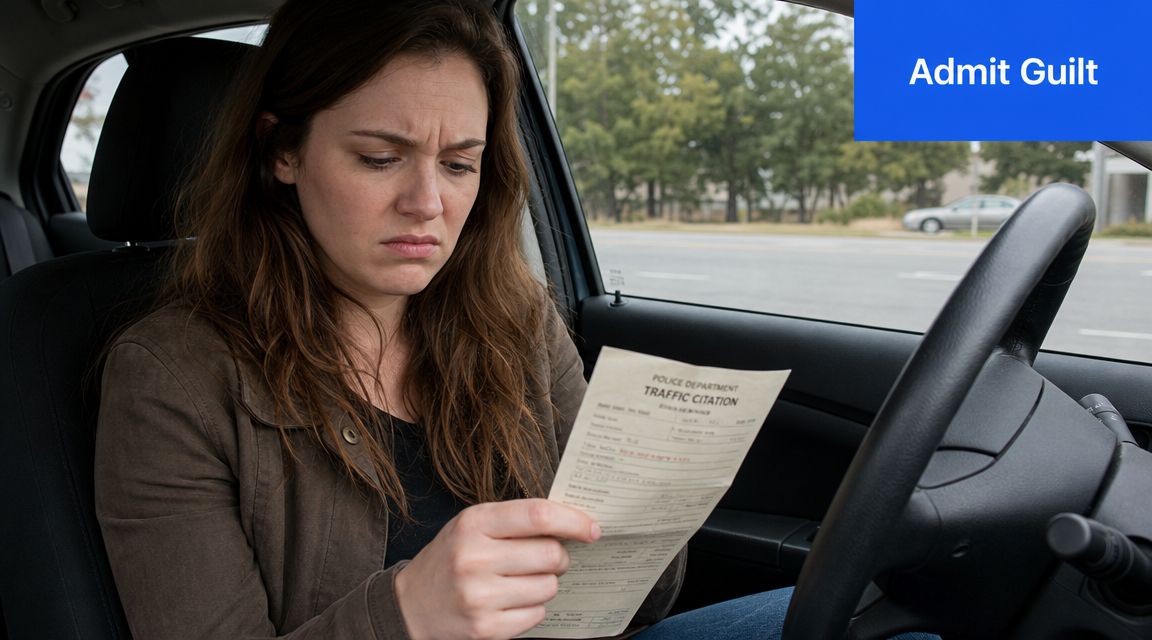
That's a mistake because payment is a legal choice. It closes off options.
Paying is a legal decision, not a convenience move
When you pay, you're usually not “making it disappear.” You're resolving the case on the court's terms, not yours. That can mean a conviction on your record instead of a better negotiated result.
For Florida drivers, especially rideshare drivers, delivery drivers, military personnel, and professionals with background-check concerns, that's the wrong way to think about risk. Your goal shouldn't be speed alone. Your goal should be no points, no unnecessary conviction, and the cleanest outcome available.
The right defense often isn't about arguing that the tag wasn't expired. It's about showing prompt correction, using timing rules, and pushing for a disposition that protects your record.
Paying a ticket is easy. Undoing the record damage later usually isn't.
What to do immediately instead
Take these steps in order:
Correct the registration problem first: If you can renew, do it quickly.
Keep every receipt and confirmation: You may need proof for court or negotiations.
Do not miss the response date: A deadline mistake can turn a manageable case into a bigger one.
Get the case reviewed before you pay: That's how you preserve options.
Think beyond today's bill: A rushed payment can cost more over time than a deliberate defense.
A quick explanation of that decision point is in this guide on whether to pay a ticket or hire a lawyer.
Before you decide, watch this. It helps frame why handling a ticket strategically matters:
Why You Need a Lawyer Instead of a Ticket App
You get stopped for an expired tag, open an app, upload the ticket, and assume the problem is handled. Then the costs start stacking. Court deadlines keep running, a technical defense gets missed, and what looked like a small registration issue turns into a bigger hit to your wallet and record.
If your case is being heard at the Broward County Judicial Complex in Fort Lauderdale, you need a lawyer who knows how that court works and how these cases are resolved in practice.

A lawyer looks for the mistake that changes the case
Expired registration cases are often won or improved on details. Timing matters. Proof matters. Local court habits matter. An app is built to collect information and push cases through a system. A lawyer examines whether the officer wrote the ticket too early, whether your renewal timing helps, whether the court will dismiss on proof of correction, and whether there is a way to keep this from becoming a more expensive problem than it already is.
That last point matters more than drivers realize.
The ticket amount is only the front-end cost. Actual exposure can include extra court costs, time off work, missed deadline problems, and record issues that follow you long after the fine is paid. If you drive for work, hold a professional license, or deal with background checks, a careless result can cost far more than the citation itself.
Direct attorney access protects you better than automation
You need answers from the person making decisions on your case. You do not need a chatbot, a call center, or a status page that gives you updates without strategy.
A local lawyer can tell you what matters in your court, what documents to gather, whether your correction timing helps, and what result is realistically worth pursuing. That is the difference explained in Ticket Shield's guide on why a local lawyer is often a better choice than a ticket app.
Software handles intake. Counsel handles risk.
An app can organize your ticket. A lawyer can protect you from the stacked cost of getting this wrong.
Protect Your Record and Get a Free Consultation
If you've received an expired registration citation in Florida, treat it like a legal problem with financial consequences, not a minor annoyance. The expired registration ticket cost can include more than the amount written on the citation, and delay only makes your position worse.
Your priorities should be simple:
Fix the registration issue quickly
Avoid missing any court deadline
Do not pay before understanding the consequences
Push for an outcome that protects your record and aims for no points
This is especially important if you drive for work, hold a professional license, maintain a security-sensitive job, or don't want a minor stop to become a lasting problem.
You don't need a bot for this. You need a person who can look at the citation, the timing, the court, and the statute, then tell you the smartest next move.
If you want a lawyer-led defense from Ticket Shield, PLLC, visit TicketShield.com for a free consultation. The goal is simple: protect your record and fight for No Points.
