Understanding Cost Of Ticket For Expired Tags
Cost of ticket for expired tags - Don't let a Florida expired tag ticket ruin your day. Understand the true cost of ticket for expired tags, fines, and defense
In Florida, the cost of ticket for expired tags can start as a manageable non-criminal fine, but after six months it can turn into a criminal charge with up to $500 in fines, jail exposure, probation, and a permanent record. Act fast.
You see the lights. Or you find the citation tucked under your wiper. Your first instinct is to treat it like a nuisance and move on.
That’s a mistake.
An expired tag ticket in Florida is one of those citations drivers underestimate until it starts costing real money, time, and options. If your registration is only recently expired, you may be able to fix it and limit the damage. If it’s been sitting too long, you may be looking at something far more serious than a routine traffic ticket.
Florida drivers also make another costly mistake. They assume every tag ticket works the same way in every courthouse. It doesn’t. Procedures vary. Clerks vary. judges vary. Outcomes vary. What works in one county may fail in another.
And before you click “pay now,” remember this. Traffic issues often connect to broader record concerns under Florida traffic law, including whether traffic tickets show up on background checks. That matters if you drive for work, hold a professional license, or can’t afford a blemish on your record.
Table of Contents
An Expired Tag Ticket is Not Just a Fine
Most drivers think this ticket is about money. It isn’t. It’s about risk.
If your tag expired recently, you may be dealing with a non-criminal traffic matter. If it crossed the wrong line, you may be dealing with criminal exposure. That difference changes everything, from how you respond to whether a simple online payment could hurt you.
Florida traffic law is technical. Chapter 316 controls much of what happens once you’re cited on the road, and related registration offenses can quickly pull you into court procedure that is far more serious than drivers expect. You should treat the citation as a legal problem first and a billing issue second.
Practical rule: Don’t assume an expired tag ticket is harmless just because your car was otherwise fine.
The other problem is long-term fallout. A driver who pays first and asks questions later can create record issues that don’t disappear when the fine is over. That matters if your employer runs checks, if you’re applying for housing, or if your work depends on staying insurable.
Why drivers get into trouble fast
The pattern is predictable:
You miss the renewal date: Life gets busy. Mail gets ignored. The sticker slips past you.
You get stopped for something minor: A routine stop turns into a registration citation.
You panic and pay online: That feels efficient, but it can also lock in consequences.
You learn too late what was really at stake: By then, your options are narrower.
That’s why urgency matters here. You need to know what kind of case you have before you touch the ticket.
What is the True Cost of an Expired Tag Ticket
The amount printed on the citation is almost never the full story.

Why the number on the citation is only the start
In Florida, the cost of ticket for expired tags depends heavily on how long the registration has been expired. In Palm Beach County, proof that the registration was valid before the citation can reduce the fee to $10.00, and some courts allow dismissal after prompt renewal and payment of an administrative fee, as reflected in the Palm Beach County traffic violations fee schedule.
That’s the good version of this problem.
The bad version is when drivers focus only on the face amount and ignore everything attached to it. A tag citation can bring court costs, administrative charges, and the separate expense of getting your registration back into compliance. The longer you wait, the less room you usually have to resolve it cleanly.
If you want a broader breakdown of how courts stack fees onto traffic cases, review this guide on Florida traffic ticket court costs.
What a fast fix can do
Prompt action gives you an advantage. Delay strips it away.
When a driver renews quickly and keeps proof organized, the court may view the case as a compliance issue rather than something worth pushing harder. That doesn’t mean you should walk in blind. It means timing matters. The sooner you fix the registration, the more options you may preserve.
A tag ticket often costs more in follow-up consequences than in the initial payment window.
There’s also the hidden financial problem nobody talks about enough. Even when the violation is non-moving, a conviction can still create insurance headaches. You may finish the court case and still keep paying for it later.
This video gives helpful context on how traffic cases can snowball if handled casually:
The true bill usually includes more than one layer
Think about the full stack of costs:
The citation itself: This is only the opening number.
Court-related charges: Fees can attach even in ordinary traffic cases.
Registration compliance costs: You still have to renew and fix the underlying problem.
Insurance pressure: A record entry can cost more over time than the ticket.
Lost time: Time off work, courthouse trips, and repeated follow-up all have value.
If your goal is to spend the least over the life of the case, “just pay it” is often the wrong math.
The Six-Month Cliff Why an Expired Tag Becomes a Crime
This is the part most drivers miss, and it’s the part that can hurt you the most.
What Florida law says
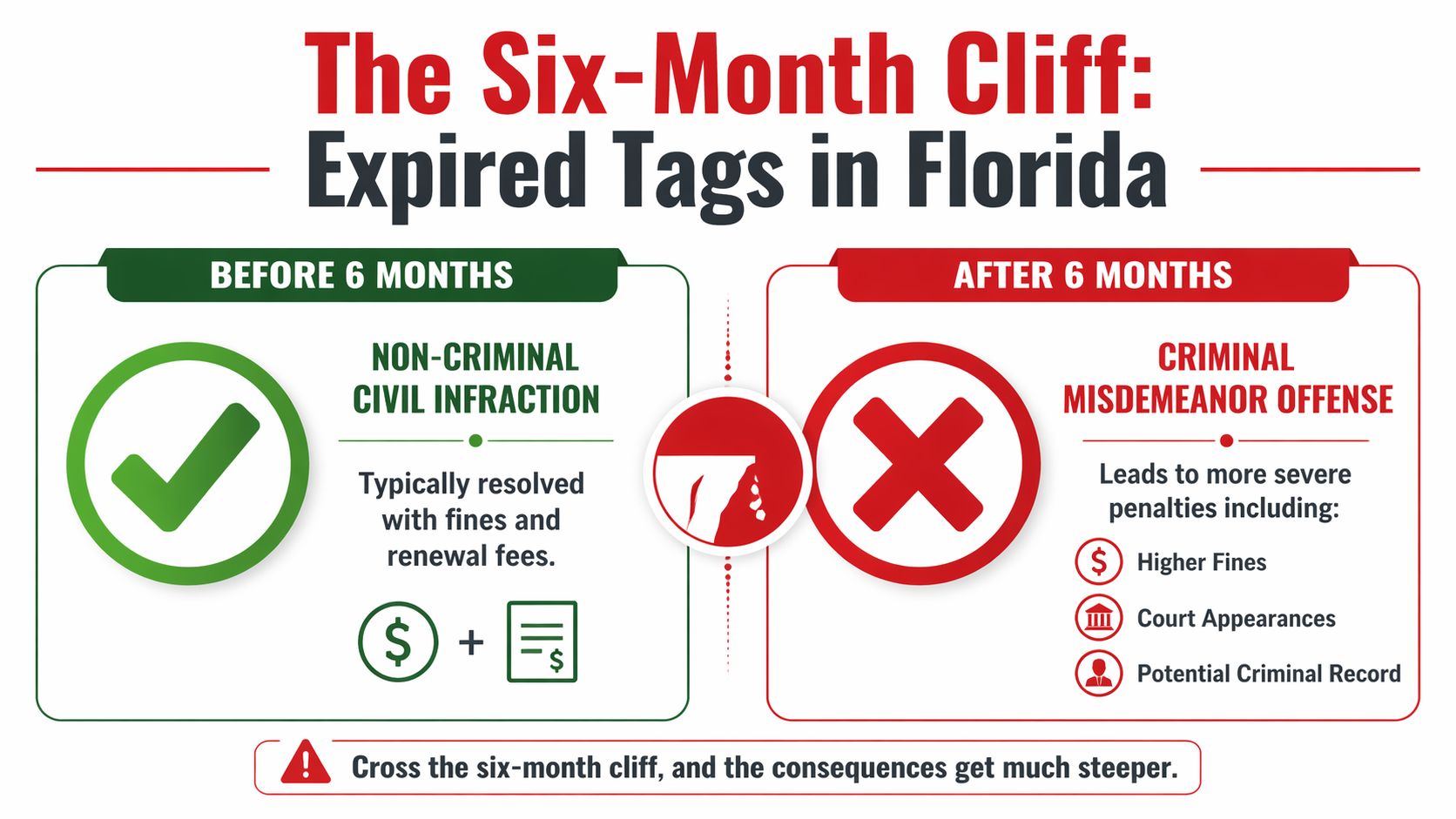
Under Florida Statute §320.07(3)(c), operating a vehicle with a registration expired for more than six months can become a second-degree misdemeanor, carrying up to a $500 fine, 60 days in jail, six months probation, and a permanent criminal record, as summarized in this discussion of Florida expired tag charges under §320.07(3)(c).
That’s the cliff.
Before that point, you’re generally dealing with a non-criminal traffic infraction. After that point, you may be dealing with a criminal accusation. Those are not the same conversation. They do not call for the same response. They should not be handled with the same level of concern.
If you need a more focused overview of consequences tied to lapsed registration, this article on the penalty for expired registration in Florida is worth reading after you check your dates.
Why this changes your strategy immediately
Once criminal exposure is in play, your priority is no longer just reducing a fine. Your priority becomes protecting your record.
A criminal case can affect background checks, employment options, and any situation where a clean history matters. For gig drivers, military personnel, and licensed professionals, that risk is not abstract. It’s practical and immediate.
If your registration has been expired anywhere near six months, stop treating this like an online payment issue and start treating it like a defense issue.
Here’s the clean comparison:
Status | Legal posture | Main concern |
|---|---|---|
Less than six months expired | Non-criminal traffic infraction | Fixing compliance and avoiding unnecessary record damage |
More than six months expired | Criminal misdemeanor exposure | Preventing a conviction and protecting your future |
That is why I’m direct about this. If you don’t know where your case falls, check the expiration date today. Not tomorrow. Today.
Do Expired Tag Fines Vary by Florida County
Yes, and that matters more than most websites admit.
A driver cited in Miami-Dade won’t necessarily face the same process as a driver handling the same issue in Duval or Hillsborough. The state statute gives the framework, but counties control a lot of the actual experience.
Local procedure changes the outcome
Fine amounts and court procedures can differ significantly between counties like Miami-Dade and Duval, which makes generic advice risky, as noted in this discussion of county-by-county variation in expired tag cases.
That’s not a technicality. It affects strategy.
At the Richard E. Gerstein Justice Building in Miami, the clerk’s process, scheduling expectations, and local handling can feel very different from what a driver sees elsewhere. The same is true in Tampa at the Edgecomb Courthouse or in Orlando at the Orange County Courthouse. Local practice shapes outcomes because paperwork, proof requirements, and negotiation posture are never identical across every county.
Here’s where drivers go wrong:
They rely on statewide advice only: That can miss local dismissal procedures.
They assume every clerk handles proof the same way: They don’t.
They wait until the deadline is close: That shrinks room to fix avoidable problems.
A workable defense in one Florida courthouse can be the wrong move in another.
The cost of ticket for expired tags is not just a statutory issue. It’s also a courthouse issue. That’s why drivers who want a clean outcome should care about local procedure, not just the words on the citation.
What Are Your Immediate Next Steps After a Ticket
The first day matters. So does the second.
If you sit on this ticket, you give away options. If you move quickly, you can often contain the problem before it spreads into something more expensive or more serious.
Immediate steps to take
Renew your registration now: Fix the underlying issue immediately, online or in person if needed. Courts respond better when you’ve already corrected the problem.
Read every line on the citation: Look for the response date, case number, county, and any court appearance instruction. Missing a deadline can turn a manageable issue into a bigger one.
Save your documents in one place: Keep the ticket, renewal receipt, proof of registration, and any confirmation emails together. Disorganized drivers lose arguments they could have made.
Don’t pay online just to get it over with: Payment is often treated as an admission. Convenience can reduce your advantage.
Check what happened before the stop: If your registration was valid before the citation or there’s an administrative mix-up, that may matter.
Get legal guidance before you choose a path: A short review now can prevent a bad decision you can’t easily undo later.
If you need a practical checklist right away, this guide on what to do when you get a ticket in Florida is a useful companion.
A few things are not optional. Renew the tag. Preserve proof. Respect the deadline. And don’t assume the quickest response is the safest one.
Should You Just Pay the Fine or Contest the Ticket
If you only care about speed, paying looks attractive.
If you care about your record, your insurance, and your future options, paying may be the worst move available.
Drivers often confuse closure with protection. They are not the same. Paying closes the file faster. Contesting the case gives you a chance to prevent the damage.
Pay vs. Contest Your Expired Tag Ticket
Factor | Paying the Fine (Pleading Guilty) | Contesting with an Attorney |
|---|---|---|
Convenience | Fast in the moment | Takes a decision, but protects your options |
Control over outcome | Very little after payment | You preserve room to challenge, explain, or negotiate |
Effect on record | Can lock in a harmful result | May allow reduction or dismissal |
Insurance risk | You may deal with fallout later | You have a chance to avoid that result |
Serious cases | Dangerous if the case has criminal implications | Essential when the expiration period raises the stakes |
Stress level | Feels easier at first | Usually better over the life of the case |
The legal point is simple. Payment is usually a plea. Once you make it, you may lose the chance to argue for a better result.
That’s especially dangerous when the facts are not clean. Maybe your renewal timing helps you. Maybe the citation can be corrected. Maybe the county procedure gives you a path to dismissal. You won’t know if you treat the ticket like a parking stub and send money first.
Why contesting is often the smarter move
Contesting doesn’t mean you’re trying to dodge responsibility. It means you’re trying to prevent unnecessary damage.
A proper defense can focus on:
Proof of compliance: Showing the issue was corrected promptly.
Technical review of the citation: Small errors can matter.
Negotiation for reduction: Particularly important if the facts are unfavorable.
Record protection: Often more valuable than arguing over the face amount.
Paying for convenience can cost far more than fighting for a controlled result.
The right question isn’t “What’s the fastest way to end this?” The right question is “What leaves me in the best position six months from now?”
How a Lawyer-Led Firm Protects Your Record
Not every defense model gives you real protection.
Some services are built like intake funnels. You upload your ticket, get canned updates, and never know who is handling the case. That may work for companies processing volume. It doesn’t work well when your record is on the line.
Why direct attorney access matters
A lawyer-led firm gives you something automated apps and ticket mills can’t give you. Direct legal judgment tied to your actual facts.
You should be able to speak to your attorney by phone or text. You should know who is reviewing the citation. You should know whether the issue is compliance, negotiation, or criminal risk. That’s how serious traffic defense should work.
Experienced defense firms can negotiate reductions or dismissals and often avoid court for over 99% of clients, helping protect the record and prevent points, as stated in the provided verified data.
That kind of representation matters because expired tag cases are not all the same. Some need a clean proof package. Some need strategic local handling. Some need direct criminal defense posture because the dates are bad.
For a broader look at how strategic representation works in Florida traffic cases, see this overview of traffic ticket defense in Florida.
A real lawyer also knows when not to oversell you. Sometimes the fastest path is a dismissal effort based on prompt compliance. Sometimes it’s damage control. Sometimes it’s protecting you from a criminal record. The key is that an attorney makes that call, not a chatbot and not a middleman.
Protect Your License and Your Future
An expired tag ticket can look small and still create serious trouble. The cost of ticket for expired tags is never just the amount you see first. It can reach into your license, your insurance, and in the wrong case, your criminal history.
Act quickly. Renew the registration. Keep every document. Don’t plead guilty out of frustration or convenience.
If there’s any chance your tag crossed the six-month line, treat it as urgent. If the case is in a county with strict procedures, treat it as local. If your job or record matters, treat it as important enough to handle correctly the first time.
If you want a lawyer-led defense focused on No Points, direct attorney access, and protecting your record from the start, visit Ticket Shield, PLLC for a free consultation.