Traffic Ticket Defense Florida: Protect Your Record
Don't just pay that ticket. Our guide to traffic ticket defense Florida explains options to protect your record, avoid points & save money. Lawyer-led defense.
A Florida traffic ticket is not just a fine. It’s a legal charge. Fight it fast with a lawyer-led defense if you want to protect your record, avoid points, and limit insurance damage. Paying it without a strategy is usually the wrong move.
You’ve got the ticket in your hand. Your stomach drops. You’re looking at the fine, the deadline, and the threat hanging over your license. That reaction is normal. What matters now is what you do next.
If you’re searching for traffic ticket defense florida, you need more than a generic guide. You need a clear plan. In Florida, a traffic citation can trigger points, insurance increases, court obligations, and for some drivers, much worse. If you drive for work, hold a professional license, or serve in the military, a “simple ticket” can create problems far beyond the courthouse.
Florida treats many traffic violations under Chapter 316, and one common example is Florida Statute 316.187, which governs unlawful speed. The statute matters because your defense starts with the exact charge, not with the officer’s roadside explanation.
A lawyer-led defense gives you something automated apps and ticket mills do not. Actual legal judgment. Real communication. A strategy built around your charge, your county, and your record.
Table of Contents
What Should You Do Immediately After Getting a Florida Traffic Ticket
The first mistake is panic. The second is paying the ticket before you understand the damage.
Florida processes traffic cases at a massive scale. Law enforcement issued 2,637,069 total traffic citations in 2022, including 1.7 million non-criminal moving violations, and speeding alone accounted for approximately 682,000 citations according to Florida traffic citation data summarized here. You’re not the first driver caught in this system. But you do need to act like your case matters, because it does.

What needs to happen first
You need to slow down and treat the citation like a legal file, not a bill. Check the charge. Check the court information. Check the response deadline. If the ticket cites speeding, unsafe lane change, careless driving, or another Chapter 316 offense, your next move should be based on defense strategy, not convenience.
Practical rule: If your goal is no points, don’t start by asking how to pay. Start by asking how to fight.
Immediate steps to take
Read every line: Confirm the statute listed, the county, and whether the charge is civil or criminal on its face.
Protect the deadline: Florida deadlines matter. Missing one can give the court an advantage and create avoidable trouble.
Write down what happened: Location, traffic conditions, weather, officer statements, and anything unusual. Do it while the stop is still fresh.
Save supporting evidence: If there’s dashcam footage, app location history, repair records, or photos, preserve them now.
Do not admit the violation online or by phone: Casual statements can box you into a weak position later.
Get legal guidance early: Review a focused guide on what to do when you get a ticket, then speak with counsel before you choose an option.
Why urgency matters
Drivers lose cases before court even starts. They pay too fast. They miss the chance to challenge the charge. They assume the fine is the whole problem.
It isn’t.
A Florida ticket can affect your driving record long after the stop is over. That’s why traffic ticket defense florida should begin immediately, while facts are still available and before you lock yourself into the wrong choice.
Why Are the Real Consequences of a Florida Ticket So Severe
The fine printed on the citation is the bait. The actual cost usually comes later.
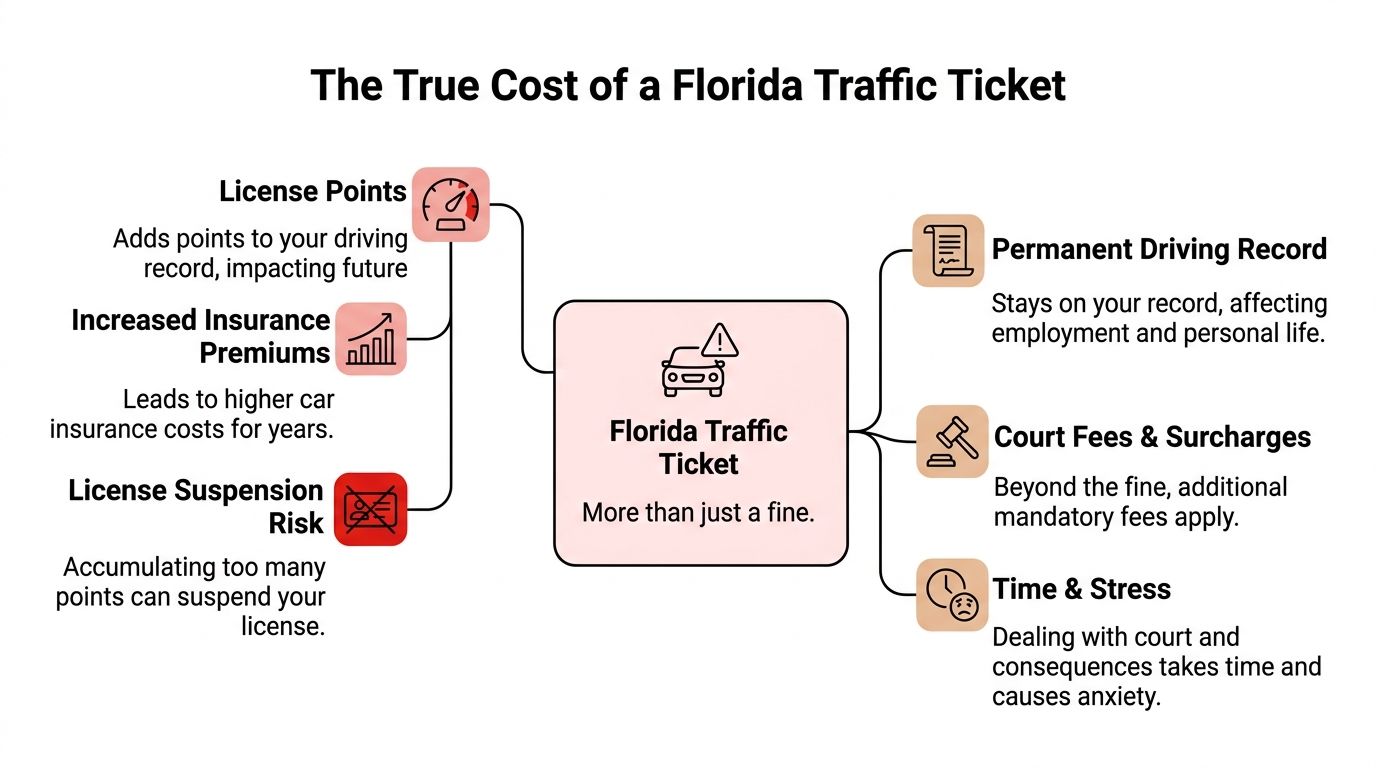
Florida’s point system is the part drivers underestimate. Under the framework described by traffic defense practitioners applying Chapter 316 violations such as Florida Statute 316.187, the Department of Highway Safety and Motor Vehicles assigns 3 to 4 points for most speeding tickets, and license suspension is triggered at 12 points within 12 months. A single 3-point violation can increase auto insurance premiums by 15-25% over 3 years, creating $1,500-$3,000 in added cost, according to this Florida traffic defense analysis.
Why points matter more than the fine
You can recover from a fine. Points stay behind and keep hurting you.
If you drive every day for work, school, family obligations, or deliveries, points create ongoing risk. They can push you toward suspension. They can also make every future stop more serious because your record starts speaking before you do.
The domino effect most drivers miss
Consequence | What it means for you |
|---|---|
License points | The violation goes onto your driving history and can move you closer to suspension. |
Insurance impact | Carriers may treat the ticket as a pricing event, not just a one-time mistake. |
Record problems | Employers, background reviewers, and fleet managers may see the violation. |
Pressure in later cases | A prior ticket can reduce flexibility if you’re cited again. |
Paying a ticket can be the most expensive option, because it turns a challengeable allegation into a finished conviction event.
Who gets hit hardest
Some drivers absorb traffic consequences badly. A rideshare driver may face account trouble. A commercial-facing employee may have to report the ticket internally. A parent with a long commute may suddenly be one step closer to losing the ability to drive legally.
The court fine doesn’t capture any of that.
Why you should think beyond today
Individuals often don’t search their record until they need it. Then the ticket that seemed minor shows up at the worst time. A job application. A professional review. An insurance renewal. A background screen. A policy re-rating.
That’s why this isn’t just about saving money on the citation itself. It’s about keeping the violation from shaping the next few years of your life.
If you want a deeper look at the long-term record impact, review how long traffic tickets stay on record. Then make your decision with your eyes open.
How Does Florida Classify Your Traffic Violation
Your defense starts with classification. Not all tickets are the same, and treating them the same is a mistake.
Florida generally separates traffic matters into a few practical categories. The label affects the court process, the stakes, and the strategy. If your citation references Florida Statute 316.187, you’re dealing with a speeding-related offense under Chapter 316. That doesn’t automatically mean the case is simple.
Civil moving violations
Many drivers face traffic tickets. Speeding, running a red light, and similar allegations often fall into this category. These cases may not sound criminal, but they still put your record and license at risk.
The defense focus here is often point avoidance, record protection, and attacking the basis of the stop or proof.
Non-moving violations
These usually involve issues tied to the vehicle or paperwork rather than the way you drove. Think along the lines of registration or equipment-related matters.
They can still create court trouble if ignored. But they don’t usually present the same point-driven exposure as moving violations.
Criminal traffic charges
Drivers facing more serious traffic offenses often get blindsided. Charges like reckless driving or DUI move into a very different lane. The stakes rise fast. Court procedure tightens up. Employment consequences become more serious.
If your citation or notice suggests a criminal charge under Chapter 316, you need immediate legal review.
The wording on the ticket matters. One phrase can change the case from inconvenience to real exposure.
Why classification changes the defense
A civil speeding case may turn on equipment records, officer observations, or bargaining power. A criminal traffic case may require a broader defense approach that addresses both court outcome and collateral consequences.
That’s why generic intake systems are weak here. They often reduce your case to a payment workflow instead of a legal diagnosis.
Check the ticket for these clues
The statute number: Chapter 316 citations point you toward the legal theory the state is using.
The court instructions: They often reveal whether you’re facing a routine infraction track or something more serious.
The language used: “Infraction,” “mandatory appearance,” and similar terms can signal very different paths.
The officer’s notes or supplemental paperwork: These may shape what evidence becomes important later.
If you want a plain-language overview of the categories, read what is a traffic infraction. Then stop guessing and get your specific charge reviewed.
What Are Your Three Options After Getting a Ticket
After a Florida ticket, you usually face three practical choices. Pay it. Elect traffic school if you qualify. Or fight it.
Only one of those options gives you a real chance to avoid the full impact.
Option one is paying the fine
Paying feels fast. It also closes the case in the state’s favor.
You are choosing certainty, but it’s the wrong kind of certainty. You remove the chance to challenge the citation, negotiate from strength, or attack the evidence. For many drivers, paying is just surrender with a processing fee attached.
Option two is traffic school
Traffic school can help in some situations. It can also be overused and misunderstood.
Some drivers treat it like a clean escape hatch. It isn’t. It’s a limited procedural tool, and using it too casually can burn an option you may wish you had saved for a different case.
Option three is fighting the ticket
This is the only path that opens the door to dismissal, a reduction, or another result that protects your record more effectively. It takes action, but it gives you an advantage.
That matters if your real goal is no points.
Florida Traffic Ticket Options At-a-Glance
Outcome | Option 1: Pay the Fine | Option 2: Elect Traffic School | Option 3: Fight with an Attorney |
|---|---|---|---|
Speed | Fastest upfront | Usually straightforward | Requires legal action |
Chance to challenge evidence | None | Very limited | Yes |
Point protection strategy | Weak | Situational | Strongest |
Record control | Minimal | Limited | Greater opportunity |
Best fit | Drivers focused only on ending the case | Drivers using a procedural option | Drivers focused on protecting license and insurance |
Which option makes sense for you
If you already have points, paying is reckless.
If you drive for Uber, Lyft, DoorDash, or another platform, you should assume your record matters more than the face amount of the fine.
If you hold a security-sensitive job, a professional position, or any role where reliability matters, you need to think beyond convenience.
A traffic case should be handled based on consequences, not based on how easy the website makes payment.
A direct recommendation
Fight the ticket unless you’ve had a lawyer review the downside and tell you otherwise. That’s the cleanest advice I can give you.
The state built an efficient collection system. It did not build a system designed to protect your long-term interests. You have to do that yourself by choosing the option that preserves your defenses.
For a practical comparison before you decide, review pay ticket vs hire a lawyer.
How Do You Build a Winning Traffic Ticket Defense
A real defense is not a speech about being a careful driver. It’s a legal attack on the state’s proof.
That process starts with the paperwork, the charge, and the evidence the officer and prosecutor would need if the case moves forward. At places like the Edgecomb Courthouse in Tampa, local procedure matters, but the central question stays the same. Can the state prove the allegation cleanly and properly?

What your attorney should do first
A proper defense usually begins with a case review and filing the right response. Then counsel handles court communications, reviews the citation for defects, and decides whether the case is best attacked through negotiation, technical challenge, or hearing preparation.
You should not be left guessing what happens next. You also should not be routed through a chatbot when legal judgment is required.
Where many tickets become vulnerable
In Florida, approximately 60-70% of traffic prosecutions rely on officer testimony and equipment certification, according to this discussion of Florida traffic prosecution vulnerabilities. That matters because those cases can weaken quickly if the underlying proof has gaps.
Some examples include:
Equipment problems: Radar or LIDAR calibration records may be incomplete or flawed.
Certification issues: The officer’s training or qualification records may not support the measurement method used.
Documentation defects: The citation or supporting materials may contain inconsistencies that matter.
Proof issues at hearing: If the state cannot present what it needs, the advantage shifts.
What a strategic defense looks like in practice
One case calls for pressing technical deficiencies. Another calls for pushing toward a non-point resolution. Another requires preparing for a hearing because the facts or the officer’s proof are weak.
That’s why assembly-line handling fails people. It treats every citation as interchangeable when they are not.
A strong traffic defense is built file by file. The best angle is the one that fits the statute, the county, and the proof.
What you should expect from counsel
You should expect your lawyer to explain the charge, the likely path, the risk points, and the realistic goal. You should also expect the firm to handle the procedural burden so you don’t lose ground to deadlines or court missteps.
That’s the difference between legal defense and ticket processing.
Why Is a Lawyer-Led Firm Your Strongest Ally
You get the ticket on the shoulder of I-275, glance at the fine print, and start searching for a fast fix before points hit your license or your insurance jumps. That is when many Florida drivers make the next mistake. They hand their case to an app, a call center, or a high-volume ticket service that treats one citation like the next.
That approach costs people options.
A lawyer-led firm gives you something those systems do not. Judgment tied to your case, your record, your county, and your deadlines. In Hillsborough County, for example, procedure at the Edgecomb Courthouse can affect timing, hearing posture, and how a case should be pushed. A generic platform will not explain that well because it was not built for courthouse-level decision-making.

Why direct attorney access matters
Traffic defense turns on legal judgment. If your issue involves a speeding allegation under Florida Statute 316.187, a county-specific hearing practice, a prior ticket history, or the risk of points on a commercial or military record, you need answers from an attorney who knows your file.
You should be able to call, text, and get a straight answer.
Volume services often put a buffer between you and the lawyer. Staff members collect documents, software pushes updates, and no one gives you a clear recommendation until the case is already on rails. That is poor defense. It is processing.
Why contested cases deserve a hard look
Many drivers pay the ticket because they assume the outcome is fixed. It is not.
Florida traffic defense lawyers have long pointed out that contested cases often end better than drivers expect, including dismissals and withholds, as noted in this summary of contested Florida ticket outcomes. The point is simple. A citation is the start of the case, not the end of it.
That is why lawyer review matters early. A defense attorney can tell you whether to press, resolve, or prepare for hearing before you lose your advantage by rushing into the wrong option.
What changes when a lawyer leads the defense
Communication improves. Accountability improves. Strategy improves.
A lawyer-led firm reviews the citation, spots the pressure points, and gives you a recommendation that fits the file. It does not push every driver toward the same canned outcome. If you want a clearer picture of the work involved, read this explanation of the role a Florida traffic ticket attorney plays in a defense case.
That distinction matters more than people think.
Why former prosecutors bring an edge
A former prosecutor knows how traffic cases are built, where proof tends to break down, and what weaknesses are worth pressing. That helps in negotiations. It also helps at hearing, where timing, document quality, and proof problems can decide the result.
Here’s a short explainer that reinforces that difference:
One clear recommendation
Hire a firm where you speak directly with your attorney and where the legal work is handled by lawyers, not hidden behind staff or software. Ticket Shield, PLLC is one Florida option built around that model, with direct attorney communication instead of an app-style handoff.
That is not a marketing preference. It is how you protect your record with a defense built for your case, not for volume.
How Do Procedures Vary Across Florida Counties
Florida traffic law is statewide. Florida traffic practice is not.
The statute may be the same, but how cases move can differ by county, courthouse, calendar structure, and local expectations. A driver walking into the Richard E. Gerstein Justice Building in Miami-Dade may face a different procedural rhythm than a driver at the Broward County Judicial Complex in Fort Lauderdale. The same is true in Tampa, Orlando, Jacksonville, and elsewhere.
Why local procedure matters
Some counties move quickly. Some are more document-driven. Some hearing rooms expect one style of preparation and some expect another. A lawyer who works these courts understands that local practice affects timing, negotiation posture, and how to present a defense cleanly.
That’s one reason generic national-style ticket services fall short in Florida. They may know the category of case. They often don’t know the courthouse culture.
Local knowledge matters because traffic defense happens in real courtrooms, with real calendars, real clerks, and real judges.
A critical issue for military drivers
For military personnel at MacDill AFB or Eglin, even minor traffic points can trigger security clearance reviews under SF-86 reporting requirements, and a reckless driving charge under Florida Statute 316.192 can be misclassified under the UCMJ, creating severe career risk, as discussed in this Florida military traffic ticket defense overview.
That is not a standard-driver problem. It requires a defense approach that accounts for both civilian court consequences and military fallout.
Other drivers with county-sensitive exposure
Gig drivers: Platform rules can react harshly to record changes.
Busy professionals: Time away from work matters, especially in counties with more involved scheduling.
Spanish-speaking drivers: Clear communication matters when paperwork, deadlines, and court expectations stack up fast.
The right traffic ticket defense florida approach is always specific. Specific to your statute. Specific to your county. Specific to what your record can and cannot absorb.
Your Next Step to Protecting Your Florida Driving Record
A Florida ticket is a legal problem first and a payment issue second. If you want the strongest chance at a No Points result, act quickly, identify the exact Chapter 316 charge, and put a real attorney between you and the system before you make a damaging choice.
Lawyer-led defense is not a luxury. It’s the safest path when your license, insurance, job, and record are on the line.
If you want direct access to a real Florida traffic defense attorney, not a middleman or automated app, visit Ticket Shield, PLLC for a free consultation. Protect your record. Fight for the No Points outcome.