
What Is the Penalty for Expired Registration in Florida?
Florida penalty for expired registration: under 6 months is usually a ticket plus late fees; 6+ months or repeat offenses can become criminal.
Driving with an expired registration in Florida is a serious legal issue. If your registration is expired for less than six months, it's a non-criminal infraction with fines. If it's over six months or a second offense, it becomes a criminal misdemeanor, risking jail time.
Florida does not generally give you a post-expiration grace period to keep driving on old tags. Once the registration is expired, an officer can cite you, and the money problem splits in two: the state can charge delinquent renewal fees, and the court can assess a separate citation with local costs if you were stopped on the road.
The practical takeaway is simple: under Florida Statute 320.07, a first offense under six months is usually handled as a noncriminal traffic matter, while six months or more expired—or a second or later offense—can move into misdemeanor territory. That legal split matters because it changes both the risk and the best response.
Is There a Grace Period for Expired Tags in Florida?
Usually, no. Florida generally does not provide a driving grace period after your registration expires. If the tag is expired, you can be stopped and cited.
What does exist is an administrative late-fee structure for renewal. Under section 320.07, a delinquent fee begins on the 11th calendar day of the month after renewal was due, and the amount depends on the base license tax. The state schedule starts at $5 for lower-tax registrations and can rise to $250 for higher-tax vehicles. That timing rule affects what you owe to renew; it does not create permission to keep driving on expired tags.
Florida tax collectors also treat renewal timing separately from traffic enforcement. You can review standard renewal and registration information through the FLHSMV registration services page and your county tax collector. In other words, renewing late may be administratively possible, but driving late can still get you ticketed.
What Are the Immediate Financial Penalties?
The fastest way to understand the penalty is to separate agency renewal costs from court penalties. Florida does not use one universal statewide dollar amount for every expired registration stop.
Late renewal fees vs. ticket costs
If your registration lapsed, you may owe the state a delinquent renewal fee when you fix it. Under Florida Statute 320.07, that delinquent fee begins on the 11th calendar day of the month after renewal was due and is tied to the base license tax:
$5 if the tax is up to $25
$10 if the tax is over $25 to $50
$15 if the tax is over $50 to $100
$50 if the tax is over $100 to $400
$100 if the tax is over $400 to $600
$250 if the tax is $600 or more
That means a driver may owe only a small late-renewal amount to FLHSMV, or a much larger one for a higher-tax vehicle, before the court side is even considered. For renewal procedures and local office processing, many drivers start with the FLHSMV motor vehicle registration page.
If you were stopped while driving, the citation is separate. Expect a base traffic fine plus county court assessments, and sometimes compliance requirements. Counties do not all total these cases the same way, so there is no single statewide “expired tag ticket” number that fits every courthouse.
For comparison only, other states structure late penalties very differently. California uses a percentage-based model that can climb sharply over time, as shown on the California DMV fee schedule; a practical overview appears in this Fire House Smog guide. Florida's system is more split: one set of charges to renew, another if law enforcement cites you.
Practical penalty breakdown
Expired less than 6 months: Usually a noncriminal traffic infraction under section 320.07. You may owe the renewal delinquent fee to the state and a separate citation with court costs if stopped.
Expired 6 months or more: The case can escalate beyond a simple infraction under section 320.07, exposing you to criminal treatment rather than just a payable ticket.
Second or subsequent offense: A repeat case can also trigger misdemeanor exposure under the same statute, even if the driver assumes it is “just another tag ticket.”
Ignoring the citation creates a different problem from the expired registration itself. Missing your response deadline can lead to added court consequences, and in some cases a license suspension for failure to comply with the citation.
Simply paying the fine is not always the best move. It may close off arguments that could otherwise support mitigation or dismissal. To protect yourself, you need to understand every detail of an expired registration ticket and how an experienced attorney can build a strategic defense.
Can You Go to Jail for an Expired Tag in Florida?
Yes, but not every expired tag case carries jail exposure. Florida law draws clear lines, and those lines matter.
When it stays a noncriminal infraction
Under Florida Statute 320.07(3)(a), operating a vehicle with registration expired for less than six months is generally a noncriminal traffic infraction. That means the case is serious, but it is not automatically a crime.
When it becomes a misdemeanor
The escalation points are set out in the same statute:
First offense under six months expired: noncriminal infraction under section 320.07(3)(a)
Registration expired six months or more: second-degree misdemeanor treatment under section 320.07(3)(c)
Second or subsequent offense: also subject to second-degree misdemeanor treatment under section 320.07(3)(c)
A second-degree misdemeanor in Florida can carry up to 60 days in jail, up to six months of probation, and a fine of up to $500, plus court costs. Those are statutory maximums tied to the criminal classification.
What can happen vs. what always happens
Jail is a legal possibility, not an automatic result in every six-plus-month or repeat case. Courts look at the exact charge, your history, whether you fixed the registration, whether you missed court, and how the local prosecutor handles these cases. Some people resolve the matter without serving jail time. Others make the case much worse by ignoring notices or treating a criminal citation like a routine ticket.
That is why the charging line matters. A driver facing a misdemeanor-level tag case should treat it very differently from a first-time infraction. If the citation has already moved into criminal territory, review your options the same way you would for any no registration criminal citation.
What Are the Long-Term Consequences of a Conviction?
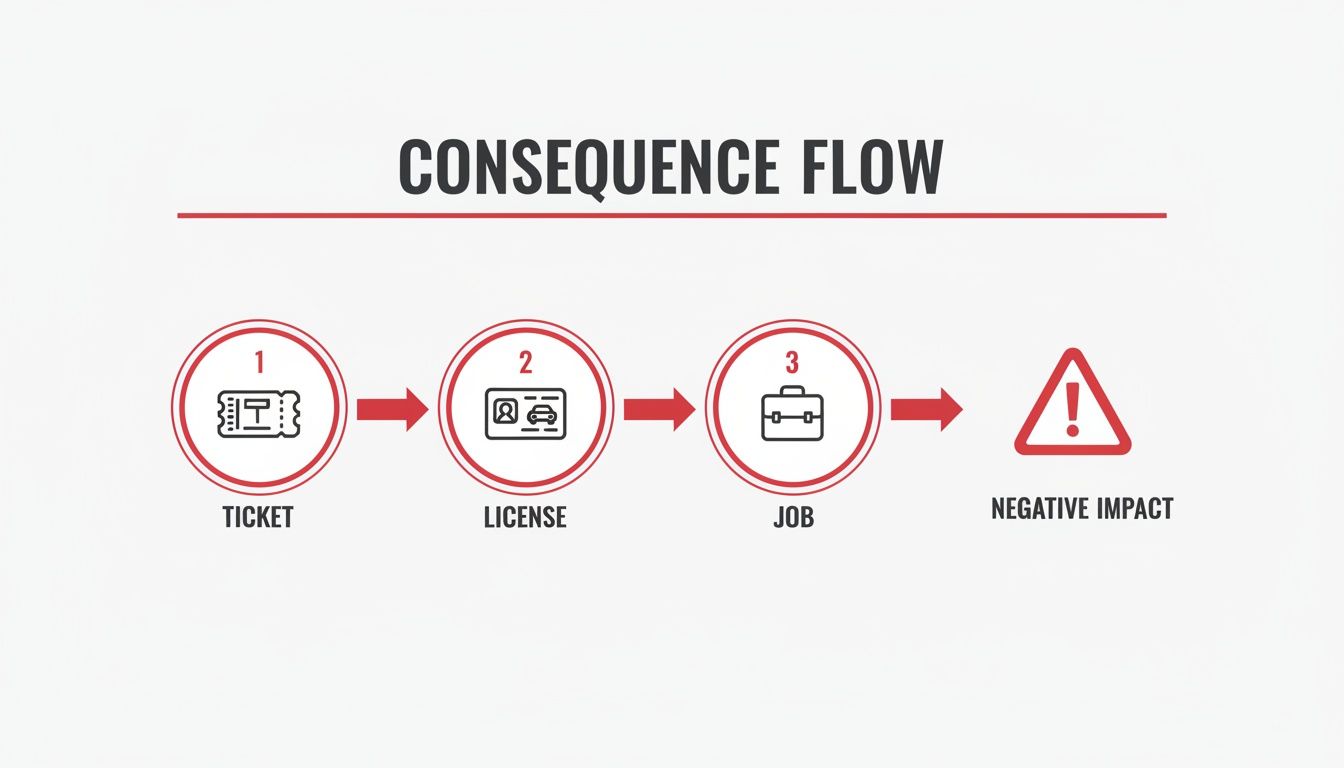
An expired registration ticket is rarely a one-time fine. Trouble often begins long after you deal with the courthouse, as hidden costs can follow you for years, impacting your finances and threatening your job.
Most drivers focus on the fine. They do not realize the penalty for an expired tag can create a ripple effect. The long-term consequences are often more damaging than the initial citation.
How Does This Affect Your Driving Record and Insurance?
A first-time expired tag ticket is a non-moving violation and carries no points. But a second offense becomes a criminal misdemeanor. This is a major red flag for insurance companies and employers.
A criminal charge is not a simple ticket. It is a permanent mark on your record that can jeopardize your job and financial stability. You need a real lawyer, not just an app, to protect what is at stake.
Insurance carriers view a criminal traffic conviction as a sign of high-risk behavior. At renewal, you can expect a significant premium increase that will last for years. Our guide to the Florida license point system shows how convictions harm your rates.
How Does This Affect Your Career?
If you drive for a living, the stakes are even higher. A clean driving record is a requirement to stay employed.
A conviction for a criminal expired tag violation can lead to:
Deactivation from Platforms: Gig workers can be deactivated almost instantly. This can also trigger a 20-30% spike in your personal auto insurance rates.
Job Loss: Many companies have zero-tolerance policies for their employees' driving records. A criminal conviction could be grounds for termination.
Higher Operating Costs: For independent contractors, a jump in insurance premiums is a direct hit to your bottom line.
Some providers offer minor violation forgiveness policies, but a criminal misdemeanor will almost certainly not qualify. Do not risk your livelihood. Facing a charge at Orlando's Orange County Courthouse demands a strategic defense from a dedicated attorney.
What Immediate Steps Should You Take After Getting a Ticket?
The first goal is compliance, and the second is preserving your options. Many drivers hurt their case by paying first and asking questions later.
What should you do right away?
Renew the registration immediately. Fixing the underlying problem does not automatically erase the citation, but it gives you proof that the violation was corrected.
Save every document. Keep the renewal receipt, confirmation email, updated registration, tag receipt, and a copy of the citation.
Check the deadline on the ticket. Some citations can be prepaid; others require a court appearance. The paper in your hand controls the next step.
Do not assume payment is harmless. Paying a citation is often treated as resolving the case by admission rather than contesting it.
Does renewing after the stop make the ticket go away?
Usually not automatically. Renewing after the officer stops you can help, but it does not normally void the ticket on its own. In many courts, prompt renewal can support mitigation, compliance-based leniency, or sometimes dismissal depending on the charge, the county, and whether this is a first-time infraction. It is evidence worth bringing, not a guaranteed reset button.
What proof should you keep?
Save items that show both timing and correction:
the renewal receipt
the date and time of payment
the updated registration card
any online confirmation from FLHSMV or the tax collector
photos of the updated sticker if applicable
Those records can matter if the court wants proof that the issue was cured quickly.
Why your ticket type matters
A payable civil citation and a required court appearance should not be handled the same way. If your registration was expired six months or more, if the citation references criminal treatment, or if you already missed a hearing, the risk is higher. In those situations, talk with counsel before taking action.
Our experienced attorneys can guide you on what to do when you get a ticket to protect your rights. We analyze the details of your stop, review the paperwork, and assess whether proof of renewal supports dismissal, reduction, or mitigation.
How Can a Lawyer Defend You Against an Expired Registration Ticket?
We protect your driving record. An expired registration ticket is not a minor problem you fix with a faceless app. It is a legal issue that demands a strategic, lawyer-led defense to prevent a conviction.

At Ticket Shield, PLLC, our process is built to get your case dismissed. We do not use middlemen or chatbots. You talk directly with your attorney, by phone or text, for immediate, professional guidance specific to your situation.
What Is Our Strategic Legal Approach?
Our attorneys get to work protecting your rights the moment you hire us. We investigate every detail of the citation and traffic stop. We hunt for legal errors that can be used to challenge the charge. This level of scrutiny is something automated "ticket mill" services cannot match.
We know the procedures and courtrooms across Florida, from Tampa's Edgecomb Courthouse to courthouses in all 67 counties. This gives us a powerful advantage when negotiating with prosecutors to get your case dismissed or charges reduced.
A conviction is not a foregone conclusion. With the right defense, we can show the court mitigating factors—like proof you renewed your registration—to argue for a complete dismissal. Our only goal is to win.
Why Does a Lawyer Beat an App Every Time?
Your defense must be a conversation, not a click. An algorithm cannot grasp the nuances of your stop. It cannot negotiate with a state attorney or stand before a judge for you. We can, and we do.
Our defense strategy is hands-on and personalized:
Meticulous Review: We dissect the citation for procedural mistakes. Errors in vehicle information, stop location, or the statute cited can invalidate the ticket.
Direct Negotiation: Our attorneys use their experience to talk directly to the prosecutor, often getting cases dismissed before a hearing.
Courtroom Advocacy: If necessary, we are prepared to represent you in court. We will present a vigorous defense built to achieve one outcome: no points, no conviction.
A strong defense is the difference between a clean record and a lasting conviction. Learn more about how we secure a traffic ticket dismissal with a lawyer. Do not leave your record to an algorithm.
Why Do You Need a Lawyer and Not an App for Your Ticket?
A lawyer is most useful when the expired-registration case carries more than a routine compliance problem. The biggest examples are the ones Florida law treats more harshly: registration expired six months or more, a second or later offense, a missed court date, a license problem tied to noncompliance, or a job that depends on a clean record.
If this is a simple first-time infraction and you promptly renewed the registration, saved proof, and have a citation that can be resolved without criminal exposure, some drivers can handle the process directly. The analysis changes when the case is no longer just about paying a fine.
When representation becomes higher-value
A lawyer can add the most value when:
the citation may be charged as a misdemeanor
you are not sure whether the ticket is payable or mandatory for court
you already missed a deadline or hearing
the case could affect a CDL, gig-work account, fleet job, or employer review
you need someone to push for dismissal based on prompt renewal or flaws in the citation
When an app is not enough
An automated service cannot tell you whether paying the ticket will shut down a defense, whether the statute was cited correctly, or whether the court is likely to treat proof of renewal as grounds for mitigation. It also cannot appear for you in a criminal courtroom.
At Ticket Shield, PLLC, the point of direct attorney access is not convenience alone. It is that some expired-tag cases are minor and fixable, while others carry genuine misdemeanor risk. We help clients sort that out quickly and act before a routine tag lapse grows into a bigger record problem.
Visit TicketShield.com for a free consultation. Let us fight to keep points off your license.
Frequently Asked Questions
Is an expired registration a moving violation in Florida?
No, but that is a misleading answer. A first offense is a non-moving, noncriminal infraction. Do not let that label fool you. A second offense escalates to a second-degree criminal misdemeanor. That is far more serious than any moving violation. It opens the door to jail time, probation, and a permanent criminal record.
Is there a grace period for expired registration in Florida?
There is no grace period for an expired registration in Florida. This is a costly misunderstanding. Your tag is expired the moment the clock strikes midnight on the expiration date. Police can pull you over and issue a citation the very next day.
Your defense requires a lawyer who can act immediately. At Ticket Shield, you communicate directly with your attorney by phone or text. We don't use chatbots or middlemen—you get real legal advice from a professional who is ready to protect you.
Can police tow my car for an expired tag?
Yes. Florida law gives police the discretion to tow and impound your vehicle for an expired registration. This becomes more likely if your registration has been expired for a long time, typically over six months. If your car is towed, you face hefty towing and daily storage fees on top of all other fines and court costs.
Visit TicketShield.com now for a free consultation. Let our experienced attorneys fight to keep your record clean. No Points. No Conviction. That is our goal.

