
DUI Manslaughter Florida: Legal Defense 2026
Facing a DUI manslaughter Florida charge? Understand penalties, crucial defenses & next steps. Get experienced legal guidance today.

A DUI manslaughter charge in Florida is a felony that can send you to prison for years. Act fast. Stop talking. Get a lawyer directly involved now, because early mistakes can lock in evidence and destroy defense options.
You may be reading this after a crash, after an arrest, or after a phone call that turned your life upside down. You’re scared. You’re exhausted. You don’t know what happens next. That confusion is exactly when people make damaging decisions.
This is not a traffic ticket. This is not a routine DUI. Under Florida law, DUI manslaughter is treated as one of the most serious driving-related crimes in the state. In 2021, Florida recorded 874 fatalities involving alcohol-impaired driving, accounting for 23.3% of all traffic fatalities, according to Florida impaired driving data. That reality is why prosecutors come into these cases aggressive, and why judges treat them with extreme seriousness.
You need control immediately. You need a plan immediately. And you need direct legal advice from an actual attorney, not an automated app, not a chatbot, and not a case manager passing messages back and forth.
Table of Contents
Introduction You Are Facing a Life-Changing Event
You are not dealing with paperwork. You are dealing with a case that can permanently alter your freedom, your license, your work, and your reputation. If law enforcement has arrested you or told you that you’re under investigation, the state is already building its version of what happened.
That means every hour matters. Statements get recorded. Vehicles get inspected. medical records get subpoenaed. Witnesses get interviewed before you’ve even had time to breathe.
Under Florida Statute § 316.193(3)(c)3, DUI manslaughter is a felony offense. If the state secures a conviction, prison is not some distant possibility. It is the center of the risk. That is why passive waiting is dangerous.
Urgent reality: The state’s case starts forming immediately after the crash. Your defense must start just as fast.
You also need to understand the emotional pressure in these cases. A death changes everything. Investigators, prosecutors, and often the public approach the case through that lens from day one. If you try to “clear things up” on your own, you usually hand them more evidence.
What you should understand right now
This charge is built early: Police reports, toxicology, crash reconstruction, and witness statements begin shaping the prosecution’s theory fast.
Your words can hurt you: Explanations made while in shock often get framed as admissions.
Delay compromises your position: The longer you wait to involve counsel, the harder it becomes to preserve favorable evidence.
Some drivers make the mistake of treating the first few days like a waiting period. It isn’t. It’s a contest over evidence, narrative, and advantage. If you’re serious about protecting yourself, you need immediate legal direction and disciplined silence.
What Exactly Is DUI Manslaughter Under Florida Law
Florida law does not convict you because a crash happened and someone died. The prosecution still has to prove specific legal elements. That matters, because good defense work starts by forcing the state to prove every single one.

What the state must prove
Under Florida Statute § 316.193(3)(c)3, the state must prove you operated a vehicle while impaired and, by that operation, caused or contributed to a death. That causation standard is a lower bar than for vehicular homicide, making it a charge prosecutors can pursue more readily in crashes with multiple contributing factors, as discussed in this breakdown of Florida DUI manslaughter law and defenses.
In practical terms, prosecutors usually focus on three issues:
Operation or control
They must place you behind the wheel or in actual physical control of the vehicle.Impairment or unlawful alcohol level
They will try to prove impairment through officer observations, chemical testing, witness statements, driving pattern evidence, or drug-related evidence.Causation
They must connect your operation of the vehicle to the death. In this charge, “caused or contributed to” is the phrase that drives the fight.
If you want a plain-language overview of how impairment is generally understood, BDISchool resources on impaired driving give useful background. For the statute-specific framework in this state, review Florida DUI statutes explained.
Why causation is the real battleground
Many clients get blindsided. They assume the entire case turns only on alcohol or drugs. It doesn’t. The prosecution also has to connect your driving to the death in a legally sufficient way.
That opens the door to serious defense questions:
Was another driver the primary cause of the crash?
Did road design, weather, lighting, or obstruction matter?
Did a mechanical issue contribute?
Did investigators jump to conclusions before testing alternative explanations?
Your defense is not “I had nothing in my system” or “the crash was tragic.” Your defense is forcing the state to prove each element with reliable evidence.
The phrase dui manslaughter florida sounds simple. The actual legal fight is not. It is technical, fact-heavy, and often won or lost on details hidden inside reports, lab work, and crash reconstruction.
How DUI Manslaughter Differs from Related Charges
People often hear several charge names after a fatal crash and assume they all mean the same thing. They don’t. In court, the differences matter because each charge carries its own elements, strategic considerations, and possible resolutions.
The charge names sound similar but they are not
DUI manslaughter focuses on alleged impairment plus a death. Vehicular homicide focuses on reckless driving causing death. DUI with serious bodily injury involves impairment and serious injury rather than a fatality. Those differences shape what the prosecutor must prove and where the defense can push back.
One reason this matters is plea strategy. In some cases, the legal distinction between a death case based on impairment and another charge involving recklessness or injury can become the center of negotiations. That’s why it helps to understand related outcomes such as wet reckless resolutions in Florida, even though a fatality case is far more serious.
Comparison table
Factor | DUI Manslaughter | Vehicular Homicide (Reckless Driving) | DUI w/ Serious Bodily Injury |
|---|---|---|---|
Core allegation | You drove while impaired and your driving caused or contributed to a death | You drove recklessly and caused a death | You drove while impaired and caused serious bodily injury |
Key mental or conduct issue | Impairment | Recklessness | Impairment |
Harm involved | Death of a human or unborn child | Death of a human being | Serious bodily injury, not death |
Causation standard | “Caused or contributed to” the death | Different causation analysis than DUI manslaughter | Injury causation rather than fatality causation |
Penalty structure | Mandatory prison exposure applies | Serious felony exposure | No mandatory minimum discussed in the verified penalty comparison |
A charge decision is not just a label. It is a legal choice by the state. A disciplined defense lawyer studies whether the prosecutors selected the most aggressive charge available or the most provable one. Those are not always the same thing.
A smart defense doesn’t accept the state’s charge as fixed. It tests whether the evidence actually fits the offense filed.
If your case involves disputed causation, conflicting witnesses, or weak impairment evidence, the distinction between these offenses becomes more than academic. It becomes your advantage.
What Are the Penalties for a Conviction
If you are convicted, the punishment is severe and rigid. You should not count on sympathy, and you should not assume a judge can automatically “go easier” because you have no record.
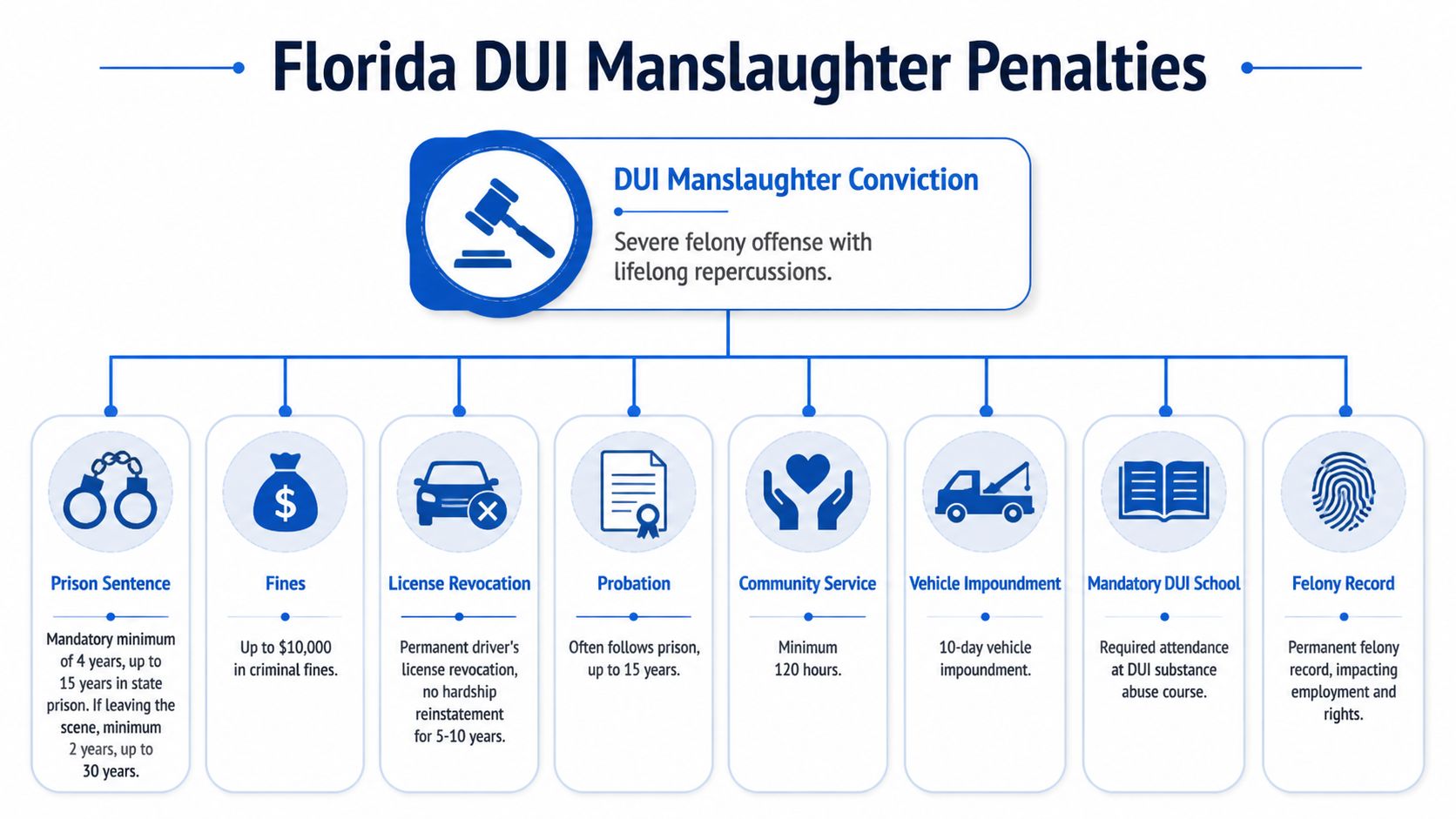
The prison exposure is rigid
Florida's sentencing grid for DUI manslaughter imposes a rigid 4-year mandatory minimum prison term, which a judge cannot deviate from. This is starkly different from DUI with serious injury, a third-degree felony with no mandatory minimum, as outlined in this explanation of Florida DUI manslaughter penalties.
The broader penalty structure is brutal:
Second-degree felony exposure: DUI manslaughter is charged as a second-degree felony.
Mandatory prison term: The court must impose at least 4 years in prison.
Maximum prison term: The sentence can reach 15 years.
Fine exposure: The court can impose up to $10,000 in fines.
License consequences: Permanent revocation is on the table, with limited hardship discussion arising much later and only in certain circumstances.
If the state alleges that you fled the scene after a fatal DUI crash, the case becomes even more dangerous. Florida law allows that allegation to upgrade the charge to a first-degree felony with up to 30 years in prison.
Here is a concise review of the broader DUI punishment framework in Florida DUI penalty guidance.
To understand how lawyers explain these sentencing consequences in practice, this video is useful:
The damage goes beyond prison
A conviction does not stop at sentencing day. It follows you into work, housing, professional licensing, immigration concerns, and every background check that asks whether you’ve been convicted of a felony.
That’s why the early phase of the case matters so much. In a charge with a mandatory prison floor, pretrial work becomes critical. Suppression issues, expert review, negotiation advantage, and causation challenges are not side topics. They are the whole fight.
Practical rule: In a case with mandatory prison exposure, the goal is not to “explain yourself better.” The goal is to attack the prosecution’s proof before the case hardens.
What Happens After a DUI Manslaughter Arrest
The process feels chaotic if no one is guiding you. It feels much different when someone is controlling deadlines, court appearances, evidence requests, and communication with the state.

The first court stages move fast
After arrest, you usually move into booking, initial charging review, and an early court appearance. In Miami-Dade, that can place you in proceedings tied to the Richard E. Gerstein Justice Building. Other counties follow the same basic rhythm even if the courthouse changes.
The early stages often include:
Booking and hold conditions: You may be processed while investigators continue collecting evidence.
First appearance: A judge reviews release conditions and the posture of the case.
Formal charging decisions: Prosecutors decide what to file based on reports, toxicology, and crash evidence.
Arraignment and scheduling: The court sets the path for motions, discovery, and hearings.
If you want a broader look at the procedural timeline after a DUI arrest, this guide on what happens after a Florida DUI arrest provides useful context.
What your lawyer should be doing early
A serious lawyer does not sit back and wait for discovery to arrive. Early defense work should be active and aggressive.
That includes things like:
Securing crash evidence: Vehicle data, photos, surveillance footage, and witness information need immediate attention.
Reviewing the stop and seizure issues: If police acted unlawfully, that can shape the whole case.
Checking toxicology foundations: Blood handling, timing, and documentation often matter.
Controlling client communication: You should not be talking to police, insurance investigators, or witnesses without legal advice.
The most dangerous period in these cases is often the beginning, because people are desperate to sound cooperative. Cooperative is not the same as protected. Your lawyer’s job is to make sure the record gets built carefully, not emotionally.
The prosecution uses the time after arrest to tighten its story. Your defense lawyer should be using the same time to break it apart.
If your case eventually moves toward motions or trial, everything done in the first stretch becomes important. Weak scenes get cleaned up. Memories shift. Digital evidence disappears. Early control is not optional.
How Can You Defend Against This Charge
A real defense in a dui manslaughter florida case does not rely on one argument. It is built in layers. If one issue weakens, another issue still matters. That is how serious felony defense is supposed to work.
A real defense attacks the case on multiple fronts
Start with the stop. If law enforcement lacked a lawful basis to stop or detain you, your lawyer may be able to challenge what came after. That can affect statements, roadside observations, testing, and the entire flow of the case.
Then move to impairment evidence. Field sobriety exercises, breath testing, blood draws, officer observations, and witness accounts all need scrutiny. A prosecutor may present them as flawless. They rarely are.
The third front is often the most important. Causation. Even if the state believes it can show impairment, it still has to prove the required link between your driving and the death. That is where reconstruction work, vehicle evidence, medical evidence, and scene analysis can change everything.
If your lawyer identifies constitutional or evidentiary problems, a motion to suppress evidence in Florida DUI cases can become a central defense tool.
Your record can shape negotiations early
Many people focus only on the crash and forget that prosecutors also evaluate the person accused. That is a mistake. Your prior driving record, even seemingly minor tickets, can significantly impact a prosecutor's stance in a DUI manslaughter case. Prosecutors may view a history of violations as evidence of a "career criminal" pattern, making them less willing to negotiate and pushing them toward a hard-line stance from the outset, as discussed in this analysis of prior driving history and DUI manslaughter strategy.
That means defense preparation should include more than attacking the state’s evidence. It should also include controlling how your history is framed. Context matters. Pattern arguments matter. Negotiation posture matters.
Good defense is not just courtroom argument. It is evidence control, narrative control, and timing.
What Immediate Steps Must You Take to Protect Yourself
You need a clean action plan. Not tomorrow. Now.

Immediate steps to take
Stop discussing the case: Don’t explain the crash to police, friends, coworkers, or on social media. Every version of events creates risk.
Follow aid and identification laws carefully: You must comply with legal duties at the scene, but you do not need to volunteer damaging narratives.
Write down your timeline privately: As soon as possible, record where you were, what you consumed, who you spoke to, what officers said, and what medical treatment occurred.
Preserve anything that may help: Save photos, call logs, rideshare records, receipts, location history, and names of possible witnesses.
Get direct legal counsel immediately: You need to speak with an attorney who can answer you by phone or text, not a middleman relaying messages hours later.
Your behavior at the scene is evidence. While you must comply with laws requiring you to render aid, how you interact with police and witnesses can be used against you. Case law, including Rubinger v. State, shows that even “unusual” post-crash conduct can be used to imply guilt, as discussed in this review of post-crash conduct and DUI manslaughter evidence.
Why direct attorney communication matters
For a charge this severe, indirect communication is unacceptable. If your freedom is on the line, you should not be waiting for a call back from intake staff, chasing updates through an app, or trusting a high-volume ticket mill to handle a felony death case with the same workflow used for routine citations.
One option is Ticket Shield, PLLC, a Florida law firm where clients communicate directly with their attorney by phone or text instead of going through automated systems or non-lawyer middlemen. In a case like this, that structure matters because fast answers affect what you say, what you sign, and what evidence gets preserved.
Your life is not a file number. It is your job, your license, your family, and your future. Treat it that way.
If you’re facing dui manslaughter florida charges, get direct legal guidance now. Ticket Shield, PLLC offers a free consultation, and the goal is simple: protect your record, protect your license, and fight for the No Points outcome wherever the facts and law allow.
