A Guide to Driving with a Suspended License in Florida
Pulled over while driving with a suspended license in Florida? Understand the serious penalties, your legal options, and how to get your license back.
When you get a notice saying your Florida driver's license has been suspended, it's easy to feel confused and a little panicked. In simple terms, a license suspension is a temporary hold on your driving privileges. It’s not the end of the road—you can get it reinstated once you take care of whatever caused the problem in the first place. This is completely different from a revocation, which is a total cancellation of your license.
Why Your Florida License Was Suspended
A license suspension can feel like a direct punishment for something you did on the road, but the reality is often much more complicated. A lot of drivers, especially in busy places like Miami-Dade County, are shocked to find out their license was suspended for something that had nothing to do with dangerous driving. Figuring out the exact reason is the first step to getting back on the road legally.
Think of it like this: a suspension is the Florida Department of Highway Safety and Motor Vehicles (DHSMV) hitting the "pause" button on your driving privileges. Your ability to drive is on hold until you take specific actions to press "play" again. A revocation, on the other hand, is like the state deleting your driver profile entirely, forcing you to start over from scratch after a long waiting period—if you're even allowed to.
Common Reasons for License Suspension
The reasons your license can get suspended fall into two main buckets: driving-related and non-driving-related issues. While most people think it’s all about serious traffic offenses, the data paints a very different picture.
Driving-Related Issues: These are the ones everyone expects. Things like racking up too many points on your record in a short time, a DUI conviction, or causing a crash without having the proper insurance.
Non-Driving-Related Issues: This category is way broader and is behind a massive number of suspensions. It includes things like failing to pay a traffic ticket, not paying court-ordered child support, or skipping a mandatory court date.
Here's a quick rundown of what can lead to a suspension in Florida.
Florida License Suspension Quick Facts
Aspect of Suspension | Key Details for Florida Drivers |
|---|---|
Common Causes | Failing to pay traffic tickets or court fees, not paying child support, DUI convictions, and accumulating too many license points. |
Notice Requirement | The DHSMV is required to mail a notice to your last known address on file. Not receiving it because you moved is not a valid legal defense. |
Suspension vs. Revocation | A suspension is temporary and can be reinstated. A revocation is a complete cancellation of your license. |
Primary Reason | The vast majority of suspensions are for non-driving reasons, primarily failure to pay fines and fees. |
The reality is, most suspensions have nothing to do with making the roads safer.
It’s a surprising fact, but research shows that over 90% of license suspensions nationwide are for non-driving events, with the failure to pay fines or fees being the number one cause. Florida is very active in this area, suspending thousands of licenses every year for issues completely separate from a person's ability to drive safely.
Important Note: Claiming you "didn't know" your license was suspended is almost never a winning defense. The state usually only needs to prove that a notice was mailed to the last address you had on file with the DHSMV. If you moved and forgot to update it, you're still considered legally notified.
The Problem of Unknowing Suspensions
Many drivers in Florida get caught in a tough spot, driving around completely unaware their license has been suspended. A notification letter from the DHSMV might get sent to an old address, or a ticket from years ago that you thought was resolved could finally trigger a suspension without you knowing it.
Unfortunately, not knowing doesn't get you off the hook. The consequences for driving on a suspended license can be severe, escalating quickly from a citation to a criminal charge with potential jail time. This is why it’s so critical to get to the bottom of the suspension and fix it. You can learn more by checking out our guide on driver's license suspension in Florida. Taking action and getting guidance is one way to protect your license and your record.
The Escalating Penalties for a DWLS Charge
In Florida, a Driving While License Suspended (DWLS) charge is a whole lot more than a simple traffic ticket. The consequences snowball fast, depending on your driving history and—most importantly—whether you knew your license was suspended in the first place.
It's not a one-size-fits-all penalty. A DWLS can be a minor civil infraction, not much different than a speeding ticket, or it can be a life-changing felony. The key that unlocks the criminal charges is "knowledge." If the state can't prove you were aware of the suspension, it's just a moving violation. But if they can show you were properly notified, you're suddenly facing a criminal court.
First Offense With Knowledge: A Second-Degree Misdemeanor
The first time you're caught driving on a suspended license with knowledge, the charge is a second-degree misdemeanor. It might be the lowest-level criminal offense for DWLS, but the penalties are a serious wake-up call.
A conviction can mean:
Up to 60 days in jail.
A fine of up to $500.
An even longer license suspension period.
This first step into the criminal justice system creates a permanent record that can follow you around, affecting everything from job applications to insurance rates. It’s the state's way of saying they don't take driving without a valid license lightly.
Second Offense: A First-Degree Misdemeanor
Get a second DWLS conviction with knowledge, and the charge gets bumped up to a first-degree misdemeanor. The potential penalties double, because now the state sees a pattern of behavior that ignores the law and puts public safety at risk.
For a second offense, you could be looking at:
Up to one year in jail.
A maximum fine of $1,000.
An offense at this level carries serious weight. A conviction will almost certainly send your insurance premiums through the roof and can be a major roadblock for any job that requires a clean driving record or a professional license.
A Critical Point: Each DWLS conviction digs you into a deeper hole. It gets progressively harder and more expensive to get your license back and clear your name. Without a sound legal strategy, it can feel like a cycle you can't break.
This flowchart breaks down some of the common reasons a license gets suspended to begin with.
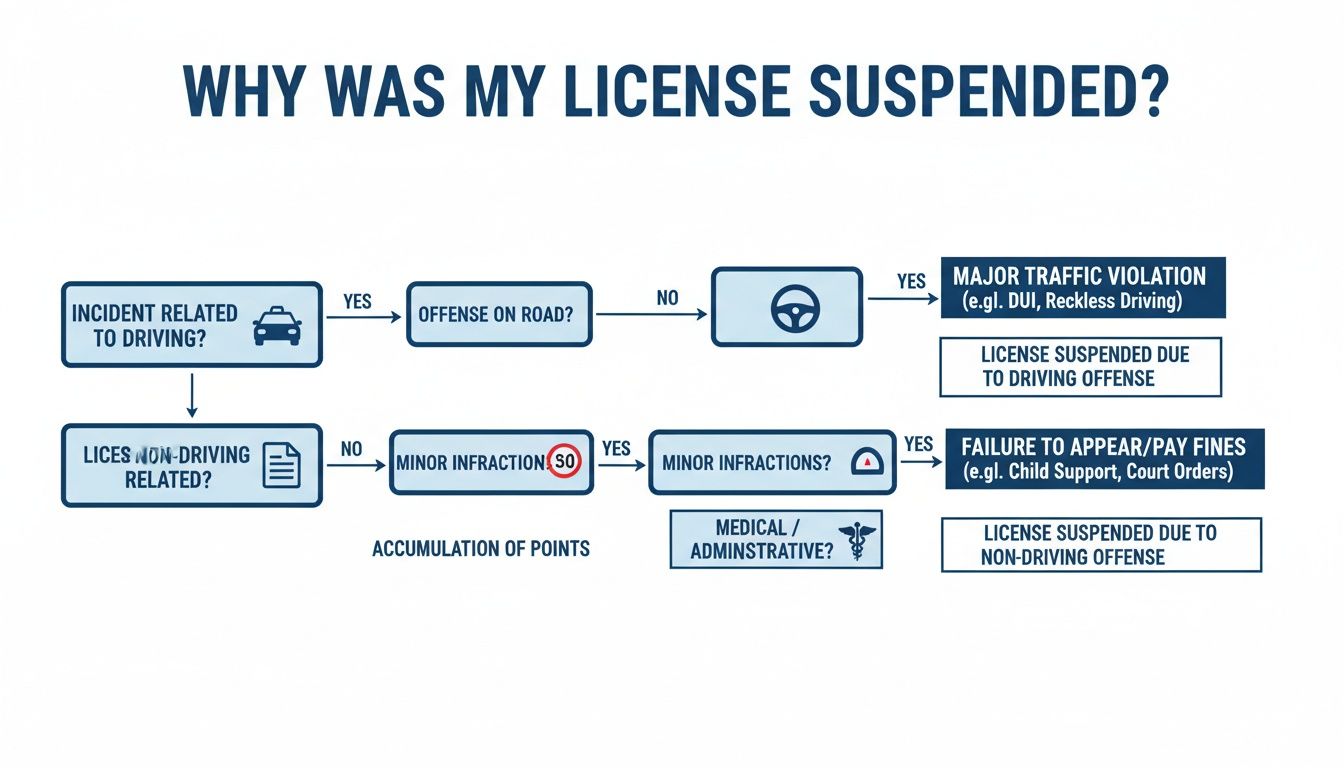
As you can see, suspensions can come from all sorts of places—some related to driving, some not. Many of these issues can be fixed before they ever lead to a criminal charge.
Third Offense: The Path to a Felony
A third or subsequent conviction for DWLS with knowledge escalates to a third-degree felony. This is a dramatic jump with severe, long-term consequences that can impact your fundamental rights, like your right to vote or own a firearm.
The penalties for a third-degree felony DWLS are steep:
Up to five years in state prison.
A maximum fine of $5,000.
At this point, the court no longer sees this as a traffic mistake. It’s viewed as a serious crime. For a deeper look at what these consequences entail, you can learn more about the penalties for driving with a suspended license in our detailed guide.
Habitual Traffic Offender Status
Beyond the individual criminal charges, racking up multiple serious traffic offenses can get you branded a Habitual Traffic Offender (HTO) by the Florida DHSMV. This isn't a criminal charge itself, but an administrative status that triggers a mandatory five-year driver's license revocation.
Three or more convictions for major offenses like DWLS or DUI within a five-year window will land you on the HTO list. Once you're designated, you can't even apply for a hardship license for at least the first year. This is why fighting every single DWLS charge is so critical—it’s about avoiding that devastating five-year revocation down the road.
What to Do Immediately After a DWLS Stop
Seeing flashing lights in your rearview mirror is always a stressful moment. But when you know—or even just suspect—that your license might be suspended, that stress can instantly turn into pure panic. What you do in the moments and days that follow is incredibly important and can directly shape the outcome of your case.

The first and most critical rule is simple: remain calm and polite. Being cooperative and respectful with the officer will never hurt your situation. Arguing or getting confrontational can take a routine traffic stop and escalate it into something much more complicated.
Under no circumstances should you ever try to drive away from the scene after getting a ticket for driving with a suspended license. That’s a separate, serious offense that will only make your legal problems much worse. Call a licensed friend or family member to come get you, or arrange for a rideshare.
Taking Control of the Situation
Once you're safely away from the traffic stop, it's time to shift your focus to what comes next. The single most impactful step you can take is to seek legal advice immediately. A charge for driving with a suspended license in Florida isn't something to tackle on your own, especially since it can quickly become a criminal matter.
Our goal is to protect your license and record. Contacting an attorney for a free consultation allows you to understand the specific charges you're facing and the potential legal pathways available to you without any commitment. Past results do not guarantee future outcomes.
To make that first consultation as productive as possible, start gathering all the relevant paperwork. The more information you can provide, the better an attorney can size up your case.
Key Documents to Collect:
The Citation or Arrest Paperwork: This is the most crucial document. It spells out the exact statute you’re accused of violating.
Any Court Notices: If you've received a notice with a court date or other instructions, bring it.
Correspondence from the DHSMV: Any letters or notices about your suspension are vital. They can be central to building a defense.
Your Driving Record: If you have a copy, it gives your attorney immediate context about your driving history.
When sorting through the aftermath of a DWLS stop, a tool like a Legal Traffic Ticket Analyzer can help bring some clarity to the charges and guide your immediate response. Understanding the details of the citation is a key first step.
Why You Need to Act Quickly
Time is not on your side after being cited for driving with a suspended license. There are strict deadlines for responding to the court and for addressing the underlying suspension itself. Waiting too long can lead to a default judgment against you or even a warrant for your arrest if you miss a court date.
It's also essential to figure out why your license was suspended in the first place. You can read more about this in our guide on how to check if your license is suspended. Taking action to resolve the original problem—like paying an old fine or finishing a required course—can sometimes be a positive factor when your case gets to court.
By contacting a law firm that focuses on traffic defense, you put a knowledgeable advocate in your corner. Our office, located in Broward, handles criminal traffic matters across Florida. A legal professional can start working on your behalf, often without you ever needing to step foot in a courtroom.
How a Strong Legal Defense for DWLS Is Built
When you're facing a charge for driving with a suspended license (DWLS), you need more than just a quick fix—you need a smart, proactive legal strategy. The objective isn't just to deal with the immediate ticket or arrest. It's about building a solid defense that protects your driving record, your finances, and your ability to get back on the road legally.
A successful defense is built by digging into the details of your specific case. This starts with a deep understanding of Florida's traffic laws and involves a meticulous analysis of everything, from the reason for the initial traffic stop to the state's actual proof of your license suspension.
Challenging the Element of Knowledge
Here’s the most important thing to understand about a DWLS charge in Florida: the line between a minor civil ticket and a serious criminal offense comes down to one simple word—"knowledge."
To get a criminal conviction, the prosecutor has to prove, beyond a reasonable doubt, that you knew your license was suspended. This is often the cornerstone of a powerful defense.
But what does the state consider legal notice? Typically, mailing a suspension order to the last address you gave the Florida DHSMV is enough. If you moved and forgot to update your address, the law often still considers you officially notified.
An experienced legal team will immediately start asking critical questions:
Was the notice mailed correctly? Clerical mistakes happen all the time. Was the letter sent to the right address on file at the exact time of the suspension?
Was there a system error? Sometimes, a suspension is triggered by a mistake at the court or the DHSMV. Uncovering these errors can get a case dismissed.
Did you actually receive the notice? While this is harder to prove, circumstances around mail delivery to your home could play a role.
Challenging the "knowledge" element is a technical legal fight that requires a careful review of state records and procedures. It’s one of the best examples of why having professional legal help is so critical.
Negotiation and Mitigating Factors
A positive outcome in a case doesn't always happen in a dramatic courtroom showdown. Often, a favorable resolution is secured through skillful negotiation with the prosecutor. An attorney knows how to present your situation in the best possible light, aiming to get the charge reduced to a much less severe offense.
A common and highly effective strategy is to negotiate a criminal DWLS charge down to "No Valid Driver's License" (NVDL). This is a game-changer. An NVDL is a civil infraction, not a crime, which means no jail time and no permanent criminal record. An outcome like this is a huge win, protecting you from the damaging long-term consequences of a criminal conviction.
Taking proactive steps before your court date can also make a huge difference. We call these "mitigating factors":
Fixing the original problem: If an unpaid ticket caused the suspension, paying it off shows the judge and prosecutor you're taking responsibility.
Getting a valid license: If you can get your license fully reinstated before going to court, the prosecutor will be far more willing to amend or even drop the charge.
A strong legal defense for DWLS often starts with thorough research; mastering how to conduct legal research is paramount for uncovering relevant statutes, case precedents, and legal arguments that can be applied to your situation.
The Broader Context of License Suspensions
It's also important to understand that license suspensions don't happen in a vacuum. They often create tremendous hardship, hitting some communities much harder than others. Many suspensions are for non-driving issues, trapping people in a cycle of debt and legal trouble they can't escape.
Research shows that suspensions for unpaid fines and fees are heavily concentrated in areas with lower incomes and higher minority populations. This effectively turns a financial problem into a criminal one. The Fines and Fees Justice Center found that dozens of states use license suspensions to collect debt, a practice that criminalizes poverty and makes it harder for people to get to work and support their families.
Disclaimer: Every case is unique, and past results do not guarantee future outcomes. The strategies discussed here are potential avenues for defense that an attorney may explore based on the specific facts of a case.
Understanding these complexities is part of building a complete defense. If you're facing a criminal charge for a suspended license, you need a team that sees the whole picture. You can learn more about how we handle these cases by reading about our approach to criminal suspended license defense.
Navigating the Path to License Reinstatement
After getting hit with a charge for driving on a suspended license, the finish line is clear: getting your driving privileges back. The road to reinstatement can feel like a maze of government paperwork and requirements, but with a clear plan, you can absolutely get it done. It all starts with one simple question: why was your license suspended in the first place?

Your first move—and the most important one—is to use the Florida Department of Highway Safety and Motor Vehicles (DHSMV) online portal. Think of this as your official cheat sheet. It will spell out every single outstanding issue, fine, and requirement tied to your license, giving you a personalized roadmap of what you need to fix.
The Standard Reinstatement Process
Once you know what’s holding up your license, you can start knocking down the obstacles one by one. Every situation is a bit different, but most reinstatements involve some combination of the following.
Paying Outstanding Fines and Fees: This is the big one. Unpaid traffic tickets, old court costs, or other government debts are often the root cause of a suspension. You’ll have to clear those balances first.
Completing Required Courses: Depending on the violation, the state might require you to complete certain classes. This could be a basic driver improvement course (what most people call traffic school) or the more intensive Advanced Driver Improvement (ADI) course.
Satisfying Court Requirements: If a criminal charge led to your suspension, you must finish whatever the court ordered. This means completing probation, community service, or any other sanctions before the DHSMV will even look at your reinstatement.
Paying the State Reinstatement Fee: Once every other box is checked, you have to pay an official reinstatement fee directly to the state of Florida. This is the final step to getting your license back in good standing.
Keep in mind, this entire administrative process is happening at the same time as your criminal case for driving with a suspended license. An attorney can help you manage both tracks, making sure the steps you take with the DHSMV also help you get a better result in court.
Understanding the Hardship License
For most of us, not being able to drive means not being able to work, get to school, or take care of our families. If losing your license has created an "undue hardship," you might be eligible for a restricted license, better known as a hardship license. This isn't a full reinstatement, but it's a special permit that lets you drive for specific, essential reasons.
Important Clarification: A hardship license is a limited privilege, not a right. It typically restricts you to driving for work ("business purposes only") or essential activities like doctor's appointments and grocery runs ("employment purposes only"). If you get caught violating those restrictions, you’re looking at another arrest and even tougher penalties.
Whether you qualify depends entirely on why your license was suspended in the first place. Some offenses, like a DUI, come with a mandatory "hard suspension" period where no driving is allowed, period. For other issues, like unpaid tickets, you might be able to apply for a hardship license much sooner. You can dig deeper into the process in our detailed guide on how to reinstate a suspended license in Florida.
To apply, you have to prove your need to the DHSMV, and that usually means completing required courses and paying some fees upfront. An attorney can help you figure out if you're eligible and put together a strong application, which boosts your chances of getting approved. This can be a critical lifeline, allowing you to keep your life on track while you work toward getting your full license back.
Protecting Your Future from a DWLS Conviction
The consequences of a conviction for driving with a suspended license (DWLS) ripple far beyond the courtroom. While you might be focused on the immediate fines and potential jail time, the long-term damage to your personal and professional life can be much more severe and lasting. It’s crucial to understand what’s really at stake and why fighting the charge is so important.
A criminal DWLS conviction in Florida isn’t some temporary mark that fades away. It becomes a permanent part of your public record, visible to anyone who runs a background check. This can create massive hurdles for years to come, long after you’ve paid the fines and gotten your license back.
The Lasting Mark on Your Professional Life
For most of us in Florida, a car isn't a luxury—it's how we get to work. A DWLS conviction can directly threaten your livelihood, especially if your job involves driving in any capacity.
Employment Background Checks: When you apply for a new job, employers almost always run a background check. A criminal traffic conviction is a major red flag that could cost you a great opportunity.
Jobs Requiring Driving: For any position that requires a clean driving record—think delivery, sales, or field services—a DWLS conviction is often an automatic disqualifier.
Professional Licenses: Certain professional licenses in fields like real estate or healthcare can be jeopardized by a criminal record, putting up a serious barrier to your career.
This single charge can slam doors you never even knew were there, making it that much harder to build the future you want. Our goal is to protect your record because we know the stakes are so much higher than a simple traffic violation.
The Financial Fallout: Insurance Premiums
One of the most immediate and painful financial hits from a DWLS conviction comes from your auto insurance. Insurance companies see this conviction as a clear sign of high-risk behavior, and they will adjust your rates accordingly.
A conviction will almost certainly lead to a massive hike in your insurance premiums, sometimes by hundreds or even thousands of dollars every year. In some cases, your insurer may just drop your policy altogether, labeling you as too high-risk to cover.
This often forces drivers into needing SR-22 insurance. It’s not actually a type of insurance, but a certificate your insurer files with the state to prove you have liability coverage. It's expensive, required for several years, and instantly signals to any insurance company that you are a high-risk driver.
The financial strain can be immense. Beyond the court fees and fines, the spike in insurance costs can cripple your budget for years.
The Public Safety Perspective
State agencies view driving with a suspended license as a serious public safety issue. They operate on the assumption that if someone is willing to drive without a valid license, they're more likely to be involved in accidents—and that's why the penalties are so strict. Research from the California Department of Motor Vehicles found that drivers with suspended licenses are over 2.5 times more likely to cause fatal crashes compared to licensed drivers. You can learn more about the research on suspended drivers and crash rates.
This perspective is why prosecutors and judges in Florida take these cases so seriously. In their eyes, they’re upholding the integrity of the licensing system and keeping the roads safe for everyone. This reinforces the need for a strong legal strategy that tackles the charge head-on, with the goal of protecting your long-term financial stability and professional opportunities. Remember, past results do not guarantee future outcomes.
Common Questions About Florida DWLS Charges
Getting hit with a charge for driving with a suspended license (DWLS) can be a confusing and stressful experience. It’s only natural to have a ton of questions about what comes next.
Below are some of the most common questions we hear from drivers across Florida. While this info can help you get your bearings, remember that it's not a substitute for real legal advice. Every case has its own unique twists, and a free consultation with an attorney is the best way to understand the options for your specific situation.
What’s the Difference Between Driving "With" and "Without" Knowledge?
This is probably the single most important question in any DWLS case. The "knowledge" element is the bright line that separates a simple civil ticket from a criminal charge here in Florida.
Driving "without knowledge" is treated as a non-criminal traffic violation, pretty much on the same level as a speeding ticket. It means the state can't prove you were officially notified that your license was suspended.
But driving "with knowledge" changes everything. This means the prosecutor believes they can prove you were properly notified of the suspension—maybe through a certified letter or a direct statement from a judge. A first offense with knowledge is a second-degree misdemeanor, a criminal offense. A huge part of any defense strategy involves challenging whether the state can actually prove you knew.
Can I Get a Hardship License in Miami-Dade County?
Whether you can get a hardship license in Miami-Dade—or anywhere else in Florida—boils down to one thing: why your license was suspended in the first place.
For some issues, like failing to pay fines or tickets, you might be eligible for a hardship license after you take care of certain requirements with the DHSMV.
However, for more serious offenses like a DUI conviction or being labeled a Habitual Traffic Offender, you're likely facing a mandatory "hard suspension" period. During this time, no driving is permitted, period. An attorney can help figure out if you're eligible and walk you through the DHSMV's often-confusing application process.
Our Goal is to Protect Your License and Record. A criminal conviction can create problems that follow you for years. Getting legal guidance early gives you the best shot at understanding your rights and building a solid defense. Past results do not guarantee future outcomes.
How Long Does a DWLS Charge Stay on My Record?
This is a critical question with two very different answers.
A civil DWLS ticket (the "without knowledge" kind) will add points to your license, but those points eventually fall off after a few years.
In stark contrast, a criminal DWLS conviction remains on your permanent criminal and driving record in Florida indefinitely. It never goes away. This is exactly why it's so important to handle the charge with experienced legal help. Our objective is always to protect your record by fighting to avoid a criminal conviction, preserving your future opportunities.
A charge for driving with a suspended license is a serious legal problem with lasting effects. At Ticket Shield, PLLC, our practice is focused on traffic and DUI defense. We handle criminal traffic matters all across Florida, and our goal is to protect your license, your record, and your peace of mind. For a free consultation to discuss the specifics of your case, visit us at https://www.ticketshield.com.
Attorney Advertisement. Office in Broward.