Drivers License Suspension in Florida: A Guide to Protecting Your Rights
Facing a drivers license suspension in florida? Learn why it happens, types, and steps to protect your driving privileges today.
Receiving a notice about a drivers license suspension in Florida can be a deeply unsettling experience. It's crucial, however, to understand what this action means. A suspension is not a permanent revocation of your driving privileges; it's a temporary hold placed by the state for various reasons, ranging from accumulating too many points to more serious infractions.
What a Florida Drivers License Suspension Really Means

Simply put, a drivers license suspension in Florida is an official action that renders your license invalid for a specific period. During this time, you are legally prohibited from operating any motor vehicle. This is not a mere suggestion—being caught driving with a suspended license is a significant offense with its own severe penalties.
The purpose of a suspension is to uphold traffic laws and promote road safety by temporarily removing drivers who have demonstrated risky behavior or failed to meet their legal obligations. Identifying the "why" behind your suspension is always the first, most critical step toward regaining your license.
Two Paths to Suspension
In Florida, your driving privileges can be suspended through two entirely different channels. This is a significant source of confusion for many drivers because each path operates on its own track.
Administrative Suspension (DHSMV): This is issued directly by the Florida Department of Highway Safety and Motor Vehicles (DHSMV). It is an administrative action, not a criminal one, and is often triggered automatically by certain events.
Court-Ordered Suspension: This is a penalty imposed by a judge as part of a sentence for a traffic-related conviction, whether criminal or civil. It is a direct consequence of a courtroom decision.
It is entirely possible to face both types of suspensions for the same incident, especially in DUI cases. Here’s the critical part: winning your court case does not automatically resolve an administrative suspension, and clearing an administrative issue will not stop a judge's order. They are separate systems.
Key Takeaway: A license suspension is a temporary pause on your driving privileges, not a permanent loss. It can be initiated either by the DHSMV through an administrative process or by a judge in court, and these two systems function independently.
Common Triggers for License Suspension
The reasons for a drivers license suspension in Florida vary widely. While many people associate suspensions with major violations like DUIs, a large number begin with smaller issues that accumulate over time.
To provide a clearer picture, here is a quick overview of common reasons for suspension, their potential duration, and the governing authority.
Florida License Suspension at a Glance
Reason for Suspension | Typical Duration | Governing Authority |
|---|---|---|
Too Many Points | 30 days to 1 year | DHSMV |
Unpaid Traffic Ticket | Indefinite (until resolved) | DHSMV (initiated by Clerk of Court) |
DUI Arrest (Refusal/BAC .08+) | 6 months to 18 months | DHSMV (Administrative) |
DUI Conviction | 6 months to permanent | Court |
Failure to Pay Child Support | Indefinite (until resolved) | DHSMV (initiated by Dept. of Revenue) |
Failure to Carry Insurance | Indefinite (until resolved) | DHSMV |
This table illustrates the wide range of triggers and timelines. Understanding which authority issued the suspension is crucial for determining your next steps.
For instance, a single unpaid traffic ticket can escalate quickly. If you fail to pay a fine or appear in court, the clerk notifies the DHSMV, which then suspends your license until the matter is resolved. Similarly, accumulating too many points on your driving record within a short period will trigger an automatic suspension. You can find more details on penalty durations in our guide on how long a license suspension lasts.
Other common reasons that can catch drivers off guard include:
Failure to pay court-ordered child support.
A conviction for certain drug-related offenses.
Being designated a Habitual Traffic Offender (HTO).
Failure to maintain required auto insurance.
Navigating the aftermath of a suspension notice requires a clear head and a solid understanding of who suspended you and why. This foundational knowledge is essential for any effective strategy to protect your license and get back on the road legally.
The Hidden Costs of Debt-Based License Suspensions

Many people assume a drivers license suspension in Florida results from a serious event like a high-speed chase or a major accident. The reality is often more mundane. Frequently, the trigger isn’t dangerous driving at all—it’s an unpaid traffic ticket.
This is where a minor financial issue can spiral into a major legal and economic hardship. A simple citation for a broken taillight or failing to stop completely can initiate a damaging chain reaction. If you miss the payment deadline, late fees are added, and the amount you owe begins to climb.
This system disproportionately affects individuals who may not have the immediate funds to cover the ticket, turning a small problem into a massive roadblock. Understanding how this financial trap works is the first step to avoiding it—or finding your way out if you're already caught.
The Snowball Effect of Fines and Fees
Imagine receiving a traffic ticket in Miami-Dade County. The initial fine might seem manageable, but life happens, and you miss the deadline. Suddenly, the consequences multiply. The original fine becomes buried under late penalties and administrative fees, growing larger each day.
Eventually, the clerk of court sends a notification to the Florida Department of Highway Safety and Motor Vehicles (DHSMV) about the unpaid ticket. That single notification automatically triggers an indefinite suspension of your driver's license. The suspension remains in effect until you pay the original fine and all associated fees that have accumulated.
This is how a simple traffic violation transforms into a debt-based license suspension. It’s an automated, impersonal process that ensnares countless drivers in a system designed to compel payment using the one thing most people cannot live without: their driver's license.
Key Insight: Debt-based suspensions often function as a debt collection tool rather than a public safety measure. A driver who cannot afford a $200 ticket is often the same person who cannot afford to lose their job because they can't legally drive to work.
The Statewide Impact of Financial Suspensions
This is not an isolated issue; it is a massive problem across Florida. Over 700,000 drivers in the state have had their licenses suspended not for being dangerous, but for being unable to pay fines and fees. This staggering number highlights how debt-based policies can trap everyday people in a difficult cycle.
According to a 2023 report, this means hundreds of thousands of Floridians may feel compelled to drive illegally, often without insurance, further worsening their financial situation.
This cycle has real-world consequences that extend far beyond the inability to drive:
Job Security: Many Floridians require a car for work. A suspended license can easily lead to job loss, making it feel impossible to pay off outstanding fines.
Increased Insurance Costs: After finally reinstating your license, you are often faced with higher insurance premiums due to the suspension on your driving record.
Further Legal Trouble: Feeling trapped, many people continue driving on a suspended license. If caught, they face a new criminal charge, additional fines, and an even longer suspension.
To better understand how financial issues can impact driving privileges, it's useful to know whether debt collectors can directly cause your license to be suspended. This resource provides clear answers: Can Debt Collectors Suspend Your License.
Breaking the Cycle Before It Starts
The most effective way to avoid a debt-based suspension is to address a traffic ticket as soon as you receive it. However, simply paying it isn't always the wisest move, as that can still add points to your record and increase your insurance rates.
Exploring your legal options can help you handle the citation without jeopardizing your license. A proactive approach is key. By understanding how a small fine can escalate into a major problem, you can take the necessary steps to prevent it from derailing your job, finances, and future. For a closer look at the costs involved, see our article on understanding court costs for a traffic ticket.
Navigating DUI and Traffic Point Suspensions
While many license issues stem from unpaid fines, a drivers license suspension in Florida is often linked to more serious driving offenses. Two of the most significant triggers are accumulating too many traffic ticket points and facing a Driving Under the Influence (DUI) charge. These situations are entirely different—they carry much heavier consequences and require a swift, strategic response to protect your license.
Unlike suspensions for debt, these are directly tied to your behavior behind the wheel. The state views these offenses as serious indicators of risk, which is why the Florida Department of Highway Safety and Motor Vehicles (DHSMV) imposes stricter penalties.
The Florida Traffic Point System Explained
Florida uses a point system to monitor drivers. Every moving violation, from speeding down the Palmetto Expressway to running a red light in Miami-Dade County, adds points to your driving record. If you accumulate too many points within a set timeframe, the DHSMV will automatically suspend your license.
Think of it as a progressive disciplinary system. A single ticket might not cause a suspension, but a series of them in a short period will. It’s the state’s method of identifying drivers who repeatedly violate traffic laws and temporarily removing them from the road.
Here’s the breakdown of how points trigger a suspension:
12 points within a 12-month period results in a 30-day suspension.
18 points within an 18-month period leads to a 3-month suspension.
24 points within a 36-month period means you lose your license for a full 1-year.
Knowing these thresholds is crucial. Each ticket you receive pushes you closer to a mandatory suspension, making it essential to handle every citation with care.
The Two Battles of a DUI Charge
A DUI charge in Florida initiates two separate and distinct legal processes, both of which can lead to a license suspension. Understanding this is vital because winning one does not guarantee a victory in the other.
The Administrative Suspension: This is immediate and comes directly from the DHSMV. If you refuse a breath, blood, or urine test, or if your blood alcohol content (BAC) is .08 or higher, the arresting officer confiscates your license on the spot. This action triggers an administrative suspension that begins automatically.
The Court-Ordered Suspension: This is a separate penalty resulting from the criminal court case. If you are convicted of DUI in court, the judge will impose another suspension as part of your sentence. This is independent of the administrative one.
Critical Deadline: After a DUI arrest, you have only 10 days to formally challenge the administrative suspension. Missing this deadline means you automatically forfeit your right to contest it, and the suspension will take effect.
Understanding the Stakes of a DUI Suspension
The stakes in a DUI case are extremely high, affecting much more than just your license—they impact your finances and future significantly. The administrative suspension for a first-time breath test refusal is a full year. A second refusal results in an 18-month suspension and may even lead to a separate criminal charge.
Here's something many people don't realize: even if an experienced attorney gets your criminal DUI charge reduced to a lesser offense like reckless driving, the administrative suspension from the DHSMV does not disappear. The two processes are completely separate. A favorable outcome in the courtroom does not automatically cancel the DHSMV's decision. You can get a more detailed look at this complex process in our guide on DUI license suspensions in Florida.
This means a solid defense requires a two-pronged approach: one strategy for the criminal court and another for the DHSMV hearing. Our goal is to protect your license and record on both fronts. While past results do not guarantee future outcomes, a proactive approach is essential when your driving privileges are at risk from either points or a DUI.
A Roadmap to Reinstating Your Florida License
Getting your license back after a drivers license suspension in Florida can feel like navigating without a map. Fortunately, it’s a process with a clear path forward. The very first step—before anything else—is to determine the exact reason why your license was suspended. You can obtain this crucial information directly from the Florida Department of Highway Safety and Motor Vehicles (DHSMV) through their online portal.
This isn’t just a recommendation; it's the foundation of your entire reinstatement plan. Once you know the specific cause—whether it's unpaid tickets, too many points, or a DUI—you can begin taking the appropriate steps to get back on the road legally.
The Reinstatement Journey Step-by-Step
Think of reinstating your license as completing a checklist. Your task is to address each item required for your specific situation. While every case has unique elements, most reinstatement plans involve some combination of these actions.
Satisfy All Fines and Fees: If your suspension is due to unpaid tickets or court costs, you must clear that debt. This means paying all outstanding amounts in full, including the original fine plus any accumulated late fees.
Complete Required Courses: Depending on the violation, the DHSMV may require you to complete a driver improvement course. For more serious offenses like a DUI, you will almost certainly have to finish a substance abuse education course.
Secure Specialized Insurance: For certain suspensions, particularly those related to a DUI, you will need to obtain an SR-22 or FR-44 certificate from your insurance company. This serves as proof that you carry the state-mandated liability coverage.
Pay the Reinstatement Fee: After you have completed all other requirements, the final step is to pay a reinstatement fee directly to the DHSMV. The amount will vary based on the reason for your suspension.
This decision tree flowchart provides a simplified visual guide to the different paths a license suspension can take, from the root cause to the possible solutions.
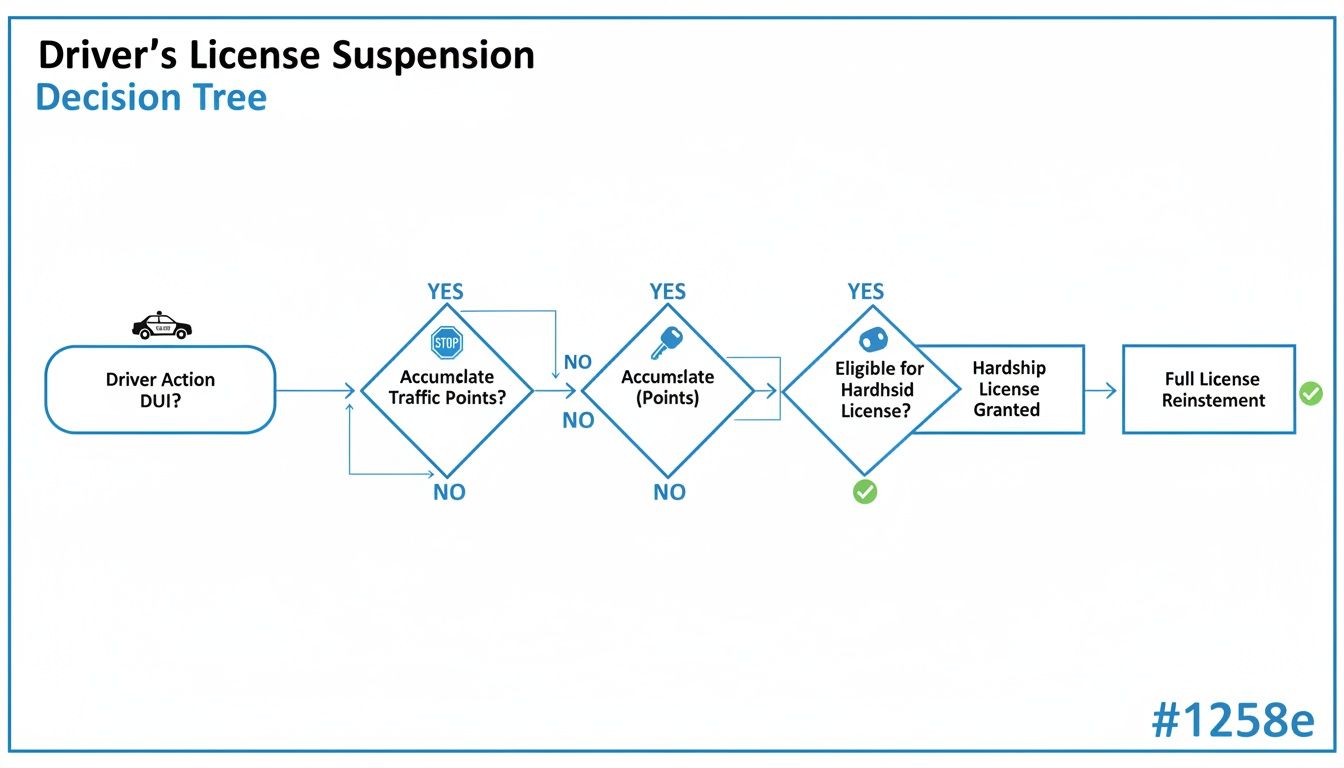
As the flowchart illustrates, different offenses—such as a DUI versus accumulating too many traffic points—lead to very different consequences and paths forward, including the potential for a hardship license.
What Is a Hardship License?
For most people, a full license suspension means losing the ability to get to work, school, or critical medical appointments. A hardship license, sometimes called a Business Purposes Only (BPO) or Employment Purposes Only (EPO) license, can be invaluable. It grants you limited driving privileges during your suspension period.
Important Clarification: A hardship license is not a full reinstatement. It strictly limits you to driving for essential activities related to your employment, education, health, or religious services. Driving for non-essential purposes is a serious violation that can lead to even greater penalties.
Obtaining one is not guaranteed. Your eligibility depends heavily on the reason for your suspension and your driving history. For example, drivers with multiple DUI convictions may face a "hard suspension" period where they are not permitted to drive at all, with no exceptions. To apply, you generally must show proof of enrollment in or completion of required courses (like DUI school) and submit an application to the DHSMV's Bureau of Administrative Reviews.
To help you track what might be required for your situation, here's a quick checklist breaking down the common steps for different types of suspensions.
Florida License Reinstatement Checklist
Reinstatement Step | Applies to Debt-Based Suspension? | Applies to Points-Based Suspension? | Applies to DUI Suspension? |
|---|---|---|---|
Pay Outstanding Fines/Fees | Yes (Primary Requirement) | Yes (If tickets are unpaid) | Yes |
Pay DHSMV Reinstatement Fee | Yes | Yes | Yes |
Complete Driver Improvement Course | No | Yes (Often Required) | No |
Complete DUI School/Substance Course | No | No | Yes (Mandatory) |
Obtain SR-22 or FR-44 Insurance | No | No | Yes (Mandatory) |
Serve a "Hard Suspension" Period | No | No | Yes (Often Required) |
Apply for a Hardship License | No | Possible | Possible (After Hard Suspension) |
This checklist provides a general overview, but your exact requirements will come directly from the DHSMV.
Getting through the reinstatement process requires patience and a clear understanding of what is expected. For a more detailed walkthrough, our guide on how to reinstate a suspended license in Florida offers additional insights. Tackling these steps methodically is the surest way to regain your driving privileges.
How Miami-Dade County Broke the Suspension Cycle
While the statewide issue of debt-based suspensions can seem insurmountable, it is important to know that real, meaningful change is not just possible—it's already happening. Look no further than Miami-Dade County to see what a targeted, common-sense approach can achieve.
Local leaders there confronted a crisis, recognizing that the vast majority of license suspensions were related to financial hardship, not dangerous driving. This wasn't about excusing reckless behavior. It was a practical solution to a broken system that was trapping hundreds of thousands of people in a cycle of debt and unemployment. Their story serves as a powerful blueprint for how things can improve.
Confronting a Countywide Crisis
Just a few years ago, the situation in Miami-Dade was overwhelming. In 2020, more than 600,000 residents had their licenses suspended, not for offenses like DUIs or reckless driving, but for unpaid tickets and missed court dates—issues rooted in poverty, not public safety. This flood of suspensions clogged the courts and contributed to unemployment as people lost their legal ability to drive to work.
Recognizing the immense social and economic damage, the county established the Driver’s License Suspension Task Force. This was more than just another committee; it brought together judges, clerks, public defenders, and community leaders to identify the root of the problem and design effective solutions. The framework they built provides a clear roadmap for untangling the complexities of debt-based suspensions.
Attorney Advertisement: Our practice focuses on traffic and DUI defense matters across Florida. This content is for informational purposes only and does not constitute legal advice. Office in Broward.
Key Reforms That Made a Difference
The Task Force implemented a series of smart, coordinated initiatives that gave people a real opportunity to resolve their issues and restore their driving privileges. These were not complicated legal loopholes but practical, common-sense fixes.
Some of their most effective initiatives included:
Operation Green Light: This annual event provided a window for people to pay off old court fees and traffic tickets without the additional collection agency fees, making it much more affordable to resolve outstanding issues.
Specialized Court Programs: The county created specific court divisions to help low-income defendants handle fines through community service or realistic payment plans, preventing suspensions before they could even begin.
Proactive Communication: Instead of just sending out warning letters, they launched campaigns to inform people of their options, ensuring residents understood how to handle a simple ticket before it spiraled into a full-blown suspension.
These were not merely acts of forgiveness. They were about building clear, accessible pathways for people to meet their obligations and move forward with their lives.
The Staggering Results of Targeted Action
The outcome of these reforms has been remarkable. Miami-Dade County's Driver’s License Suspension Task Force has reduced the number of suspended licenses by an astounding 73%, bringing the total down from 915,424 in 2022 to just 246,676 in 2025.
This proves a simple, powerful truth: focusing on solutions instead of punishment works. It restores driving privileges for hundreds of thousands of people without compromising road safety. You can read more about these game-changing results in a local news report on the task force's success.
This is more than a local success story. It’s evidence that the massive problem of debt-based drivers license suspension in Florida can be solved. By focusing on practical fixes, communities can help people regain their independence, strengthen the local economy, and improve the efficiency of the entire justice system. It is a powerful reminder that no matter how challenging a situation may seem, there is almost always a path forward with the right strategy.
How a Traffic Attorney Can Help Protect Your License
Facing a drivers license suspension in Florida is a stressful situation, but you do not have to navigate it alone. Understanding the system is one thing; successfully navigating it often requires professional guidance. A traffic law attorney does much more than appear in court—they serve as your advocate and strategist, guiding you through a legal system that can feel overwhelming.
Our firm's approach is straightforward. We work to shield your license, driving record, and insurance rates from the consequences of a traffic ticket or criminal charge. Our goal is to challenge the evidence, identify procedural errors, and negotiate for an outcome that does not negatively impact you for years to come.
Strategic Defense for Your Driving Privileges
An experienced attorney provides a critical advantage by examining every detail of your case. For a routine traffic ticket, this might involve questioning the officer's methods or the calibration of their equipment. For a more serious matter like a DUI, it involves a two-front effort—one in criminal court and the other at the DHSMV administrative hearing.
Your attorney manages both processes concurrently to protect your rights at every stage. This includes meeting strict deadlines, such as the 10-day window to challenge an administrative DUI suspension. Missing that deadline results in an automatic license suspension, regardless of the outcome of your criminal case.
Attorney Advertisement: Our practice focuses on traffic and DUI defense matters across Florida. This content is for informational purposes only and does not constitute legal advice. Office in Broward.
Saving You Time and Stress
One of the significant benefits of hiring a lawyer is convenience. For the vast majority of our clients—over 99%—we handle all court appearances on their behalf. You will not have to take time off work, travel to the courthouse, and wait for hours only to face a judge and prosecutor by yourself.
We manage all communication, file the necessary paperwork, and attend hearings for you. This not only saves you a great deal of time but also alleviates the stress and uncertainty of confronting the legal system alone. Our team keeps you informed every step of the way by phone, text, or email, so you are never left wondering about the status of your case.
Our Commitment to Protecting Your Record
Ultimately, our objective is to achieve a favorable outcome for your situation. While no attorney can promise a specific result, our efforts are always focused on several key goals:
Seeking Dismissal: We thoroughly review every case to find grounds for having the ticket or charge dismissed entirely.
Negotiating to Avoid Points: We work to amend charges to non-moving violations to keep points off your record, which helps protect you from rising insurance premiums.
Challenging Suspensions: We represent you in administrative hearings and in court to fight against a potential drivers license suspension in Florida.
If your driving privileges are at stake, professional guidance can make a significant difference. You can get a better sense of how our firm handles these complex situations by reading about our approach to suspended license defense.
Do not wait until it's too late. Schedule a free, no-obligation consultation today to discuss your case and understand your options.
Common Questions About Florida License Suspensions
Facing a driver's license suspension in Florida can be confusing and stressful, often raising numerous practical questions. Here are straightforward answers to some of the most common concerns we hear from drivers.
How Do I Check if My Florida License Is Suspended?
The fastest and most reliable method to check your license status is by using the official Florida Highway Safety and Motor Vehicles (FLHSMV) online portal. You will need your driver's license number to access their "Driver License and ID Card Tracking System." This tool provides real-time information on your license's validity and highlights any issues that need to be addressed.
What Is a Hardship License?
A hardship license, officially known in Florida as a Business Purposes Only (BPO) license, is a restricted license that grants limited driving privileges during a suspension. It is not a permit to drive anywhere you wish, but it does allow you to travel to and from essential activities such as work, school, church, or medical appointments.
Eligibility for a hardship license depends entirely on the reason for your suspension and your driving history.
Can an Out-of-State Ticket Suspend My Florida License?
Yes, it certainly can, and this occurs frequently. Florida is a member of the Driver License Compact, an agreement among states to share information about traffic violations. If you receive a ticket in another member state and fail to resolve it—by not paying the fine or appearing in court—that state will report the violation to Florida. The FLHSMV can then suspend your license here at home until you address the issue in the other state.
How Long Does a Suspension Stay on My Record?
This is a critical point: a driver's license suspension is a permanent part of your Florida driving record. Unlike points from a ticket, which typically fall off after a few years, the suspension itself never expires or disappears. This can have long-term consequences, especially for insurance premiums, as carriers will always view a suspension as a significant risk factor.
If you are dealing with a license suspension or a serious traffic ticket, do not attempt to navigate the system alone. The team at Ticket Shield, PLLC is here to defend your driving privileges and protect your record. Call us 24/7 for a free, no-obligation consultation to discuss your case and learn how we can help. https://www.ticketshield.com