Drivers Permit in Florida: Drivers Permit in Florida: Avoid
Drivers permit in florida - Our legal guide simplifies getting a drivers permit in Florida. Learn qualifications, documents, and tests to protect your record.
TL;DR: A Florida learner's permit is the first legal gate, not a school milestone. A missing document, a bad test decision, or a ticket can stall this process fast and create problems that follow your teen into the licensing stage.
Your child gets pulled over driving outside permit rules before the family fully understands them. Or you show up at the tax collector’s office with the wrong proof of address and get turned away after waiting half the day. I see both mistakes all the time. They are avoidable, and they cost families time, money, and sometimes a court date.
Florida treats permit applicants like future drivers who can already create real legal exposure. That is the right approach. A permit gives limited driving authority, and the state can deny, delay, suspend, or restrict that authority if the applicant or parent gets careless.
Approach the permit process like a record-building exercise. Every form, every identity document, every course certificate, every supervised hour, and every decision behind the wheel matters. Sloppy paperwork leads to rejection. Poor preparation leads to failed testing. A citation during the permit stage can become a much bigger problem than families expect.
Before you start, review recent changes in Florida driving laws so you do not walk into this process relying on outdated advice.
Table of Contents
Why Is Getting a Florida Driver's Permit So Complicated?
Your teenager studies, shows up at the tax collector’s office, and still gets turned away over one missing document, one course problem, or one mismatch in the system. That is how Florida handles permits. The state treats this process like a screening tool, because once a new driver gets on the road, a simple mistake can become a citation, a crash, or a licensing delay.
Florida built the permit process to slow people down on purpose. You are asking for legal authority to drive on crowded roads under Florida traffic law. The state wants proof that the applicant can follow instructions before it trusts them with a car. If your family approaches this like a casual errand, expect wasted trips and preventable problems.
Parents also miss the bigger point. A permit application is often a young driver’s first direct contact with a system that keeps records, verifies identity, and punishes noncompliance. One bad assumption at this stage can follow the applicant into the licensing stage that comes next.
Why Florida puts so many gates in front of new drivers
Florida is trying to filter out risk early. That means identity checks, education requirements, testing rules, supervision rules, and strict limits on how a permit holder can drive. The state is not interested in your explanation for why something was close enough. It wants the right document, the right course, the right score, and the right supervision.
Age eligibility is only the first gate. Families often fixate on Florida permit age and ignore the harder part, which is getting every requirement lined up without a mistake. That is where delays happen.
Law changes and enforcement priorities also matter. If you are relying on outdated advice from a friend, you are taking an unnecessary risk. Check current Florida driving law updates that affect new drivers before you file anything or put a permit holder behind the wheel.
Why small mistakes cause outsized problems
A permit problem rarely stays small.
A name mismatch between school records and identification can stop the application cold. An error in coursework can force a retake. A bad assumption about supervision or hours can create trouble later when the family is ready for the next license step. If the permit holder gets cited early, the issue stops being administrative and starts becoming legal.
Three rules will keep you out of trouble:
Bring documents that match exactly, not documents you hope the clerk will accept.
Treat every course and exam as part of the driver’s record, not a box to check.
Assume any traffic stop while driving on a permit can create consequences that last longer than the ticket itself.
That is why getting a drivers permit in florida feels harder than it should. Florida designed it as a filter, and families who do not treat it seriously are the ones who get delayed, denied, or cited.
What Exactly Is a Florida Learner's Permit?
A Florida learner’s permit is a restricted driving privilege. It is not a junior version of a full license, and it is not something you can treat casually once it’s in your wallet.
The permit lets you practice driving under controlled conditions. That’s all. If you start treating it like unrestricted freedom, you create the kind of problem that turns a routine traffic stop into a licensing delay.
Why the permit is legally different from a license
The legal difference is simple. A full license gives you broad authority to drive. A learner’s permit gives you narrow authority to practice.
That distinction matters every time you sit behind the wheel. You are operating under conditions, supervision rules, and timing restrictions that can become the basis for a citation if you ignore them. If you’re confused about where Florida draws the line between licensed and unlicensed driving, read when driving without a valid license becomes a legal problem.
A permit doesn’t prove you’re ready to drive alone. It proves Florida is willing to let you learn under rules.
For age-related context, a useful overview of Florida permit age requirements can help families understand when the process starts. But age eligibility is only the opening gate. It doesn’t reduce the restrictions that apply once the permit is issued.
What your permit does and does not allow
Think of the learner’s permit as a supervised training tool.
What it generally means in practice:
You may practice driving. Practice is the point of the permit.
You are not free to improvise. The state expects compliance with the permit’s conditions every time you drive.
You must respect the difference between permission and privilege. You have permission to learn, not a privilege to ignore restrictions.
Here is the mistake I see too often. A teen gets comfortable after a few weeks, then starts making “small” judgment calls. A quick solo trip. A drive at the wrong hour. A run to pick someone up. Those are exactly the facts that create citations.
Florida Statute § 316.003 supplies basic definitions used throughout Chapter 316, and those definitions matter because traffic enforcement starts with how the state classifies drivers, vehicles, and conduct on public roads. Once you’re driving, even as a permit holder, you’re inside that enforcement framework.
If you want the cleanest path forward, act like every drive could be reviewed later. Because if you get stopped, it might be.
What Documents Will Florida Demand You Provide?
Florida doesn’t want a hopeful application. It wants a file that proves who you are, where you live, and that your paperwork is consistent.
That’s why this stage knocks people out before they ever touch the steering wheel. A missing document, a name mismatch, or weak proof of address can end the appointment on the spot. No debate. No sympathy. You leave, fix it, and start again.
Why document errors cause instant rejection
At the counter, you are not telling a story. You are presenting evidence.
If your name appears one way on one document and differently on another, that’s a problem. If your address proof doesn’t match what the office expects, that’s a problem. If you assume a photocopy or outdated record is “close enough,” that’s a problem.
Before you go in, make sure you can answer these questions cleanly:
Identity: Can you prove exactly who you are with an acceptable original document?
Social Security: Can you prove the number the state expects to match your record?
Residency: Can you prove Florida residency with documents that look current and credible?
If you’re worried there may already be a problem attached to your record, including an old issue you don’t know about, review how to check whether a Florida license status is suspended before your appointment.
Office reality: The licensing clerk is not there to “help you make it work.” The clerk is there to approve complete, compliant applications.
Florida REAL ID Document Checklist
Use this as your working file structure. Bring originals where required. Keep everything flat, organized, and easy to review.
Document Type | Examples (Bring ONE) | Important Notes |
|---|---|---|
Identity | U.S. birth certificate or valid U.S. passport | The document should match your legal name exactly or be supported by legal name-change records |
Social Security proof | Social Security card or another accepted Social Security record | The number must align with your other identifying records |
Florida residency | School record, utility-related residency record, or other accepted residential proof | Bring documents that clearly show your current Florida residential address |
Name change support | Marriage certificate or court order, if applicable | Bring this only if your current legal name differs from your identity document |
Parent or guardian support documents | Any required consent-related paperwork for minors | Parents should review all signatures before the appointment |
How to prepare the file the right way
Don’t walk in with a loose pile of papers. Build a packet.
Separate originals from supporting papers. You don’t want to fumble at the counter.
Check names line by line. Middle names, suffixes, and spelling issues matter.
Use current address proof. If the address is stale or inconsistent, expect trouble.
Bring more than the bare minimum. Redundancy helps when one document is questioned.
This part feels tedious. Good. That usually means you’re taking it seriously enough.
What Courses and Exams Must You Pass?
A lot of permit problems start here. A parent assumes the class is easy, the teen clicks through it half-prepared, and then the state forces a retake after failed exam attempts. That mistake costs time, money, and momentum.
For applicants under 18, Florida now requires the 6-hour Driver Education Traffic Safety, or DETS, course before a learner’s permit. The state also limits how many times a student can miss the mark on the final exam. If you treat this like a box to check, expect delays. Florida laid out those permit-course requirements here: Florida DETS permit requirements.
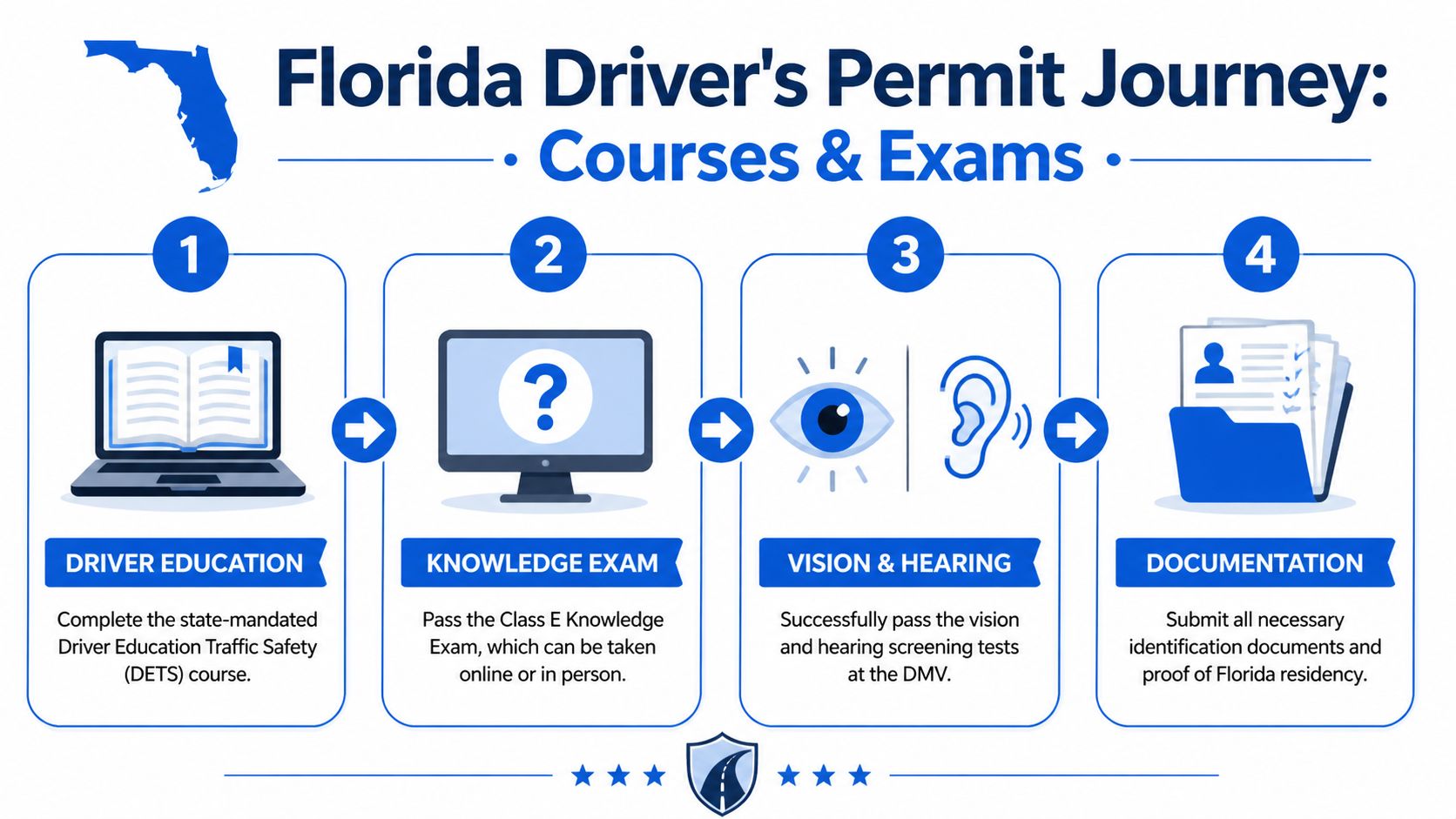
What changed under DETS
The old approach got families in trouble. DETS demands attention from start to finish.
Here is what applicants are up against:
Five formative quizzes with 15 multiple-choice questions each
A 70% minimum score on those quizzes
A 40-question final exam
An 80% passing score on the final
Only three final exam attempts before the entire course must be retaken
There is a second testing point families often blur together with the course final. Florida also requires the learner’s permit knowledge exam on traffic laws, road signs, and safe driving rules. If your teen struggles with the course material, do not assume the state exam will somehow go better. It usually goes worse when the first warning signs are ignored.
How to handle the testing process without creating your own delay
Treat every quiz and exam like it matters. It does.
Use a disciplined approach:
Master road signs first. These are easy points only if your teen knows them immediately.
Drill right-of-way, speed rules, and common restrictions next. That is where careless misses pile up.
Use quiz scores as a warning. Barely passing means your teen is not ready for the final.
Take the final at a good time of day. Tired students make avoidable mistakes.
Stop after a failed attempt and study the weak areas. Panic-clicking into attempt two or three is how families end up repeating the full course.
Florida expects new drivers to know the rules before they get behind the wheel. That includes rules people only learn about after a stop or a crash if nobody took the permit stage seriously enough. Florida Statute § 316.066 is one example. It covers crash reporting duties, and it reflects the larger point. The state tests for legal responsibility, not just memorization.
If practice scores are sitting near the minimum, postpone the test. Protect the permit application now instead of cleaning up a preventable mess later.
How Do You Correctly Log Your 50 Practice Hours?
Your teen finishes the permit period, walks into the licensing office, and suddenly nobody can clearly explain when the night hours happened, who supervised them, or whether the log was filled out after the fact. That is how a simple recordkeeping mistake turns into delay, scrutiny, and a credibility problem you created yourself.
The 50-hour log is evidence. Treat it that way.
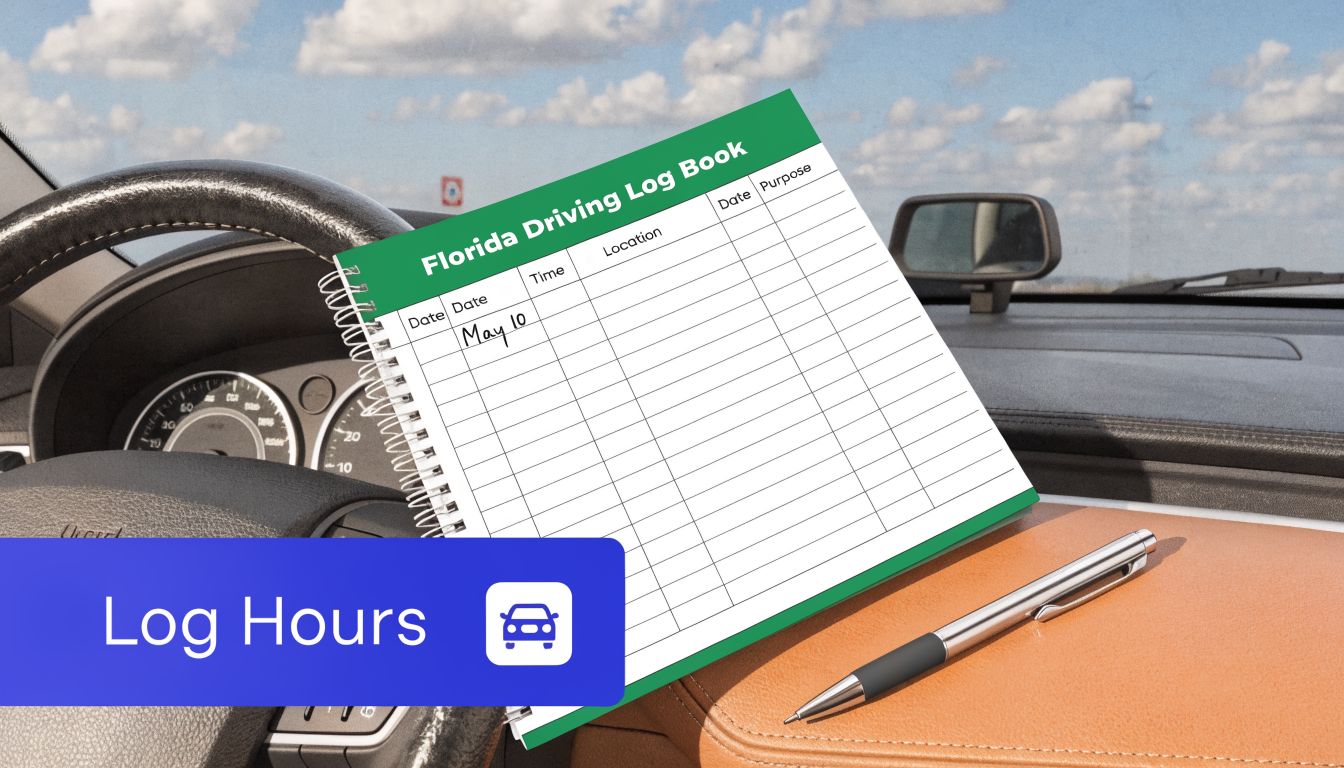
Why the practice log matters
Florida requires 50 hours of supervised driving, including 10 hours at night, before a teen can move to the next stage. Families get in trouble when they treat that requirement like a rough estimate instead of a record that needs to be accurate.
I see the same pattern repeatedly. A parent means to keep up with the log, misses a few entries, then tries to rebuild a month of drives from memory. That backfilled log is weak. If the dates, conditions, and progression do not make sense, you have no good answer if the record is questioned.
The larger problem is safety. Sloppy logs usually mean sloppy supervision. A teen who still struggles with lane control, scanning, or turns does not need a prettier form. That teen needs more practice before a citation, crash, or a later license problem forces the issue.
How to log the hours without creating a legal mess
Write down each drive the same day. Put in the date, start and end time, total time, location or route, road conditions, and the skills practiced.
Be specific. “Drove around” is useless. “30 minutes in neighborhood traffic, four-way stops, left turns, parking, light rain” is credible.
Keep the log honest. Do not round up aggressively. Do not invent night hours. Do not sign off on drives you did not supervise.
Use a pattern that shows real development:
Start with low-risk practice. Parking lots, quiet neighborhoods, basic turns, braking, and stop-sign judgment.
Add ordinary traffic next. Traffic lights, lane changes, speed control, and gap selection.
Build in night driving deliberately. Do not wait until the end and cram all 10 hours.
Practice in bad conditions only when it is safe and controlled. Rain and reduced visibility matter because that is where poor judgment gets expensive fast.
Keep the log with permit records. If you cannot produce it cleanly, you look unprepared.
The supervising adult matters too. That person is not a passenger. That person is the witness who may later need to explain whether the training was real, whether the teen was ready, and whether warning signs were ignored.
Florida Statute § 316.1925 covers careless driving. That should get your attention. Many permit-stage mistakes start as the same bad habits parents wave off during practice: drifting, late braking, rushed turns, poor scanning, and divided attention. Those habits do not stay minor for long. They turn into tickets, crashes, and in some cases bigger licensing trouble tied to offenses like penalties for driving with a suspended license.
Keep the log current, accurate, and detailed enough that another adult could read it and understand exactly what happened on the road. That is how you protect the next step instead of sabotaging it.
What Happens if You Violate Your Permit Restrictions?
This is the part families underestimate. They think a permit violation is a small ticket with a small consequence. That assumption is wrong.
A moving violation during the learner’s permit stage can do more than cost money. It can push back the date when you can move forward. Under Florida learner’s permit requirements, a conviction for a moving violation while on a learner's permit requires you to hold that permit for a full year from the conviction date, regardless of how long you held it before. That single mistake can delay your license by 12 months.
Why a permit ticket is not minor
The permit phase is a probationary stage in everything but name. Florida is watching whether you can follow rules before it expands your driving privileges.
If you violate permit restrictions, several things can happen at once:
Your timeline gets reset. That hurts most when the violation happens late in the permit period.
Your family may face insurance fallout. Insurers care about convictions, not excuses.
You may need to deal with court. In Hillsborough County, that can mean dealing with matters at the Edgecomb Courthouse.
Your future eligibility gets harder, not easier. Early citations create a bad start to your driving record.
Florida Statute § 322.161 is the statute families should know here because it governs the learner’s driver license period and the consequences tied to traffic convictions before advancement. On top of that, Chapter 316 violations remain the underlying trigger for many of these problems.
If the stop escalates and there is any concern about license status, permit validity, or a related charge, understand how serious driving with a suspended license penalties can become in Florida.
A permit violation is not just about the ticket you got. It’s about the time you lose after the ticket.
Immediate Steps to Take
If you or your child gets cited while driving on a permit, act fast.
Read the citation carefully. Confirm the exact charge, date, and court instructions.
Preserve the facts immediately. Write down where the supervising adult was, the driving conditions, and what happened before the stop.
Do not admit guilt casually. What you say to others can come back later.
Track every deadline. Missing a court or payment deadline creates a second problem.
Get legal advice early. Waiting until conviction is often too late to protect the permit timeline.
Automated apps, call-center systems, and ticket mills can harm people. A permit case often turns on details, timing, and future licensing consequences. You need a lawyer reviewing those details, not a chatbot routing your file.
What Are Your Next Steps and When Should You Call a Lawyer?
Once the permit is issued, your job changes. You’re no longer trying to qualify. You’re trying to avoid disqualification from the next step.
That means driving conservatively, documenting practice properly, and treating every traffic stop like it matters. Because it does.
How to move forward without hurting your record
A clean path forward usually looks disciplined, not dramatic.
Focus on habits that protect the future license:
Drive only within permit limits. Don’t test boundaries because a short trip “should be fine.”
Keep your paperwork organized. Permit, log, course records, and identity documents should stay easy to produce.
Use the practice period to fix weaknesses. Night driving, parking, and judgment at intersections should improve over time.
Take every notice from the state seriously. Administrative mistakes become legal headaches when ignored.
If a citation is issued and you’re wondering whether an attorney can handle court for you, review how a lawyer may appear in Florida traffic court. For many families, time and appearances matter almost as much as the citation itself.
When legal help stops a small problem from becoming a major one
Call a lawyer immediately if any of these happen:
You get any moving violation while on a permit. The one-year reset issue is too serious to ignore.
You’re in a crash. Fault is not always obvious at the scene.
The licensing office rejects your application or documents. Repeated errors can create longer delays.
There is any question about your eligibility or driving status. Guessing is dangerous.
You drive for income or expect to later. A dirty record can affect driving-based work opportunities.
Florida Statute § 316.183 requires drivers to operate at a lawful speed, and that kind of basic Chapter 316 rule is where many young drivers get introduced to the court system. The lesson is simple. Ordinary traffic charges create extraordinary consequences when they hit early in your driving life.
Parents should save a traffic lawyer’s contact information before there’s a problem. Not after. The right response in the first few days can protect a record. A delayed response often just manages damage.
If you want a drivers permit in florida to become a full license on schedule, don’t just ask what forms to file. Ask what mistakes could cost you months, court time, and insurance pain. That is the smarter question.
If you’re facing a permit ticket, application denial, crash issue, or any Florida traffic problem, talk to a lawyer before you make it worse. Ticket Shield, PLLC is a lawyer-led Florida defense firm where you speak directly with your attorney by phone or text, not middlemen, automated apps, or chatbots. Visit TicketShield.com for a free consultation and protect the No Points goal from day one.