Can I Drive Without a License in Florida? A Guide to Laws and Penalties
In Florida, can i drive without a license? Usually no—penalties range from a ticket to jail, depending on license status and prior history.
Let's get straight to it: no, you cannot legally drive on public roads in Florida without a valid driver's license. It's a violation of state law, and getting caught can lead to anything from a simple fine to serious criminal charges.
The question isn't if it's illegal, but how illegal it is. The consequences you face will depend entirely on why you don't have a valid license with you.
How We Reviewed Florida Law for This Guide
We built this guide by reviewing the Florida statutes that control the most common license-related charges discussed here, including Florida Statute 322.03, Florida Statute 322.065, and Florida Statute 322.34. We also checked Florida Highway Safety and Motor Vehicles rules on license status services and new resident licensing requirements.
Our focus was practical, not theoretical: what charge is usually written, what tends to happen at the roadside, and what details often change the outcome after the stop. In our review, the biggest misunderstandings usually involve four points: whether the driver was ever licensed, whether the license was merely left at home, whether the expiration is under or over six months, and whether a suspension case involves proof of knowledge.
We also prioritized the scenarios Florida drivers most often face after a stop: a forgotten wallet, a recently expired license, a suspended license the driver says they did not know about, and a move to Florida from another state. What can change the analysis? Prior DWLS history, commercial-driving status, proof problems, and whether the officer or state can show the driver knew their privilege was invalid.
Florida Driving License Requirements and Scenarios
Florida does not treat every license problem the same. For a driver trying to size up the risk quickly, the key question is which of these four buckets applies:
No license was ever issued. This is usually the most direct path to a criminal charge under section 322.03.
You are licensed, but you do not have the card with you. That is different from never being licensed. At the roadside, an officer may still verify your status electronically, and that distinction matters.
Your license is expired, but by less than six months. Florida usually treats this as a civil problem rather than a misdemeanor.
Your license is suspended or revoked. This is a separate category, and the case often turns on whether the state can prove knowledge.
In our view, this is the part many broad articles get wrong: “driving without a license” is a shorthand phrase, not a single legal outcome. A valid license left at home, an old out-of-state license after the new-resident deadline, and a knowing suspension case can all start with the same traffic stop but lead to very different exposure.
A Quick Florida Decision Guide
If you were stopped in Florida, start here. If you have never been licensed, you are usually looking at No Valid Driver's License. If you have a valid license but forgot it, the issue is often proving valid status, not proving eligibility to drive. If your license is expired less than six months, the case is commonly treated as a non-moving civil infraction under section 322.065. If your privilege is suspended or revoked, the officer will usually focus on the suspension record and whether there is evidence you knew about it.
Florida does allow limited lawful driving without a standard unrestricted Class E license, but these are narrow exceptions with conditions, not loopholes. A learner's permit holder may drive only within permit rules, and a person who recently became a Florida resident can generally use a valid out-of-state license during the state's 30-day new-resident window. Once those conditions fail, the protection usually disappears.
Florida Unlicensed Driving Scenarios at a Glance
Scenario | Florida Statute | Typical Classification | What usually happens at the roadside |
|---|---|---|---|
No Valid Driver's License (NWL) | § 322.03 | Second-Degree Misdemeanor | Often a criminal citation or notice to appear; arrest risk depends on identity issues, local practice, and prior history. |
Valid license exists but not physically on hand | Varies by facts | Often handled as a citation if status can be confirmed | Commonly citation and release if the officer can verify you are validly licensed. |
Expired License (Six Months or Less) | § 322.065 | Non-moving Civil Infraction | Usually cited and released; later proof of renewal may help reduce or resolve the matter. |
Expired License (More Than Six Months) | § 322.03 | Second-Degree Misdemeanor | Usually treated more like NWL than a renewal mistake; court appearance risk increases. |
Driving While License Suspended/Revoked (DWLS/R) - Without Knowledge | § 322.34(1) | Moving Civil Infraction | Commonly citation and release, with the suspension record becoming the key issue later. |
Driving While License Suspended/Revoked (DWLS/R) - With Knowledge | § 322.34(2) | Second-Degree Misdemeanor (or higher) | Criminal citation, notice to appear, and possible custodial arrest depending on prior record and circumstances. |
As you can see, the state draws a hard line between a minor oversight and a deliberate violation. Remember, this information is for educational purposes and is not a substitute for legal advice from a licensed attorney about your specific case.
Scenario | Florida Statute | Typical Classification |
|---|---|---|
No Valid Driver's License (NWL) | § 322.03 | Second-Degree Misdemeanor |
Expired License (Six Months or Less) | § 322.065 | Non-moving Civil Infraction |
Expired License (More Than Six Months) | § 322.03 | Second-Degree Misdemeanor |
Driving While License Suspended/Revoked (DWLS/R) - Without Knowledge | § 322.34(1) | Moving Civil Infraction |
Driving While License Suspended/Revoked (DWLS/R) - With Knowledge | § 322.34(2) | Second-Degree Misdemeanor (or higher) |
Understanding Different Unlicensed Driving Charges
In Florida, not all unlicensed driving charges are created equal. The law draws some very clear lines between a simple mistake and a deliberate violation, and those distinctions make a massive difference in the penalties you could be facing. Think of it like a library book: having one that’s a day overdue is a small fine, but knowingly keeping a rare book that was recalled is a much bigger problem.
The specific charge an officer writes on your ticket depends entirely on the status of your license when you were pulled over. Getting a handle on these differences is the first step toward building a strong defense.
No Valid Driver’s License (NWL)
A charge for No Valid Driver's License, or NWL, under Florida Statute § 322.03 usually means one of two things. Either the person has never been issued a driver's license in the first place, or their license has been expired for more than six months. After that six-month mark, the state stops seeing it as a simple renewal issue and treats it far more seriously.
This isn't a minor infraction; it's a criminal offense right out of the gate. An NWL charge is classified as a second-degree misdemeanor, which means it carries the potential for up to 60 days in jail and a $500 fine. If you're convicted, it creates a permanent criminal record. If you’re facing this, it's critical to explore all your legal options. You can learn more in our guide on what qualifies as no valid driver's license in Florida.
Driving With an Expired License (DWEL)
Florida law does offer a little bit of a grace period if you've recently let your license expire. If your license has been expired for six months or less, the offense is treated as a non-moving civil infraction—think of it as being in the same league as a parking ticket.
But the moment you cross that six-month threshold, the situation changes dramatically. The charge gets upgraded to the much more serious NWL misdemeanor we just talked about. This is why it’s so important to stay on top of your renewal date and get an expired license sorted out immediately.
Driving While License Suspended or Revoked (DWLS/R)
This is the most serious category of unlicensed driving: Driving While License Suspended or Revoked (DWLS/R). The penalties for this offense all hinge on one critical question: did you drive with knowledge of the suspension?
Key Distinction: The prosecution has to prove you knew your license was invalid. That knowledge is often the dividing line between a simple moving violation and a criminal charge that could lead to jail time.
The state has a few common ways to establish you had "knowledge":
An officer or judge told you in person that your license was suspended.
You got an official notice in the mail from the Florida Department of Highway Safety and Motor Vehicles (FLHSMV).
You personally paid a ticket that directly resulted in a suspension.
If the state can't prove you knew, the charge is just a civil infraction. But if they can, it becomes a second-degree misdemeanor for a first offense. These charges are more common than you might think, and the consequences can escalate quickly in repeat cases, which is why it helps to understand the penalties for driving with a suspended license before deciding how to respond.
The infographic below really simplifies the core legal principle here.
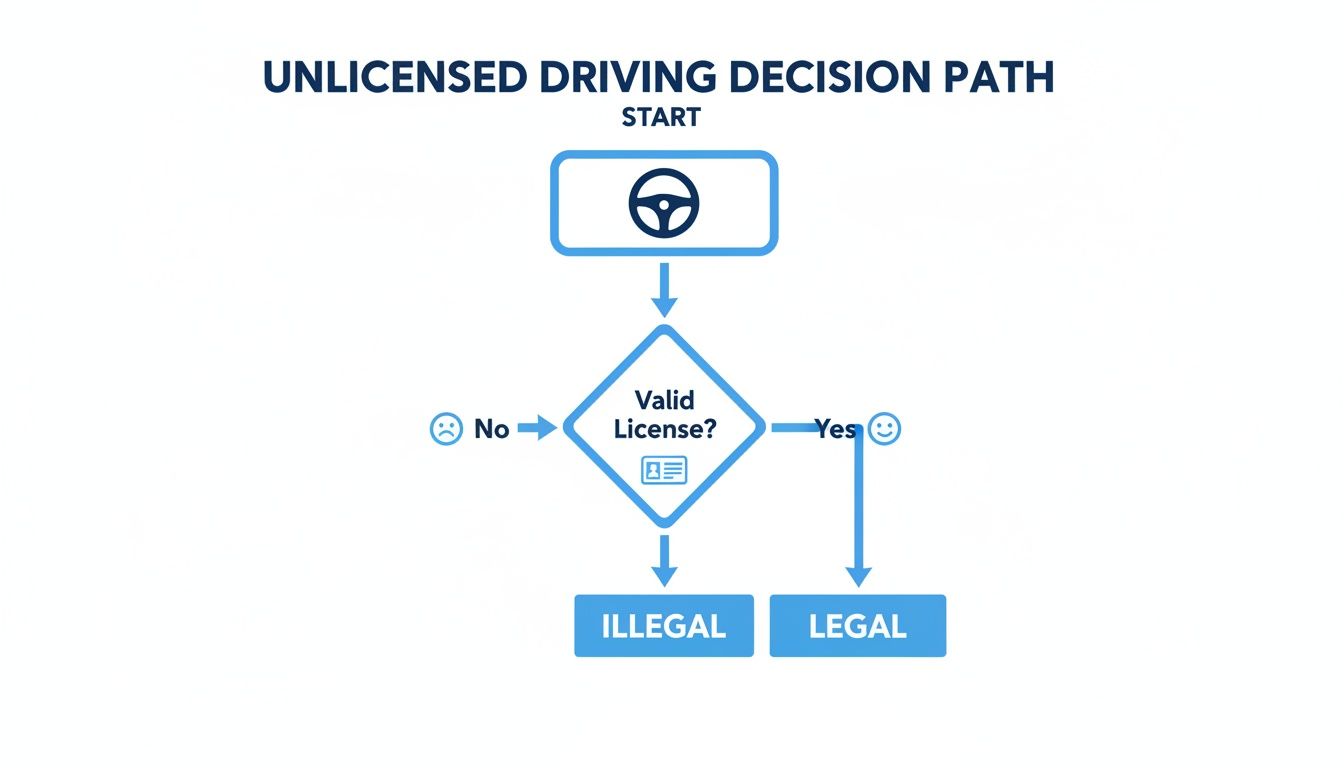
As you can see, it all boils down to one simple fact: having a valid license is the only way to legally get behind the wheel on public roads.
What Are the Penalties for Driving Without a License
The most useful way to think about penalties in Florida is in sequence: what happens at the roadside, what charge gets filed, and what punishment that charge can carry. That is the order most drivers experience it, and in our review that sequence clears up more confusion than a list of maximum penalties by itself.
A stop for a license issue can end with a simple citation and release, a notice to appear in court, or a custodial arrest if the facts are worse. Florida treats driving without a valid license as more than a paperwork problem; one Florida legal summary collecting the statutory penalties notes that a first conviction under section 322.03 can carry up to 60 days in jail, while repeat convictions increase the misdemeanor level and can add mandatory jail exposure in later cases, as outlined in this Florida license-violation summary. If the issue is suspension rather than never being licensed, the analysis shifts, and our guide to the penalties for driving with a suspended license explains how DWLS/R exposure can differ.
What Usually Happens When You Get Pulled Over in Florida
If the officer stops you and you have a valid license but not the physical card, the stop often ends with a citation after the officer checks your identity and status through the system. If the records show you are validly licensed, this is usually the lowest-risk roadside scenario.
If you never had a license, the officer is dealing with a criminal traffic offense rather than a simple documentation problem. Depending on the county, your identification, and your prior history, that may mean a criminal citation, a notice to appear, or in some cases a custodial arrest. The practical issue at the roadside is not just the statute; it is whether the officer is satisfied about identity, address, and your ability to appear in court.
If your license is expired less than six months, many cases are handled like ordinary traffic citations. If it is expired more than six months, the roadside outcome starts to resemble NWL because Florida no longer treats it as a small renewal lapse.
If your license is suspended or revoked, the officer will usually run your record and decide whether the case looks like civil DWLS without knowledge or criminal DWLS with knowledge. A knowing suspension case can lead to a misdemeanor charge, court date, and higher arrest exposure. Prior DWLS history can raise the stakes fast, and repeat cases may also create vehicle impound risk depending on the facts and court orders.
Charge Classification Comes Next
After the stop, the legal classification drives what happens in court:
Expired less than six months: usually a non-moving civil infraction under section 322.065.
Never licensed or expired more than six months: usually charged under section 322.03 as a second-degree misdemeanor.
DWLS without knowledge: typically a moving civil infraction under section 322.34(1).
DWLS with knowledge: typically a second-degree misdemeanor for a first offense under section 322.34(2), with repeat cases increasing sharply.
This distinction matters because paying a civil ticket may close out the case, while resolving a criminal traffic charge can require a court appearance, negotiation, proof issues, or a motion-based defense.
Fines, Jail Risk, and Court Exposure
For most unlicensed driving offenses, fines are only the starting point. A recently expired license may bring a civil fine and court costs. NWL and first-offense criminal DWLS can bring up to $500 in fines and up to 60 days in jail. A second knowing DWLS offense can rise to a first-degree misdemeanor with up to one year in jail, and habitual or repeat cases can become a felony-level problem.
One reason Florida courts take these cases seriously is that unlicensed driving is often treated as a public-safety issue, not just an administrative defect. A Florida-focused discussion of section 322.03 cites studies linking non-licensed driving to elevated crash risk, including higher fatal-crash involvement, in this summary of the safety concerns behind Florida's license law.
Florida Penalties for Unlicensed Driving Offenses
Offense Type | Potential Fines | Potential Jail Time | Other Consequences |
|---|---|---|---|
Expired License (<6 Months) | Small fine + court costs | None | Civil infraction, typically dismissed with proof of renewal. |
No Valid License (>6 Months) | Up to $500 + court costs | Up to 60 days | Second-degree misdemeanor, permanent criminal record. |
1st DWLS (with knowledge) | Up to $500 + court costs | Up to 60 days | Second-degree misdemeanor, criminal record. |
2nd DWLS (with knowledge) | Increased fines | Up to 1 year | First-degree misdemeanor, criminal record. |
3rd+ DWLS (Habitual) | Up to $5,000 | Up to 5 years | Third-degree felony, permanent criminal record, vehicle impoundment. |
Why the Same Charge Can End Differently for Different Drivers
In our experience reviewing Florida traffic cases, roadside behavior and prior history often shape the immediate outcome more than drivers expect. A calm stop where identity is clear and the paperwork issue is fixable can be handled very differently from a stop where the officer believes the driver knew about a suspension, gave conflicting answers, or has a repeat record.
There is also a longer-term risk many drivers miss. A major Florida fines-and-fees report described how debt-based suspensions have affected hundreds of thousands of residents and how long those suspensions can linger, as explained in this Florida suspension-impact report. From our perspective, that is why it is dangerous to treat a license ticket as minor before confirming exactly what status problem triggered it.
Navigating Special Circumstances and Common Scenarios
The edge cases are where drivers get tripped up. Florida law is much easier to understand when you look at the actual scenario instead of the broad label.
Forgot Your Wallet, but You Have a Valid License
If your license is valid and you left it at home, that is not the same as never being licensed. At the stop, the officer may verify your status through state records and issue a citation rather than a criminal charge. Proof that you were validly licensed on the date of the stop is often the most important fact here.
In our review, this is one of the scenarios that is often fixable if addressed quickly, especially when the ticket is really about failure to carry proof rather than lack of lawful driving privilege.
Driving With a Digital Copy Only
A photo of your license on your phone is useful for identification, but it is not automatically the same as carrying the legally required physical credential in every situation. An officer may still insist on running your information and may still cite you if the physical license is required and unavailable.
What helps later is proof that your actual license was valid on the stop date. The digital copy may support your explanation, but it does not guarantee the stop will be treated the same as having the card in hand.
Recently Moved to Florida and Still Using an Out-of-State License
Florida generally gives a new resident 30 days after establishing residency to obtain a Florida license, according to the state's new resident guidance. If your out-of-state license is still valid and you are within that window, driving is usually lawful.
Once that window passes, the issue changes. A still-valid out-of-state card does not necessarily protect a new Florida resident forever, and proof of when residency began can become central to the case.
Learner's Permit Holder Driving Alone
A learner's permit is permission to drive only under specific restrictions, not a substitute for a full unrestricted license. In Florida, a permit holder driving alone can be treated as driving outside the scope of lawful authorization.
The most helpful proof in these cases is often factual: who was in the vehicle, what time the stop happened, and whether the supervising licensed driver requirement was satisfied. When those facts are bad, the permit does not function as a defense.
Commercial Drivers With a Suspended Privilege
For commercial drivers, a suspension problem can spill into both ordinary traffic consequences and job-threatening CDL consequences. A stop in a personal vehicle can still affect a commercial career if the underlying privilege is suspended or revoked.
We see these cases turn on timing and documentation more than people expect: whether the suspension was already cured, whether notice was properly received, and whether the driver has a reinstatement path. If your license has been suspended, acting fast is critical. Our firm offers a clear guide on how to reinstate your suspended driver's license.
A Note on Other Scenarios: It's worth remembering that license eligibility rules can be dramatically different from one state to another. For example, some states have specific laws on driver's licenses for undocumented immigrants in California. Every state sets its own policies, which is why it's so important to know the specific rules for where you live and drive.
Your First Steps After Being Pulled Over
Being pulled over is stressful enough. But when you’re not sure about the status of your license, that stress can go through the roof. What you do in those first few minutes—and in the next 24 hours—can materially affect the outcome.
Knowing how to handle the stop protects your rights and lays the groundwork for a much stronger defense.
The single most important thing is to stay calm and respectful. Pull over somewhere safe, cut the engine, and keep your hands where the officer can see them. Avoid any sudden moves. When they ask for your ID, provide whatever you have, like a state ID card, even if you don't have a valid driver's license on you.
During the Traffic Stop
That roadside interaction is critical. You want to be cooperative, but you also need to be careful not to say anything that could make your situation worse.
Don't Admit Fault. You are not required to explain why you were driving or admit you knew your license was invalid. If the officer asks questions, stick to the simple facts, like confirming your name and address.
Keep it Brief. Politely decline to answer questions about where you were going or where you were coming from. There’s no need to volunteer extra information.
Accept the Citation Calmly. If you’re given a ticket or even arrested, don’t argue. The side of the road is not the courtroom. Just accept the paperwork.
Remember, anything you say can be used against you later. The goal is to get through the stop without giving them any extra ammunition to use in court.
What To Do in the First 24 Hours
Check your official license status with FLHSMV. Use the state's driver license check tool to confirm whether the record shows valid, expired, suspended, or revoked.
Read the ticket carefully. Look for whether the officer cited NWL under section 322.03 or DWLS under section 322.34. Those are not interchangeable.
Figure out whether the issue is “not licensed” or “not carrying proof.” If you were validly licensed but did not have the card, gather documents showing your status on the stop date.
Gather proof fast. That may include proof of renewal, a copy of your driving record, reinstatement paperwork, or records showing you were still within the out-of-state new-resident window.
Write down exactly what the officer said. If the officer used words like “you knew it was suspended” or “you were notified,” note that immediately. In a DWLS case, that knowledge issue can become the center of the defense.
Calendar the response deadline and any court date. Missing the deadline can create a new problem on top of the old one.
The Most Common Mistake After the Stop
The avoidable mistake we see most often is paying first and asking questions later. For some charges, payment can operate like a guilty plea or waiver of defenses, and by the time the driver learns that, the best options may be gone.
If the ticket is criminal, the consequences can include a record, not just a fine. Even in civil cases, the smarter move is to verify the exact charge, confirm your status, and understand whether later proof could reduce or resolve the allegation before you send payment.
After You Receive a Citation
Crucial Next Step: The most powerful thing you can do is write down everything you remember about the stop. Do it immediately. Memories get fuzzy fast, so capture every detail while it’s fresh.
Jot down the time, the location, the reason the officer gave for pulling you over, and anything that was said. Once you’ve documented it, your very next call should be to a firm that focuses on traffic defense. An attorney can look at the specific charge on that ticket and explain exactly what you’re up against.
Attorney Advertisement. Office in Broward.
How a Traffic Defense Firm Can Help Your Case
Getting pulled over for driving without a license can feel like you're cornered, but you don't have to face it on your own. Bringing in an experienced traffic defense firm means you have a professional in your corner, ready to challenge the state’s case against you. Our goal is to protect your license and your record by exploring every legal option available. Our practice focuses on traffic and DUI defense.
The right defense always comes down to the specifics of your situation. We start by digging into the traffic stop itself—did the officer have a legitimate reason to pull you over in the first place? If the stop wasn't valid, any evidence they gathered could be thrown out.
Crafting a Strategic Defense
For a charge as serious as Driving While License Suspended (DWLS), the prosecutor has to prove you knew your license was suspended. We can often poke holes in their argument by showing you never received proper notice from the state, which can be a game-changing defense.
Negotiation is another powerful tool. In many cases, we can talk directly with the prosecutor to get a criminal charge like DWLS knocked down to a less severe civil infraction, keeping a criminal conviction off your record. Our firm takes care of all court appearances and legal filings, all while aiming for the best resolution possible. Past results do not guarantee future outcomes.
Our primary objective is to minimize fines, prevent points from being added to your record, and avoid further license suspensions. We manage the legal complexities so you can focus on your life.
If your case involved an arrest, a defense firm is also invaluable for helping you in understanding pretrial release options. You can learn more about how we can help by checking out our detailed guide on how to resolve a ticket for no valid driver's license.
Attorney Advertisement. Office in Broward.
Frequently Asked Questions
What happens if you get pulled over without a license in Florida?
It depends on the underlying status. If you are validly licensed but do not have the card, the stop may end with a citation after the officer verifies your record. If you were never licensed, expired more than six months, or are driving on a knowing suspension, the case can become criminal and may involve a court date, notice to appear, or arrest risk.
Is it illegal to drive without your license on hand in Florida?
It can be, but that is different from never having a valid license. A driver who is properly licensed but forgot the physical card is usually in a better position than someone who was never licensed or whose privilege is suspended. Proof that the license was valid on the date of the stop often helps.
Can you go to jail for driving without a license?
Yes. In Florida, a first criminal case for never having been licensed can be charged as a second-degree misdemeanor, and a knowing DWLS case can also carry jail exposure. Jail does not happen in every case, but it is legally possible, especially with repeat history or more serious facts.
How can you legally drive without a license in Florida?
In most cases you cannot drive unless you remain lawfully authorized under a different status, such as complying with a learner's permit or using a valid out-of-state license during the state's new-resident period. These are conditional exceptions and not workarounds.
Can a driving-without-a-license charge be dismissed if you later renew?
Sometimes, but it depends on the charge. Later renewal can help significantly in a recent-expiration or proof-of-valid-license case. It is less likely to erase a case where the allegation is that you were never licensed, your license was expired too long, or you drove while suspended with knowledge.
How do I check whether my Florida license is suspended or valid?
The fastest starting point is the state's online status tool. Check it as soon as possible after a stop so you know whether the ticket involves expiration, suspension, revocation, or a record error.
Attorney Advertisement. Office in Broward.
If you’ve been cited for driving without a license, don't just hope it will go away. The team at Ticket Shield, PLLC is here to defend your rights and protect your driving record. We're available 24/7 for a free, completely confidential consultation to talk about your case. Call us or submit your ticket online today.