Drive With an Expired License? Your Florida Defense Plan
Caught in Florida when you drive with an expired license? Learn the penalties, your immediate steps, and how an experienced attorney can protect your record.
TL;DR: Driving with a license expired for six months or less is a citation. Over six months, it becomes a criminal offense in Florida. The consequences include fines, points, and even arrest. A dedicated traffic attorney can often get the charge reduced or dismissed.
You got pulled over. The officer asked for your license. Then you saw the date.
That moment matters. In Florida, an expired license is not a harmless paperwork issue. Under Florida Statute §322.03, you must have a valid driver license to operate a motor vehicle. If your license has been expired long enough, the stop can move from a traffic citation into criminal territory fast.
If you've already been cited, your next move matters more than your excuse. Paying the ticket too quickly can lock in damage that could have been avoided. If you're unsure what to do after the stop, start with this guide on what to do when you get a ticket.
Table of Contents
Your Guide to an Expired License Charge in Florida
The panic you feel after this kind of stop is justified. Florida treats license validity seriously, and judges do too. If your first instinct is to just pay it and move on, stop.
Under Florida Statute §322.03, driving without a valid license is unlawful. That includes driving after your license has expired. Depending on how long it has been expired, what looks small at roadside can become a court problem, a record problem, and an insurance problem.
Why this charge is more dangerous than people think
Most drivers don't get pulled over expecting a license issue. They get stopped for something minor under Chapter 316, like speeding or another routine traffic violation. Then the officer checks the license status and the entire stop changes.
Practical rule: If you drive with an expired license in Florida, treat the citation as a defense problem, not a payment problem.
A quick payment feels efficient. It often isn't. A guilty resolution can create consequences that follow you longer than the inconvenience of hiring counsel and fixing the issue correctly the first time.
What you should assume right now
Assume the court will expect you to take this seriously. Assume the prosecutor will care whether you renewed promptly. Assume your explanation alone won't carry the day.
You need two things working at the same time:
A legal response: someone evaluates the citation, the charging level, and the best path to reduction or dismissal.
An administrative fix: you move immediately to renew or reinstate your Florida license if you're eligible.
If your case is headed to court in Miami, that may mean dealing with procedures tied to the Richard E. Gerstein Justice Building. If you're elsewhere, the same principle applies. The court cares less about why you forgot and more about what you've done since.
What Happens the Moment You Are Pulled Over?
A roadside stop is not casual from the officer's side. The officer isn't deciding whether your mistake seems understandable. The officer is checking whether you're legally allowed to drive at that moment.
What the officer checks first
Once the officer takes your license, the check is immediate. Your information is typically run through state licensing records and related law enforcement databases to confirm whether the license is valid, expired, suspended, revoked, or tied to another issue.
That matters because law enforcement treats unlicensed driving as a safety concern, not just a paperwork violation. According to NHTSA's 2021 data, unlicensed drivers, including those with expired licenses, were involved in 18.4% of all fatal motor vehicle accidents, and 31.8% had prior license suspensions or revocations, which is one reason officers scrutinize these stops closely (NHTSA-related reporting on unlicensed fatal crash involvement).
When a stop becomes more serious
If your license has only recently expired, the stop may stay at the citation level. If it has been expired longer, the officer may treat it as a criminal offense. Your attitude still matters, but it won't override the license status in the system.
That is why you should be careful with what you sign and say. Signing a citation is generally not an admission of guilt, but you still need to understand what you're being handed. If you're unclear on that part of the process, review whether you have to sign traffic tickets.
Be polite. Be quiet. Don't argue roadside. The defense starts after the stop, not during it.
Officers also look for surrounding issues. If the stop began with a moving violation under Chapter 316, that underlying allegation can remain in play even if the expired license becomes the bigger problem. A client who tries to explain everything often gives the state more than it needs.
What this means for you after the stop
By the time you're back in your car, the state has already started building its version of the case. The citation, the database return, your statements, and the officer's notes all matter.
If your case is in Miami-Dade, the paper you received may eventually pull you into proceedings connected to the Richard E. Gerstein Justice Building. Don't wait until the court date to think about strategy. By then, you've already lost time you could have used to renew the license, gather records, and put a lawyer in position to negotiate from strength.
Understanding the Penalties for an Expired License
Florida draws a hard line based on how long your license has been expired. That line affects whether you are dealing with a traffic citation or a criminal charge.
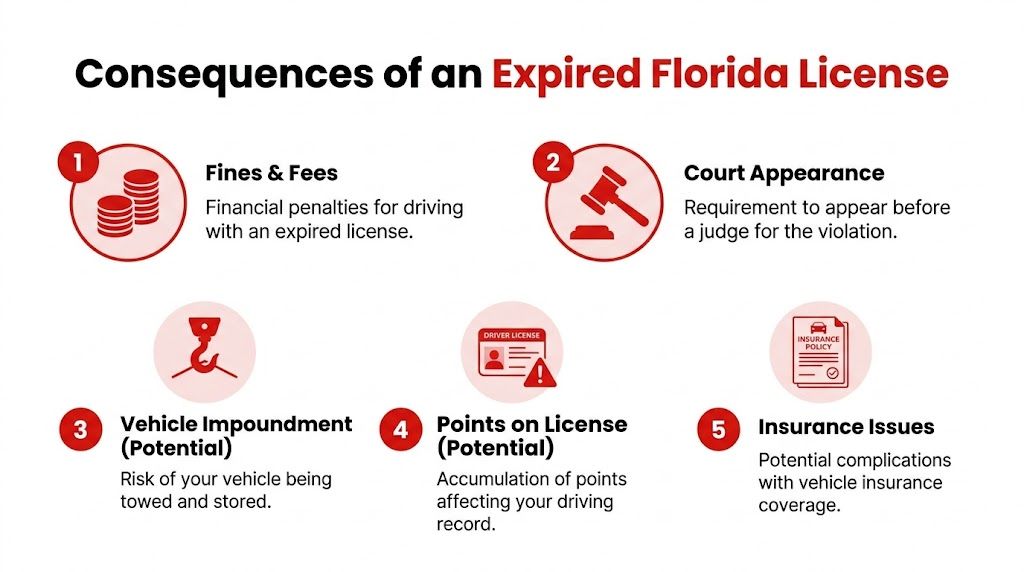
How Florida treats shorter versus longer expiration
If your Florida license is expired for six months or less, you're generally facing a citation-level problem. If it's expired for more than six months, Florida treats that as a misdemeanor. That difference changes everything. It affects court handling, risk exposure, and how urgently you need a defense.
Reported Florida outcomes show that driving with a license expired over six months can bring penalties that average $150 to $300 plus 3 to 4 license points, and the same reporting states that attorney-led defenses can achieve dismissals in over 99% of cases based on good-faith renewal arguments, while self-representation often ends in conviction (Florida expired license penalty discussion).
The legal issue often begins with §322.03, but many drivers first get stopped because of a moving violation under Chapter 316, such as speeding. That's one reason this charge can become expensive quickly. You're not always defending one allegation. You're often defending a cluster of problems created during one stop.
The real cost is larger than the fine
The fine is only the obvious part. The bigger risks are often these:
A court record: especially dangerous if the expiration period pushes the case into criminal court.
License points: points can affect your driving record and trigger other headaches.
Insurance pressure: insurers don't ignore avoidable license violations.
Work fallout: drivers who rely on a clean record can face immediate employment issues.
Time loss: court dates, renewal efforts, compliance documents, and follow-up all take time.
If you want a broader look at related charges, review charges for driving without a license.
Expired License Paying the Ticket vs Hiring an Attorney
Outcome | Paying the Ticket (Pleading Guilty) | Hiring Ticket Shield (Fighting the Charge) |
|---|---|---|
Case posture | You resolve it fast, but you usually give up leverage | You preserve defenses and negotiation options |
Record risk | You may lock in a conviction or adjudication outcome | A lawyer can seek reduction, dismissal, or another protective resolution |
Points exposure | You may accept points consequences tied to the case | Defense strategy focuses on avoiding points where possible |
Court handling | You handle deadlines and filings yourself | Counsel handles appearances and communications where permitted |
Work impact | Harder to explain a guilty outcome after the fact | Stronger chance to protect your record before damage happens |
Bottom line: A fast payment solves the court's paperwork. It doesn't solve your record.
What Are Your Immediate Steps After a Citation?
You need an action plan. Not tomorrow. Today.
What to do in the first day
Read the citation line by line. Check the statute listed, the court date, the county, and whether the officer described the offense as a citation issue or something more serious.
Renew the license if you're eligible. Do it immediately. Proof that you corrected the problem fast can matter later.
Preserve every document. Keep the citation, renewal receipt, temporary license, DMV email confirmations, and screenshots.
Write down the facts while they're fresh. Note where you were stopped, why you were stopped, what the officer said, and what you said back.
Call a Florida traffic defense lawyer before paying anything. Once you pay, you may lose options you had a few hours earlier.
What not to do
Don't ignore the ticket. Don't assume showing up with a renewed license means the court will automatically dismiss it. Don't rely on a customer-service script, a chatbot, or a nonlawyer intake person to tell you your exposure.
If this stop happened while you were driving for income, act even faster. A delay can leave you fighting the court and your platform at the same time.
Bring order to the problem. Documents first. Renewal second. Legal advice immediately after.
Why speed matters
A driver who moves quickly looks different from a driver who shrugs it off. Courts notice the difference. Prosecutors notice it too.
That doesn't mean you should rush into the wrong resolution. It means your response must be organized. Calm is good. Passive is not.
How Do You Renew or Reinstate Your Florida License?
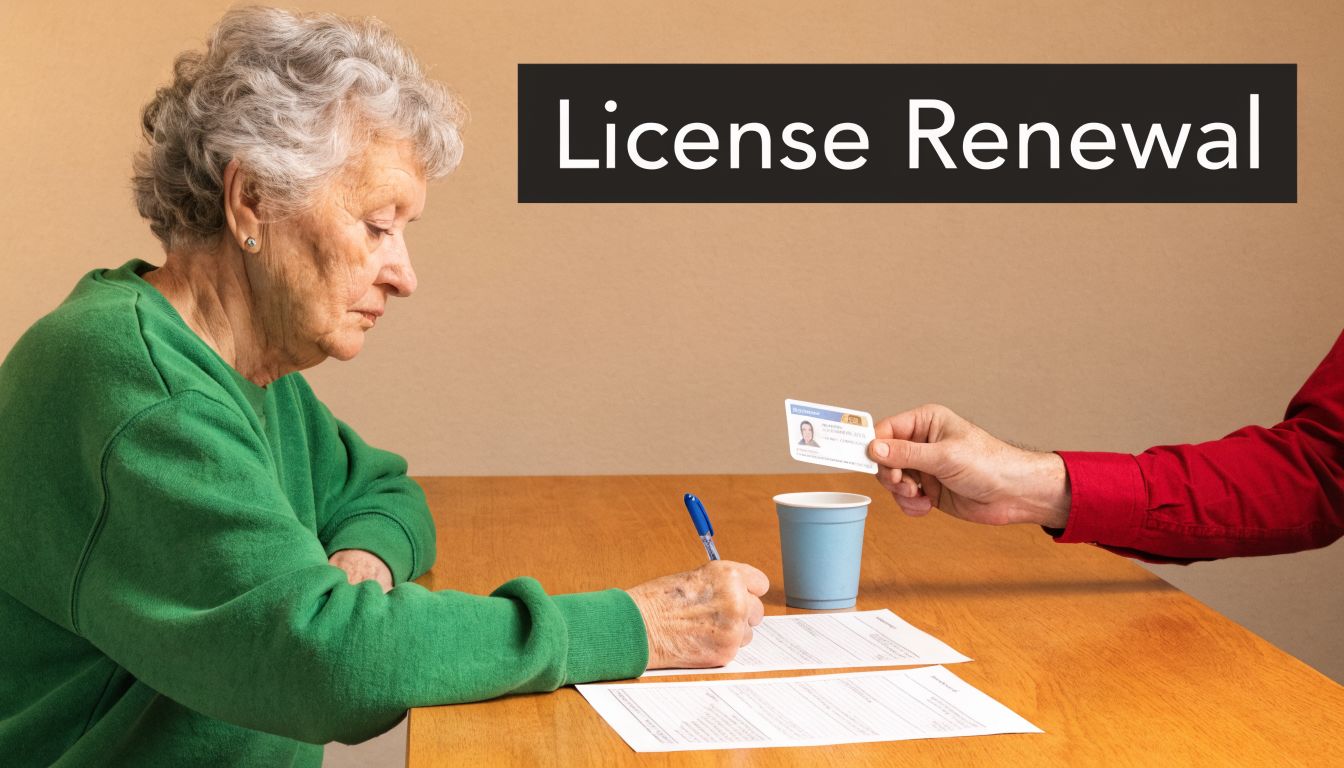
Fixing the underlying license issue helps your legal position. It doesn't erase the citation by itself, but it gives your defense something solid to work with.
Start fixing the license problem immediately
Start with the Florida licensing system and determine whether you're dealing with a simple expiration or a deeper status problem. Some drivers think they only need a renewal and later learn there's a suspension, hold, or missing compliance item behind it.
That distinction matters. A plain expiration is one problem. A hidden suspension is a different and more dangerous one.
If your status is more than simple expiration, review this guide on how to reinstate a suspended license in Florida. It helps you separate a renewal issue from a reinstatement issue before you make the wrong move.
What to bring if you must go in person
Bring more documentation than you think you'll need. In practice, that usually means records proving identity, Florida residency, and anything tied to the licensing issue that triggered the stop.
Use a simple checklist:
Your current identification documents
Proof of Florida address
Any renewal notice or DMV correspondence
Your traffic citation
Receipts or confirmations showing you've started the process
If you're unsure what the process looks like, this overview may help:
Renewing helps your defense, but it isn't the defense
A lot of drivers make the same mistake. They renew, feel relieved, then assume the court problem is gone. It isn't.
Renewal shows responsibility. It can support a good-faith argument. It can help a lawyer negotiate. But the citation still exists unless the state agrees to reduce or dismiss it, or the court enters a favorable result.
If your case is in Orange County, that may mean dealing with procedures connected to the Orange County Courthouse. Administrative compliance and legal defense run on parallel tracks. You need both moving at once.
What Legal Defenses Can Protect Your Record?
A strong defense is rarely about one dramatic argument. It is usually about details. The right detail, presented the right way, can change how the prosecutor sees the case.
Good faith matters when you can prove it
One of the strongest defense themes in these cases is good-faith renewal. That means more than telling the judge you meant to renew. It means showing action. Renewal receipts, date-stamped confirmations, prior attempts, notice problems, and clerical confusion all matter if they can be documented.
Florida-specific discussions of expired-license cases note that general content often misses a key point: Florida has no official grace period, and a conviction can lead to immediate deactivation for Uber or DoorDash drivers. The same reporting says a lawyer-led approach focused on issues like clerical errors has achieved over 99% dismissals pre-court in Miami-Dade and Broward (Florida-specific expired license defense discussion).
That doesn't mean every case is a guaranteed dismissal. It means the right defense is built from facts, not hope.
Common defense angles that can matter
Some of the most useful defenses involve proof problems, not speeches:
Clerical error: the state record, notice, or citation contains a mistake.
Prompt correction: you renewed immediately and can prove it.
Documentation gap: the charging document or supporting record doesn't line up cleanly.
Context that supports discretion: your record, your work needs, and your immediate compliance can affect negotiation.
A judge won't be moved by "I forgot" nearly as much as by a clean file of documents showing you fixed the issue fast.
Why gig drivers and professionals need a real strategy
If you drive for Uber, Lyft, DoorDash, or another platform, a conviction can affect your income immediately. If you hold a professional license, government clearance, or a job that depends on a clean driving record, this is not something to handle casually.
That is also why self-help advice online fails people. A generic checklist won't tell you which defense to push first, which documents matter most in your county, or when a prosecutor is likely to consider a reduction.
A defense lawyer does that by reading the citation, checking the charge level, evaluating your license history, and deciding how to frame the case before the first court date. That's strategy. It isn't a form fill.
Why You Need a Lawyer and Not an App
If you're charged with driving on an expired license in Florida, you need legal judgment. Not software. Not a call center. Not a ticket mill that routes you through layers of nonlawyer staff.
An app processes tickets. A lawyer makes judgments.
An automated service can collect your information. It can send reminders. It can make the process feel tidy. But this kind of case turns on legal choices. Should the defense emphasize quick renewal, a clerical problem, charging defects, or record mitigation? Should counsel push early with the prosecutor or wait for a hearing posture that provides a strategic advantage?
An app can't make those calls like a lawyer can. A chatbot doesn't know what matters to the judge assigned to your division. It doesn't know how your county handles expired-license cases when work-related hardship is part of the story.
That difference is obvious in real courthouses. A lawyer walking into the Broward County Judicial Complex or the Edgecomb Courthouse in Tampa isn't just carrying your citation. That lawyer is carrying local experience, procedural awareness, and the ability to adapt.
Local court knowledge changes outcomes
Florida traffic practice is not one-size-fits-all in practice. The statute may be statewide, but court culture is local. The timing of your renewal, the wording on the citation, and the way your case is presented all affect how much room there is to protect your record.
That's one reason people still see value in the benefits of hiring a lawyer when the stakes reach beyond a simple payment. Legal problems rarely improve when they're handed to systems built for speed instead of judgment.
A lawyer can also tell you when not to talk, when to provide documents, and when to hold something back until it serves your defense. Nonlawyer services tend to flatten every case into the same workflow. That's efficient for them. It's risky for you.
Direct access to your attorney is not a luxury
If your record, job, or insurance is on the line, you should be able to speak directly to the person handling your case. By phone. By text. Without going through a sales desk or a scripted support queue.
That's the standard you should demand from any Florida traffic defense representation. You should know who is making decisions. You should know who is appearing for you. You should be able to ask direct questions and get direct answers.
For drivers comparing options, why choose a local lawyer over apps is the right question. Convenience matters. But convenience without legal judgment is what gets people to plead guilty when they still had room to fight.
There is also a practical point. Some Florida firms, including Ticket Shield, PLLC, offer lawyer-led traffic defense starting at $39.99 and handle cases statewide, which gives drivers an accessible way to get actual legal review instead of automated processing. That matters when the goal is to avoid points and keep a manageable citation from becoming a lasting problem.
You don't need a flashy dashboard. You need a defense plan. You need someone who understands Florida statutes, local court expectations, and how to protect your record before the damage is done.
If you've already been cited, the clock is running. The state doesn't care that you meant to renew. The court won't protect your license for you. And paying first, then asking questions later, is how drivers create problems that were avoidable.
If you want the No Points outcome and a direct review from a Florida traffic defense lawyer, visit Ticket Shield, PLLC for a free consultation now.