Charges for Driving Without a License in Florida Explained
Facing charges for driving without a license in Florida? Understand the criminal penalties, fines, and how a lawyer-led defense can protect your record.
Driving without a license in Florida is a criminal offense, not a simple ticket. Penalties can include fines up to $500 and up to 60 days in jail. You need a real defense fast to protect your record, license, and livelihood.
You got pulled over. Maybe it started with a broken taillight, a rolling stop, or a routine checkpoint. Then the officer asked for your license, and everything changed.
Now you're scared, confused, and probably wondering if this is something you can just pay and move on from. In Florida, that assumption can hurt you. Charges for driving without a license can put you into criminal court, expose you to jail, and create problems with your job, insurance, and future driving privileges.
The worst mistake people make is treating a criminal traffic charge like a regular ticket. It isn't. If you're facing this in Miami at the Richard E. Gerstein Justice Building, in Fort Lauderdale, Tampa, Orlando, or anywhere else in Florida, you need to act like the stakes are real, because they are.
Table of Contents
What Happens If You Are Caught Driving Without a License?
A stop for unlicensed driving usually goes bad fast. The officer asks for your license. You don't have one, or your status isn't valid. Then what felt like a traffic stop turns into a criminal charge.
Florida treats this seriously because public safety is part of the equation. According to NHTSA fatal crash data on invalidly licensed drivers, drivers with invalid licenses represented up to 14% of drivers in fatal crashes. Courts and prosecutors don't look at this as paperwork. They look at it as a risk issue.
What the stop usually turns into
You may be cited and ordered to appear in court. In some cases, you may be arrested. The exact path depends on what the officer believes happened, your prior history, and whether the issue is simple no valid license or something more serious like a suspension.
The mistake I see all the time is delay. People go home, panic, search online, and try to solve a criminal charge with an app or a payment portal. That's the wrong move.
Practical rule: If your case involves charges for driving without a license, assume you're dealing with a criminal matter until a lawyer confirms otherwise.
Why speed matters
The earlier you get counsel involved, the more options you usually have. A lawyer can check the citation, review the stop, pull your driving record, and start working on a strategy before your court date gets close.
If you're trying to understand the basic legal issue, start with this guide on whether you can drive without a license. Then stop reading random forums and get actual legal advice.
You need a defense built for criminal traffic court. You don't need a chatbot, a call center, or a ticket mill that shuffles you to a middleman.
Is Driving Without a License a Criminal Offense in Florida?
Yes. In Florida, driving without a valid license is not just a payable nuisance. It can be charged as a criminal offense under Florida Statute § 322.03.
That matters because criminal cases don't just threaten money. They threaten your record.
Why this charge is different from a normal traffic ticket
A civil traffic infraction usually means points, a fine, or traffic school. A criminal traffic charge is different. It puts you in a courtroom where the prosecutor can pursue a conviction that follows you long after the court date is over.
This article also references Chapter 316 because Florida drivers often confuse criminal license cases with standard moving violations under that chapter. For example, a simple moving violation under Chapter 316 is one thing. A no valid license charge under Chapter 322 is another. If your stop began with a Chapter 316 allegation, the license issue can still become the actual danger.
If you want a broader breakdown of when traffic cases become criminal, this page on whether traffic violations are misdemeanors is useful.
What the prosecutor has to prove
For a conviction, the prosecution generally has to prove three core ideas: you operated a motor vehicle, on a public way, and you did not have a valid license. As explained in this discussion of unlicensed operation elements and strict liability, the state does not need to prove that you knowingly drove without a license.
That is why these cases are dangerous for people who thought, "I didn't mean to break the law."
A lack of criminal intent doesn't automatically save you.
Why you shouldn't treat this as self-help
People often think they can walk into court, explain what happened, and get mercy. Sometimes that works. Often it doesn't. Prosecutors and judges deal with these cases every day. They expect proof, legal arguments, and clean mitigation.
A criminal traffic charge is not the moment to trust automated apps or intake staff who can't give legal advice.
You need someone who can look at the exact statute, the exact citation, the exact driving history, and the exact county practice. That's how you protect your future. Not by guessing.
What Are the Different Charges for Unlicensed Driving?
Not all charges for driving without a license are the same. In Florida, the distinction matters a lot.
The two main problems are No Valid Driver's License and Driving While License Suspended or Revoked. They sound similar. They are not.
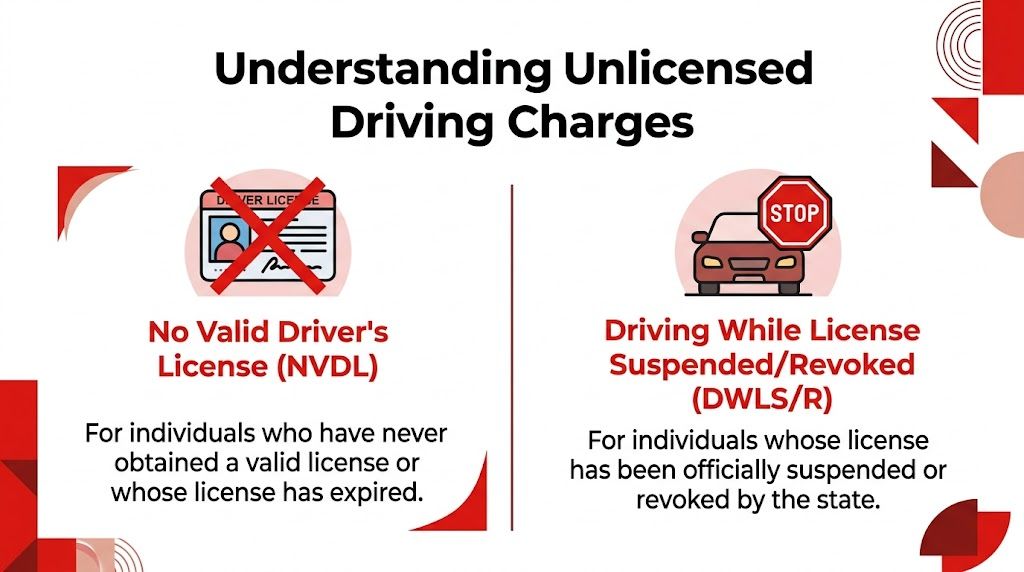
No valid driver's license under Florida law
This charge usually applies under Florida Statute § 322.03. It's commonly used when a person never obtained a valid Florida driver's license but was operating a vehicle anyway.
That doesn't always mean the person was reckless. Sometimes it's a new resident who didn't handle the transition properly. Sometimes it's someone whose license status wasn't what they thought it was. Sometimes it involves someone who never got licensed at all.
The legal issue is straightforward. Were you operating a vehicle on a road, and did you have a valid license?
For a more focused explanation, review what qualifies as no valid driver's license in Florida.
Driving while license suspended or revoked under Florida law
This charge falls under Florida Statute § 322.34. It is more serious because the state believes you already lost the privilege to drive and drove anyway.
The distinction usually turns on notice and history. If the state says you knew your license was suspended, the charge can become criminal rather than civil. A first offense for DWLS without knowledge can be a civil infraction, but if done knowingly it becomes a second-degree misdemeanor. A second knowing offense becomes a first-degree misdemeanor, and a third can become a third-degree felony, as summarized in this explanation of how suspended-license offenses escalate.
That escalation is why people walk into court thinking they have a minor license problem and walk out facing something much worse.
Florida unlicensed driving charges compared
Cases like this are often handled in criminal traffic court, not just ordinary ticket dockets. In Broward, that means you may find yourself dealing with the process around the Broward County Judicial Complex, where procedure, proof, and negotiation matter.
Factor | No Valid Driver's License (NVDL) | Driving While License Suspended/Revoked (DWLS/R) |
|---|---|---|
Main Florida statute | § 322.03 | § 322.34 |
Typical scenario | You never had a valid license | You had a license, but the state suspended or revoked it |
Criminal exposure | Often charged criminally | Often more serious, especially if the state alleges knowledge |
Key factual issue | Whether a valid license existed | Whether the suspension existed and whether you knew |
Risk level | Serious | Higher, especially with prior history |
Court handling | Criminal traffic court | Criminal traffic court, often with harsher treatment |
Why the distinction matters for workers
If you drive for work, the type of charge matters even more. Commercial drivers, fleet applicants, and anyone trying to enter trucking should understand commercial driving license requirements because a license-related criminal issue can interfere with career plans quickly.
The wrong plea can create long-term damage. The right defense can separate a fixable problem from a record that keeps following you.
What Are the Penalties for Driving Without a License?
If you're charged under Florida law, the direct penalties can be harsh even before you get to the hidden fallout.
A first offense for driving without a valid license in Florida can involve fines up to $500 and up to 60 days in jail. That's the part many people don't know until it's too late. They thought they were dealing with a traffic ticket. They were facing a misdemeanor.

What first offense exposure can look like
Even if jail doesn't happen, you can still face:
A criminal conviction that stays on your record
Court costs and fines
Probation conditions
Additional license complications
Insurance consequences that can last well beyond the court date
Florida courts do not have to treat your case gently just because it is your first arrest or first criminal traffic appearance.
Why repeat or aggravated cases get dangerous fast
Escalation is the danger. Driving while license suspended or revoked under § 322.34 can rise from a civil issue to a misdemeanor, and then higher, based on whether the state says you knew and whether you have prior qualifying history.
Nationally, states treat this conduct seriously. For context, Texas penalties for driving without a license escalate from a Class C misdemeanor with about a $200 fine to a Class A misdemeanor with up to a $4,000 fine and one year in jail for repeat offenses or accidents causing injury. The point isn't Texas law. The point is that courts across the country view unlicensed driving as a public safety offense, not a paperwork issue.
If your case includes an accident, prior suspensions, or a claim that you knew you weren't allowed to drive, do not walk into court unprepared.
Why the wrong "solution" makes it worse
This is where lawyer-led representation matters. A real attorney can review the citation, inspect the driving history, challenge notice, and negotiate directly with the prosecutor. An automated app can't argue your case. A middleman can't file motions. A ticket mill built for routine infractions often isn't built for criminal traffic exposure.
You need actual legal judgment. Not form emails.
A strategic defense may aim to reduce the charge, challenge the proof, avoid a conviction, or protect you from outcomes that trigger even more damage down the line. In many cases, avoiding the wrong plea is just as important as winning outright.
How Can This Charge Affect Your Job and Insurance?
The courtroom penalties are only part of the problem. The bigger damage often shows up at work, on background screenings, and on your insurance bill.
Why gig drivers get hit immediately
If you drive for Uber, Lyft, DoorDash, or similar platforms, this charge can shut off your income almost overnight. According to this discussion of Florida valid-license consequences for gig workers, Florida has over 100,000 rideshare and delivery drivers, and a charge for driving without a license can mean immediate account deactivation with an average income loss of $1,200 per week.
That is why delay is so expensive.
If you rely on driving to pay rent, support kids, or cover school tuition, every week matters. A fast legal response is not optional. It's income protection.
Why professionals and service members should take this seriously
Military personnel and veterans often need to protect security clearances, on-base driving privileges, and clean records. Professionals in healthcare, finance, government contracting, and transportation face similar issues.
A criminal traffic case can also show up where employers are looking. If you want to understand how employers review driving-related history, read this overview of an MVR check. Many employers don't just look at convictions. They look at patterns, license status, and driving risk.
Background check concerns also matter. This guide explains whether traffic tickets show up on background checks.
Insurance fallout is often brutal
Insurance companies don't like uncertainty, and they don't like criminal driving cases. A conviction can trigger higher rates, non-renewal risk, or placement into a more expensive category.
Even if you keep your job, the monthly cost of driving can change fast. That's why people who try to "just get it over with" often regret that decision later. The plea they entered in five minutes can cost them for much longer.
Your case is not just about the court date. It's about whether you can keep working and afford to keep driving.
What Are the Best Defenses Against This Charge?
There is no one-size-fits-all defense. Good results come from matching the legal strategy to the exact charge, the exact record, and the exact county.
Some defenses attack the stop itself. Others attack the state's proof. Some cases are won through negotiation because the facts support a reduction or dismissal.
Defenses that attack the stop and the evidence
If the officer lacked a lawful reason to stop your vehicle, that can matter. A bad stop can weaken the case from the beginning.
Another issue is operation. The state has to prove you were driving or operating the vehicle. In some cases, that point is less clear than the citation suggests.
Record accuracy matters too. License cases often depend on government records. If the status was incorrect, delayed, or misread, the prosecutor may have a problem.
Defenses that focus on knowledge records and reduction
For suspended-license cases, notice is often central. If the state claims you knew your license was suspended, that must be examined carefully. Mailing history, prior notices, reinstatement issues, and clerical problems can all matter.
Mitigation also matters. If you were eligible to fix the issue, obtained a valid license, or corrected the underlying problem quickly, that can strengthen your position in negotiations.
Common defense paths include:
Challenging the stop: If law enforcement lacked a valid basis for the stop, the case may weaken immediately.
Disputing operation: If you were not driving, the state may fail on an essential element.
Attacking notice in DWLS cases: Knowledge is often where these cases are fought.
Correcting record errors: A bad database entry can create a false criminal charge.
Seeking a reduction: Some cases should end with a noncriminal outcome instead of a conviction.
This is lawyer work. It requires record review, legal analysis, motion practice, and direct negotiation. Self-representation usually misses facts that matter.
What Immediate Steps Should You Take After Being Charged?
Panic won't help. A clear sequence will.

Do these things immediately
Read every line of the citation: Look for the court date, the statute number, and whether the officer alleged suspension, revocation, or no valid license.
Write down what happened: Record where the stop occurred, what the officer said, what you said, and whether there were passengers or video.
Check your license status carefully: Do not guess. Confirm whether the issue is expiration, no valid license, or suspension.
Preserve documents: Keep the citation, bond paperwork, towing records, proof of insurance, and any licensing paperwork together.
Get legal help quickly: A criminal traffic charge gets harder to manage when you wait.
If you need a practical starting point, this page on how to resolve a ticket for no valid driver's license can help you understand the immediate process.
Avoid these common mistakes
Don't just pay something because it's available online: Payment can function like an admission.
Don't miss court: Failing to appear can create a much bigger problem.
Don't explain your whole case to law enforcement or court staff: Be polite, but don't try to litigate from the parking lot.
Don't trust a chatbot with a criminal case: You need legal advice, not scripted customer support.
A short explanation of the process can help before you talk strategy:
What you should expect from real representation
You should be able to speak directly with your lawyer by phone or text. You should know what court you're facing, what statute you're charged under, and what the defense plan is. If your case is in Miami, Broward, Tampa at the Edgecomb Courthouse, or Orlando at the Orange County Courthouse, local procedure matters.
Get your documents together the same day. Fast organization gives your lawyer more room to work.
How Can Ticket Shield Defend Your Case?
A charge like this needs legal analysis, not automation. Ticket Shield, PLLC handles Florida traffic and criminal traffic cases with direct attorney communication by phone or text, not middlemen. That matters when your record, license, and income are exposed.
The defense starts with the basics. Review the citation. Confirm the statute. Pull the driving history. Identify whether the state can prove operation, license status, and knowledge if it's a suspended-license case. Then the work turns to negotiation, motion practice, and damage control aimed at protecting your record and pursuing the No Points outcome whenever the law and facts allow.
In many cases, the right result is avoiding a conviction. In others, it's reducing the charge, fixing the license issue, and preventing the case from getting worse. Either way, this isn't something you should handle alone.
If you're facing charges for driving without a license in Florida, act now. Visit Ticket Shield, PLLC for a free consultation and a lawyer-led plan focused on protecting your record, your license, and the No Points goal.