Disputing Speeding Tickets: A Florida Driver's Guide
Our guide to disputing speeding tickets in Florida. Learn the immediate steps, how to build a defense, and when to hire an attorney to protect your record.
Yes. Disputing speeding tickets in Florida is often worth it because paying is a conviction decision, not just a payment decision. Your real risk is points, insurance, and record damage. Move fast, preserve evidence, and treat the case like a proof problem under Florida law.
You were pulled over. The officer handed you a citation. Your stomach dropped, and now you're asking the wrong first question if all you're thinking about is the fine.
The main issue is what that ticket can do to your record, your insurance, your job, and your license. Under Florida Statute 316.187, the state alleges unlawful speed. Once you pay, you stop arguing and start accepting consequences. That's why disputing speeding tickets has to be a strategic decision, not an emotional one.
Most drivers also miss the economic side of this choice. Consumer guidance on speeding defenses often focuses on courtroom arguments, but the harder question is whether fighting makes financial sense after you factor in insurance, court costs, and time away from work, especially for commuters and gig workers whose livelihoods depend on a clean record, as noted in this discussion of common defenses to speeding tickets. If you drive for work, one bad entry on your record can create problems far beyond the citation itself.
That's especially true in Florida, where drivers deal with everything from dense urban enforcement to specialty vehicle rules. If your citation involved a bike lane, scooter issue, or a confusion point around micromobility, it helps to understand related e-bike regulations in Florida, because vehicle classification and roadway rules can matter more than drivers realize.
You should also assume the state's version of events will harden quickly if you do nothing. Officer notes get relied on. Video gets overwritten. Your memory gets less sharp. Deadlines don't move just because life is busy.
Practical rule: A speeding ticket is an evidence case. If you wait, the evidence gets worse for you.
If you want a broader look at changes affecting Florida drivers, review recent Florida speeding law insights. Then decide quickly whether you're protecting your record or financing a preventable problem.
Table of Contents
Your Guide to Disputing a Florida Speeding Ticket
You get home, look at the citation, and think paying it tonight will make the problem disappear. That is how drivers give away good cases. A Florida speeding ticket is a legal accusation. If you pay it, you usually admit guilt, accept the points consequences that may follow, and shut down defense options before anyone has reviewed the officer's work.
Under Florida Statute 316.187, the allegation is unlawful speed. The state still has to support that allegation with usable proof. Your job is to protect your record and force the state to carry that burden. Do not treat this like a routine bill.
Why is paying the ticket usually the wrong first move
Paying is fast. Fast is not smart here.
Once you close the case, you lose the chance to test the speed-measurement method, examine whether the citation was written cleanly, and push for a result that does less damage to your record. That matters even more now, because enforcement rules and penalty exposure can shift. Review the current Florida speeding law changes and penalty updates before you make any decision.
This is also where drivers get burned by ticket mills. They sell volume, not strategy. You upload the citation, get routed through a system, and may never speak directly with the lawyer responsible for your case. That is a bad way to handle a charge that can affect your license, insurance costs, and work.
Direct attorney review is better. It lets someone look at your facts, your county, your prior record, and the officer's allegations before any choice is made.
What makes speeding cases beatable
Speeding cases are often won or improved on details the average driver misses. The issue is not whether the officer sounded confident. The issue is whether the state can prove the charge cleanly.
Start with the citation itself. Check the time, location, speed alleged, posted limit, and the stated method of measurement. Radar, LIDAR, pacing, and visual estimation each raise different proof problems. Small errors do not always kill a case, but they can create pressure points for negotiation or trial.
Context matters too. Road design, traffic flow, visibility, and vehicle type can all matter depending on how the stop happened. That is one reason Florida drivers on scooters and other smaller vehicles should also understand related road rules, including e-bike regulations in Florida, because classification and roadway use can affect how an officer describes the event.
A ticket can look routine and still be weak.
The right goal is not just “fight it.” The right goal is to protect your record in the smartest way available. Sometimes that means pushing for dismissal. Sometimes it means exposing proof problems early and driving the case toward a reduction or withhold. Either way, strategy beats speed, and real attorney access beats an automated intake system every time.
What Are Your Immediate Steps After Getting a Ticket
Your first moves matter more than most drivers realize. Bad statements and lost evidence damage cases every day.
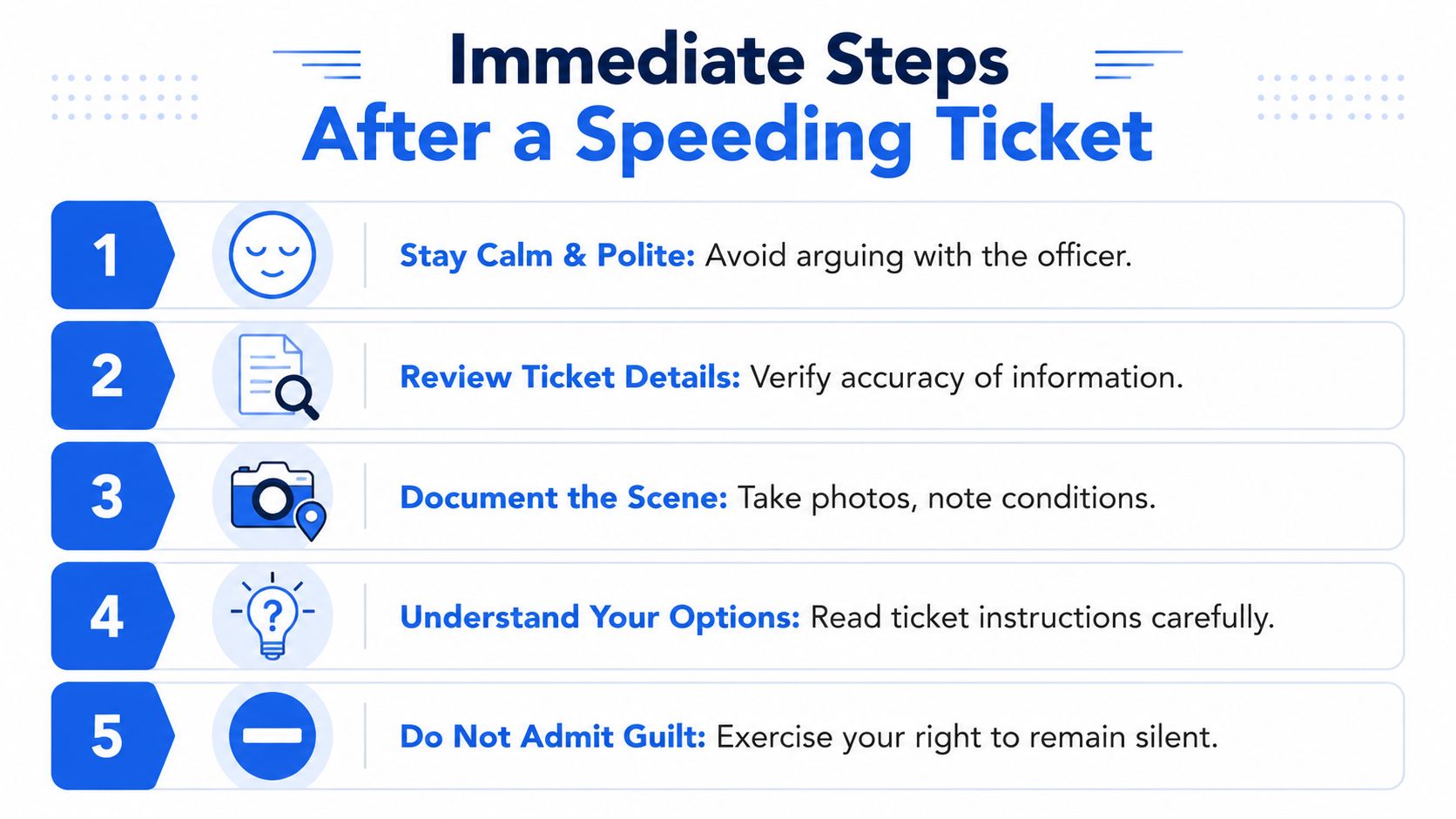
What should you do in the first hour
Use this checklist. Don't improvise.
Stay calm with the officer: Don't argue roadside. Don't give a speech. Don't guess your speed out loud.
Say less: Don't admit you were “probably going a little fast.” That kind of statement can haunt you.
Secure the citation: Put it somewhere safe and readable. You'll need every detail on it.
Read the instructions carefully: Deadlines matter. If you miss one, your options shrink fast.
Write down what happened: Do it while your memory is fresh. Note lane position, traffic flow, weather, visibility, and where the officer was positioned.
A practical walk-through helps. Review what to do when you get a ticket in Florida as soon as possible and compare it to your facts.
If you drive commercially, the stakes are even higher. This guide on how speeding affects CDL driver safety is useful because it shows why professional drivers can't treat a citation casually.
What evidence should you preserve in the first 48 hours
Don't wait for court to start gathering proof. Start now.
Then preserve what the state will not preserve for you:
Photographs of the scene: Get signs, road markings, tree cover, curves, hills, and any visual obstruction.
Your dashcam footage: Save the original file. Don't rely on an app that overwrites storage.
GPS or phone data: If your device logs trips or speed history, preserve it immediately.
Screenshots of weather conditions: If visibility was poor, document it.
Passenger notes: If someone was with you, have them write down what they saw while it's fresh.
Immediate warning: General complaints don't help. Specific facts do.
Your notes should answer concrete questions. Was the speed limit sign visible? Was traffic dense? Was there a hill, curve, or merge? Was the officer on the opposite side of the road? Those details can later support a technical defense instead of a vague denial.
How Do You Build a Strong Defense Strategy
A real defense starts after the panic wears off. Now you build the file.
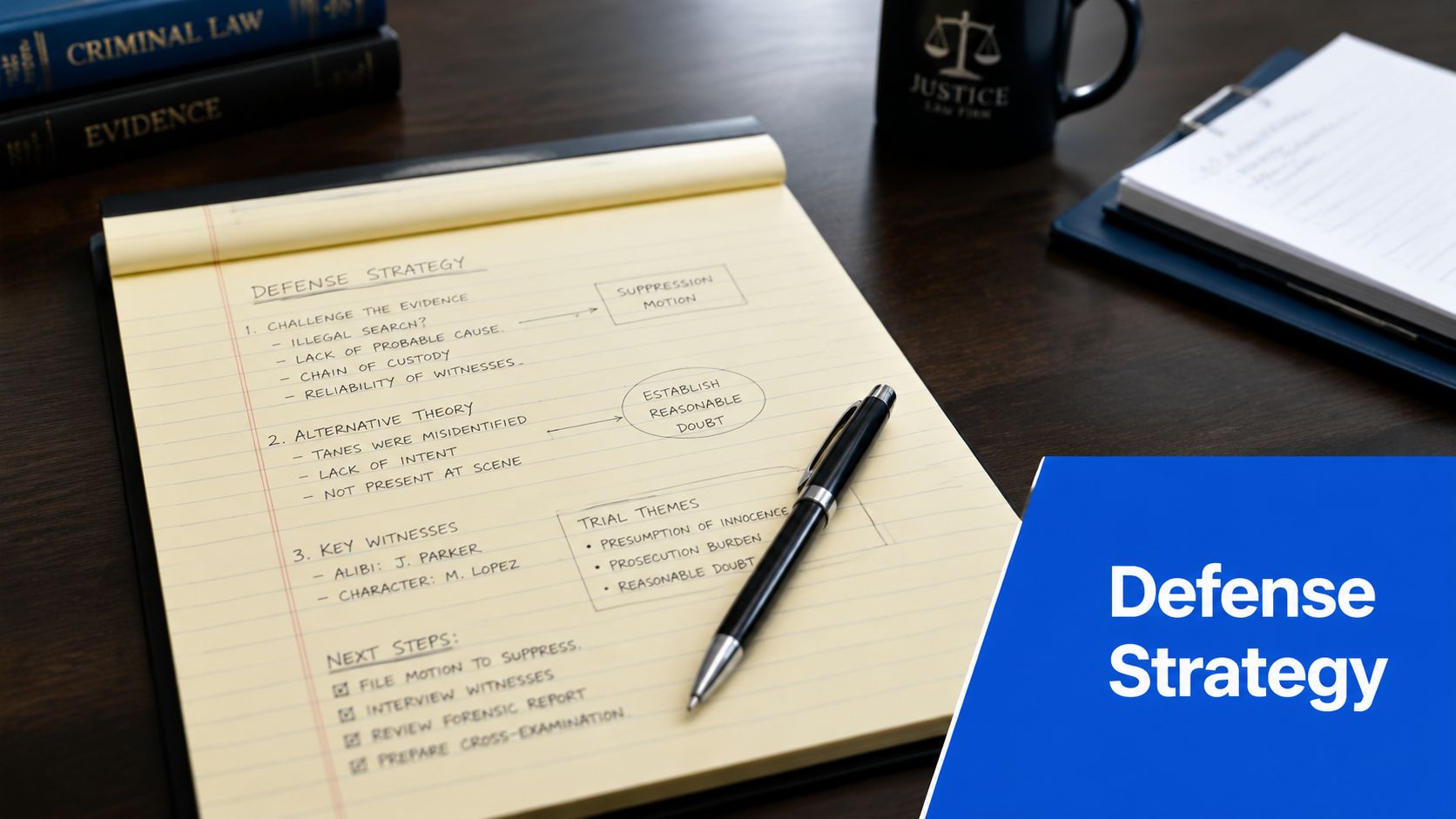
What evidence should you demand from the state
The smart attack is not “the officer was wrong.” The smart attack is “show me the proof, and let's test it.”
A defensible challenge starts with requesting calibration and maintenance records for the specific device used. Radar, LIDAR, and pacing each have distinct failure modes, and the strongest defenses tie the challenge to a concrete defect such as missing calibration records or inconsistent ticket data, as explained in this guide to fighting a speeding ticket step by step.
That means you focus on records like these:
Record or proof | Why it matters |
|---|---|
Device calibration records | Shows whether the speed device was maintained and checked |
Maintenance history | Can reveal gaps, missing entries, or unreliable upkeep |
Officer training or certification | The state should be able to show the operator was qualified |
Dashcam or bodycam footage | May confirm or contradict the stop narrative |
Citation details and notes | Inconsistencies can become leverage |
If the method was radar, you look for setup issues and whether traffic conditions could have interfered with target identification. If it was LIDAR, line of sight and stable aim matter. If it was pacing, following distance, traffic density, and patrol car speedometer reliability come into play.
For a plain-English primer before you review the records, read how radar speed guns work. It helps you ask smarter questions.
How can your own data help your case
Your evidence may be stronger than you think, but only if you handle it correctly.
Use:
Dashcam files with timestamps
Phone GPS logs
Vehicle telematics or trip history
Photos of signage and lane conditions
Witness statements from passengers
Don't oversell weak data. A rough screenshot without context can hurt as much as help. Preserve original files where possible and keep track of when and how you saved them.
The strongest defense turns a speeding allegation into a documentation problem.
That can mean mismatched times, unclear location data, conflicting speeds, or missing maintenance proof. Judges usually don't reward emotional arguments. They respond to organized records, concrete contradictions, and disciplined presentation.
This is also where many drivers lose ground with automated apps and ticket-processing services. They collect intake information, but they don't think like trial counsel. A lawyer-led review is different because someone examines the state's evidence for pressure points instead of just moving your case through a system.
What Happens When You Go to Court
You walk into traffic court thinking you will get a quick chance to explain yourself. Instead, you are standing in a crowded room, the docket is moving fast, and the court is treating your case like one more file in a stack. That is where drivers get hurt. Good facts are wasted by bad timing, bad framing, and missed procedure.
At the Richard E. Gerstein Justice Building in Miami and in courthouses across Florida, a speeding case usually turns on preparation long before the judge says a word. Court is where weak records are exposed, officer testimony is tested, and smart negotiation can protect your license and insurance record. It is also where ticket mill services leave people exposed. They process volume. They do not stand next to you and make judgment calls in real time.

What does the court process usually look like
A Florida speeding case usually follows a predictable path, but the risk changes at each step.
Your not guilty position is entered
This preserves your right to challenge the citation and forces the case into court review instead of automatic payment and conviction.A pre-trial setting may follow
This is often the first real pressure point. The state may be open to a reduction. The court may set deadlines. A lawyer uses this stage to judge the strength of the officer, the paperwork, and the practical value of pushing forward.The state's evidence is examined
The officer's method, notes, calibration records, and the wording of the citation all matter here. Small defects can matter a lot.A hearing or trial happens if the case does not resolve earlier
The judge listens to testimony, reviews the documents, and decides whether the state proved its case.
The biggest mistake is treating court like a chance to tell your side of the story and hope for mercy. That is not how this works. A speeding case is won by controlling the record, objecting when needed, exposing gaps in proof, and knowing when a reduction is better than gambling on a full hearing.
What counts as a good outcome in traffic court
A good result is any result that protects you from the long-term damage of a moving violation.
That can mean:
A reduction from the original charge
A result that helps avoid points
A resolution that limits insurance fallout
A cleaner record for work, fleet, CDL, or background concerns
A dismissal when the proof falls apart
Many drivers fixate on one outcome and miss the smarter target. Full dismissal is excellent. It is not the only result worth fighting for. In many cases, the right strategy is to protect the record first and chase the headline win only if the evidence supports it.
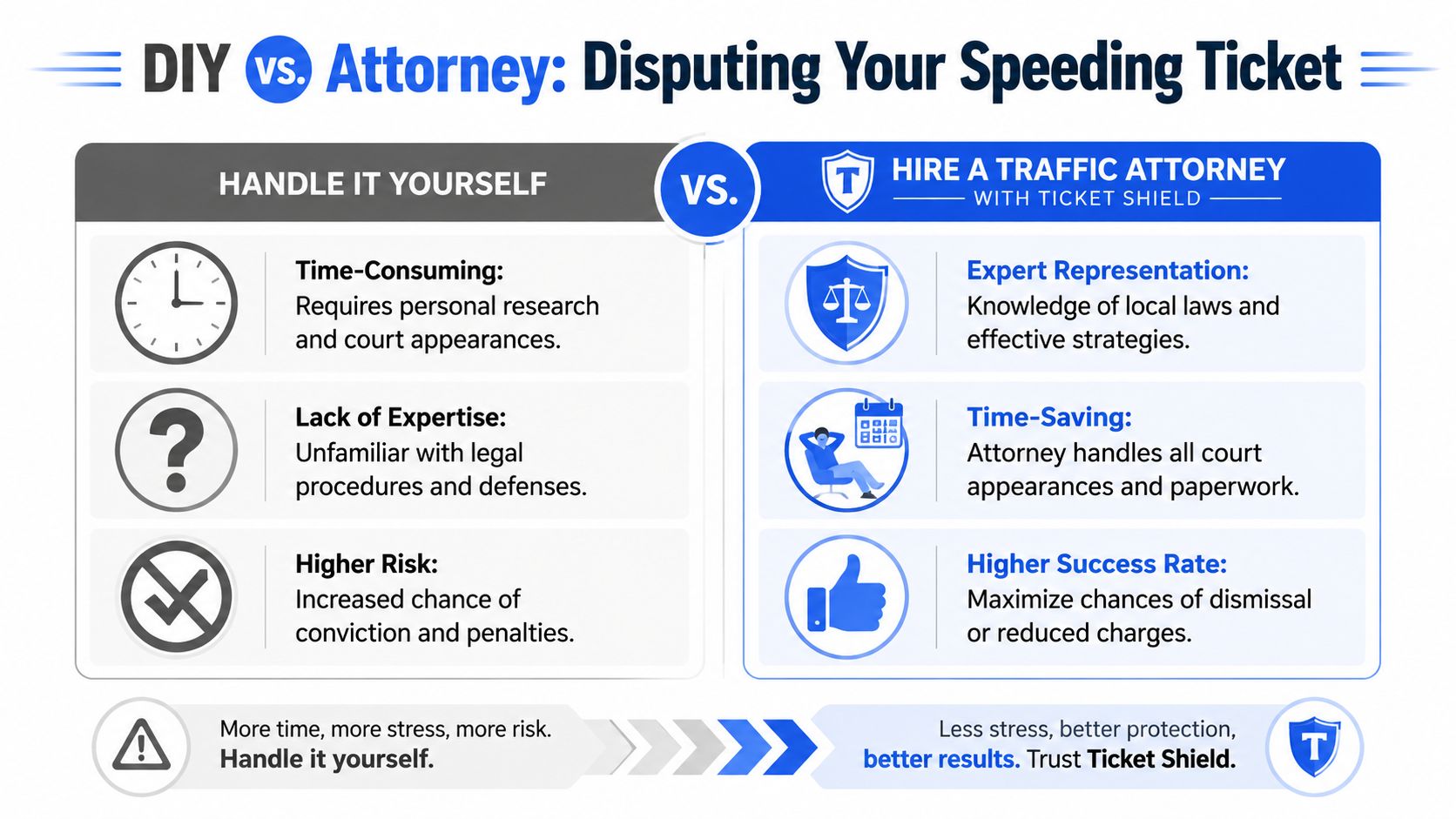
This is why direct attorney access matters. A real lawyer can read the room, assess the judge, challenge the officer, and decide whether to negotiate or press the case. An automated service cannot do that. If you are deciding whether to handle this alone, read when to hire a traffic lawyer for a speeding ticket.
Court rewards preparation, discipline, and proof.
Show up with a vague explanation, and the system will roll right over you. Show up with a case strategy, and the ticket stops being just a ticket. It becomes a claim the state still has to prove.
When Is It Time to Call a Traffic Attorney
If your job depends on driving, the answer is now. If your license is already vulnerable, the answer is now. If you're busy and can't spend your week learning traffic procedure, the answer is also now.
This system is built for volume. One source reports that only about 5% of motorists challenge their traffic tickets, which helps explain why experienced attorneys can spot documentation and procedural problems that most drivers never use, as described in this discussion of how often drivers contest traffic tickets.
Who should not handle this alone
Some drivers are taking too much risk by going DIY.
You should get counsel quickly if:
You hold a CDL or drive for a living
You're a gig worker whose account can be affected by moving violations
You already have prior citations or license concerns
You were cited at a high alleged speed
You can't attend court comfortably because of work, travel, or family obligations
A lawyer can also evaluate whether the practical target should be dismissal, reduction, mitigation, or another record-protective resolution. That's a legal judgment call, not a chatbot decision tree.
For a fuller breakdown of representation issues, see when to hire a traffic lawyer for a speeding ticket.
Why direct attorney access matters
Many drivers get burned when they hire a service that looks simple, then discover they're dealing with intake staff, account managers, or automated messages instead of a lawyer.
You should insist on direct access to the person responsible for your defense. That means being able to ask questions by phone or text and get legal answers from your attorney, not a middleman.
One option is Ticket Shield, PLLC, a Florida traffic defense firm that handles speeding citations statewide with lawyer-led representation and direct attorney communication by phone or text rather than chatbot-only intake or ticket-mill handoffs. That model matters because disputing speeding tickets is not clerical work. It is case analysis.
Frequently Asked Questions About Florida Speeding Tickets
Do I have to appear in court if I hire a lawyer
Often, your lawyer can handle much of the process for you. The exact requirement depends on the court, the charge, and the posture of the case. Don't assume you must personally stand in line and lose a workday. Ask that question immediately when you speak with counsel.
Should you just elect traffic school
Not automatically. Traffic school can be useful in some situations, but it is not a universal answer. First look at the ticket, your driving record, your work situation, and whether the state's case has weaknesses. Don't choose convenience before you assess your position.
What if the officer does not show up
It can matter, but don't build your whole strategy around that hope. The stronger approach is to prepare an evidence-based defense. Materials aimed at traffic defense consistently stress that vague denials rarely succeed, and many cases are resolved through mitigation or reduction rather than unsupported claims that the officer was wrong, as explained in this traffic-court strategy guide.
Can one ticket really affect insurance
Yes, it can. Its impact is often broader than the initial fine. That's why drivers who commute, drive for income, or already have prior issues shouldn't treat a citation as minor.
If you want to understand the record side more clearly, review how many points a speeding ticket can mean in Florida.
Is disputing speeding tickets really worth it
If protecting your record matters, yes. The mistake is thinking the only question is whether you were speeding. The better question is whether the state can prove the case cleanly and whether there is a smarter path to keep points off your record.
If you just got cited, don't pay first and ask questions later. Get legal advice while the facts are still fresh and the evidence can still be preserved. Visit Ticket Shield, PLLC for a free consultation and a no-points strategy review.