Commercial Traffic Ticket Lawyers in Florida: How to Choose
Need commercial traffic ticket lawyers? Learn how to choose experienced Florida counsel to protect your CDL, avoid points, and fight tickets effectively.

You've just been handed a Florida traffic citation while driving your truck. Your first thought may be that it's only a fine, especially if the stop didn't involve a crash and you believe you can pay it off before the deadline. For a commercial driver, that decision can affect far more than your wallet.
A conviction can place points on your Florida driving record, create problems with your employer, affect insurance decisions, and expose your CDL to consequences that a routine traffic article may never mention. Commercial traffic ticket lawyers don't treat your citation like ordinary paperwork. They examine what the conviction could do to your license, your record, and your ability to keep earning a living.
Table of Contents
Qualifications to Look for in Commercial Traffic Ticket Lawyers
Key Questions to Ask Before Hiring a Traffic Defense Attorney
Cost Expectations and Likely Defenses for Commercial Tickets
Why Your Commercial Ticket Is Not Just Another Fine
A driver leaves the roadside with a citation folded into a pocket. The truck is still running, the route is still scheduled, and the employer may not know anything happened. Paying the ticket can feel like the fastest way to put the incident behind you.
That instinct creates risk. Under Florida's point system, speeding generally carries 3 points, reckless driving carries 4 points, careless driving carries 3 points, and speeding more than 50 miles per hour over the limit can carry 4 points, according to the Florida Department of Highway Safety and Motor Vehicles point suspension rules. Points remain on the driving record for at least 5 years from the conviction date, so the consequence can follow you well beyond the payment date.
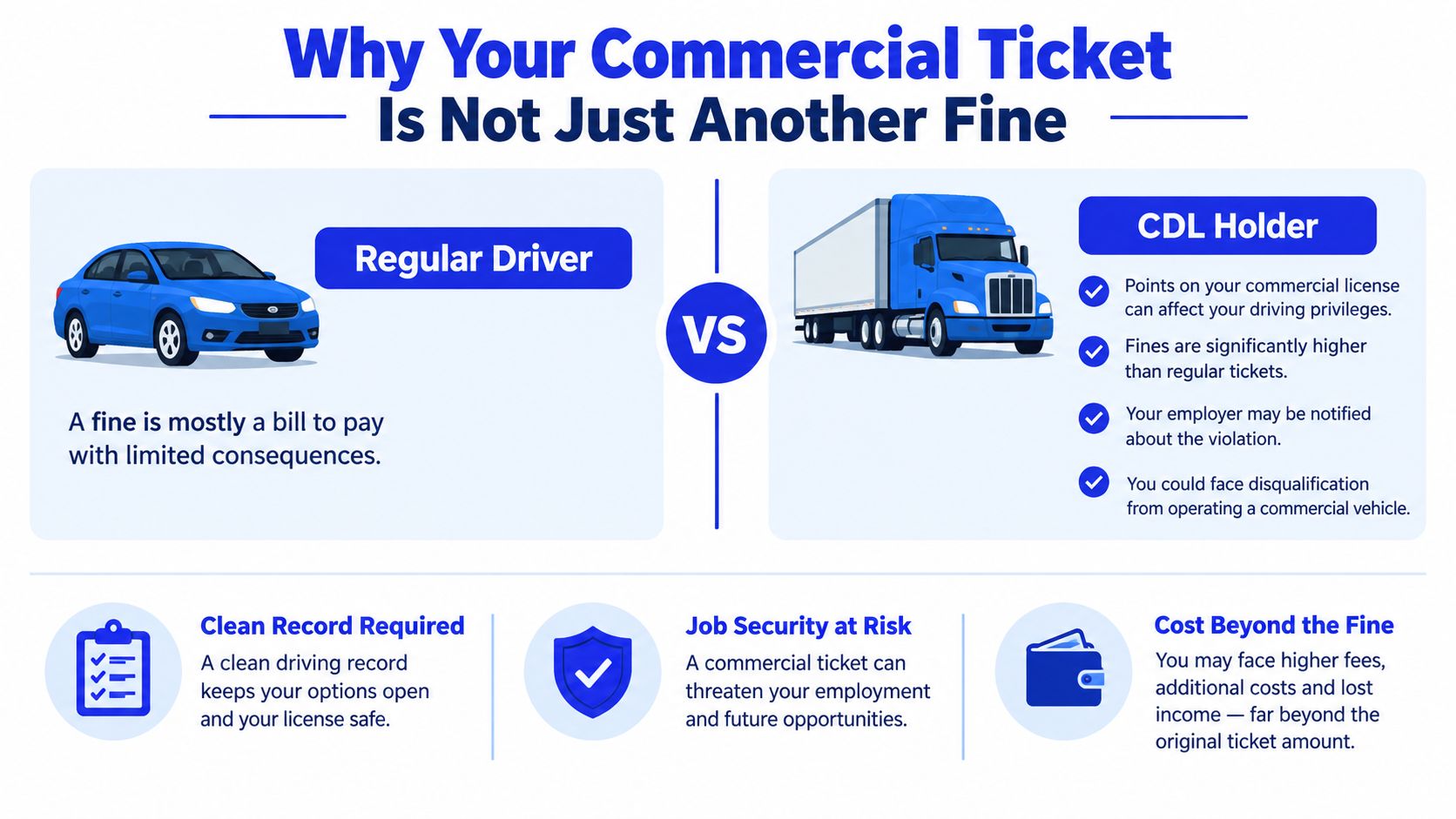
The record matters more than the receipt
Florida's Department of Highway Safety and Motor Vehicles says a driver who receives 12 points in 12 months faces a 30-day suspension, while 18 points in 18 months results in a 3-month suspension, and 24 points in 36 months results in a 1-year suspension. Those thresholds apply to the Florida driving record, not merely to the paper citation in your glove compartment. The same agency also identifies a Habitual Traffic Offender as a person who accumulates 15 moving violations with points assessed within 5 years, or 3 major violations within 5 years. These rules are detailed in the Florida HSMV explanation of other suspensions and revocations.
Florida's traffic system is designed to place the result of an infraction onto the driver record. Under Florida Statute 316.650, the state's traffic infraction reference guide identifies the violation class, penalty, and points, and the department enters the proper points under section 322.27 when it receives the infraction report. The Florida statutory traffic citation provisions make clear why paying without legal review can be a record-management decision, not just a financial one.
Scenario | Paying the Ticket | Fighting with Counsel |
|---|---|---|
Immediate result | Resolves the citation through payment but may create a conviction and record consequences | Preserves the opportunity to challenge the citation before accepting a record outcome |
CDL exposure | Leaves the driver to evaluate employer and licensing consequences after the result is entered | Allows counsel to evaluate the commercial consequences before choosing a resolution |
Evidence | The officer's notes, device records, and roadway conditions may never receive meaningful review | Counsel can request and compare available documents, records, and physical evidence |
Work impact | The driver may still need to explain the conviction to an employer or insurer | Representation may reduce the need for the driver to handle every court appearance personally |
Long-term objective | Focuses on closing the ticket | Focuses on protecting the license and pursuing a No Points outcome when legally available |
Traffic cases are not rare administrative events. In 2022, traffic cases represented 57% of state and local court filings, or about 38 million cases, and a 2024 court statistics summary reported that traffic infractions accounted for about 46% of incoming cases. The Pew Research Center court statistics summary shows the scale of the system. For you, the important point is practical: courts process high volumes, but your CDL and income are personal stakes. A routine docket does not make your individual citation routine.
For more detail on the specific risks facing professional drivers, review this guide to CDL traffic ticket consequences before you decide to pay.
Qualifications to Look for in Commercial Traffic Ticket Lawyers
A lawyer who handles ordinary traffic paperwork may not be prepared to protect a commercial driver's livelihood. You need someone who understands Florida traffic defense, the point system, court procedure, and the commercial consequences that can follow a conviction.
Start with the attorney's actual Florida practice. Ask whether the lawyer personally handles traffic cases in the county where your citation is filed. Florida courts do not all operate identically, and local filing practices, hearing procedures, scheduling, and courtroom expectations can affect how a case moves. Experience in the Richard E. Gerstein Justice Building in Miami-Dade, the Broward County Judicial Complex, or the Orange County Courthouse in Orlando is more meaningful than a vague statement that a firm “serves Florida.”
Verify the lawyer's CDL judgment
The attorney should ask about more than the alleged speed or lane movement. A proper intake should address:
License status: Has your Florida driving privilege or CDL already received points, restrictions, or a suspension notice?
Vehicle status: Did the citation arise while you were operating a commercial motor vehicle, or while driving another vehicle?
Employment exposure: Does your employer require immediate reporting, and could the citation affect your current route or position?
Citation classification: Is the allegation an ordinary moving violation, a serious safety concern, or conduct connected to federal compliance requirements?
Prior history: What other convictions or pending matters could change the consequences of this case?
Evidence: Are officer notes, speed-measuring records, photographs, maintenance documents, or roadway conditions relevant?
A lawyer who never asks these questions may be applying a standard consumer-ticket script to a commercial case. That's a warning sign. A CDL holder needs an individualized assessment before the attorney recommends payment, negotiation, a hearing, or litigation.
Confirm courtroom coverage and communication
Statewide representation matters when your route crosses Florida counties or when you live outside Florida but received a citation here. Confirm that the firm can handle the court where the ticket is pending and that the attorney understands how to represent an out-of-state commercial driver cited in Florida.
You should also ask whether the lawyer personally reviews the citation before offering a strategy. A mass-processing service may collect the citation, send it through a generic workflow, and provide an outcome without explaining why that strategy fits your evidence. A lawyer-led practice should be able to identify the alleged violation, the possible record effect, and the documents that need review.
Practical rule: Choose the attorney who can explain what must be protected on your record, not merely what must be filed with the court.
Look for direct attorney communication by phone or text. Corporate answering services, middlemen, and automated chatbots may collect information, but they can't replace legal judgment when a court document conflicts with the officer's narrative or when your employer needs a careful explanation of the possible outcome.
A useful starting point is this overview of how to evaluate a Florida traffic ticket attorney. Use it as a checklist, then press the firm for answers specific to your CDL and the county handling your case.
Key Questions to Ask Before Hiring a Traffic Defense Attorney
The first consultation should feel like a case evaluation, not a sales call. You're not trying to prove that you understand traffic law. You're testing whether the attorney can identify the risk created by your particular citation.

Ask these questions directly:
“How do you handle Florida CDL cases like mine?”
The answer should address commercial consequences, not only the possibility of reducing a fine. Ask whether the attorney has handled cases involving employer concerns, point exposure, and license protection.“Who will review my citation and communicate with me?”
You should know whether you'll speak with the attorney, a paralegal, a call center, or an automated system. Direct communication matters because a change in your work schedule, a new notice from the state, or an additional document can change the legal strategy.“What evidence will you examine?”
A serious review may include the citation narrative, officer notes, speed-measuring device certification, calibration or maintenance records, roadway photographs, signage visibility, and any procedural issue apparent from the file. If the response is limited to “we'll take care of it,” you haven't received a meaningful evaluation.“Do I need to appear in court?”
Ask whether the attorney can appear for you and under what circumstances your presence may still be required. A commercial driver needs to plan routes and work obligations around any unavoidable appearance.“What outcomes are realistically available?”
A responsible attorney won't promise dismissal before reviewing the evidence. The lawyer should explain whether the practical objective is dismissal, a reduction, a non-moving disposition when legally available, or another resolution that limits record damage.“What is included in the fee?”
Get the fee structure in writing. Ask whether the quoted amount includes the initial review, court appearance, negotiations, motions, document requests, and communication with you. Transparent pricing lets you compare legal value instead of comparing a bare filing fee with full representation.
The right answers will be specific without pretending that any lawyer controls the court. You should hear a clear explanation of what the attorney knows, what still needs investigation, and what facts could change the recommendation.
After the consultation, compare the substance of the advice. A lawyer who identifies a certification issue, asks for the right records, and explains the commercial consequences has done more than a service that promises a generic “ticket defense.”
This list of questions for your traffic attorney can help you prepare before you call.
The consultation should also establish how quickly the firm responds when something changes. You need a lawyer who can address a new court notice or employer concern without forcing you through several layers of support.
Why Direct Attorney Communication Changes Your Outcome
Direct access to your lawyer affects the quality of decisions made before the court date. It isn't a luxury for a CDL holder. It's how the attorney learns the facts that a form may not capture, then adjusts the defense to the actual record.
A citation may appear straightforward until the attorney compares the narrative with the roadway layout, checks whether a device record exists, or notices that the alleged conduct could carry a different practical risk for a commercial driver. An automated app can collect the citation. A corporate answering service can repeat a status update. Neither replaces an attorney deciding which evidence matters and what resolution protects your license.
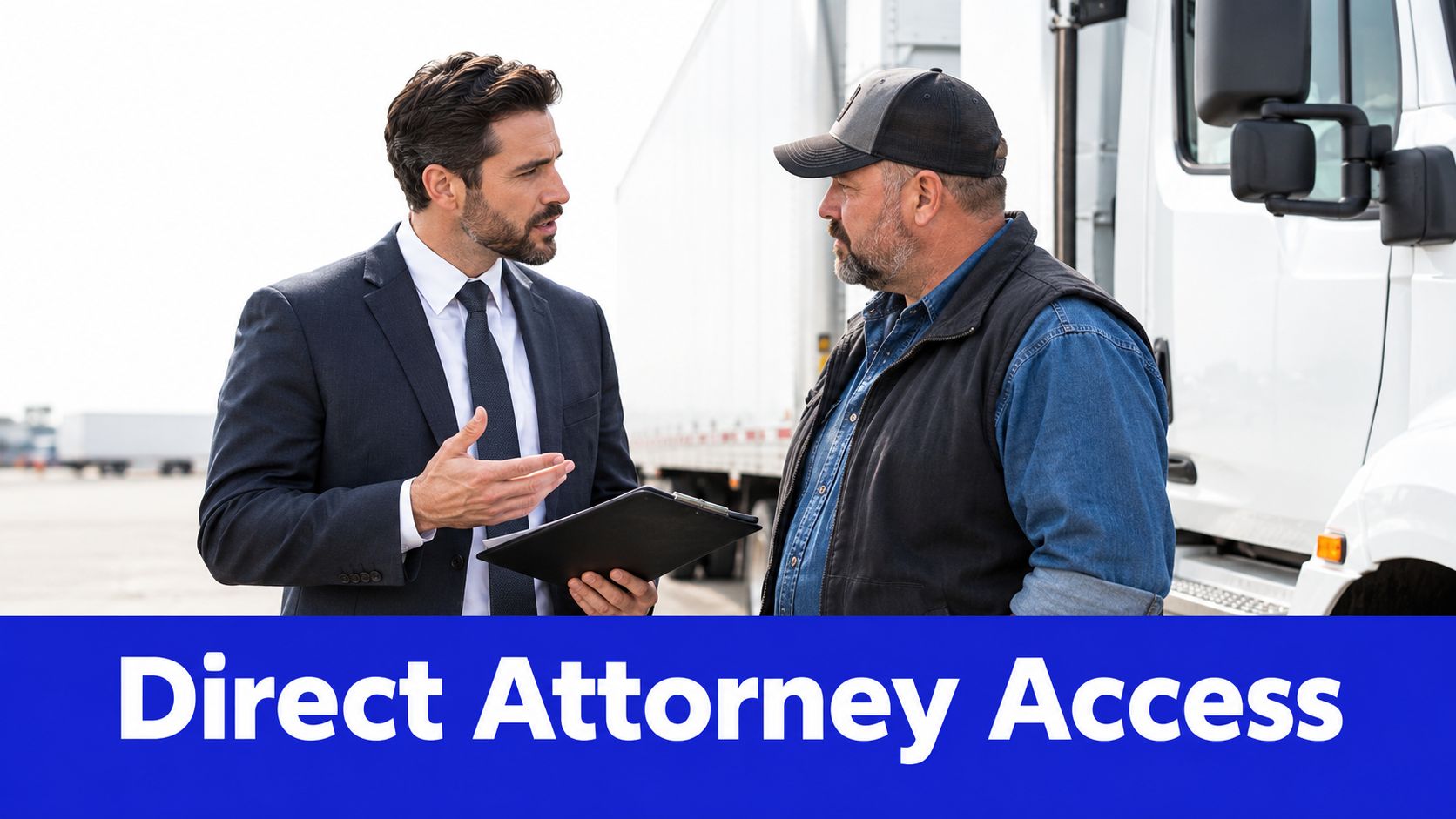
The difference between access and intake
Ask who makes the legal decisions. If the answer is a sales representative, a call-center employee, or an automated chatbot, you may not know the attorney's position until the case has already been placed into a standard process.
A lawyer-led model should give you a direct way to discuss:
New facts: Your employer's reporting requirement, a changed work assignment, or a separate notice from the state.
Evidence questions: Whether a speed-measuring device was certified, whether records are available, and whether the citation matches the scene.
Resolution choices: Whether a proposed plea or reduction still creates unacceptable commercial consequences.
Deadlines: What must be done before the court date and what happens if the court requests additional action.
Direct communication also protects against a common error, treating every citation as if the driver were a noncommercial motorist with no professional exposure. The attorney should understand that preserving your ability to work can matter more than closing the file quickly.
That doesn't mean direct access guarantees a particular result. No ethical attorney can promise a dismissal without reviewing the evidence and the court's authority. It means the person advising you has the information and legal responsibility needed to make a case-specific decision.
A ticket service can process a document. Your attorney must protect the consequences attached to that document.
The service model described in a direct attorney consultation guide is useful for evaluating whether you're receiving legal communication or merely administrative support. Ask whether you can call or text the attorney handling your case, and whether that attorney will explain the strategy in plain language.
You should also ask how the firm handles urgent developments. If you receive a notice that affects your license or employment, a delayed chatbot response isn't enough. You need a lawyer who can review the notice, explain its significance, and tell you what action is available.
Cost Expectations and Likely Defenses for Commercial Tickets
The cost of defending a commercial citation should be measured against the consequences of a conviction, not only the amount printed on the ticket. A conviction may affect your Florida driving record, create point exposure, trigger employer action, increase insurance concerns, or place your CDL at risk. For a commercial driver, the legal fee may be the smaller part of the financial decision when a record threatens continued work, as explained in this breakdown of how much it costs to fight a traffic ticket.
The attorney's fee should match the work the case requires. That work may include reviewing the citation, requesting officer notes, examining speed-measuring device certification, checking calibration and maintenance records, photographing the roadway, evaluating signs and signals, contacting the clerk, negotiating with the prosecutor where appropriate, and appearing in court. A simple citation and a serious speed allegation should not receive the same review.
What evidence can change the case
A defense begins with proof. In speeding matters, the traffic-ticket evidence analysis on calibration records reports that formal calibration-record requests led to dismissals or reductions in 40% to 50% of challenged matters, while 25% to 30% of radar devices had expired certifications when records were requested. Those figures do not predict what will happen in your county. They show why counsel should request the underlying records instead of assuming the device was properly certified and maintained.
The same source reports that courts gave substantial weight to roadway defects, including obstructed signs, signal malfunctions, and road hazards. A photograph taken soon after the stop can carry more value than a general statement that the road was confusing. Your lawyer should connect the physical condition to the specific elements of the alleged violation.
Representation can also affect how fully the file is developed. According to the same traffic-ticket evidence analysis on calibration records, dismissals occurred in 30% to 35% of attorney-represented cases, compared with 15% to 20% for self-represented defendants, and an additional 25% to 30% of represented matters received charge reductions. Those figures vary by jurisdiction and violation type, so treat them as context rather than a promise. The practical point is to examine the evidence before the first court date, when the available choices may be wider.
Defense Type | Applicable Violations | Basis |
|---|---|---|
Device certification review | Speeding allegations involving radar or another measuring device | Counsel checks whether certification, calibration, or maintenance records support the measurement used against you |
Citation narrative comparison | Speeding, careless driving, or other moving allegations | The attorney compares the written account with photographs, roadway geometry, timing, and your account |
Visibility or roadway condition review | Speeding and roadway-control allegations | Obstructed signs, malfunctioning signals, or dangerous road conditions may weaken the government's proof |
Officer testimony analysis | Moving violations that depend heavily on observation | Counsel evaluates whether the testimony is consistent, specific, and supported by available records |
Charge and record negotiation | Eligible Florida traffic matters | The attorney seeks a resolution that limits record consequences when dismissal is unavailable |
Serious speed allegations need separate treatment
Florida Statute 316.1922 defines dangerous excessive speeding as driving 50 miles per hour or more over the speed limit, or driving 100 miles per hour or more in a way that threatens safety or interferes with another vehicle. The Florida dangerous excessive speeding statute provides that a first conviction can bring up to 30 days in jail or a $500 fine, or both. A second or later conviction can bring up to 90 days in jail or a $1,000 fine, or both. A second or subsequent violation within 5 years also requires revocation of the driving privilege for at least 180 days and up to 1 year.
For a CDL holder, that type of allegation requires attorney review before any decision to pay, plead, or accept a proposed resolution. The measurement, allegation, roadway conditions, and prior history all matter. A quick disposition can leave the court file closed while the driving, employment, and licensing consequences remain.
Commercial drivers must also consider federal penalty exposure when the conduct involves federal compliance rules. The FMCSA penalty schedule shows that penalties adjusted for 2025 include a maximum of $19,246 for certain out-of-service-order violations and $7,155 for CDL violations. Those amounts do not apply to every Florida traffic citation. They demonstrate why counsel must identify the precise conduct alleged before discussing cost, reporting duties, or strategy.
A lawyer should provide a written fee explanation and a candid assessment of the evidence. Ask what the fee covers, which court appearances are included, and whether additional work will cost more. Avoid anyone who guarantees an outcome, hides the scope of representation, or treats a CDL matter as a simple payment transaction. Cost-effective representation means paying for targeted legal work that addresses the actual risk, not for a template that overlooks how one citation can affect your license and your job.
Take Action Now to Protect Your Florida CDL
The period after a citation is when you have the most control over the next decision. Waiting can make it harder to gather roadway evidence, obtain records, understand the court process, or address an employer's reporting requirement before the case affects your driving history.
Start by preserving everything. Keep the citation, take photographs of the location when conditions are comparable, save any employer correspondence, and write down what happened while your memory is fresh. Don't send an explanation to an insurer, employer, or government office before a Florida traffic defense attorney has reviewed the situation if that communication could affect your legal position.
You also need to separate the fine from the objective. For a commercial driver, the objective is usually protecting the CDL, protecting the ability to work, and pursuing No Points on the license when the facts and law allow it. A quick payment may close the court file while leaving the more serious record consequences untouched.
Choose representation that fits your risk
Look for a Florida attorney who:
Reviews the actual file: The lawyer examines the citation, available records, and facts before recommending a resolution.
Understands commercial consequences: Counsel evaluates the effect on your driving record, employer relationship, insurance concerns, and CDL status.
Communicates directly: You can reach the attorney by phone or text rather than relying on a middleman or automated chatbot.
Handles the correct court: The firm can address the Florida county where your citation is pending and explain whether you must appear.
Uses transparent pricing: You understand what the representation includes before you hire counsel.
A commercial traffic ticket doesn't automatically end your career. But treating it casually can surrender options that could have protected your record. Get the citation reviewed before you pay, before you miss a deadline, and before a conviction creates a problem your employer discovers first.
Ticket Shield, PLLC provides lawyer-led Florida traffic defense with direct attorney communication by phone or text, including representation for commercial drivers facing traffic citations. Visit the firm for a free consultation and discuss a strategy focused on protecting your CDL and achieving No Points on your license when legally possible.