Florida Attorney for Driving with a Suspended License
Attorney for driving with a suspended license - Charged with driving on a suspended license in Florida? Know your rights & penalties. An attorney for driving

If you were charged with driving on a suspended license in Florida, get a real attorney involved immediately. This is often a criminal case under Florida Statute 322.34, not a routine ticket, and fast action can protect your record, license, job, and No Points goal.
You were probably just trying to get through the day. Work. School pickup. A delivery shift. A quick drive home. Then the lights came on, the officer ran your information, and now you're holding a notice that can turn into a criminal problem fast.
That shock is real. So is the risk.
In Florida, driving while your license is suspended, revoked, or canceled is generally addressed under Florida Statute 322.34. That matters because many drivers think this is something they can fix later with a payment, a phone call, or an online portal. Usually, that's the wrong move. A suspended license charge can affect your ability to drive, your insurance, your work, and how the court sees you going forward.
If you're searching for an attorney for driving with a suspended license, you're already asking the right question. The next step is choosing the right kind of help. You need strategy. You need speed. And you need a lawyer who handles both the court side and the license-status side, because those are often connected but not identical problems.
Table of Contents
What Should You Do After Being Charged with Driving on a Suspended License?
The first thing you should do is stop treating this like a simple citation. In Florida, a DWLS charge can be a criminal offense under Florida Statute 322.34. That changes everything.
A lot of drivers don't learn their license is suspended until the stop itself. That doesn't make the charge harmless. It means your case may turn on notice, knowledge, paperwork, and timing. Those are legal issues. They need a legal response.

Why this charge hits harder than most drivers expect
For many people, the court date is only part of the problem. The bigger damage can show up at work. One legal source notes that the harm is often bigger than the fine: for rideshare and delivery workers, one suspended-license matter can deactivate earning accounts; for professionals and military personnel, it can create cascading problems with employment screening or security requirements in its discussion of license suspension consequences at Francavilla Law Firm's suspended license overview.
That is why delay is expensive.
If your income depends on driving, mobility isn't optional. If you commute, supervise kids, visit job sites, or carry a professional clearance, a bad result can spread into every part of your life. This is exactly why drivers need an attorney for driving with a suspended license, not a payment link and false confidence.
Immediate reality: The charge may be criminal. The license issue may still be fixable. But only if someone handles both correctly.
What your mindset should be right now
You don't need panic. You need control.
Start by finding out exactly why Florida says your license is suspended. That answer drives the defense and the reinstatement plan. If you haven't confirmed the basis yet, review this guide on how to check if your license is suspended in Florida.
Then do one more thing. Stop talking yourself into handling it alone.
Drivers make the biggest mistakes in the first few days. They call the wrong office. They say too much. They pay something that creates a record without fixing the actual problem. They miss the chance to challenge what should have been challenged early. A proper defense starts with a lawyer reviewing the stop, the notice history, the driving record, and the suspension basis before you make the case harder.
What Are the First Steps to Take After a DWLS Charge?
You need a short, disciplined checklist. Not guesswork.
One procedural source states that if an attorney doesn't timely request an administrative hearing, there is effectively a zero chance of success because the procedural process can be lost before the merits are ever reached in its discussion of suspension-hearing timing at Avvo's legal answer on suspension hearing success. That principle is simple. Delay can destroy options before anyone argues the facts.
Immediate steps to take
Stop driving unless a lawyer tells you it's legally safe: A second stop usually makes everything worse. More exposure. More court trouble. More risk to your record.
Say less, not more: If police ask questions beyond basic identification, don't try to explain the suspension, the notice issue, or why you were driving. Explanations made on the roadside often become evidence.
Write down the stop details today: Note the location, time, reason given for the stop, what the officer said about your license, whether your car was searched, and whether anyone else was present. Small facts become important later.
Save every document and screenshot: Keep the citation, booking paperwork if any, notice letters, payment receipts, insurance records, and anything from the clerk or Florida Highway Safety and Motor Vehicles.
Call a defense lawyer before you call agencies: Many drivers think the fix starts with the DMV or an online payment screen. Sometimes that helps. Sometimes it creates a new problem. Let counsel decide the order.
What should you avoid in the first day
Don't post about the arrest. Don't message people about how you "knew" or "didn't know" your license status. Don't try to clean up the story after the fact. And don't assume that because the underlying issue seems administrative, the court will treat it casually.
A DWLS case often turns on details that seem minor at first. The reason for the stop. Whether notice was legally sufficient. Whether the suspension basis still exists. Whether your driving record reflects something outdated or incomplete.
Don't let urgency push you into random action. Let urgency push you into the right action.
What should you gather for your lawyer
Bring the things that tell the full story, not just the citation.
Your driving-history clues: Old tickets, reinstatement receipts, proof of compliance, notice letters, or proof you changed addresses.
Employment hardship material: If driving is tied to your income, gather work schedules, platform account notices, or a letter showing your need to drive.
A timeline: When you moved, what you paid, what hearings you missed, what insurance lapsed or got restored, and when you learned of the suspension.
That package lets a lawyer move quickly. It also helps separate a true driving case from a paperwork-and-clearance case.
How Do You Choose the Right Attorney for Your Case?
Not every firm handles this problem the same way. That matters.
Some services are built to process volume. They rely on intake teams, middlemen, dashboards, and canned updates. That's not what you want when your case may depend on whether the stop was lawful, whether you had notice, and whether the State can prove knowledge under Florida Statute 322.34.

Why direct attorney access matters
If your case is in Miami, the person protecting you at the Richard E. Gerstein Justice Building needs to know the file cold. Not just your name. Not just the charge code. The facts.
That is why I don't recommend automated apps or ticket mills for a suspended-license charge. An app can't spot the weakness in an officer's narrative. A chatbot can't challenge notice. A non-lawyer case manager can't stand up in court and negotiate the right resolution with the prosecutor.
If you're comparing firms, ask direct questions:
Will I speak directly with my attorney by phone or text?
Who reviews the stop report and my driving history?
Who decides whether to fight, fix, or coordinate both tracks?
Who appears in court if the case requires it?
If the answers are vague, keep looking.
What a real Florida lawyer does that an app can't
A real attorney for driving with a suspended license doesn't just "handle a ticket." The lawyer should test the whole case.
That includes:
reviewing whether the officer had a valid reason to stop you
checking the suspension basis and whether it was cured or curable
analyzing whether notice was proper
identifying whether the case should be criminally contested, administratively fixed, or both
negotiating with the State Attorney from a position built on documents, not slogans
One Florida option built around direct lawyer access is Ticket Shield's lawyer-led traffic defense model, where clients communicate directly with their attorney instead of being routed through middlemen.
The right lawyer isn't selling convenience. The right lawyer is protecting your record with strategy.
This short video helps explain why the type of representation matters:
What your decision should be based on
Choose the firm that treats your case like a legal problem, not a transaction.
You want someone who asks for documents early, explains whether your exposure is criminal or civil, and moves fast enough to preserve options. You also want clear communication. If you can't get real answers before you hire the firm, you won't get them after.
What Legal Defenses Can Be Used Against a DWLS Charge?
A strong DWLS defense starts with questions. Good lawyers don't begin with panic. They begin with investigation.
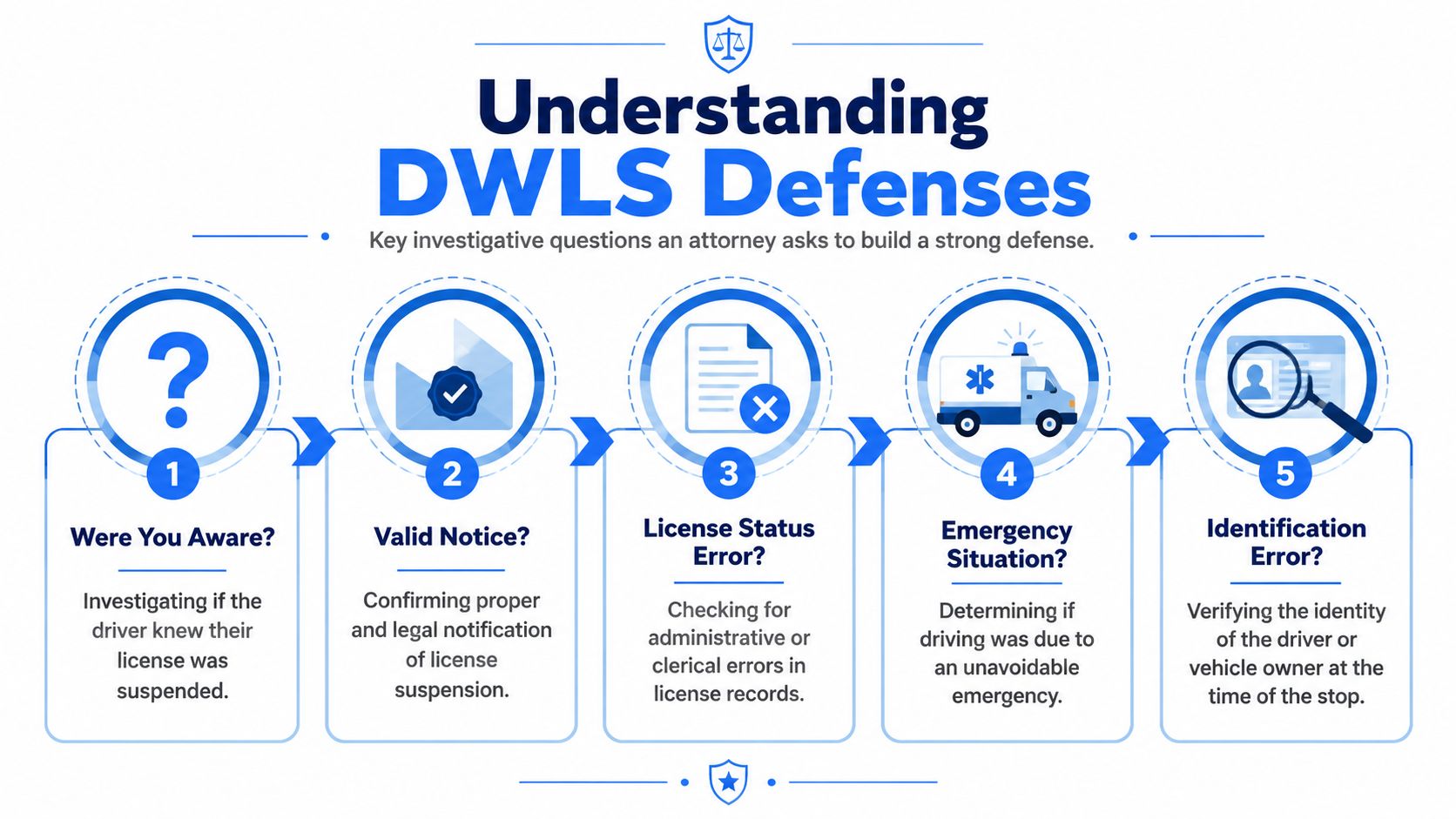
Did the State prove you knew your license was suspended
That is often the first serious question.
A legal discussion of suspended-license cases notes that a key defense is whether the suspension was properly noticed and that the fastest path to a resolution is often fixing the status issue, because many drivers are stopped for unpaid tickets or missed reinstatement steps and may never have been effectively informed, as discussed in Patrick Brooks Law's page on suspended driver's license issues.
In Florida terms, that means your lawyer should ask:
Was notice mailed to an old address?
Was the suspension based on something already resolved?
Did the driving record contain an administrative error?
Is the State assuming knowledge without proving it?
If the prosecution can't establish the required knowledge element, the defense path changes.
Was the stop and the suspension process legally sound
Your attorney should also examine how the case started.
If law enforcement stopped you without legal justification, the defense may attack the stop itself. If key evidence flowed from an unlawful stop, suppression may become central. If you want a plain-English breakdown of that process, read this explanation of what a motion to suppress evidence means in traffic cases.
Other defense angles can include:
Administrative mistakes: Clerical errors happen. A wrong status code, unresolved update, or database issue can distort what the record shows.
Identity issues: In some files, the officer's identification of the driver or vehicle needs close review.
Emergency circumstances: Rare, but important when the facts support it.
Curative documentation: If the underlying issue has been fixed, that can change one's position, negotiations, and outcomes.
Some suspended-license cases are really notice cases. Some are record-error cases. Some are stop-legality cases. A lawyer's job is figuring out which one you actually have.
Why document repair can matter as much as courtroom argument
Many drivers assume the defense is a dramatic courtroom speech. Usually, it isn't.
Often the best result comes from building a careful package. Proof of payment. Proof of insurance. Proof of compliance. Proof that the suspension basis no longer exists. That can shift the entire case.
A lawyer who sees only the criminal citation may miss the administrative cure. A lawyer who sees only the license issue may miss the constitutional problem. Good defense work connects both.
What Are the Potential Penalties and Court Timelines?
You need to understand the stakes clearly. A DWLS case can start small and become much more serious if handled badly.
One published analysis reports that an estimated 11 million people across the United States have suspended licenses, and that the economic fallout is severe, including a finding that 42% of people lose their job after their license is suspended, as discussed in the New Jersey Lawyer article on the disparate impact of driver's license suspensions. That statistic comes from the source's discussion of suspension consequences and shows why this isn't just about a court date.
What can the charge become in Florida
Florida treats driving while license suspended, revoked, or canceled under Section 322.34. The exact outcome depends on the facts, including whether the State claims you had knowledge and whether there are prior qualifying offenses.
Here is the general structure:
Florida DWLS Penalties at a Glance | Classification | Maximum Jail Time | Maximum Fine |
|---|---|---|---|
Without knowledge | Civil traffic infraction | None listed here | Not stated here |
First criminal offense with knowledge | Misdemeanor | Up to 60 days | Up to $500 |
Second criminal offense with knowledge | First-degree misdemeanor | Up to 1 year | Not stated here |
Third or subsequent qualifying offense with knowledge | Felony exposure possible | Up to 5 years | Not stated here |
For a fuller Florida-focused overview, review this guide on the penalties for driving with a suspended license.
Court timing varies by county. Your first court event may come quickly. In places like the Broward County Judicial Complex or the Orange County Courthouse, local scheduling can move fast enough that procrastination costs you an advantage before your lawyer has collected the right records.
Why the real damage often happens outside the courtroom
The judge sees a case file. You live with the fallout.
That can mean trouble with work, insurance, company driving policies, professional screenings, and public records exposure. If your case appears online and you later need help reducing the digital footprint, this guide on how to erase court records with ContentRemoval.com is a practical resource on digital privacy issues after a case is filed.
A bad DWLS outcome doesn't stay in traffic court. It follows you into hiring decisions, background checks, and insurance renewals.
The timeline that matters isn't just your hearing date. It's the time between the stop and the first smart decision. That's when a lawyer can still shape the record, preserve defenses, and work toward a result aimed at protecting your ability to drive and keeping points off your license.
How Can You Get Your Florida Driving Privileges Back?
Getting the criminal case handled is only part of the job. You also need to get legal to drive again.
That means dealing with the administrative side through Florida's licensing system. If nobody explains that clearly, drivers leave court thinking the problem is over when their status still isn't fixed.
Why the court case and reinstatement process are separate
You can resolve a court appearance and still remain suspended. That's the trap.
The criminal case asks whether you committed the offense charged. The reinstatement process asks whether every underlying hold, compliance failure, or reinstatement requirement has been satisfied. Those are related questions, but they are not the same question.
A careful attorney helps you track both. If you only solve one, you may end up stopped again.
What reinstatement usually requires
The exact path depends on why Florida suspended you in the first place, but the usual work can involve:
Clearing outstanding obligations: Unpaid fines, court costs, or missed compliance items often have to be resolved first.
Providing required documents: Insurance proof, clearance paperwork, and other records may be needed before your status updates.
Completing required courses or filings: Some drivers may need educational requirements or specialized filings tied to the suspension basis.
Confirming the system updated: Never assume payment alone fixed the status. Verify the hold is gone.
If you need a practical roadmap, review this Florida guide on how to reinstate a suspended license.
Working rule: Don't drive because you think you're valid. Drive only after the status is confirmed.
If your livelihood depends on mobility, treat reinstatement like part of the defense, not an afterthought. The right legal approach doesn't stop at court. It gets you back on the road legally and keeps you from repeating the same crisis.
If you were charged and you want a real plan focused on protecting your license, your record, and the No Points goal, contact Ticket Shield, PLLC for a free consultation.