
Traffic Citation Florida: What It Means and How to Fight It
Learn what a traffic citation Florida actually means, the citation types that drive points and fines, and the strategic steps to protect your license today.

A Florida traffic citation is a 30-day deadline, not just a fine notice, and paying it is treated as a guilty plea that can add points and create a long insurance tail. In 2024, Florida recorded over 3 million traffic citations statewide and 744,082 speeding tickets, so the paper in your hand is part of a system that moves fast and punishes hesitation FLHSMV citation reporting Florida traffic citation statistics summary.
Table of Contents
The Paper in Your Hand Is a 30-Day Clock
Treat the deadline like a legal fork in the road
Understanding a Florida Traffic Citation
Read the citation like a legal document
What you should identify immediately
Why the form looks uniform statewide
Pay, School, or Contest the Three Real Choices
Paying is fast, but it usually closes the door
Traffic school is a tool, not a default
Contesting is the move when the case deserves pressure
Speeding, Red Light, and Reckless Citations Compared
The three citations do not carry the same risk
A simple comparison you can use
Know which box you're in
How Points and Insurance Penalties Stack Up
Why one ticket can affect later tickets
The point ledger is the most critical area to defend
Do not confuse payment with resolution
Why Lawyer-Led Defense Beats a Ticket App
Direct access changes the quality of the case
What a lawyer-led approach does differently
Choose the service model that protects the result
Your First 30 Days After a Florida Citation
Move in order, not panic
Use the 30 days like a working file
Protect Your License Talk to a Florida Attorney Today
The Paper in Your Hand Is a 30-Day Clock
That citation is not a suggestion. It is a case-management trigger with a hard response window, and the wrong move inside that window can cost you more than the face value of the ticket. Florida drivers get a short fuse, and the state expects action, not delay.
Treat the deadline like a legal fork in the road
You usually get three paths, pay, elect traffic school, or contest the citation. If you ignore the paper or shove it in a glove box, you are not buying time. You are giving the state time to move your case under Chapter 316 procedures Florida Statute §316.650.
Paying is what drivers do when they want the stop over with tonight. That instinct is understandable, and it can be the wrong one. In Florida, payment often works like an admission, and once points hit your record, the ticket can outlast the stop through licensing and insurance consequences.
Practical rule: if you are staring at a Florida citation, stop thinking “fine” and start thinking “deadline.”
The cost printed on the ticket is only the opening number. Points can follow, insurance can climb, and a conviction can stay in the background long after the roadside encounter ends. If you want a plain-English breakdown of the dismissal path, how to dismiss a ticket in Florida is a useful starting point. If you need the first steps after getting pulled over, what to do when you get a ticket gives drivers a clean checklist before they make any election.
A Florida traffic citation is designed to force a response, not invite delay. Handle it as soon as you get it.
Understanding a Florida Traffic Citation

A Florida traffic citation is the state's formal notice that a driver is being charged with a traffic violation and must respond. Florida Statute §316.650, titled Traffic citations, governs how those citations are issued and processed in Chapter 316, so the paper in your hand is not casual roadside paperwork. It is the document that starts the case and tells you what comes next.
Read the citation like a legal document
Start with the issuing agency. That identifies who wrote the citation and often shows which court process will handle it. Then check the county, the violation description, and the statute number. Those fields tell you the legal accusation, not just the officer's roadside explanation.
The citation also sets the deadlines and election choices that control your response. Those entries matter more than the story on the front, because they tell you when you must act and what options Florida gives you under its traffic-citation process Florida traffic citations guidance.
What you should identify immediately
If you are holding a Florida Uniform Traffic Citation, look for these items first:
Issuing agency: the law enforcement agency that made the stop.
County: the Clerk of Court that will process the case.
Violation and statute: the exact offense the state alleges.
Deadline and options: the response window and the available election path.
Driver information: your identifying details, which must match the case record.
Do not ignore the statute number. That code controls the legal category of the charge, and the defense you need depends on what the state has alleged. If you want a clean explanation of how citations differ from ordinary tickets, traffic citation vs ticket is the best comparison to read before you respond.
Why the form looks uniform statewide
Florida uses a uniform citation system, but each county still processes cases through its own Clerk of Court. That is why the same form can lead to different filing steps depending on where the stop happened. Uniform format does not mean uniform outcome.
Read the citation as a control document. Once you know the issuing agency, county, statute, and deadline, you know exactly what kind of case you are dealing with.
Pay, School, or Contest the Three Real Choices
You are not holding a simple fine notice. You are holding a 30-day case-management decision, and the wrong choice can cost you points, insurance pain, or your best chance to beat the charge. Florida's traffic-citation process gives you three real paths, pay, take traffic school, or contest, and the deadline controls which ones stay open.
Paying is fast, but it usually closes the door
If you pay, you are accepting the citation and usually ending the fight before it starts. That may be the right move for a minor nuisance, but it is a bad trade when the charge can hit your license record and follow you into your insurance file.
Drivers choose this option because it feels simple. Simple is not the same as smart. If your record matters, if your job depends on a clean driving history, or if your premiums already sting, paying first can be the most expensive shortcut in the file.
Traffic school is a tool, not a default
The Basic Driver Improvement Course exists for a reason. Use it when your goal is to blunt the record impact and keep points off your license, not when you are trying to erase every consequence of the stop. The election has to be made on time, and the Clerk of Court controls the filing path Florida speeding ticket options.
Bottom line: choose traffic school on purpose, after you check your record and the charge in front of you.
The Florida DHSMV also allows a successful course completion to reduce the citation fine by 18%, but that benefit is tied to the election process and the county filing deadline. If you want to compare the practical differences between paying, school, and fighting the ticket, review the options before you send anything back.
Contesting is the move when the case deserves pressure
Contesting the citation forces the state to prove its case. That means the officer's observations, the paperwork, the timing, and the way the stop was handled all become part of the fight. You are not pleading with the system to be reasonable, you are making the state carry its burden.
That choice matters most when the citation threatens your points, your insurance, or your license status. Do not pay first and hope to fix it later. Read the charge, check your driving record, and choose the response that protects you before the deadline closes the file.
Speeding, Red Light, and Reckless Citations Compared
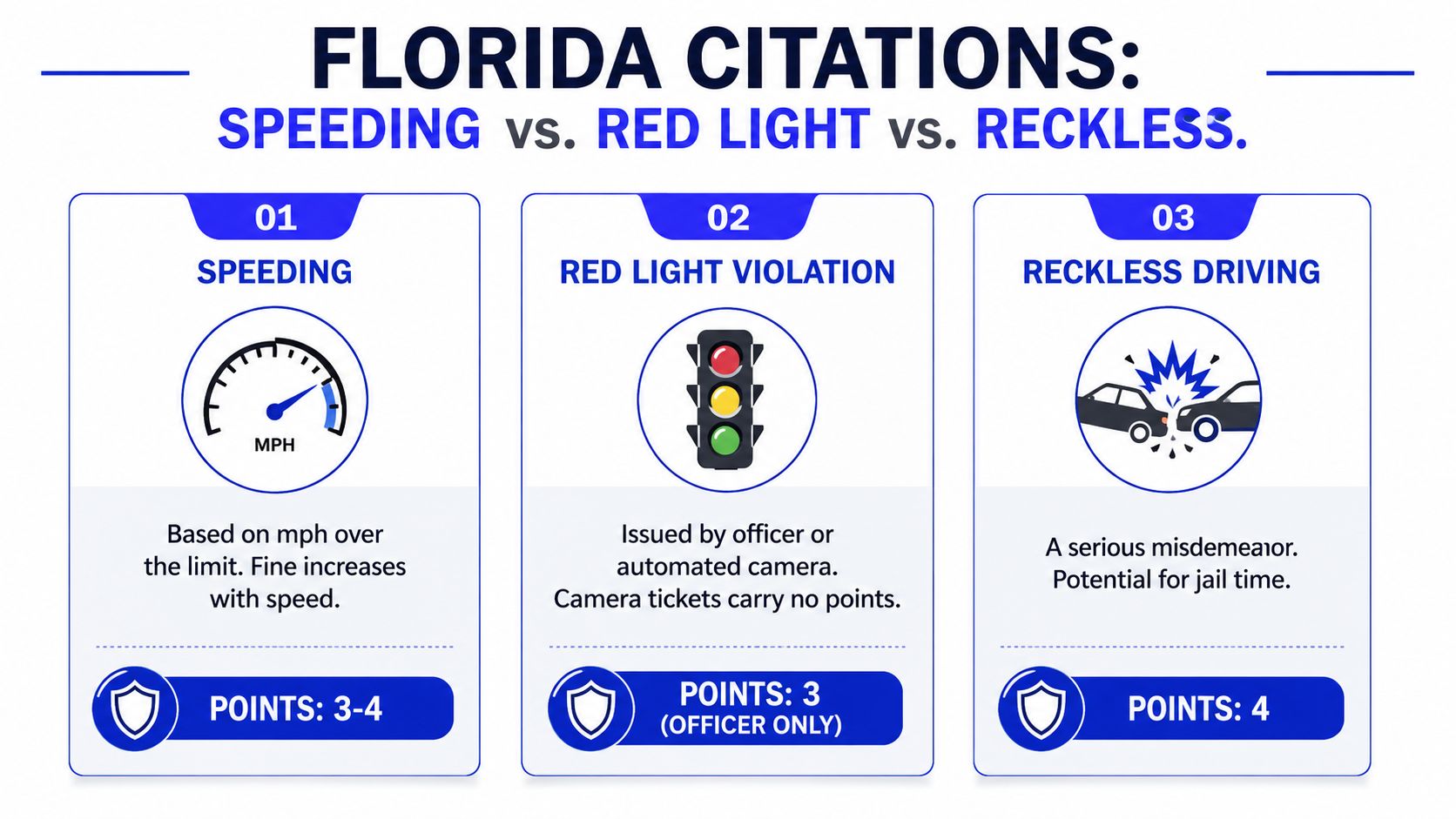
Hold a Florida citation in your hand and treat it as a 30-day case-management problem, not a bill to toss aside. The charge matters more than the amount due, because speeding, red light, and reckless driving tickets do not carry the same legal risk.
Speeding is the most common type of Florida ticket, and the reporting cited for 2024 shows 744,082 speeding tickets. Another 2024 summary shows 1,878,962 traffic citations across 22 violation types, which places speeding at roughly 39.6% of that dataset Florida traffic citation statistics summary. That volume explains why so many drivers underestimate the charge. They see a routine stop, then miss the record damage.
The three citations do not carry the same risk
A speeding ticket is usually a points problem first. Florida DHSMV assigns 3 points for speeding and careless driving, and 4 points for reckless driving points and suspensions. That difference matters because reckless driving can push a traffic case into a far more serious category than a routine citation.
Red-light violations work differently. The case can turn on an officer's observation or on automated enforcement, and Florida's statutory framework gives photographic or electronic evidence special weight in certain violations. That changes the defense question from whether the officer saw the act to what proof the state can use Florida Statute §316.0083.
A simple comparison you can use
Florida Traffic Citation Type Compared | Florida Points | Criminal Risk |
|---|---|---|
Speeding | 3 points for speeding under DHSMV's schedule | Usually civil, but still serious because of points |
Red light violation | 3 points for an officer-issued citation, camera evidence changes the defense issue | Usually civil, with statutory evidence rules for camera-based cases |
Reckless driving | 4 points | Higher risk, can move into criminal exposure |
Know which box you're in
If you are holding a speeding citation, the main problem is usually points and insurance. If the charge is reckless driving, stop treating it like a minor ticket. If the citation came from a camera or another electronic record, the evidence question changes and you need to look closely at notice, reliability, and identification.
The mistake is simple. Drivers compare tickets by the fine instead of the legal exposure. Use the points, the proof, and the possibility of escalation as the test. If you want to see how Florida license points work in practice, review Florida driver license points explained.
How Points and Insurance Penalties Stack Up
Florida's point system is blunt by design. DHSMV assigns 3 points for speeding and careless driving, and 4 points for reckless driving, with suspension thresholds at 12 points in 12 months, 18 points in 18 months, and 24 points in 36 months points and suspensions.
Why one ticket can affect later tickets
A single citation is rarely the whole problem. The point ledger is cumulative, so a second moving violation can push you into a suspension threshold even if each ticket looked manageable on its own. That is why repeat citations turn into a license problem, not just a payment problem.
Insurance works the same way in practice. Once points and convictions land on the record, the financial hit can hang around long after the stop. The ticket is temporary, but the record effect is not.
The point ledger is the most critical area to defend
Use this framework:
Keep points off the license: that is the first objective.
Avoid threshold stacking: two manageable tickets can become one suspension risk.
Protect the record first, price second: the fine is rarely the largest cost.
Practical rule: do not judge a citation by the amount due. Judge it by what it does to your license history.
If you want a plain explanation of how Florida driver-license points work, Florida driver license points lays out the system directly. I care about that because once you cross a suspension threshold, you are dealing with a problem that is bigger than a single stop.
Do not confuse payment with resolution
Paying may end the immediate task, but it can still leave you with points and a record hit. That is why the smart question is not, “How fast can I pay?” It is, “What does this citation do to my ledger if I do nothing else?”
If the answer is that it adds points, treat the ticket like a licensing issue from day one.
Why Lawyer-Led Defense Beats a Ticket App
Automated apps are built to process volume. A lawyer-led defense is built to protect your record. That difference matters when the question is whether you keep points off your license or hand the state an easy win.
Direct access changes the quality of the case
Ticket Shield, PLLC is a lawyer-led Florida firm, and clients speak directly with their attorney by phone or text. That is a real advantage over systems that push you through middlemen, corporate answering services, or chatbots. When the person handling your ticket is also the person answering your questions, the advice is sharper and the response is faster.
The firm also serves all 67 Florida counties and works on a value-driven flat-fee model that starts at $39.99, which keeps the decision practical for drivers who need real defense rather than a scripted intake flow [publisher information]. I'm mentioning it because service model matters when you're fighting a citation, not because a legal product is a substitute for judgment.
What a lawyer-led approach does differently
Reads the citation for defenses: not just the payment amount.
Handles court process strategically: instead of sending you to generic forms.
Keeps communication direct: so you aren't chasing a callback from a queue.
Focuses on record protection: because points matter more than the fine.
If you want to see how an app-based approach is marketed, fight speeding ticket app is a useful contrast. My view is simple. When your license is at stake, you want a lawyer's judgment, not a software prompt.
Choose the service model that protects the result
Drivers make a mistake when they compare legal help only on convenience. The better test is whether the provider can push the case toward a no-points outcome or a stronger defense posture. That's the standard that should guide your choice.
If the process feels automated, your defense probably is too. Your citation deserves better than that.
Your First 30 Days After a Florida Citation
Move in order, not panic
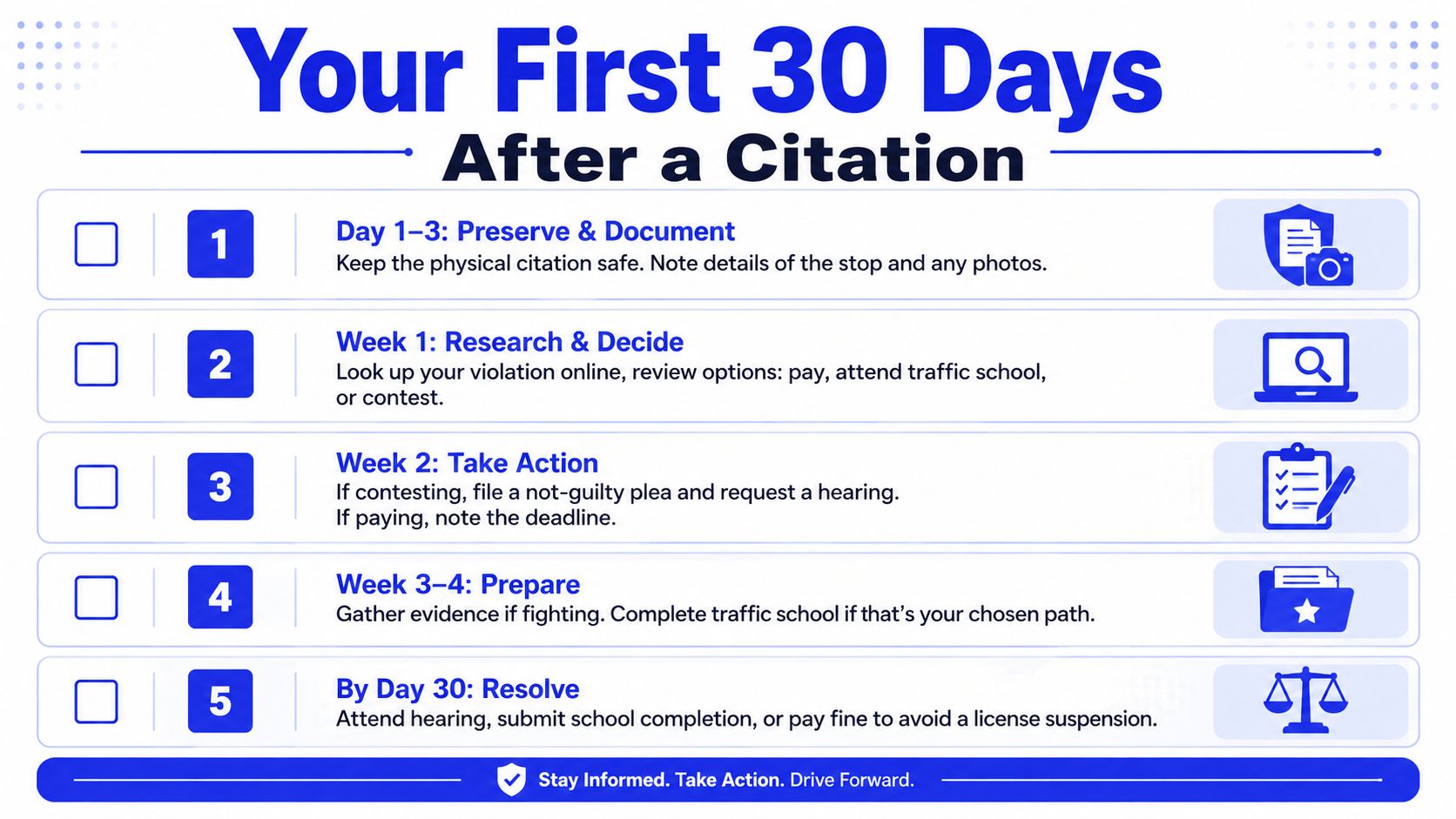
The first thing to do is preserve the physical citation and write down what happened while the stop is still fresh. Keep the county, the issuing agency, the violation, and any photos or notes together in one place. That record becomes the foundation for every later decision.
Next, decide what you're trying to protect. If you care about points, insurance, or a clean license file, your response should reflect that. If you wait until the deadline is almost gone, your choices shrink fast.
Use the 30 days like a working file
Day 1 to 3, preserve and document: keep the citation safe and note the stop details.
Week 1, research and decide: look at the violation and compare your response options.
Week 2, take action: file the election or prepare the defense path before time runs out.
Week 3 to 4, prepare the proof: gather records, photos, and anything that helps your position.
By Day 30, resolve it: pay, complete school, or get the case moving in court.
A civil traffic infraction in county court is a different animal from a criminal traffic charge. Don't let anyone blur that line for you, because the exposure changes the strategy. And if you're working with counsel, you should expect the attorney to control the court-facing steps, which is how well-run defenses keep clients out of unnecessary court appearances.
For a practical workflow perspective, legal practice management software is worth reviewing if you want to understand how organized legal operations support response speed. In traffic defense, speed and file control matter.
Don't let day 29 become the first day you read the ticket carefully.
The cleanest move is to act immediately. Waiting feels easier, but it usually costs you an advantage.
Protect Your License Talk to a Florida Attorney Today
A Florida citation can cost you points, insurance trouble, and time off work if you handle it casually. The state's system is built to move quickly, and your response should be just as fast. If you want a serious defense, you need a lawyer who treats the citation like a license problem, not a billing event.
Ticket Shield, PLLC provides direct Florida traffic defense with attorney access by phone or text, and the goal in these cases is clear, No Points when that result can be pursued. If you're still deciding how to handle a citation, do not sit on it while the 30-day clock runs.
Visit TicketShield.com now for a free consultation and push for No Points on your license before the deadline controls your case.
Ticket Shield, PLLC handles Florida traffic citations with direct attorney access, strategic defense, and a focus on protecting your record from points. If you're holding a citation right now, visit Ticket Shield, PLLC and get the defense moving before your 30-day window closes.
