Puntos de la licencia de conducir de Florida: La guía completa de Florida
Entienda los puntos de la licencia de conducir de Florida, los límites para la suspensión, el impacto en el seguro y las estrategias probadas para apelar o eliminar puntos de su historial.

Acaba de recibir una multa de tránsito en Florida, y el verdadero peligro no es la multa que tiene en la mano. El peligro es lo que sucede después si paga demasiado rápido, ignora la fecha límite o asume que la infracción es menor. Los puntos en la licencia de conducir de Florida pueden perseguirlo durante años, acumularse hasta una suspensión y elevar el costo de todo lo relacionado con su historial de manejo.
Florida no trata una multa como un problema de un solo día. La trata como un evento en su historial, y ese registro puede afectar su licencia, su seguro y su empleo. Si quiere proteger su privilegio de conducir, debe pensar como lo hace el estado, no como la ventanilla del tribunal.
Índice de contenido
Qué son realmente los puntos en la licencia de conducir de Florida
Por qué una defensa dirigida por abogados supera a las aplicaciones de multas
El costo oculto de una multa de tránsito en Florida
Un conductor de Florida paga lo que parece una multa de exceso de velocidad de rutina, la archiva y sigue adelante. Luego llega el aviso del seguro. Luego, la verificación de historial muestra puntos. Es entonces cuando el conductor se da cuenta de que la opción "fácil" no fue para nada fácil.
Esa es la trampa. Pagar una infracción de tránsito en movimiento a menudo se trata como una declaración de culpabilidad, y una vez que el caso se cierra de esa manera, la condena puede permanecer visible en el historial durante años. El sistema de puntos de Florida mantiene las condenas por infracciones de tránsito en movimiento durante al menos cinco años desde la resolución, y las reglas de retención del estado hacen de la multa un problema de cumplimiento a largo plazo, no una molestia de una sola vez. Puntos y suspensiones por puntos del Departamento de Seguridad Vial y Vehículos Motorizados de Florida
Regla práctica: Una multa nunca es solo una multa si usted conduce para trabajar, viaja diariamente o tiene un presupuesto familiar ajustado. Una mala decisión ahora puede seguir costándole más adelante.
Muchos conductores nunca conectan la multa con los daños colaterales. Las compañías de seguros revisan el historial de manejo. Los empleadores también lo hacen. Lo mismo ocurre con las verificaciones de antecedentes para trabajos que dependen de un historial limpio. La multa original suele ser la parte más pequeña del problema.
Si su infracción es por exceso de velocidad, los riesgos aumentan rápidamente. Un conductor que desee comprender cómo se evalúa el costo de la infracción en la práctica puede revisar el análisis de Ticket Shield sobre cuánto cuestan las multas por exceso de velocidad en Florida. El problema no es solo la cantidad de dinero que figura en la multa. Es si permite que la infracción se convierta en un registro de puntos que inicie una reacción en cadena.
Una vez que eso sucede, ya no está lidiando con una simple multa. Está lidiando con un evento en su historial que puede perseguirlo en las renovaciones de seguros, verificaciones de licencia y futuras detenciones de tránsito.
Qué son realmente los puntos en la licencia de conducir de Florida
Los puntos en la licencia de conducir de Florida son un sistema de seguimiento que el estado utiliza para medir las infracciones de tránsito en movimiento a lo largo del tiempo. No son la multa en sí, ni son un recargo aparte. Son la forma en que el estado registra el comportamiento al conducir según el Capítulo 316 de los Estatutos de Florida, especialmente el marco de infracciones en movimiento que rige el comportamiento vial en Florida, con las consecuencias de licencia correspondientes manejadas a través de las reglas de suspensión del estado en la sección 322.27.
El mecanismo es simple. A una infracción de tránsito en movimiento se le asignan puntos según la gravedad, y esos puntos se agregan a su historial de manejo. El Departamento de Seguridad Vial y Vehículos Motorizados de Florida utiliza ese historial para decidir si se está acercando al territorio de la suspensión. Por eso, pagar una multa sin pensar es arriesgado. No solo está cerrando un caso, sino que podría estar consolidando puntos.

La distinción práctica es importante. Las infracciones civiles de tránsito pueden conllevar puntos cuando implican infracciones en movimiento. Por lo general, las infracciones de tránsito no estacionamiento o que no son en movimiento no funcionan de la misma manera. Florida también hace explícito el período de retención del historial, por lo que la misma condena puede permanecer visible para las autoridades de licencias durante años después de que el propio caso haya terminado. Esa visibilidad es importante para la evaluación de seguros, la selección de personal y cualquier revisión de su historial de manejo.
En conclusión: Los puntos son una señal de comportamiento. El estado los utiliza para detectar patrones, no solo errores aislados.
Si está examinando su propia multa, léala bajo esa perspectiva. Pregúntese si es una infracción en movimiento, cuántos puntos conlleva y si impugnarla es la única forma realista de mantener limpio su historial. Si espera a que los puntos ya aparezcan en su registro, sus opciones serán más limitadas.
La escala de suspensión progresiva explicada
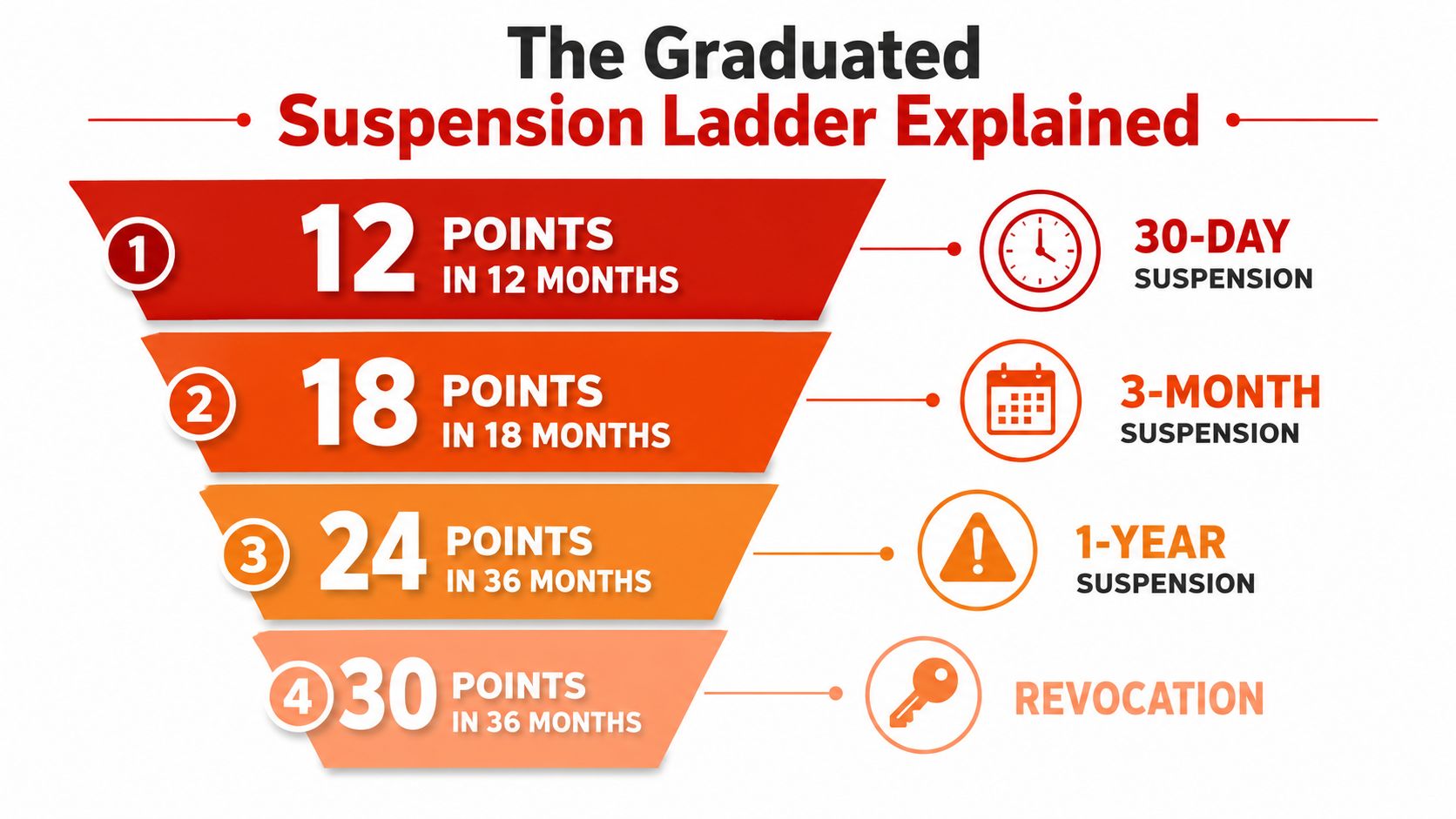
Florida no necesita una sola infracción catastrófica para quitarle la licencia. Utiliza una escala de suspensión progresiva, y los límites están establecidos para detectar infracciones repetidas antes de que se conviertan en un problema de seguridad mayor. Bajo el marco del estado, 12 puntos en 12 meses desencadenan una suspensión de 30 días, 18 puntos en 18 meses provocan una suspensión de tres meses, y 24 puntos en 36 meses conllevan una suspensión de un año.
Esa escala es importante porque es un conteo acumulativo continuo y se actualiza con cada multa en su historial. Unas pocas multas comunes pueden acumularse hasta el rango de suspensión mucho más rápido de lo que la mayoría de los conductores esperan. Un conductor que recibe multas más de una vez en un período corto puede cruzar la línea sin haber recibido nunca una sola infracción grave.
Cómo funcionan los límites en la vida real
Una suspensión de 30 días parece corta hasta que necesita su automóvil para ir al trabajo, a la escuela o a citas médicas. Una suspensión de tres meses es más difícil porque interrumpe la vida normal el tiempo suficiente como para generar problemas de empleo y transporte. Una suspensión de un año ya no es una advertencia. Es un problema grave de movilidad.
Florida también trata con mayor severidad a los conductores más jóvenes. Un conductor menor de 18 años que acumula 6 o más puntos en 12 meses tiene una restricción de un año para conducir únicamente por motivos de trabajo, y cada punto adicional extiende esa restricción por 90 días. Esta regla muestra con qué firmeza Florida intenta evitar que los malos hábitos tempranos se conviertan en un patrón.
Al estado no le importa si sus intenciones eran buenas. Lo que cuenta son los puntos.
Si quiere una referencia clara de los límites y los tiempos de suspensión, la guía de Ticket Shield sobre con cuántos puntos se suspende una licencia en Florida lo explica de manera sencilla. La lección es sencilla: no espere a que su historial esté lleno de puntos. Combata la multa antes de llegar a la escala.
Infracciones comunes y sus valores de puntos
El sistema de puntos de Florida se basa en la gravedad de la infracción, y esa es exactamente la razón por la que una sola multa puede causar problemas reales rápidamente. La mayoría de las infracciones de tránsito en movimiento comunes se sitúan en el rango de 3, 4 o 6 puntos. Una multa puede parecer menor en el papel, pero dos o tres pueden acercarlo al territorio de la suspensión y comenzar a generar problemas con el seguro mucho antes de que el estado le retire la licencia.
Los niveles comunes que debe vigilar
Una infracción de tránsito en movimiento estándar puede conllevar 3 puntos. Los materiales de guía de Florida incluyen ejemplos como conducir con un exceso de velocidad de 15 mph o menos sobre el límite, además de otras infracciones comunes. Una conducta más grave puede conllevar 4 puntos, lo que incluye el exceso de velocidad de 16 mph o más sobre el límite. Consulte la guía del sistema de puntos del DHSMV de Florida y el resumen de puntos por multas de tránsito de Florida para ver cómo se describen estos niveles.
El nivel común más alto en las guías es de 6 puntos. Ahí es donde Florida ubica las infracciones más graves, que incluyen conductas como abandonar la escena de un accidente y otras infracciones mayores similares. Un conductor que acumule dos incidentes de 6 puntos puede alcanzar los 12 puntos rápidamente, lo que activa el primer límite de suspensión sin necesidad de acumular muchas multas menores. Para ver detalladamente cómo funcionan los niveles de exceso de velocidad, utilice la guía de puntos por multas de exceso de velocidad en Florida de Ticket Shield.
Esta es la forma práctica de interpretar su multa:
Multa de 3 puntos: Por lo general, es una infracción de tránsito en movimiento de menor gravedad, pero sigue siendo importante si ya tiene otras multas.
Multa de 4 puntos: Más grave, especialmente cuando se trata de exceso de velocidad por encima del límite inferior.
Multa de 6 puntos: Trátela como una alerta roja. Este nivel puede acercarlo a la suspensión de manera mucho más rápida.
Identifique el nivel de su multa de inmediato. Una vez que sepa si tiene una multa de 3, 4 o 6 puntos, podrá decidir si impugnarla, solicitar una reducción o recurrir a la escuela de tránsito si el caso reúne los requisitos. Una defensa dirigida por un abogado es el camino más seguro si desea mantener los puntos fuera de su historial y evitar que la multa se convierta en un problema para su seguro.
No lo deje a la suerte. Lea la multa, verifique la imputación y asuma que el estado contará cada punto que corresponda por ley.
Cómo afectan los puntos a su seguro y a su trabajo
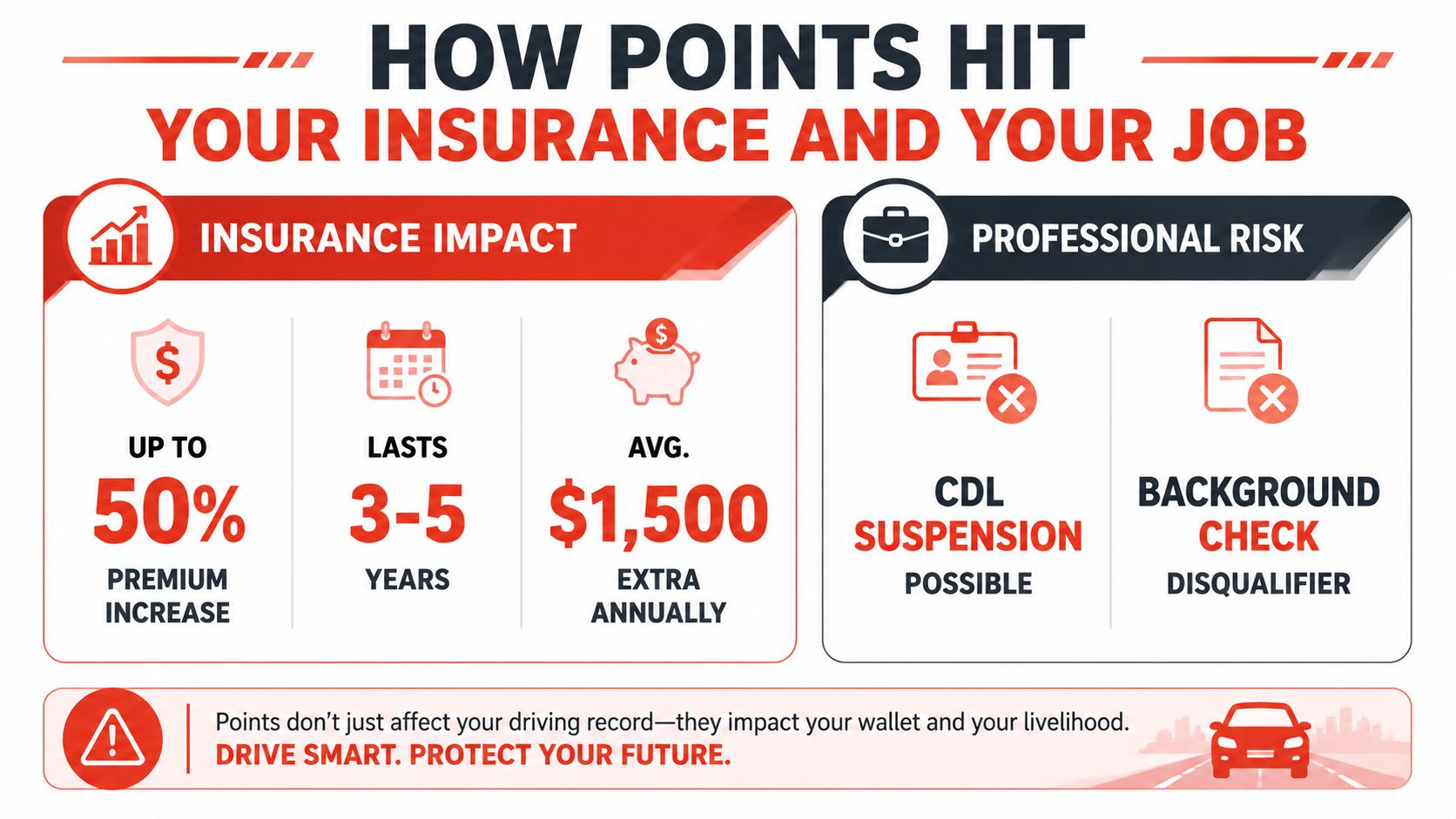
A las compañías de seguros no les importa que usted considere que la multa fue por algo menor. Les importa que su historial ahora muestre una infracción de tránsito en movimiento. Una vez que aparecen los puntos, la aseguradora ve a un conductor con un riesgo documentado, y eso puede afectar las tarifas y decisiones de cobertura por años.
El problema mayor es que la complicación no se detiene en el seguro. Los empleadores revisan los historiales de manejo para trabajos que requieren un historial limpio. Quienes trabajan en plataformas de transporte, repartidores, conductores comerciales y cualquier persona cuyo trabajo dependa de conducir un vehículo pueden verse afectados rápidamente. Una multa puede convertirse en un problema laboral incluso antes de la fecha de la comparecencia ante el tribunal.
El problema del dinero es mayor que la multa
Muchos conductores se concentran en la multa porque es la cifra que pueden ver de inmediato. Eso es un error. El verdadero costo suele llegar más adelante, en forma de aumentos de primas, problemas de renovación y la molestia de tener que dar explicaciones sobre la infracción a un empleador o administrador de flota de vehículos.
Si se gana la vida conduciendo, los puntos no son un simple trámite. Son una amenaza para sus ingresos.
El riesgo laboral es igual de grave. El historial de manejo puede aparecer en las revisiones de antecedentes para puestos que dependen de la confiabilidad, los viajes o el uso de vehículos. Quienes cuentan con una licencia comercial tienen aún menos margen de error. Si necesita su licencia para generar ingresos, cada punto es una amenaza directa para su economía.
Para los lectores que deseen comprender mejor el aspecto laboral, resulta útil el artículo de Ticket Shield sobre si las multas de tránsito aparecen en las verificaciones de antecedentes. También debe pensar en los riesgos indirectos, como la pérdida de turnos de trabajo, restricciones en sus cuentas de aplicaciones y oportunidades perdidas cuando tener un historial limpio es fundamental.
El sistema de puntos de Florida es, ante todo, un asunto legal, pero se convierte en un problema financiero casi de inmediato. Por eso, impugnar la multa desde el principio es la mejor opción. Un breve proceso ante el tribunal suele ser más fácil que enfrentar meses o años de seguros más caros y estrés laboral.
Formas de evitar o eliminar puntos de su historial
Tiene tres opciones reales después de recibir una multa en Florida. Puede dejar que la multa proceda, tomar un curso de tránsito elegible o pelear para que sea desestimada. Solo una de esas opciones le ofrece una oportunidad real de conseguir Cero Puntos.
Escuela de tránsito frente a defensa judicial
La escuela de tránsito puede evitar que se sumen puntos al historial por infracciones menores que califiquen, pero no borra el hecho de que recibió la multa. Es una herramienta de prevención, no un borrón y cuenta nueva. Una defensa judicial exitosa es diferente. Si la acusación se desestima o se reduce adecuadamente, puede salir de allí sin puntos asociados a la infracción.
Comience revisando su historial actual. Los conductores en Florida pueden consultar su récord de manejo a través de la plataforma del FLHSMV para ver cuál es su situación. Esto es importante porque no puede planificar su estrategia si no sabe qué tan cerca está del territorio de suspensión.
Escuela de tránsito: Útil para multas menores elegibles, especialmente cuando su objetivo es evitar que se agreguen puntos.
Impugnación en el tribunal: Es la mejor opción cuando la multa es defendible y busca la mayor probabilidad de desestimación o reducción.
Revisión del historial: Indispensable antes de tomar cualquier decisión, ya que los puntos anteriores y los nuevos pueden combinarse de manera perjudicial.

Solicitar una audiencia también puede ser importante si una suspensión resulta inminente. No espere a que le llegue la carta de suspensión para actuar. Para entonces, estará reaccionando en lugar de defenderse.
Si su infracción es elegible para una alternativa, actúe rápido. Si no lo es, no pierda el tiempo con soluciones ineficaces. Impugnar la multa puede ser el único camino que proteja su historial y evite que las consecuencias en el costo de su seguro empeoren.
El tema del seguro es donde muchos conductores se ven perjudicados. Los puntos no solo se quedan estáticos en el historial de manejo. Pueden provocar primas más altas, dificultades para renovar y un mayor escrutinio por parte de empleadores o administradores de flotas. Por eso, una defensa dirigida por un abogado es fundamental cuando la meta es conservar cero puntos, no solo conseguir una solución rápida. La guía de la firma sobre por qué elegir a un abogado local en lugar de aplicaciones explica por qué el contacto directo con un abogado marca la diferencia cuando su licencia está en juego.
Para los conductores que también deben cumplir con pruebas de control no relacionadas, la guía de pruebas de orina de Addiction Resource Center LLC puede ayudarle a mantener ese asunto organizado mientras resuelve lo de la multa. Mantenga presente cada fecha límite; si se pasa de una sola, el estado puede convertir una simple multa en un problema a largo plazo.
Por qué una defensa dirigida por abogados supera a las aplicaciones de multas
Una aplicación para multas puede procesar el registro de datos, pero no puede pensar como un abogado. Esa diferencia es clave cuando el objetivo no es simplemente "hacerse cargo" de la multa, sino proteger su licencia y evitar los puntos en su historial.
Ticket Shield, PLLC es una opción dirigida por abogados diseñada para ofrecer un contacto directo con el abogado mediante llamada o mensaje de texto, sin tener que pasar por laberintos de centros de atención telefónica o sistemas de chat automáticos. Esto representa una ventaja real cuando la infracción no es de rutina, ya que el abogado a cargo puede evaluar los argumentos del oficial, el cargo y el mejor camino hacia una reducción o desestimación del caso. Usted no querrá intermediarios tomando decisiones sobre su historial de manejo.
El modelo que realmente ayuda
Las herramientas automatizadas son prácticas para el registro de datos inicial. Sin embargo, resultan insuficientes cuando el caso requiere criterio profesional, negociación o litigio. Una defensa dirigida por un abogado puede aportar estas tres facultades, marcando la diferencia entre pagar simplemente para tramitar una multa o pagar para defenderse de ella.
Además, Ticket Shield cubre los 67 condados de Florida, incluidos los tribunales principales de Miami-Dade, Broward, Palm Beach, Hillsborough, Orange y Duval. Esta presencia estatal es importante porque la aplicación de las leyes de tránsito varía según la localidad, y una aplicación de soluciones genéricas no puede tomar eso en cuenta. Si desea comparar más a fondo este enfoque, la guía de la firma sobre por qué elegir a un abogado local en lugar de aplicaciones detalla los motivos.
Una estrategia guiada por un abogado es la única que mantiene de manera constante el mismo objetivo que a usted más le interesa: Cero Puntos. Ese es el resultado por el que vale la pena pagar, no una simple actualización de estado genérica.
Su siguiente paso para no tener puntos en su licencia
Obtenga hoy mismo su historial de manejo de Florida. Revise cada punto activo. A partir de ahí, decida rápidamente si su multa es algo que puede ignorar, algo que puede solucionar con un curso, o si necesita que un abogado la combata antes de que venza el plazo.
Visite TicketShield.com para una consulta gratuita y luche por mantener Cero Puntos en su licencia. Si prefiere una defensa dirigida por abogados con acceso directo a un profesional en lugar de aplicaciones automatizadas o intermediarios, este es el paso que debe tomar ahora. Elija la defensa que proteja su historial antes de que el sistema de puntos de Florida convierta una simple multa en un problema mayor.
Un llamado a la acción para Ticket Shield, PLLC.