
Multa por conducir sin licencia: Sanciones y defensas en Florida
¿Enfrenta una multa por conducir sin licencia en Florida? Conozca las sanciones, las posibles defensas y los pasos que debe seguir para manejar su citación.

You're standing at the kitchen counter with a Florida citation in your hand, trying to decide whether you can pay it online and move on. Then you see Florida Statute 322.03 and the words “no valid driver's license” or “never issued a license.” That language matters. A no license ticket can be a criminal misdemeanor, not an ordinary civil traffic infraction, and the wrong response can affect your court case, driving privilege, insurance, and record.
Don't treat the citation as paperwork. Read the charge, protect your deadline, and get a Florida traffic defense lawyer involved before you enter a plea or pay anything.
Table of Contents
What a No License Ticket Really Means in Florida
The first question is what the officer charged. A citation alleging that you drove without a valid license or that you were never issued a license generally points to Florida Statute 322.03, the core Florida law governing operation of a vehicle without a valid driver license. The statute prohibits driving on a Florida highway without a valid license issued under the chapter and includes a separate rule for certain licenses expired beyond six months. Read the statute directly through the Florida Legislature's text of Section 322.03.
That's different from driving while your license is suspended, canceled, or revoked, which is addressed under Section 322.34. The words on the citation help identify which legal problem you must solve. A person who had a license but lost driving privileges may face a different charge and different defenses from someone who never held a valid license or cannot prove a valid license existed.
The citation is not a routine payable ticket
Florida Highway Safety and Motor Vehicles states that when a violator has no driver license, a court appearance is required, with a fine range of $250 to $500. Those figures come from the FLHSMV Uniform Traffic Citation penalty schedule. You shouldn't assume an online payment portal can close the matter because the citation lists a fine.
Florida's traffic enforcement authority is organized under the Florida Uniform Traffic Control Law, Chapter 316, which provides the statutory framework for traffic tickets and procedures. The no-license offense itself is located in Chapter 322, but Chapter 316 remains the appropriate statutory framework when discussing Florida traffic enforcement and ticket procedure. Review the Florida Legislature's Chapter 316 contents.
Why ignoring the date creates risk
A court date is not the same as a payment deadline. If you ignore the citation, fail to appear when required, or fail to respond through the proper court process, the court can take additional action, including issuing a warrant or capias. The citation begins a legal process. It doesn't merely request payment.
Practical rule: Don't plead guilty or pay a no license ticket until a lawyer has reviewed the charge, your license history, and the facts surrounding the stop.
For a closer explanation of the distinctions involved, review what qualifies as no valid driver's license in Florida. Your next move should be based on the exact statutory subsection and your actual licensing record, not on the appearance of the paper citation.
Florida Penalties for Driving Without a Valid License
Florida treats repeated violations under Section 322.03 seriously. The first two convictions are generally second-degree misdemeanors, while a third or subsequent conviction becomes a first-degree misdemeanor and carries a minimum mandatory 10-day jail term under the verified statutory framework. The Florida Legislature's Section 322.03 is the controlling authority.
The basic tiers described in the statute are:
Offense level | Criminal class | Maximum jail | Maximum fine | Minimum license suspension |
|---|---|---|---|---|
First conviction | Second-degree misdemeanor | Up to 60 days | Up to $500 | Case-specific |
Second conviction | First-degree misdemeanor | Up to one year | Up to $1,000 | Case-specific |
Third or subsequent conviction | First-degree misdemeanor | Up to one year | Up to $1,000 | Case-specific, with mandatory jail risk |
The statute creates escalating criminal exposure, but the citation alone doesn't tell you how the court will evaluate your prior record, proof of licensing, or available resolution. A third conviction is especially dangerous because the 10-day jail minimum is mandatory if the statutory conditions for that offense are met. That makes early legal review essential.
Court exposure extends beyond the fine
A criminal traffic case can produce consequences beyond the sentence. A conviction may create a criminal record, complicate insurance renewal, and affect future interactions with licensing authorities. Later efforts to seal a traffic misdemeanor can also face stricter rules than drivers expect, so avoiding an unnecessary conviction is more protective than trying to repair the record afterward.
The citation's fine range also tells you why this isn't always a clerk-level matter. FLHSMV identifies a $250 to $500 fine range for a violator with no driver license and states that a court appearance is required. Once the alleged conduct or prior conviction history increases the charge, the case demands even closer attention.
Florida's separate point system can create another licensing problem when other traffic convictions are involved. FLHSMV states that 12 points in 12 months trigger a 30-day suspension, 18 points in 18 months trigger a three-month suspension, and 24 points in 36 months trigger a one-year suspension. Points remain on the driving record for at least five years from the conviction date, according to FLHSMV's point suspension guidance.
For a detailed discussion of the charge itself, see charges for driving without a license. The key recommendation is simple. Do not evaluate this case by the fine alone.
Why Paying This Citation Is the Costliest Mistake
Paying a no license ticket can function as an admission or guilty disposition in a case that may be criminal. You may believe you're buying closure, but the payment doesn't automatically prove that you're legally licensed, remove a suspension, restore your driving privilege, or prevent the court from taking action on an unresolved underlying issue.
The payment can also leave you with a conviction that affects your driving history and insurance profile. Depending on the disposition, the consequences may include record exposure, insurance non-renewal, and additional licensing complications. A payment made today can therefore create a problem that continues after the citation disappears from your immediate to-do list.
The money doesn't solve the licensing problem
A fine is one part of the case. The licensing issue is another. Florida's reinstatement process requires the driver to clear the underlying obligation with the agency or court that placed the hold, complete any required course, provide proof of insurance when applicable, and then pay the FLHSMV reinstatement fee before driving privileges can be restored.
That sequence matters. Paying a fine or reinstatement fee doesn't itself create a valid license. It also doesn't guarantee that the court or agency has released the hold. A driver can spend money and still remain unable to drive legally.
A better resolution strategy
Your lawyer should examine whether the case can be dismissed, whether adjudication can be withheld, or whether the charge can be amended to a non-criminal disposition. The right option depends on the citation, your prior history, your license status at the time of the stop, and the court's available procedures.
The cheapest-looking option is often the least protective one when payment creates a criminal disposition.
Before making any payment, compare the consequences of paying with the consequences of defending the charge through paying a ticket versus hiring a lawyer. Protecting your record and driving privilege should come before making the fastest online transaction.
Defenses That Hold Up in a Florida Courtroom
A no license charge isn't automatically un defensible. The strongest defense depends on what was true at the moment of the stop and what documents can prove it.
Proof that you were licensed
If you held a valid license when the officer stopped you, gather evidence immediately. That may include an out-of-state license, a Florida credential issued recently but not yet reflected in the officer's database, or records showing that you had a valid license but left the physical card at home.
The evidence should identify you, show the license status, and establish the relevant date. A lawyer can present the documentation to the prosecutor or court and argue that the charge doesn't accurately describe your legal status.
The statutory cure opportunity
Florida law includes a narrow cure provision for qualifying cases. Under Section 322.03(6)(a), some first-time offenders may obtain a valid license before the case is disposed and ask the court for a favorable resolution, including a withholding of adjudication. This is not an automatic dismissal and shouldn't be treated as a guaranteed result.
The timing matters. If you wait until the case is closed, you may lose the opportunity to use the cure process. A lawyer should confirm whether you qualify, identify the required documents, and present the request in the way the assigned court accepts.
Clerical and identity problems
Review the citation for errors. A misspelled name, incorrect identifying information, inaccurate license data, or mistaken identity can affect the State's ability to prove the charge. These issues need supporting records, not just an assertion that the ticket is wrong.
Defense | Evidence required | Typical court outcome |
|---|---|---|
Valid license at the time of stop | License record, credential, issuance records, or out-of-state documentation | Possible dismissal, amendment, or other favorable disposition |
Qualifying cure under Section 322.03(6)(a) | Valid license obtained before disposition and proof of eligibility | Possible withholding or dismissal-related resolution, subject to court approval |
Clerical or identity error | Correct identity documents, citation comparison, agency records | Possible correction, dismissal, or challenge to proof |
For practical guidance on the documents and process, review how to resolve a ticket for no valid driver's license. Don't bring only an explanation. Bring records that let the court verify the explanation.
How a Lawyer Resolves a No License Ticket for You
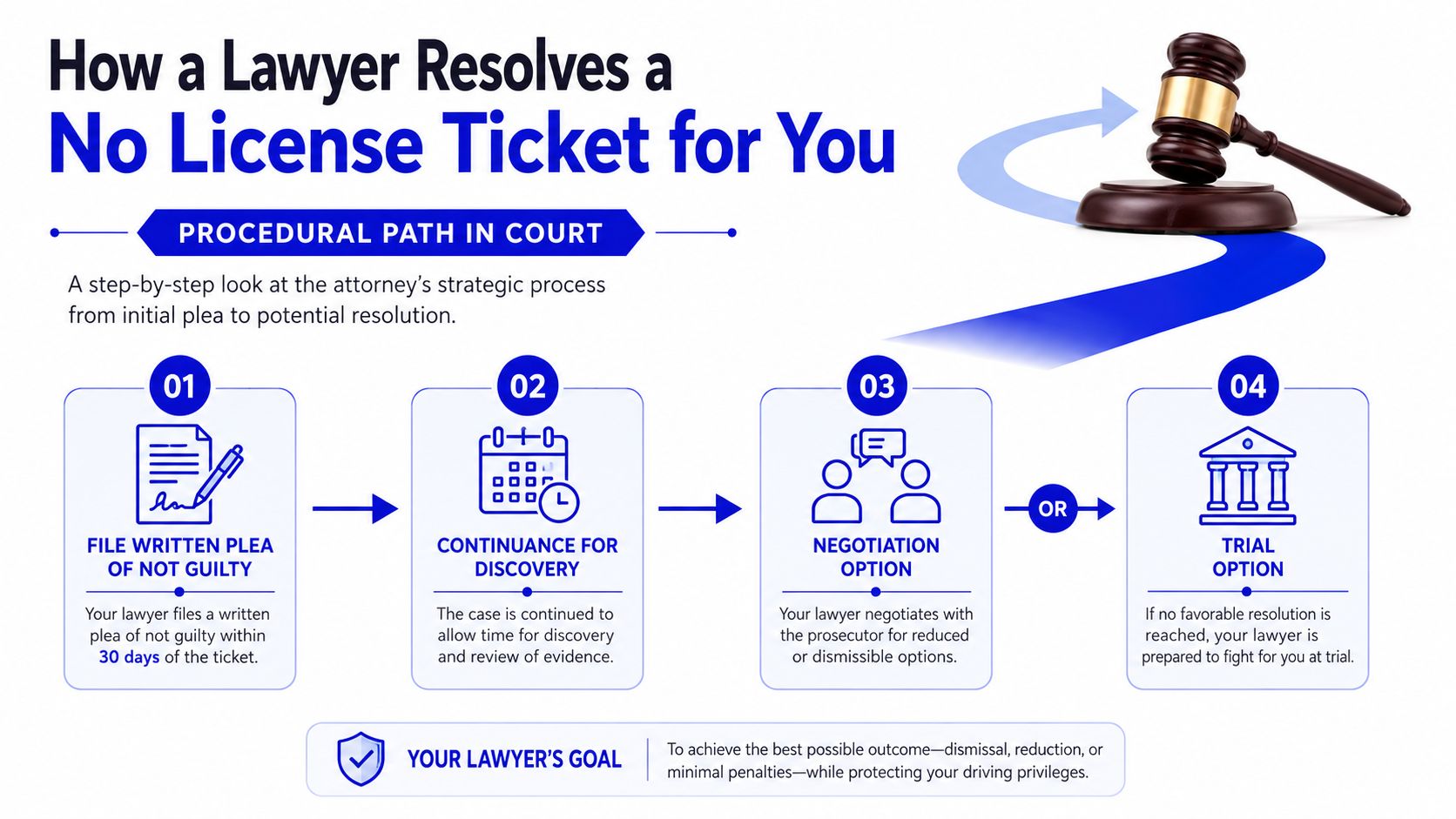
A Florida defense lawyer starts by protecting the case from an avoidable default. That usually means reviewing the citation, confirming the county and court requirements, and filing a written plea of not guilty before the applicable response window closes. The lawyer then seeks additional time when needed so you can address licensing documents without rushing into a damaging disposition.
The case review
Counsel examines the citation, officer notes, license records, court history, and any evidence relating to the stop. If the traffic stop itself was unlawful, the lawyer may evaluate a motion to suppress. If the problem is a database error or licensing discrepancy, the lawyer can develop a documentary defense instead of relying on a general explanation.
Discovery can also reveal whether the officer had accurate identifying information and whether the State can prove every required element. Those questions should be answered before you agree to a plea.
Negotiation or trial
When the facts support it, counsel can negotiate with the prosecutor for dismissal, withholding of adjudication, or an amendment under the applicable cure provision. If negotiation fails, the lawyer can prepare for trial and challenge the State's evidence.
A lawyer may be able to appear for you in some Florida traffic courts, but you still need to sign required paperwork and complete any licensing or insurance steps the court demands. Ask specifically whether your appearance is excused, what documents must be provided, and what event formally closes the case.
Your lawyer should coordinate the courtroom resolution and the licensing paperwork as one plan, not treat them as unrelated errands.
Administrative support can help organize documents and deadlines. A virtual legal assistant may be useful for scheduling and file coordination, but legal decisions, pleadings, negotiations, and courtroom representation belong with a licensed Florida attorney.
Reinstating Your Florida Driving Privilege After the Case
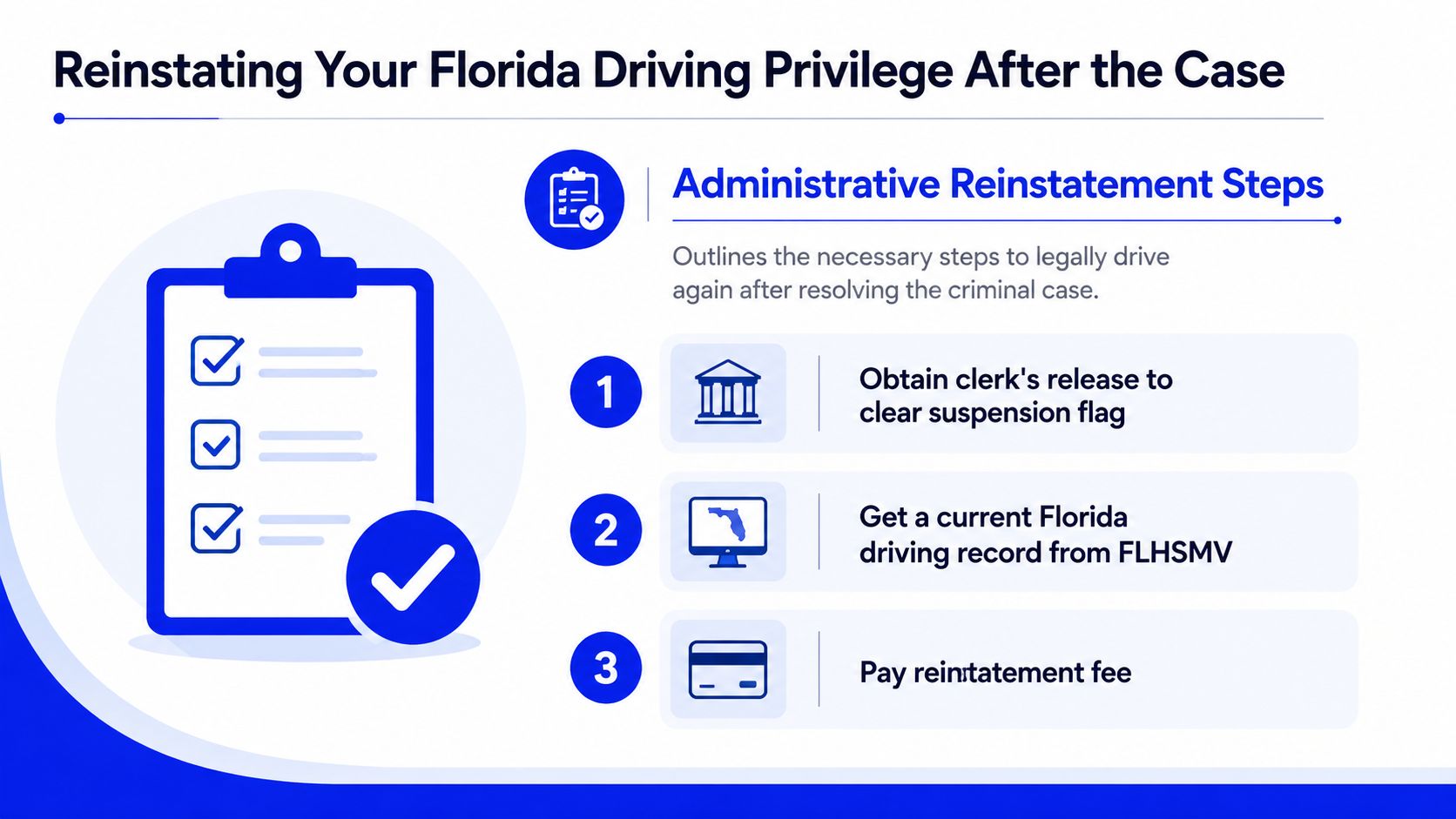
Closing the criminal case doesn't necessarily restore your ability to drive. Florida requires a separate administrative process through the agency that owns the hold and FLHSMV. You must clear the underlying obligation, complete any required course, provide proof of insurance when applicable, and pay the reinstatement fee only after the release reaches the licensing system.
Follow the order exactly
Start with the court or agency that placed the hold. Obtain confirmation that the obligation has been satisfied and that the release has been transmitted. If the matter involved a criminal disposition, keep the clerk's documentation showing the outcome and release.
Then verify your current status with FLHSMV. If insurance proof is required, submit the correct filing, such as an SR-22 or FR-44 when applicable. Only after the hold clears should you pay the reinstatement fee and confirm that the license has been restored.
Avoid the payment trap
A common operational mistake is paying the reinstatement fee before the court or agency release has been transmitted. The payment doesn't force the system to remove the hold. It can be rejected or leave the suspension active, requiring you to repeat the process.
The correct sequence is:
Close the court case: Confirm the disposition and satisfy court requirements.
Transmit the release: Make sure the clerk or responsible agency sends the release to FLHSMV.
Clear administrative requirements: Complete courses and provide insurance proof when required.
Pay the reinstatement fee: Pay only after the hold is ready for reinstatement.
Verify the credential: Confirm that FLHSMV recognizes your driving privilege before operating a vehicle.
Use how to reinstate a suspended license in Florida as a practical reference. Until the system confirms restoration, don't assume that a receipt means you can legally drive.
Why Direct Lawyer-Led Defense Matters on a Criminal Count
A charge under Florida Statute 322.03 is different from a routine civil traffic infraction. The classification can involve criminal penalties, court involvement, record consequences, and licensing complications. An automated app or online plea portal can't replace a lawyer who evaluates the statutory elements and takes responsibility for the defense strategy.
Automation can't investigate your facts
A direct Florida traffic defense attorney can review officer notes, request available discovery, challenge an unreliable identification check, and evaluate whether dispatch or agency records support your account. Counsel can also file written motions, negotiate with the State Attorney, and prepare for trial if the evidence doesn't support the charge.
An automated service may route information through a corporate answering system or chatbot. It won't necessarily identify that your license was valid at the time of the stop, recognize that you may qualify for a cure opportunity, or coordinate the release needed for administrative reinstatement.
The distinction matters when the same case involves several moving parts:
Court defense: Protects your plea, record, and available disposition.
License review: Determines whether you were validly licensed or can cure the problem.
Administrative follow-through: Confirms that the court's release reaches FLHSMV.
Collateral advice: Helps you evaluate insurance, employment, commercial driving, and immigration consequences where relevant.
Direct communication gives you accountability
Ticket Shield, PLLC is a Florida lawyer-led firm where clients can communicate directly with their attorney by phone or text. That model differs from automated apps and ticket mills that may rely on middlemen, corporate answering services, or automated chatbots. For a criminal traffic count, you should know who is reviewing your documents, who is making the legal recommendation, and who will handle the court process.

The practical goal is to pursue a resolution that protects your driving privilege and avoids points where legally available. The following video provides additional context on the difference between handling a traffic matter mechanically and addressing it through legal strategy.
Visit Ticket Shield, PLLC for a free consultation about your Florida no license ticket. A lawyer-led team can review the charge, investigate your licensing status, address the court process and reinstatement hold, and pursue the ultimate goal of achieving No Points on your license.
