Costo de las multas de tránsito en Florida: multas, tarifas y números reales
Conozca el costo real de una multa de tránsito en Florida, desde las multas base y las tarifas judiciales hasta los recargos y el aumento de los seguros, además de estrategias para reducir lo que realmente paga.

Una multa de tránsito en Florida puede costar aproximadamente de $1,100 a $2,500 o más en un plazo de tres años tras los aumentos de seguro, costos judiciales, recargos y tarifas relacionadas. La multa reglamentaria impresa en la citación puede parecer más cercana a $25 o $250, pero esa cantidad es solo el punto de partida.
El costo de una multa de tránsito en Florida depende de la infracción, el condado, de si la resuelve a tiempo y de lo que ocurra con su historial de licencia. Una citación por exceso de velocidad que hoy parece manejable puede generar años de primas de seguro más altas, puntos, tarifas administrativas y riesgo de suspensión. Debe evaluar la multa como un problema financiero y de licencia, no solo como una factura.
Índice de contenido
Los estatutos de Florida que establecen el programa de multas
Niveles de multas por exceso de velocidad y comparecencias obligatorias ante el tribunal
Costos judiciales, recargos y penalizaciones por pago tardío
Infracciones no relacionadas con el movimiento y clases de citación de menor costo
Puntos del conductor de Florida y factores desencadenantes de la suspensión
Pagar la multa frente a la escuela de tránsito frente a contratar a un abogado
Costos de restablecimiento y cumplimiento más allá de la multa
Por qué una defensa dirigida por un abogado cambia el resultado
Lo que realmente le cuesta una multa de tránsito en Florida
La cantidad que figura en la citación suele ser la parte más pequeña de la exposición financiera. Los informes neutrales de los consumidores sitúan el costo potencial de propiedad a tres años de una multa típica por exceso de velocidad en aproximadamente $1,100 a $2,500 o más una vez que se incluyen los aumentos de seguro, mientras que la cantidad inicial a pagar puede situarse en un rango de aproximadamente $113 a $303, según la velocidad y el programa de tarifas del condado. La información sobre el costo de las multas de tránsito en Florida ilustra por qué los conductores que se enfocan solo en la multa impresa a menudo subestiman la factura final.
Las aseguradoras de Florida pueden tratar una infracción de tránsito como una señal de riesgo durante varios ciclos de renovación. El efecto exacto sobre la prima depende de la aseguradora, la póliza y el historial del conductor, por lo que no debe asumir que pagar rápidamente evitará una consecuencia en el seguro. La multa aún puede afectar el historial del vehículo motorizado que revisan las aseguradoras.
Componente de costo | Cantidad típica | Plazo |
|---|---|---|
Multa reglamentaria | $25 a $250 para niveles comunes de exceso de velocidad | Inmediato |
Costos judiciales y recargos del condado | Varía según el condado y la citación | Cuando se paga la citación |
Impacto en el seguro | Aproximadamente $1,100 a $2,500 o más en costo de propiedad documentado a tres años | Aproximadamente tres años |
Administración de la licencia | Varía según los puntos, la suspensión y el estado de cumplimiento | Hasta que se resuelva el historial |
Su comportamiento al conducir también importa. Recursos como el análisis de comportamiento de Fleetalyse pueden ayudar a los conductores y administradores de flotas a comprender cómo los patrones de conducción generan control de tránsito y exposición al riesgo, pero no pueden resolver una citación ni proteger su licencia de Florida.
Regla práctica: Antes de pagar, averigüe si la multa suma puntos y si es elegible para una resolución que proteja su historial.
La mejor pregunta no es "¿Cuánto cuesta la multa?". Es "¿Cuánto me costará esta citación después de que el condado cobre sus tarifas y mi aseguradora revise la condena?". Para un desglose enfocado de las cantidades de citación comunes, revise los precios de las multas por exceso de velocidad en Florida antes de elegir una respuesta.
Los estatutos de Florida que establecen el programa de multas
Las infracciones de tránsito en Florida comienzan con el Capítulo 316 de los Estatutos de Florida, el capítulo de Control Uniforme de Tránsito del Estado. Define la conducta que puede resultar en una citación, incluido el exceso de velocidad y la conducción temeraria. El capítulo que rige está disponible a través del contenido del Capítulo 316 de los Estatutos de Florida.
El Capítulo 318 controla la disposición de las infracciones de tránsito, incluido el programa de penalizaciones en la Sección 318.18. Esa distinción importa. El Capítulo 316 le indica qué conducta está prohibida. La Sección 318.18 ayuda a determinar la penalización civil base asignada a la clase de infracción.
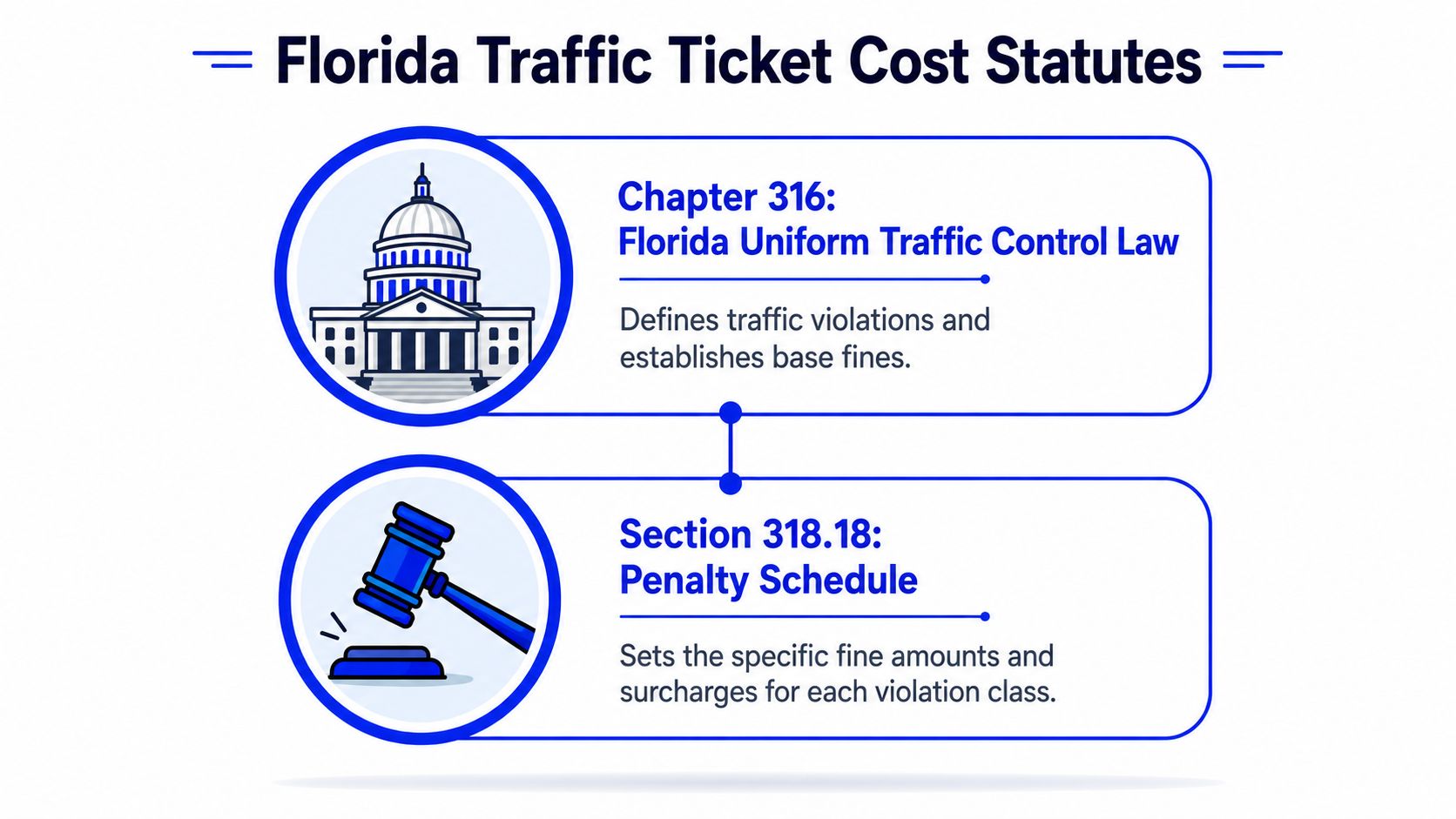
Para el exceso de velocidad, la Sección 318.18 detalla multas base de:
$25: De seis a nueve millas por hora sobre el límite.
$100: De diez a catorce millas por hora sobre el límite.
$150: De quince a diecinueve millas por hora sobre el límite.
$175: De veinte a veintinueve millas por hora sobre el límite.
$250: Treinta millas por hora o más sobre el límite.
$50: Exceso de velocidad en zona escolar de hasta cinco millas por hora sobre el límite.
El estatuto también permite a los tribunales imponer penalizaciones civiles después de una audiencia, que incluyen hasta $500 para la mayoría de las infracciones civiles y hasta $1,000 por exceso de velocidad en zona escolar o zona de construcción. Un caso de comparecencia obligatoria conlleva un nivel de exposición diferente al de una citación prepagada ordinaria.
La conducción temeraria se rige por la Sección 316.192 de los Estatutos de Florida. No es simplemente otro nivel de exceso de velocidad. La clasificación y las posibles consecuencias pueden ser más graves, por lo que debe tratar una citación que alegue conducción temeraria como un asunto legal en lugar de una decisión de pago rutinaria. Para obtener una descripción general accesible, consulte las leyes de tránsito del estado de Florida.
Niveles de multas por exceso de velocidad y comparecencias obligatorias ante el tribunal
El programa estatutario de Florida crea diferentes penalizaciones base según el margen por el que se supere el límite establecido en la acusación. La cantidad a pagar puede ser mayor debido a que el secretario recauda los costos judiciales autorizados, los cargos por servicio y las evaluaciones junto con la penalización civil.
MPH sobre el límite | Rango de multa base | ¿Se requiere comparecencia ante el tribunal? |
|---|---|---|
De seis a nueve | $25 de base estatutaria, los programas locales pueden mostrar totales a pagar más altos | Por lo general no, si de otro modo califica para el pago |
De diez a catorce | $100 de base estatutaria, los programas locales pueden mostrar totales a pagar más altos | Por lo general no, si de otro modo califica para el pago |
De quince a diecinueve | $150 de base estatutaria, los programas locales pueden mostrar totales a pagar más altos | Por lo general no, si de otro modo califica para el pago |
De veinte a veintinueve | $175 de base estatutaria, los programas locales pueden mostrar totales a pagar más altos | Por lo general no, si de otro modo califica para el pago |
Treinta o más | $250 de base estatutaria, con exposición judicial separada | Comparecencia obligatoria ante el tribunal |
Un programa de un secretario de Florida, por ejemplo, detalla el exceso de velocidad en $128 por seis a nueve millas por hora sobre el límite, $203 por diez a catorce, $253 por quince a diecinueve y $278 por veinte a veintinueve. Esas cifras demuestran por qué un conductor no debe confundir la multa base estatutaria con la cantidad requerida para cerrar la citación. El programa también identifica el exceso de velocidad de treinta millas por hora sobre el límite como una situación de comparecencia obligatoria ante el tribunal en lugar de una simple cantidad prepagada. La guía de multas por exceso de velocidad de Florida proporciona otra referencia práctica para revisar los niveles.
Las acusaciones por infracciones en zonas escolares y zonas de construcción merecen atención inmediata porque la ley de Florida permite penalizaciones civiles mejoradas en esos entornos. La ubicación, las señales publicadas y los hechos de la citación pueden afectar el progreso del caso.
No asuma que una acusación mayor por exceso de velocidad se puede resolver enviando un cheque por correo. Si la citación requiere una audiencia, faltar a esa comparecencia puede generar un problema de cumplimiento separado. Haga que revisen la multa antes de seleccionar una opción de pago.
Costos judiciales, recargos y penalizaciones por pago tardío
La cantidad a pagar en Florida puede superar la multa principal porque el secretario del tribunal recauda más que la penalización civil estatutaria. El Departamento de Seguridad en las Carreteras y Vehículos Motorizados de Florida explica que el pago elegido va al secretario del condado donde ocurrió la infracción, y la ley de Florida autoriza la recaudación de multas, tarifas, cargos por servicio y costos judiciales a través de ese proceso. Revise la información de pago de citaciones de tránsito de Florida del estado antes de enviar el pago.
Para las infracciones de tránsito que no requieren una comparecencia obligatoria ante el tribunal, la Sección 318.18 establece una penalización de $60 en el programa de infracciones de tránsito del estatuto y crea un recargo separado de $3 para las infracciones de tránsito no penales según el Capítulo 316. Otras categorías de citación pueden implicar diferentes cantidades estatutarias y cargos a nivel de condado.
Clase de citación | Multa base | Recargo de $3 | Recargo de $50 para Ed. Vial | Tarifa de servicio del secretario | Penalización por pago tardío | Total real |
|---|---|---|---|---|---|---|
Infracción de no movimiento | $30 | Puede aplicar según la clase de citación | Varía según el caso | Específico del condado | $16 si aplica | Mayor que la base |
Infracción de tránsito no penal | Programa estatutario de $60 | $3 | Varía según el caso | Específico del condado | $16 si se retrasa | Mayor que la base |
Exceso de velocidad de seis a nueve por encima | $25 de base estatutaria | Recargo por movimiento aplicable | Depende del condado o del caso | Específico del condado | $16 si se retrasa | Cantidad a pagar en el condado |
Exceso de velocidad de treinta o más por encima | $250 de base estatutaria | Depende del caso | Depende del caso | Específico del condado | Depende del cumplimiento | Exposición determinada en la audiencia |
La ley de Florida añade $16 cuando una persona no cumple con los requisitos del tribunal o no paga las penalizaciones civiles dentro del período reglamentario de treinta días. No espere a que llegue un aviso para descubrir que la cantidad ha cambiado. El plazo de pago es parte del problema legal.
El total preciso depende del condado y del tipo de citación. El programa publicado de un secretario puede mostrar una cantidad por exceso de velocidad en los cientos bajos, a pesar de que la base estatutaria es más baja. Para un análisis práctico de los cargos adicionales, consulte los costos judiciales de las multas de tránsito de Florida.
Infracciones no relacionadas con el movimiento y clases de citación de menor costo
No todas las multas de tránsito en Florida son por una infracción de movimiento. La Sección 318.18 establece una penalización base de $30 para infracciones de no movimiento, mientras que el estatuto establece por separado $15 para infracciones de regulación de peatones y ciertas infracciones del Capítulo 316 relacionadas con bicicletas. Esas clasificaciones pueden evitar la estructura de puntos por infracciones de tránsito, pero el total a pagar aún puede incluir tarifas autorizadas.
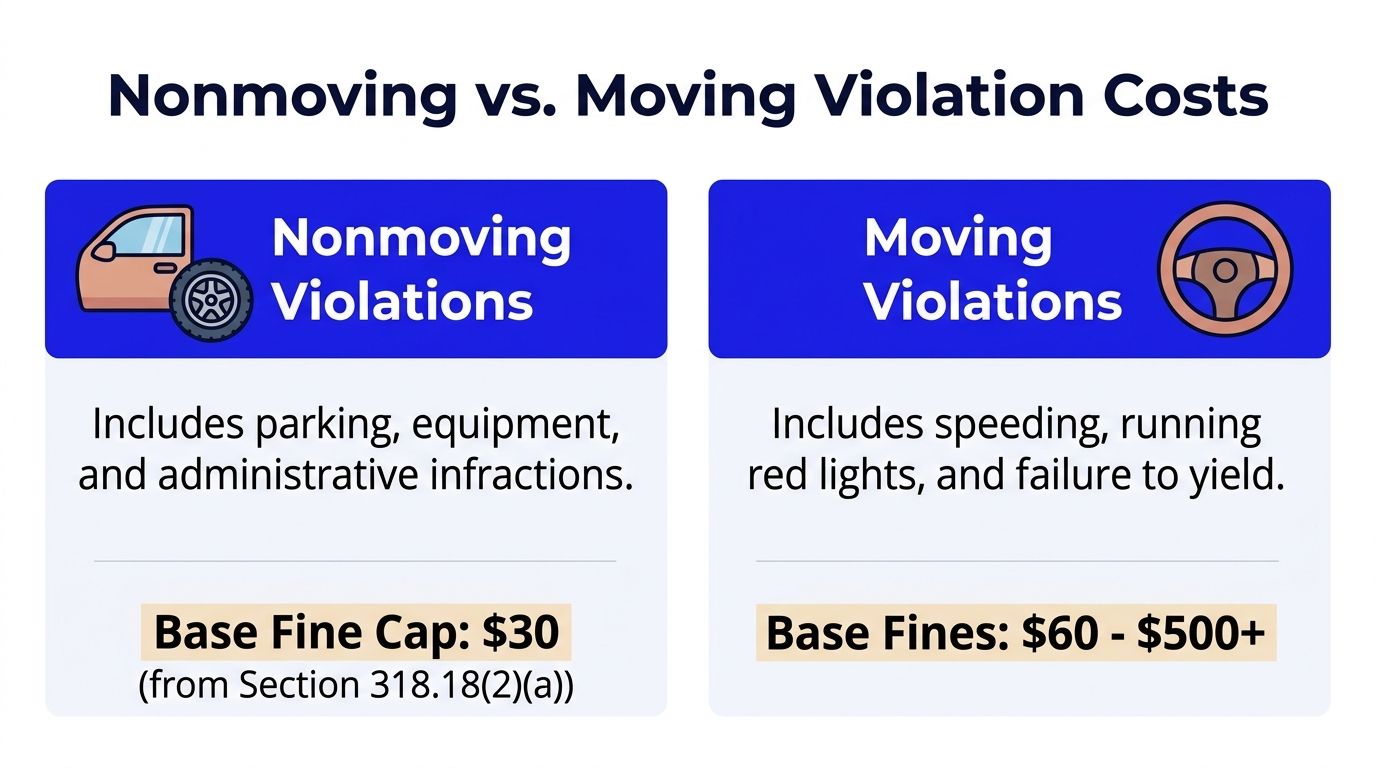
El programa de un condado también puede mostrar cantidades fijas para problemas administrativos. El condado de Palm Beach, por ejemplo, detalla en su programa de tarifas de infracciones de tránsito $116 por problemas de licencia de conducir, registro o seguro vencidos y $60 por el restablecimiento. Estos son ejemplos publicados por el condado, no un total único estatal. Las tarifas por infracciones de tránsito de Palm Beach demuestran por qué es necesario consultar al secretario del condado involucrado.
La distinción importante es el cumplimiento. Si su registro, seguro o licencia han caducado, pagar la citación puede no corregir el estado subyacente. Es posible que necesite una prueba, renovación, restablecimiento u otro paso administrativo antes de poder conducir legalmente.
Revise la citación para verificar:
Clasificación de la infracción: De movimiento, de no movimiento o administrativa.
Requisito de cumplimiento: Si debe renovar, proporcionar pruebas o corregir equipos.
Total del condado: La cantidad indicada por el secretario puede superar la base estatutaria.
Efecto en la licencia: Una multa baja no significa automáticamente un riesgo bajo.
Para obtener una explicación en lenguaje sencillo sobre la categoría, consulte qué significa una infracción de tránsito de no movimiento. Nunca asuma que una multa base más baja hace que sea seguro ignorar un problema de cumplimiento no resuelto.
Puntos del conductor de Florida y factores desencadenantes de la suspensión
El sistema de puntos de Florida convierte una citación en un problema de gestión de licencias. El Departamento de Seguridad en las Carreteras y Vehículos Motorizados de Florida detalla tres puntos por conducción temeraria y six puntos por abandonar la escena de un choque que involucre más de $50 en daños. Esos ejemplos muestran qué tan rápido las infracciones de movimiento graves pueden aumentar el riesgo de suspensión. Las reglas oficiales de puntos y suspensión de Florida deben ser su referencia para su historial específico.
Los límites de suspensión en Florida incluyen:
Doce puntos en doce meses: Suspensión de treinta días.
Dieciocho puntos en dieciocho meses: Suspensión de tres meses.
La condena y la citación no son fechas intercambiables. La forma en que se resuelve un caso determina lo que ingresa al historial de conducción, por lo que debe verificar su elegibilidad y opciones antes de considerar el pago como algo inofensivo.
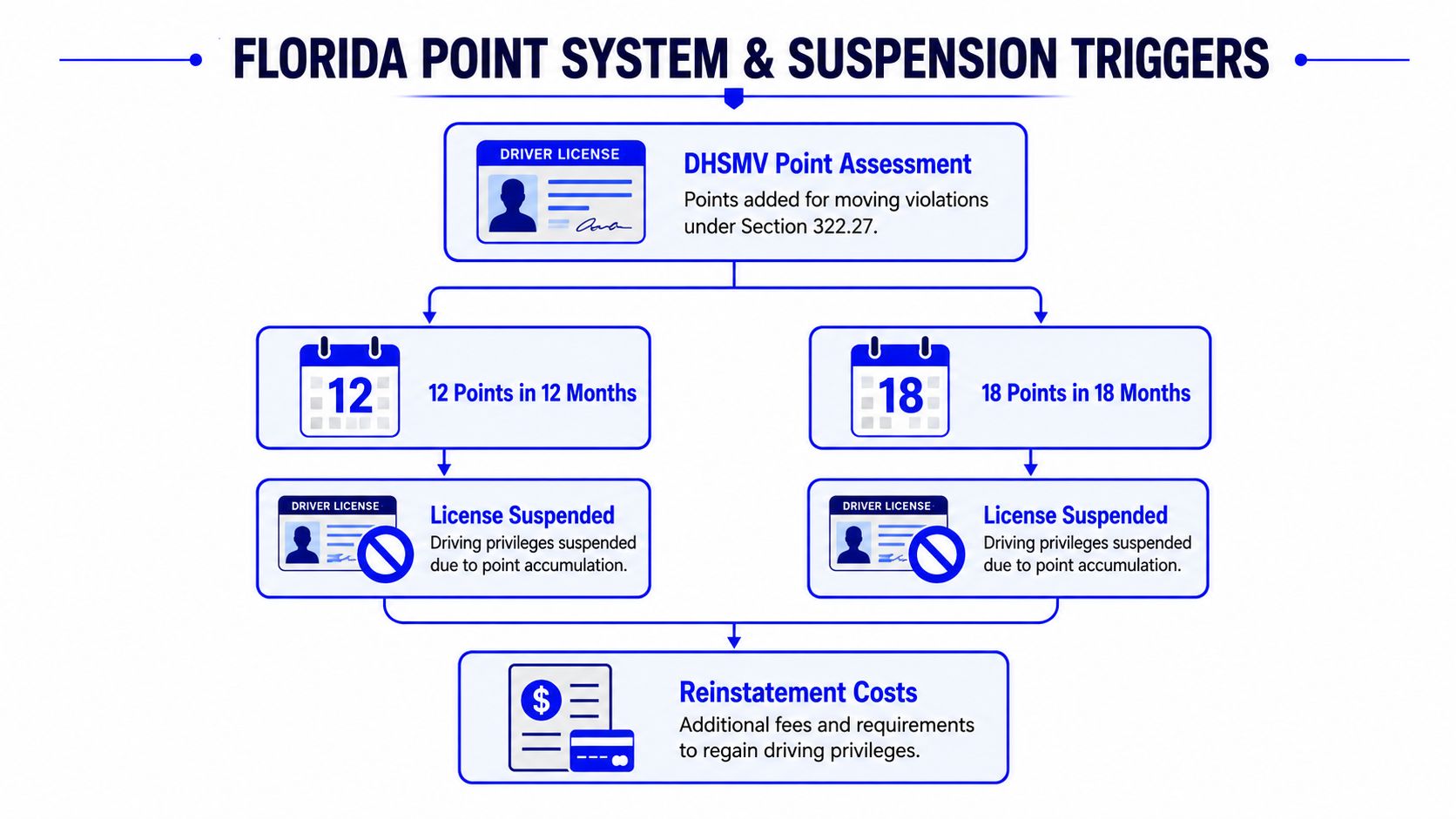
Una suspensión genera costos que van más allá de la multa original. Es posible que enfrente requisitos de restablecimiento, problemas de transporte, días de trabajo perdidos y consecuencias en el seguro. Si su trabajo o sus responsabilidades familiares dependen de la conducción, el impacto administrativo puede superar la cantidad de la citación.
Una multa cercana a un límite de suspensión merece una estrategia de historial, no un pago automático.
Verifique su total de puntos actuales antes de elegir una resolución. Una nueva condena puede importar mucho más a un conductor con un historial existente que a alguien sin puntos recientes.
Aumentos de seguro que sobreviven a la multa
La factura del seguro a menudo se convierte en la parte más grande del costo de la multa de tránsito de Florida. Los informes neutrales de los consumidores describen un costo potencial de tres años de aproximadamente $1,100 a $2,500 o más después de incluir los aumentos de seguro. El resultado exacto depende de su aseguradora, historial de manejo, póliza e infracción.
Una citación pagada aún se puede reportar a través del historial de conducción. Pagar al secretario no borra la condena subyacente y no garantiza que una aseguradora la pase por alto en la renovación.
Tipo de infracción | % Recargo promedio | Costo adicional de 3 años | Costo adicional de 5 años |
|---|---|---|---|
Infracción de tránsito rutinaria | Varía según la aseguradora | Aproximadamente de $1,100 a $2,500 o más | Puede continuar más allá de los tres años |
Infracción de tránsito grave | Varía según la aseguradora e historial | Puede ser sustancialmente mayor | Puede seguir siendo financieramente significativo |
Infracción de no movimiento | A menudo no hay recargo por infracción de tránsito | Depende del problema | Depende del cumplimiento y la aseguradora |
No base su decisión en un porcentaje asumido por la aseguradora. Las aseguradoras de Florida calculan el riesgo de manera diferente, y una estimación precisa de la prima requiere la información de su póliza. El punto confiable es que una condena de tránsito puede afectar múltiples renovaciones, mientras que una clasificación de no movimiento puede evitar ese efecto particular en el seguro.
En la renovación, compare las aseguradoras disponibles y pregunte a su aseguradora cómo se está calificando la condena. También puede solicitar una revisión de la información de conducción utilizada para la evaluación de riesgos. Cuanto antes proteja el historial, más control conservará sobre la factura futura.
Pagar la multa frente a la escuela de tránsito frente a contratar a un abogado
Tiene tres caminos prácticos después de una citación de tránsito en Florida. La acción inmediata más barata no siempre es la de menor costo total.
Opción | Costo típico | Compromiso de tiempo | Puntos / Impacto en el seguro |
|---|---|---|---|
Pagar la multa | Total de la citación más tarifas | Esfuerzo inmediato limitado | Puede generar puntos y futuro impacto en el seguro |
Escuela de tránsito | Costo del curso y costos judiciales | Finalización del curso antes de la fecha límite | Puede evitar puntos si es elegible |
Defensa dirigida por un abogado | Tarifa de la firma más cargos judiciales correspondientes | Por lo general, participación limitada del cliente | Puede buscar la desestimación, reducción o una resolución sin puntos |
La ley de Florida permite a los conductores elegibles elegir un curso de mejoramiento de conducción en los casos apropiados. La elegibilidad depende de la infracción, el historial del conductor y las elecciones previas, por lo que no asuma que la escuela de tránsito está disponible solo porque la citación es civil. Confirme la opción y la fecha límite con el secretario o con un asesor legal antes de pagar.
La escuela de tránsito puede ser sensata cuando el conductor es elegible y la multa es sencilla. Puede que no sea la opción correcta si la citación conlleva una exposición obligatoria ante el tribunal, si su historial ya está cerca de un límite de suspensión o si necesita un desafío estratégico a la acusación.
Contratar a un abogado cambia el proceso de una decisión de pago a una evaluación de la defensa. El asesor legal puede revisar la citación, identificar problemas con las pruebas, negociar una reducción o comparecer por usted cuando esté permitido. Ticket Shield, PLLC describe su modelo como dirigido por abogados, donde los clientes se comunican directamente con su abogado por teléfono o mensaje de texto en lugar de hacerlo a través de aplicaciones automatizadas, intermediarios o servicios de atención telefónica corporativos.
Mi recomendación: Si la multa amenaza con puntos, requiere comparecer ante el tribunal o podría afectar su capacidad para trabajar, compare la tarifa legal con el posible costo del historial y del seguro a largo plazo antes de pagar.
Costos de restablecimiento y cumplimiento más allá de la multa
Un conductor suspendido o que no cumple con las normas debe resolver el problema administrativo de manera independiente a la citación. Pagar una multa no restablece automáticamente los privilegios de conducción, ni renueva el seguro o corrige el registro.
Comience confirmando el estado exacto con el Departamento de Seguridad en las Carreteras y Vehículos Motorizados de Florida. Luego, identifique el motivo de la suspensión, complete el paso de cumplimiento requerido, pague la cantidad correspondiente de la secretaría o de restablecimiento, y verifique que la licencia esté activa antes de conducir.
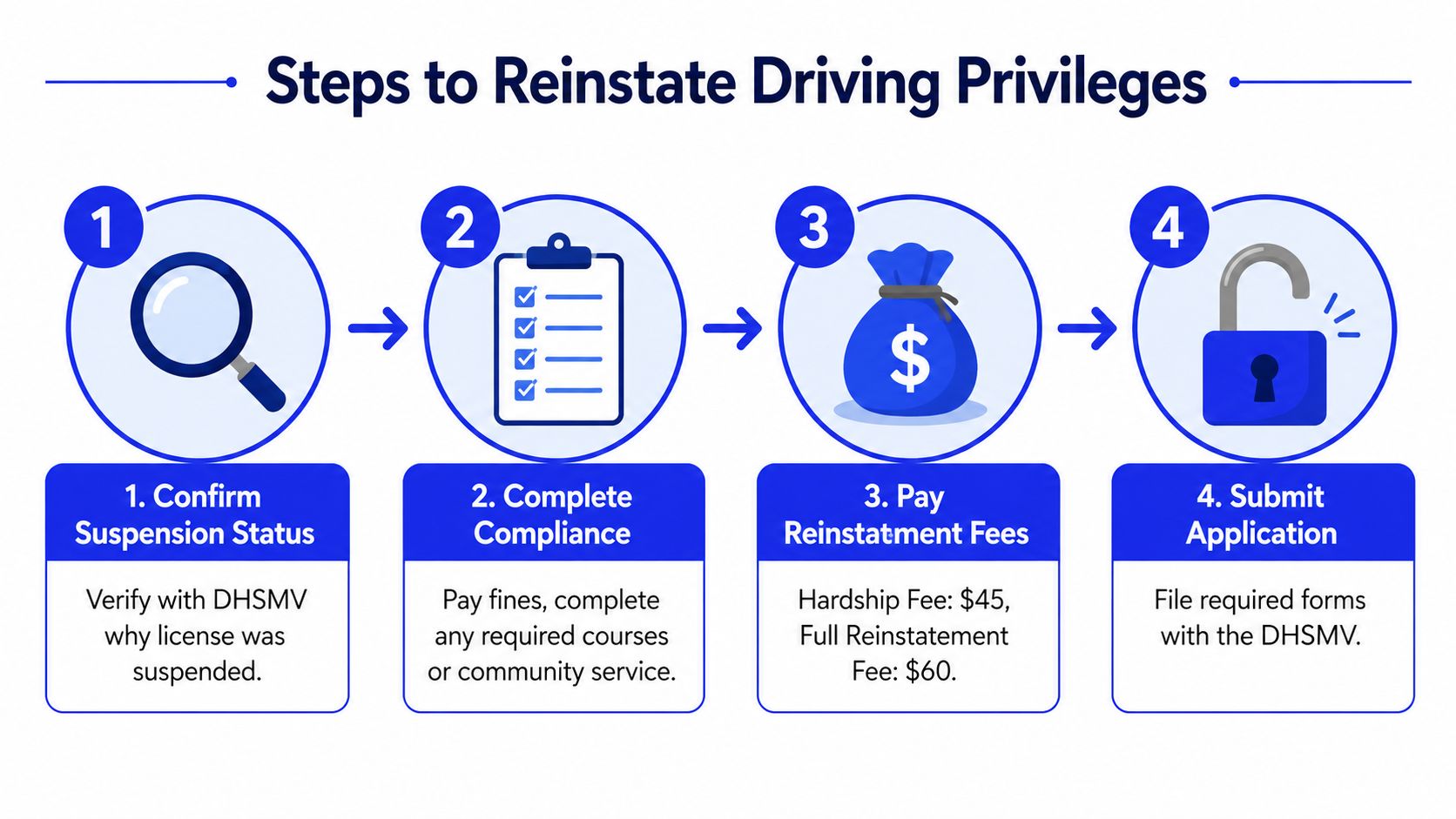
Las tarifas no siempre se incluyen en una sola factura. Un programa del secretario del condado puede detallar un cargo de restablecimiento por separado, mientras que el estado puede requerir una prueba de seguro, un registro actualizado u otro documento de cumplimiento. Esas obligaciones pueden continuar incluso después de que se pague la penalización civil de la citación.
Use esta secuencia:
Confirmar el estado: Averigüe si el problema es una suspensión por puntos, una citación impaga, un seguro vencido, un problema de registro u otra retención.
Corregir la causa: Renueve los documentos, proporcione pruebas o complete el requisito identificado por el estado o por el secretario.
Resolver la citación: Pague o dispute la multa subyacente según su fecha límite y clasificación.
Verificar la activación: Confirme que el privilegio de conducir se haya restablecido antes de operar un vehículo.
Vea esta descripción general para obtener una explicación visual del proceso de restablecimiento:
Si ya tiene una suspensión o un seguro vencido, no confíe en la estimación de un artículo general. Pregunte al secretario o a un abogado de tránsito de Florida qué cantidad resuelve la multa y qué cantidad restablece el cumplimiento.
Por qué una defensa dirigida por un abogado cambia el resultado
Un abogado puede cambiar la economía de una multa de tránsito de Florida al cambiar la resolución, no solo ayudándole a enviar el pago. Pagar la cantidad impresa significa aceptar las consecuencias de la citación. Un servicio automatizado puede encargarse del papeleo, pero es posible que no le brinde acceso directo al abogado que evalúa las pruebas. Un abogado de tránsito con licencia de Florida puede evaluar la acusación, negociar con la oficina correspondiente y comparecer cuando el caso requiera una audiencia.
Las preguntas de la defensa son concretas:
Registros de dispositivos: ¿Se les dio mantenimiento adecuado y se documentó el equipo de radar o láser?
Fundamento del oficial: ¿Puede el oficial que emite la multa explicar el entrenamiento, el ángulo de observación y la base para la estimación de la velocidad?
Condiciones de la carretera: ¿Las señales eran visibles, precisas y aplicables en el momento alegado?
Reducción de cargos: ¿Se puede resolver la acusación como una infracción de no movimiento u otra disposición que proteja la licencia?
Exposición del historial: ¿Cómo afectará el resultado propuesto a los puntos, al seguro y al riesgo de suspensión?
El valor no está garantizado y ningún abogado puede prometer un resultado en particular. La decisión debe comparar la tarifa legal con la posible exposición financiera. Pagar unos pocos cientos de dólares por una defensa estratégica puede resultar rentable cuando la alternativa incluye el costo del seguro a largo plazo de aproximadamente $1,100 a $2,500 o más descrito anteriormente.
Factor | Pagar la multa | Escuela de tránsito | Defensa dirigida por un abogado |
|---|---|---|---|
Simplicidad inmediata | La más alta | Moderada | Requiere la admisión del abogado |
Revisión de pruebas | Ninguna | Ninguna | El abogado evalúa el caso |
Participación del tribunal | Por lo general limitada | Por lo general limitada | El abogado puede comparecer cuando esté permitido |
Estrategia de historial | Acepta las consecuencias de la citación | Disponible solo si es elegible | Busca la desestimación, reducción u otra protección |
Mejor opción | Historial de bajo riesgo y sin preocupación significativa por los puntos | Conductor elegible con una citación adecuada | Exposición a puntos, comparecencia obligatoria o hechos en disputa |
La comunicación directa importa. Ticket Shield, PLLC ofrece defensa de tránsito en Florida con contacto directo con un abogado por teléfono o mensaje de texto y se presenta como una alternativa a las aplicaciones automatizadas y gestores de multas en masa que dirigen a los clientes a través de intermediarios o chatbots. Si su multa conlleva un riesgo significativo en el historial, hable con un asesor legal antes de consolidar la condena.
Los casos que más justifican una revisión legal son los que involucran más de tres puntos, una comparecencia obligatoria ante el tribunal, pruebas de velocidad en disputa o la posibilidad realista de reducir el cargo a una infracción de no movimiento. No debe elegir una resolución basándose únicamente en la cantidad a pagar hoy.
Visite Ticket Shield, PLLC para una consulta gratuita antes de pagar su multa de tránsito en Florida. Se comunicará directamente con un abogado por teléfono o mensaje de texto, con el objetivo de proteger su historial y lograr "Cero Puntos" en su licencia.