Abogado de DUI en Fort Lauderdale: Cómo defender su licencia
Encuentre un abogado de DUI en Fort Lauderdale en quien los conductores confían. Conozca las leyes de DUI de Florida, el plazo de 10 días para la licencia, las defensas, las tarifas y cómo Ticket Shield protege sus

You generally have 10 days after receiving a Florida administrative suspension notice to request review, and your criminal case and license suspension need separate defense strategies. If you've just been arrested in Fort Lauderdale, don't wait for a court date to get your paperwork reviewed.
You're home with an arrest packet, a missing license, and a work schedule that hasn't changed. Your immediate problem isn't just the accusation. It's figuring out whether you can drive, what deadline applies, and who will take responsibility for protecting your options.
Hire an attorney who will examine the suspension notice immediately, not someone who treats it as paperwork for later. A useful consultation should produce an action plan, not just a price.
Table of Contents
The First 10 Days After a Fort Lauderdale DUI Arrest
You leave a Broward County roadside stop with documents you've never seen before. One concerns the criminal allegation. Another may concern your driving privilege. Put them side by side, because they don't necessarily belong to the same proceeding.
Florida separates administrative suspension proceedings from criminal prosecution. Its official administrative suspension guidance explains review procedures and possible hardship pathways. A driver generally has 10 days after the suspension notice to request formal or informal review, and requesting review doesn't automatically pause the suspension.
Identify the notice before choosing a strategy
Your lawyer should read the actual notice, identify the stated suspension basis, and confirm the applicable procedure. A refusal allegation and an unlawful alcohol-level allegation require different factual review. Your prior suspension history and employment needs also matter.
Bring the paperwork together before the consultation:
Suspension notice: Include every page, including instructions and any temporary driving language.
Arrest documents: Keep the citation, release paperwork, testing documents, and property receipts.
Driving history: Tell counsel about earlier suspensions, convictions, and existing restrictions.
Work requirements: Explain whether you drive between job sites, carry equipment, or depend on a vehicle for essential travel.
Use the timeline as a planning aid, but let your actual notice control the deadline.
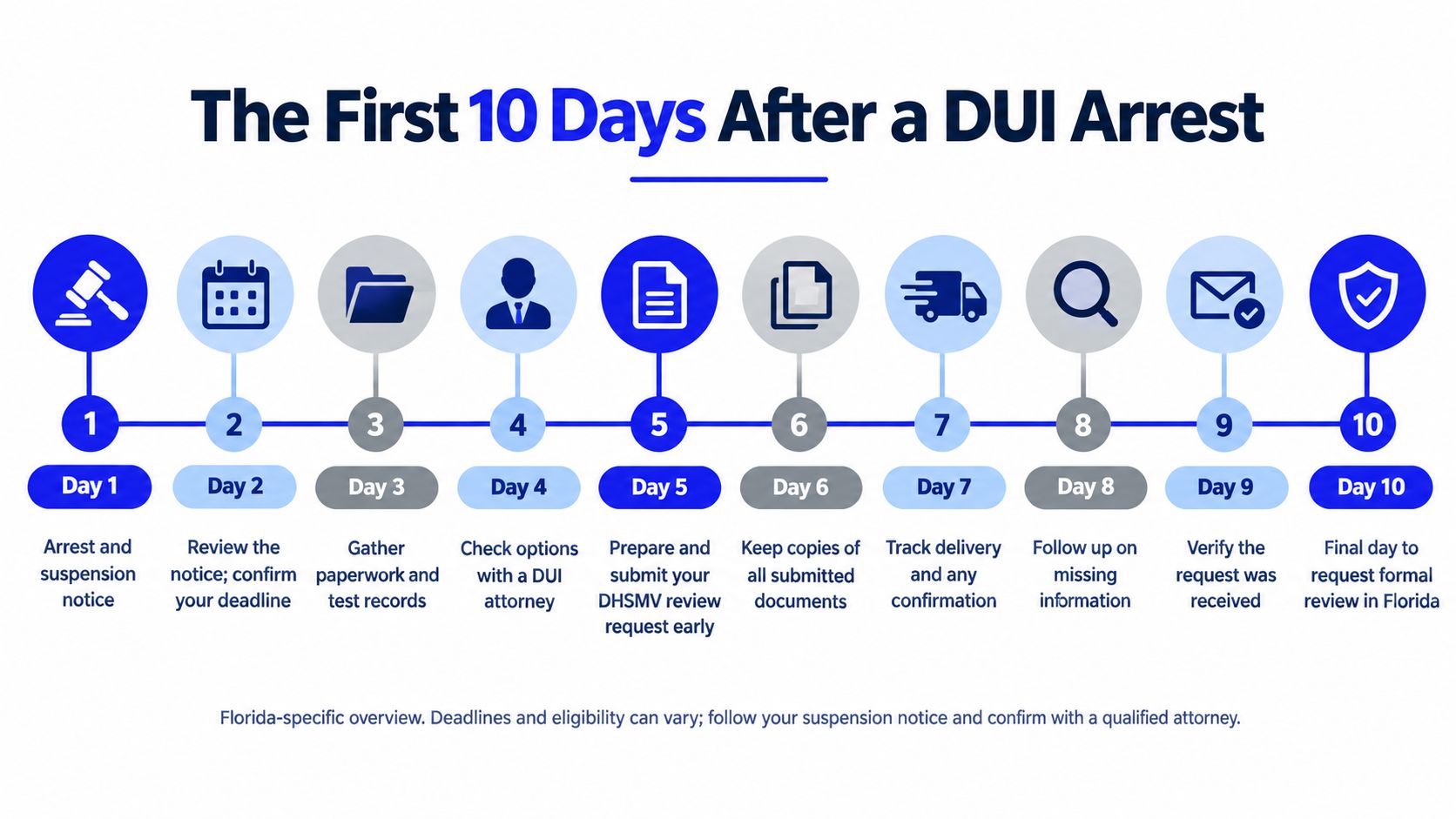
Don't interpret an intermediate marker in a graphic as a separate statutory filing deadline. Have counsel verify the deadline directly from your documents and the applicable law.
Review and restricted driving aren't interchangeable
Challenging the suspension and pursuing limited driving privileges serve different purposes. Ask what each route preserves, what conditions apply, and whether DUI-school enrollment or an administrative hearing is necessary.
If your paperwork mentions refusal, review the Florida implied-consent explanation with counsel. The warning given, your response, and the officer's documentation deserve individual attention.
Immediate priority: Don't assume your criminal court date preserves your administrative driving options.
How Florida Defines DUI Under Chapter 316
Florida Statutes §316.193 provides the criminal framework. §316.1934 addresses the blood- and breath-alcohol evidence that can support the prosecution. Your attorney should identify the prosecution's theory before discussing any proposed resolution.
Under the Florida statutory framework for alcohol testing and impairment, an unlawful blood- or breath-alcohol concentration of 0.08 or higher is a central statutory criterion. But the prosecution may also pursue impairment of normal faculties. A number isn't the entire case, and the absence of an unlawful numerical result doesn't automatically defeat an impairment allegation.
Separate the allegation into its elements
Start with whether the state alleges driving or actual physical control. Don't assume that a vehicle's being stationary resolves that question. Tell your lawyer exactly where you were, what you were doing, and what the officer observed.
Then separate the evidence into categories:
Observed impairment: Driving behavior, roadside observations, statements, and field-sobriety performance.
Chemical evidence: Breath or blood results, testing procedures, and supporting records.
Connection to the vehicle: The facts supporting alleged driving or actual physical control.
The statutory framework is easier to understand when those categories stay separate.

Don't use a general infographic to decide age-specific eligibility or administrative consequences. If a younger driver is involved, counsel must identify the applicable provisions rather than assume the ordinary criminal concentration criterion answers every licensing question.
Make the state prove its theory
Your lawyer's job is to compare the allegations with admissible evidence. That means examining the stop, arrest basis, observations, testing, and timeline instead of accepting the officer's conclusion as the starting point for negotiations.
Ask a direct question: Which element does the evidence support, and which element can we challenge? An attorney who can answer that clearly is giving you legal analysis rather than describing penalties.
Penalties, Aggravators, and Long-Term Record Impact
Don't budget around the lowest fine you find online. Your exposure depends on the applicable statutory version, prior convictions, and any legally supported aggravating allegation.
The ordinary first- and second-conviction ranges are serious enough to demand an evidence-based defense. Enhanced tiers require particular care because older statute pages still circulate in search results. An archived threshold must never be presented as current law without checking the controlling statute.
Florida DUI Penalty Tiers at a Glance
The following comparison reproduces the ranges in the archived Florida §316.193 provision, including its historical 0.20 enhancement threshold. It isn't a substitute for a current sentencing calculation.
Conviction Tier | Fine Range | Maximum Jail Time | Key Aggravator |
|---|---|---|---|
Ordinary first conviction in the cited provision | $500–$1,000 | Six months | No listed enhanced-tier trigger |
Ordinary second conviction in the cited provision | $1,000–$2,000 | Nine months | Prior conviction |
Enhanced first conviction in the archived provision | $1,000–$2,000 | Nine months | Historical alcohol level of 0.20 or higher, or passenger under 18 |
Have your lawyer verify the law applicable to your alleged offense before relying on any enhanced-penalty figure. Prior convictions also need verification. A recollection, background-search summary, or intake notation isn't a substitute for examining the underlying record.
Don't confuse different record consequences
Points, criminal convictions, and administrative suspensions aren't interchangeable. Florida's official point schedule generally assigns 3 points to standard speeding convictions and 4 points to specified violations involving speed more than 50 miles per hour over the limit; assessed points remain on the record for at least five years from disposition.
Florida's Chapter 316 index separately identifies §316.183, §316.187, and §316.189 as speed-related provisions. Those moving-violation rules don't provide a shortcut for calculating criminal exposure.
The habitual-traffic-offender framework also reaches drivers with 15 point-assessed moving violations within five years, or three major violations within five years. That's why counsel needs your complete history.
Review how long a DUI stays on your record, then ask counsel to distinguish the criminal record from your driving record and licensing status.
The Arrest-to-Resolution Timeline in Broward County
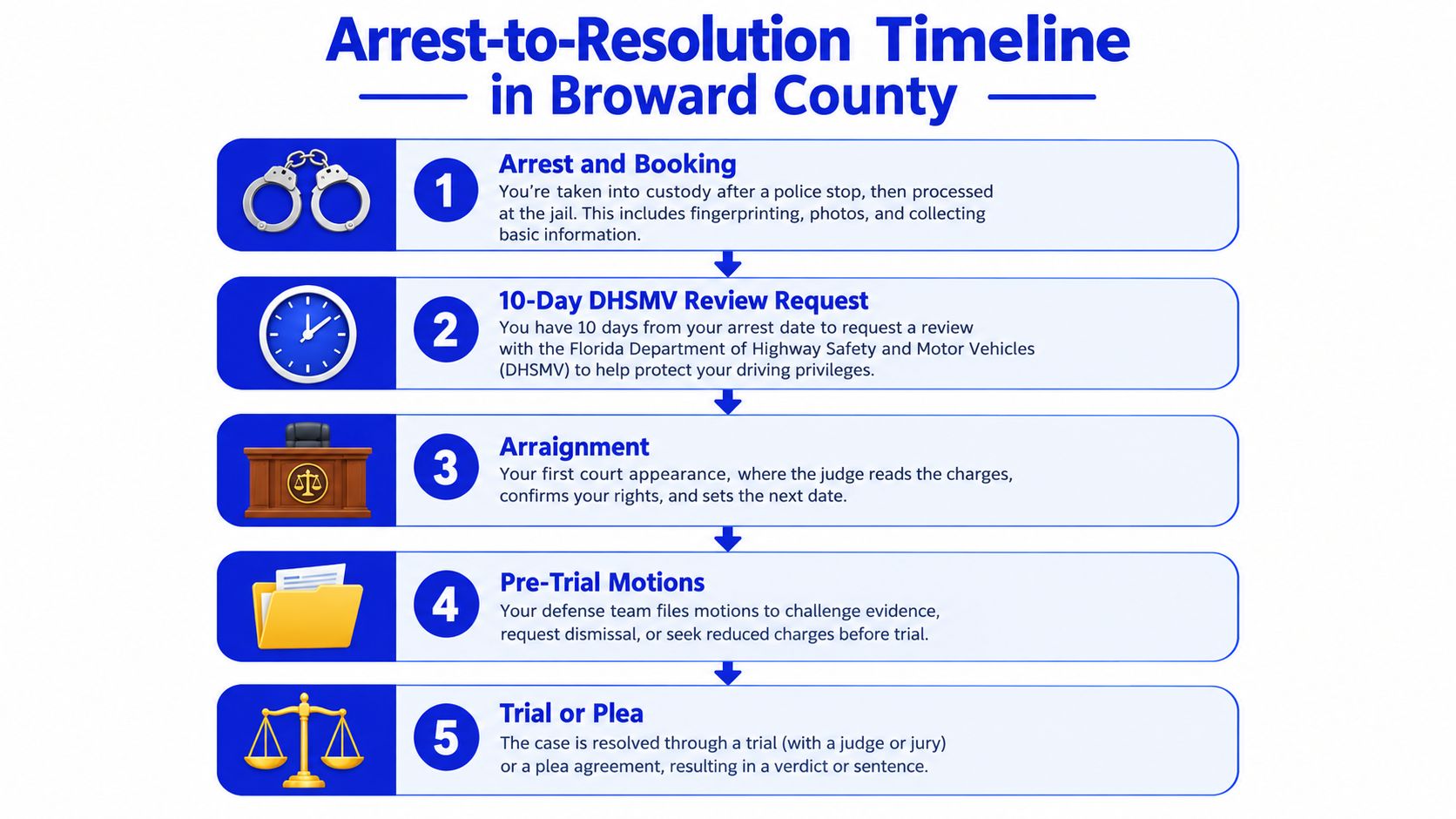
A useful defense timeline assigns responsibility to each task. You should know who is handling the administrative filing, who is requesting evidence, and who will explain the next court obligation.
This visual maps the broad progression, not a guaranteed schedule.
Give each stage a concrete task
Arrest and release: Preserve all documents. Write a private factual account for your lawyer while you remember the sequence clearly.
Administrative review: Obtain confirmation of the selected licensing strategy and any filing. Don't confuse a consultation appointment with a completed request.
Court appearance preparation: Have counsel explain the notice, your attendance obligations, and how the charge will be addressed.
Evidence review: Request the relevant recordings, officer reports, testing packet, maintenance records, and laboratory documentation.
Motions and negotiations: Ask which disputes justify a legal challenge and which affect the strength of the prosecution's proof.
Resolution planning: Before accepting any agreement, review its criminal, licensing, financial, and program-related consequences.
Evidence collection deserves attention before anyone talks confidently about an outcome. A breath-test printout may show a result without supplying the records needed to assess how that result was obtained.
Expect analysis, not a promised finish date
Don't choose counsel because someone promises a quick resolution. A responsible attorney should explain what remains unknown and what work must happen before a recommendation is sound.
Ask for updates tied to completed work: records requested, records received, discrepancies identified, and decisions requiring your input. That's more useful than repeated assurances that the case is moving.
Use the accompanying video as general orientation, then have counsel apply the process to your documents.
A hearing date tells you when to appear. It doesn't tell you whether your evidence has been reviewed or your driving status has been protected.
Keep your contact information current and forward every new notice promptly. Don't assume an unfamiliar envelope duplicates something your lawyer already received.
Choosing a Fort Lauderdale DUI Attorney the Right Way
Choose the attorney you can reach and the defense process you can understand. An automated intake confirmation doesn't tell you whether a lawyer has examined your suspension notice.
When searching for a DUI lawyer in Fort Lauderdale, ask who will represent you. The person answering the phone, collecting payment, and reviewing the evidence may not be the same person.
Attorney-led review should involve your documents, not just a booking questionnaire.

Compare access and accountability
What you need | What to ask |
|---|---|
Direct attorney communication | Can I contact my assigned lawyer by phone or text? |
Licensing responsibility | Does the engagement include administrative suspension work? |
Evidence analysis | Who reviews recordings and chemical-testing records? |
Local representation | Who handles my Broward County appearances? |
Clear scope | What services require a separate agreement or additional fee? |
Ticket Shield, PLLC is a lawyer-led Florida defense option that provides direct attorney communication by phone or text. Compare that model with services that route every question through middlemen, corporate answering services, or automated chatbots.
Ask for substance during the consultation
Prior prosecution experience and regular Broward courtroom work are reasonable questions to ask. Don't treat either as a guarantee. Ask how the attorney would investigate the specific weakness or uncertainty in your case.
A strong consultation should identify missing records, immediate tasks, and the person responsible for each. If you leave without knowing who handles the licensing issue, you haven't solved your urgent problem.
For geographic context only, Atascocita DWI legal help is a separate-location resource, not guidance for your Florida proceeding. Keep your Broward strategy grounded in Florida law and the documents issued in your case.
Buy legal responsibility, not a convenient interface. You need an attorney who can explain decisions and respond when your circumstances change.
What DUI Representation Actually Costs in Florida
Ask for a written scope before comparing prices. A fee tells you little unless you know whether it includes administrative work, criminal representation, contested hearings, and trial preparation.
There isn't a defensible universal budget without knowing your case. Don't let someone turn an uncomplicated intake description into a promise that the defense will remain uncomplicated.
Compare fee structures by what they cover
Fee structure to ask about | Question that matters |
|---|---|
Flat fee | Which proceedings and services are included? |
Phased or tiered fee | What event triggers the next payment? |
Hourly billing | How are time, expenses, and updates documented? |
Initial retainer | How is it applied, and what happens when it's exhausted? |
Treat these as options to discuss, not assumptions about a particular firm's agreement. Ask whether payment arrangements are available and obtain the terms in writing.
Your agreement should also address records expenses, expert work, and services beyond the initial scope. A cost-effective defense isn't necessarily the one with the smallest opening payment. It's one whose scope matches the work your situation requires.
Evaluate the cost of the decision
Before accepting a resolution, ask counsel to explain any possible insurance, employment, program, or ignition-interlock implications that apply to your circumstances. Don't attach an invented dollar estimate to consequences that haven't been established.
Use the Florida DUI lawyer cost guide to prepare questions about scope and billing. The separate resource on how to reduce DUI defense costs can also prompt fee-related questions, but it doesn't establish Florida pricing or procedures.
Billing safeguard: Get the service scope, additional-fee triggers, and payment terms in writing before you authorize representation.
Organized documents and prompt responses help your attorney work efficiently. Concealing an earlier suspension or delaying delivery of a notice does the opposite. Be candid from intake onward.
Defenses and Likely Outcomes by Case Type
The defense should follow the evidence. Don't start with the outcome you want and assume a standard motion will produce it.
A useful case evaluation separates challenges to the stop, roadside observations, chemical testing, and the connection between testing and alleged driving. Each raises different questions.
Match the challenge to the record
Traffic stop: Compare the officer's stated reason with available recordings and dispatch information. Ask counsel whether the facts support a legal challenge.
Field-sobriety observations: Examine the instructions, recorded performance, and surrounding conditions. Give your lawyer relevant medical and physical information.
Breath testing: Obtain instrument records, operator documentation, observation entries, and maintenance materials. Don't stop at the reported result.
Blood testing: Review collection documentation, sample handling, laboratory records, and chain of custody.
Timing: Compare alleged driving, police contact, observation, collection, and booking timestamps for inconsistencies.
The breathalyzer accuracy discussion provides a starting point for questions. Your lawyer still needs the actual testing packet to assess your evidence.
Distinguish possible outcomes from promises
Ask counsel whether the evidence supports seeking dismissal, negotiating a reduced charge, or contesting the accusation at trial. Those are different strategies, not interchangeable promises.
Don't assume withholding adjudication is available for the charged offense. Have counsel explain what is legally permitted for any proposed disposition and how it affects your driving position.
Visitors, seasonal residents, newly relocated drivers, and commercial drivers should disclose their licensing circumstances immediately. A license card alone doesn't settle whether Florida permits you to drive while a restriction is pending. Obtain a clear explanation of Florida authorization before relying on it.
The geographically separate resource titled find DUI dismissal options in Texas isn't authority for a Broward defense. Your attorney must evaluate dismissal under the law and evidence governing your Florida case.
Don't accept “we can probably get it reduced” without an explanation of the evidence, the proposed charge, and the remaining consequences.
Your goal is a decision you understand. Require counsel to explain both the opportunity and the tradeoff before you approve a strategy.
Protect Your License Starting Today
Put your arrest packet and suspension notice in one folder today. Save readable copies, record upcoming obligations, and arrange an attorney consultation that addresses your driving status before discussing a distant court outcome.
Don't drive based on an assumption. Ask what document authorizes driving, whether it remains effective, and what restrictions apply. Business-purpose driving isn't unrestricted permission to use your vehicle however you choose.
Leave the consultation with written next steps
Ask your attorney to identify:
The immediate filing: What must be submitted, by whom, and how completion will be confirmed.
Your current driving position: What permission exists and what conduct falls outside it.
The evidence requests: Which recordings and testing records counsel will obtain.
Your responsibilities: Documents, appointments, enrollment, or other tasks you must complete.
The communication plan: How to reach your lawyer and when to expect the next substantive update.
If limited driving is central to keeping your job, use the Florida DUI hardship-license guide to prepare for a case-specific discussion. Don't enroll or pay for a program on the assumption that completion alone guarantees eligibility.
Keep the objective honest
No Points is a defense objective, not a promise that every licensing consequence will disappear. Your attorney should explain what a proposed outcome accomplishes and what remains unresolved.
That distinction matters when you're under pressure to get back to work. A criminal resolution, a driving authorization, and compliance with restrictions each require attention. Demand clarity rather than accepting a reassuring label.
You don't need to solve the entire case before making the call. You need to deliver the documents, disclose your history, and choose counsel who will take responsibility for the immediate decisions. Start there, and insist on direct answers.
Visit Ticket Shield, PLLC at TicketShield.com for a free consultation about your Fort Lauderdale case and threatened driving privileges. The firm offers lawyer-led representation with direct attorney access by phone or text, so you can address your suspension paperwork and criminal defense together. Act today to pursue the strongest available outcome, with the ultimate goal of achieving “No Points” on your license where the facts and law allow.