How to Fight a Ticket for Stop Sign in Florida
Ticket for stop sign - Received a ticket for a stop sign in Florida? Don't pay it without understanding your rights. Our lawyers can help you learn defenses,
A Florida stop sign ticket is a moving violation with lasting consequences. You can face 3 points, higher insurance, and job-related fallout. Don’t just pay it. A strategic defense can protect your record, your income, and your license.
You get pulled over on the way to work, accept the citation, and assume paying it online will end the problem. It will not. A stop sign ticket in Florida can put points on your record, raise your insurance costs, and create problems for anyone whose income depends on a clean driving history.
That risk is exactly why automated ticket apps fall short. They process forms. They do not study the officer’s observations, the stop location, the visibility of the sign, or whether the state can prove a legal violation. A real lawyer does. That difference protects your record and, in many cases, your earning power.
Florida drivers make a costly mistake when they treat this ticket like a minor inconvenience. Paying it usually means admitting the violation and accepting consequences that can keep affecting your finances after the fine is paid.
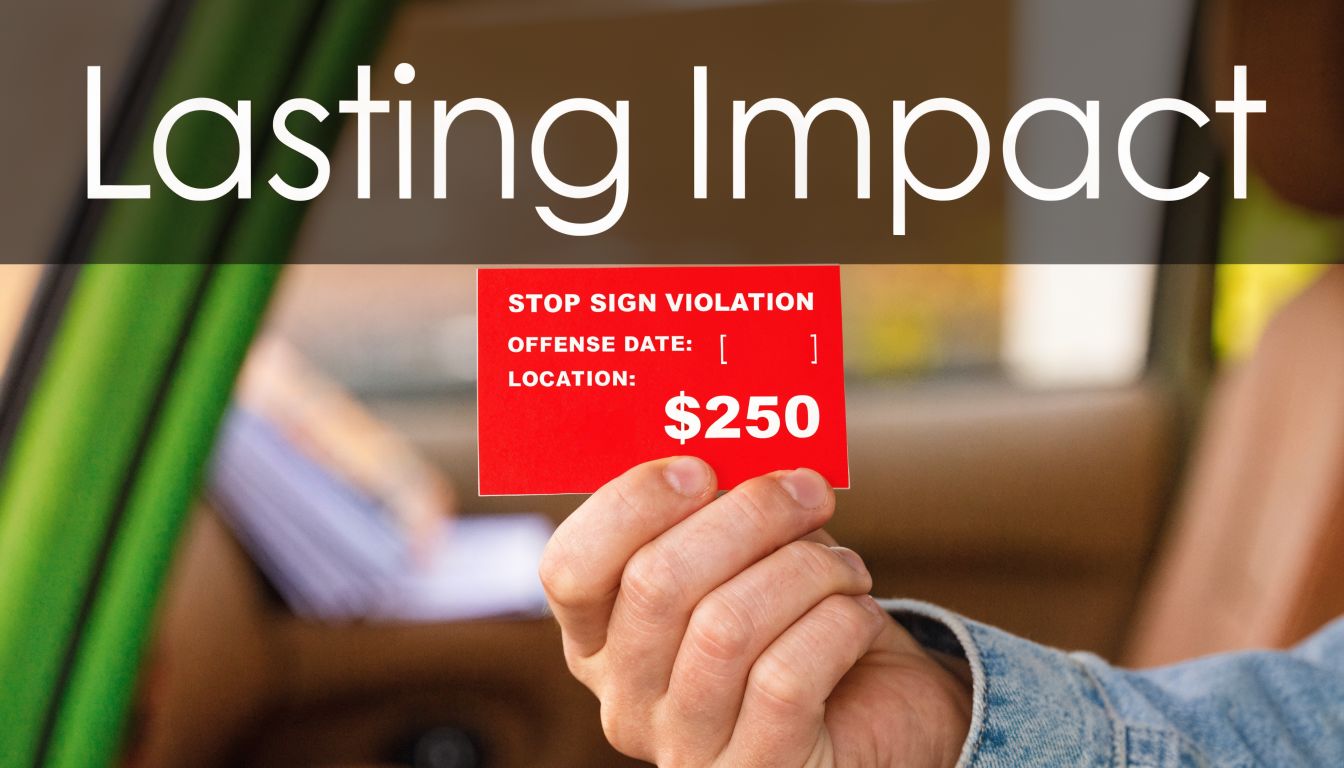
Before you decide how to respond, review the full cost of a ticket for running a stop sign and measure it against what a conviction can do to your driving record.
Table of Contents
A Stop Sign Ticket Is More Than Just a Fine
You pay the citation on your lunch break, assume it is over, and then the true cost shows up later. Your insurance renewal climbs, your driving record takes the hit, and if you rely on a clean license to earn a living, one quick payment starts affecting your income.
That is the mistake drivers make with a stop sign ticket in Florida. Paying it is usually a guilty plea to a moving violation. The court closes the file. You keep the consequences.
The fine is only the front-end cost. The longer-term exposure is usually worse. If you want a clear breakdown of how a citation can grow beyond the amount printed on the ticket, review the full cost of a stop sign ticket in Florida.
Why paying the ticket is risky
Paying a ticket for stop sign is not an administrative shortcut. It is a legal decision that can damage your record.
A conviction can add points to your license, raise insurance costs, and put you in a weaker position if you get stopped again. For many drivers, a primary problem is cumulative risk. One conviction by itself may seem manageable. Combined with prior tickets, it can push you closer to a suspension problem and make every later citation more expensive.
The hidden danger is how permanent the decision feels after the fact. Once you pay, you give up the chance to challenge the officer’s observations, the stop location, the sign visibility, and other details a lawyer would examine immediately.
Ticket apps do not solve that problem. They process volume. A lawyer builds a defense around the facts of your case, your record, and the professional damage a conviction can cause.
Direct advice: Do not treat a stop sign ticket like a bill. Treat it like a record problem before it becomes an income problem.
Who gets hurt the most
Drivers with commercial pressure on their license get hit first. That includes gig drivers, sales professionals, field employees, military members, and anyone whose job depends on staying mobile and insurable.
Young drivers also get punished hard. So do drivers with prior points who think one more ticket will not matter much. It often matters more than they expect.
A lawyer-led defense gives you something an app cannot. Judgment. An attorney can spot legal weaknesses, assess the officer’s proof, and choose the strategy that protects your record instead of pushing you toward a fast, impersonal resolution.
What Does Florida Law Actually Say About Stop Signs
Florida’s stop sign law is stricter than many drivers realize. Under Florida Statute §316.123(2)(a), you must come to a complete cessation of movement. Slowing down isn’t enough. Rolling through isn’t enough. A brief glide that feels like a stop from inside the car can still be charged as a violation.
Courts have treated a momentary pause or rolling stop as insufficient. The issue isn’t whether you thought you were careful. The issue is whether your vehicle fully stopped as required by law, as explained in this discussion of Florida stop sign law and complete cessation of movement.
If you’re comparing stop sign cases with related signal and sign violations, this overview of a violation of traffic control device helps frame how Florida treats traffic control offenses.
What complete cessation of movement means
The legal standard matters because it creates a narrow factual question. Did the car stop completely or not?
Officers are trained to focus on movement. If your wheels were still turning, even slowly, the officer may describe that as a failure to stop. That’s why these cases often turn on observation details, line of sight, and whether the officer could clearly see the vehicle’s actual movement at the stop point.
A “rolling stop” is still a stop sign violation in Florida if the vehicle never fully stops.
Where you must stop
The law also cares about where you stop. The required stop point depends on the intersection layout. In practice, that means the proper location is typically:
At the marked limit line
At the crosswalk
Before entering the intersection
That detail matters in courtrooms like the Orange County Courthouse in Orlando. An officer may say you didn’t stop where the law required, even if you braked somewhere nearby. A lawyer reviews the intersection layout, the citation wording, and any available video to test whether the charge matches the actual roadway conditions.
A stop sign case is never just about whether you touched the brake. It’s about the state proving the exact violation under Chapter 316.
What Is the True Cost of a Conviction
Most drivers focus on the ticket amount because it’s the first number they see. That’s not the actual cost.
A conviction for a ticket for stop sign can follow you through your driving record, your insurance, and your paycheck. For some people, the lasting damage starts after the court case is over.
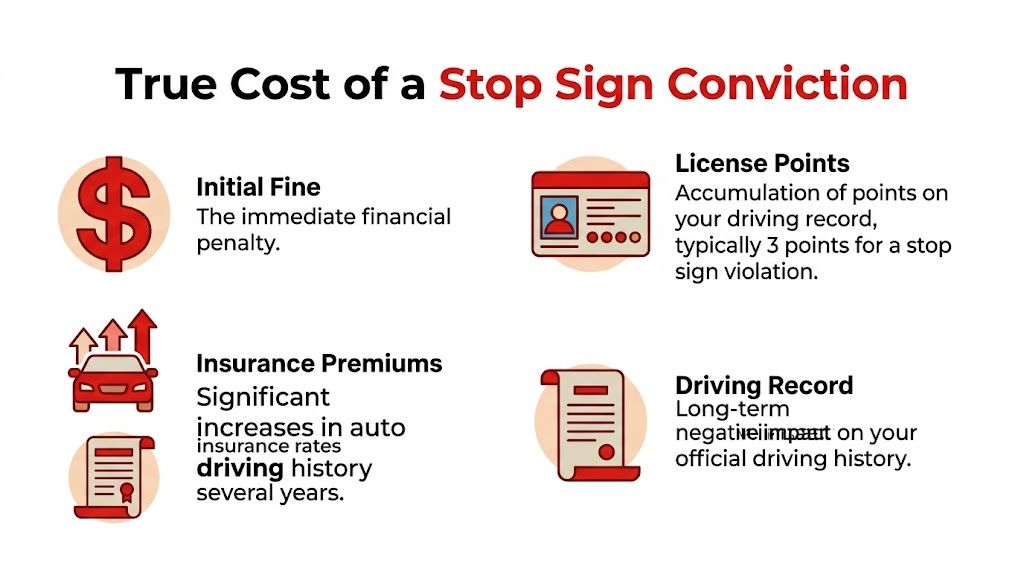
If you need context on how Florida points build toward bigger license problems, read this overview of the license point system in Florida.
The cost keeps growing after court
The insurance impact is where many drivers get blindsided. For Uber or DoorDash drivers, a single stop sign violation and its 3 points can lead to account deactivation, turning a roughly $250 ticket into the loss of thousands in income, according to this discussion of the insurance impact multiplier effect of a stop sign ticket.
That’s why I tell drivers to stop thinking about the citation as a one-time nuisance. It can affect:
Your income: If you drive for deliveries or rideshare, even one moving violation may create account trouble.
Your insurance: A conviction can increase premiums for years.
Your mobility: If you already have points, another 3 can bring suspension much closer.
Your professional standing: Some employers and licensing bodies care about a clean record.
Florida’s point system is unforgiving. A stop sign conviction doesn’t happen in isolation. It stacks.
Paying the Fine vs. Hiring Ticket Shield A Cost-Benefit Analysis
Factor | Option 1: Paying the Ticket (Pleading Guilty) | Option 2: Hiring Ticket Shield to Fight It |
|---|---|---|
Immediate outcome | Fast closure, but you accept the violation | The case is reviewed and challenged strategically |
Driving record | 3 points added after conviction | Goal is reduction, dismissal, or a result that avoids points |
Insurance impact | Greater risk of higher premiums | Better chance to protect your record and reduce downstream cost |
Career risk | Possible platform deactivation or record-related employment issues | Defense can focus on protecting income-sensitive drivers |
Court burden | You resolve it quickly, but with lasting consequences | The firm states that over 99% of clients don’t have to appear in court, based on Ticket Shield firm information provided in the publisher background |
Legal strategy | None. You concede the case | A lawyer can evaluate evidence, signage, procedure, and negotiation options |
Bottom line: The cheapest-looking option often becomes the most expensive one.
This is especially true for drivers whose livelihood depends on staying active, insured, and licensed.
What Are Your Strongest Defenses Against a Stop Sign Ticket
A stop sign charge can be challenged. The officer’s accusation is not the same as proof.
Florida treats these matters as noncriminal infractions, but the state still has to prove the violation. In practical terms, that means the government must show you failed to make the legally required stop and that the facts support the citation.
If you want to see how these arguments are developed, review this guide on how to get a stop sign ticket dismissed.
The state still has to prove the case
Strategic defenses often come from evidentiary gaps. The officer’s testimony must prove the absence of a complete stop beyond a reasonable doubt, which opens the door to challenges involving obstructed signs, improper placement, or missing reflective compliance, as discussed in this article on handling a Florida stop sign ticket through evidentiary defenses.
A strong defense may focus on issues like these:
Obstructed visibility: Tree branches, poor lighting, glare, weather, or parked vehicles may have limited what the driver could reasonably see.
Improper sign placement: Florida law requires traffic control devices to be properly placed. If the sign location is off, that can matter.
Officer line of sight: The officer may not have had a clear vantage point to determine whether your wheels fully stopped.
Video contradictions: Dash cam footage, body cam footage, or nearby surveillance may not match the citation narrative.
At places like the Edgecomb Courthouse in Tampa, details decide these cases. A generic defense won’t catch them.
The evidence you should preserve now
You should start building facts immediately. Don’t wait until the hearing date gets close.
Collect evidence that helps recreate the scene:
Photograph the sign: Take pictures from different distances and angles.
Record the roadway layout: Capture the limit line, crosswalk, lane markings, and your approach.
Save video fast: Preserve dash cam footage before it overwrites.
Document conditions: Note glare, rain, fog, faded paint, blocked sight lines, or construction changes.
This short video gives useful background on how stop sign cases are commonly challenged:
The right defense is fact-specific. An app won’t inspect the intersection for you. A real lawyer will know what to look for.
What Are Your Immediate Next Steps
Florida enforces stop sign violations aggressively because intersection crashes carry serious consequences. Intersection collisions in Florida contribute to approximately 885 fatalities and 94,700 injuries each year, according to this review of Florida intersection accident statistics. That enforcement reality is exactly why your response has to be disciplined.
Your three legal paths in Florida
You generally have three ways to handle a stop sign citation.
Pay the ticket
This is the fastest option and usually the worst one for your record. You accept guilt and the normal consequences that come with the conviction.Elect traffic school if eligible
This can help in some situations, but it doesn’t erase the fact that you still have to deal with the citation process and cost. It also isn’t always the smartest route for every driver.Fight the ticket
This is the option that gives you a chance to avoid points or improve the outcome. If your record, work, or insurance matters, this is the option you should seriously examine first.
If your first instinct is to pay and forget it, stop and get the case reviewed before you lock in the damage.
Immediate Steps to Take
Take these actions right away:
Read the citation carefully: Check the date, location, statute listed, and hearing instructions.
Preserve every detail: Write down what happened while it’s still fresh, including traffic, weather, lighting, and where the officer was positioned.
Return to the intersection safely: Take photos and video showing visibility, signage, lane markings, and any obstruction.
Save your electronics evidence: Keep dash cam footage, phone location history, and any relevant messages or delivery app logs.
Don’t admit the violation casually: Statements to insurers, employers, or anyone else can create problems later.
Get legal advice fast: Early review gives your lawyer more time to gather evidence and choose the right path.
A rushed plea helps the state. It rarely helps you.
Why Is a Lawyer Your Strongest Shield
A stop sign case looks simple until you see how many small legal details control the outcome. That’s where automated apps and high-volume ticket mills fall short.
They can collect payment and automate intake. They can’t replace attorney judgment. They can’t inspect whether the officer’s narrative is thin, whether the sign placement is vulnerable, or whether a prosecutor may agree to a no-points resolution based on the right presentation.

If you’re deciding whether legal help makes sense, this guide on when to hire an attorney for a traffic ticket is worth reviewing.
Apps don’t build legal strategy
An automated platform works from templates. Your case may need much more than that.
A real lawyer can do things software doesn’t do well:
Challenge factual assumptions: Was there no complete stop?
Test the officer’s viewpoint: Could the officer see wheel movement at the legal stop line?
Negotiate from context: Is there a practical path to a reduced charge or non-moving outcome?
Appear where it matters: Cases in places like the Richard E. Gerstein Justice Building in Miami still turn on courtroom judgment, not app design.
Direct attorney access changes the outcome
You need answers from the person handling your defense, not from a chatbot or intake layer. Direct attorney communication matters because stop sign cases often hinge on a few very specific facts that don’t show up well in a generic form.
Ticket Shield, PLLC is one Florida option that uses a lawyer-led model where clients communicate directly with their attorney by phone or text, rather than through middlemen. That matters when you need a legal strategy built around your work, your record, and the facts of your stop.
A stop sign citation is small only if you ignore what follows it.
The right lawyer isn’t there to make the process feel fancy. The lawyer is there to protect your record and pursue the result that matters most. No points.
Take Control and Protect Your Florida Driving Record
A ticket for stop sign can cost far more than the paper says. The legal issue is narrow, but the consequences are broad. Points, insurance increases, work disruption, and suspension risk can all flow from a single guilty plea.
You don’t have to accept the officer’s version without scrutiny. Florida law under Chapter 316 sets precise requirements, and those details create defense opportunities. Sign visibility, sign placement, stop location, line of sight, and video evidence can all change the case.
Your job now is simple. Don’t panic. Don’t pay blindly. Don’t let convenience turn into a long-term record problem.
Act quickly. Preserve evidence. Get the citation reviewed by someone who handles Florida traffic cases strategically and understands how to pursue a no-points result.
A fast guilty plea closes the file. It doesn’t protect your future.
Visit Ticket Shield, PLLC for a free consultation. If you want the strongest chance at a No Points outcome, get legal help before you pay the ticket.