
Can a Florida Speeding Ticket Be Expunged from Your Record?
Explore why speeding tickets expunged isn't available in Florida and learn effective legal strategies to protect your driving record and license today.

Ever wonder if you can just make a speeding ticket disappear from your record? It’s a common question we hear from drivers all over Florida. After all, the idea of "expungement" sounds like the perfect solution—a legal eraser for a past mistake.
But when it comes to a standard Florida speeding ticket, the answer is a straightforward no.
The Reality of Expunging Speeding Tickets in Florida
From the busy highways of Broward County to the quieter roads in rural areas, the question is often the same: "Can I get this speeding ticket expunged?" It’s a completely logical question. A clean driving record is valuable, and nobody wants to deal with points or insurance hikes.
The reality, however, is that for a typical speeding ticket, expungement isn't an option. This isn't a hidden loophole or technicality; it's a fundamental aspect of Florida law.
Understanding the Civil vs. Criminal Divide
So, why is that? It all comes down to a crucial legal distinction. The concept of expungement was created to give people a second chance by clearing their criminal history.
Think of it like this: expungement is for erasing a minor criminal charge that was dismissed, allowing someone to apply for a job or an apartment without that old mistake holding them back.
A speeding ticket, though, lives in a totally different world. It's a non-criminal civil infraction.
Civil Infractions: These are violations of traffic rules, not criminal laws. They’re handled in traffic court and lead to fines and points, but they don't create a criminal record.
Criminal Offenses: These are violations of state criminal laws that can result in probation, jail time, and a permanent criminal record. Expungement is reserved for these kinds of cases.
This is the core reason you can't expunge a speeding ticket. The system just wasn't designed for it. In fact, Florida Statute 943.0585 explicitly states that non-criminal traffic infractions are not part of the "criminal history record" that can be sealed or expunged.
Attorney Advertisement: This content is for informational purposes only. Past results do not guarantee future outcomes. Our goal is to protect your license and record. Office in Broward.
A Better Goal: Dismissal Over Expungement
Since you can't wipe a speeding ticket conviction off your record later on, the entire strategy has to shift. The real goal isn't cleaning up a mess after the fact—it's preventing the mess in the first place.
This is where fighting the ticket from the get-go becomes so critical. An experienced traffic attorney isn't looking for a way to expunge a conviction down the road. The focus is on getting the ticket dismissed right now.
The table below breaks down the key differences.
Expungement vs. Dismissal for Florida Speeding Tickets
Legal Action | Applicability to Speeding Tickets | Outcome for Your Record | Common Method |
|---|---|---|---|
Expungement | Not Applicable. Reserved for criminal records, not civil traffic infractions. | N/A, as you cannot expunge a speeding ticket conviction. | Filing a formal petition with the court, which is not an option for this violation. |
Dismissal | The Primary Goal. This is what is sought in traffic court. | Ticket is Thrown Out. No conviction, no points, no record of the incident. | Challenging evidence, identifying procedural errors, or negotiating with the court. |
As you can see, a dismissal achieves what most people think an expungement does—it keeps the ticket from ever hitting your driving record. An attorney can challenge the officer's evidence, question the procedures used during the stop, and negotiate on your behalf. A dismissal is a far better outcome than a conviction you can never erase.
For a deeper dive into this topic, check out our complete guide on Florida traffic ticket expungement.
Ever wondered why you can't just get a Florida speeding ticket wiped from your record like other legal issues? It all comes down to a crucial distinction in state law: a speeding ticket isn't a crime.
Florida classifies a standard speeding violation as a non-criminal civil infraction. Think of it less like a criminal act and more like a code violation. This isn't just legal jargon—it's a completely different track in the justice system, and it's the single biggest reason the conversation about expunging speeding tickets is a non-starter.
This framework is the same everywhere in the state, from quiet country roads to the busiest city centers. The traffic court system in Broward County, for example, is a high-volume machine built to process tens of thousands of these civil infractions every year. It’s designed for efficiency, completely separate from how the criminal courts operate.
The Civil Infraction Framework in Broward County
When a driver gets pulled over for speeding on I-95 or the Sawgrass Expressway, they’re entering a civil process, not a criminal one. The penalties are limited to fines, court costs, and points on their license. Most importantly, it doesn't create a criminal history record.
Because it's not a crime, the legal tools designed for criminal records—like sealing or expungement—simply don't apply. This is spelled out clearly in Florida Statute 943.0585, which defines what a "criminal history record" is. Non-criminal traffic violations are specifically left out. The entire system is designed to keep minor traffic issues from clogging up the criminal courts while still enforcing road safety with administrative penalties.
This is why the focus has to shift from a dead-end search for expungement to a proactive defense. The goal isn't to erase a conviction later; it's to stop the ticket from becoming a conviction in the first place.
Why This Classification Matters for Your Record
Grasping this concept is the key to protecting your driving record. It stops you from wasting time and energy on an impossible solution and lets you focus on strategies that actually work within Florida's system. The civil nature of a ticket is precisely why an experienced attorney can often negotiate outcomes that a criminal court would never consider.
While a speeding ticket conviction won't show up on a criminal background check, it absolutely appears on your official driving record. That’s the record your insurance company pulls, and in some cases, so do potential employers. This is where the real, long-term damage happens. Points can lead to a license suspension, and the conviction itself can trigger steep insurance hikes that stick around for years.
Across the United States, speeding tickets are rarely eligible for expungement because they're civil infractions, but their direct impact does fade. According to driving record analyses, points from speeding tickets typically stay active for license suspension purposes for just 1 to 3 years after a conviction, even though the conviction itself may linger on your record longer.
Ultimately, the civil status of traffic tickets is a double-edged sword. On one hand, it keeps you out of the criminal justice system. On the other, it slams the door on remedies like expungement, making a strong initial defense your only real path to keeping a clean slate. You can learn more about the specific rules of the road by exploring Florida's specific traffic statutes.
Effective Legal Alternatives to Expungement
Since getting a Florida speeding ticket expunged isn't on the table, the entire game plan shifts. Instead of trying to clean up a conviction after the fact, the goal becomes preventing the conviction from ever happening in the first place.
Fortunately, there are several powerful legal strategies to do just that. A proactive defense can protect your driving record from points, convictions, and those dreaded insurance hikes. An experienced traffic attorney’s playbook isn't about damage control; it’s about a proactive defense from day one.
Seeking an Outright Dismissal
The most desirable outcome for any traffic ticket is a full dismissal. Think of it as having the charge wiped away before it can even leave a mark. A dismissal means no fine (you might still have court costs), no points on your license, and no conviction on your driving record. It's the clean slate every driver is hoping for.
So, how is a ticket dismissed? It often comes down to a meticulous review of the traffic stop itself. An attorney can challenge several key parts of the citation, including:
Equipment Calibration: Was the radar or laser gun used to clock your speed properly calibrated and maintained? Florida has very strict requirements for this, and any slip-up can be grounds for dismissal.
Officer's Procedures: Did the officer follow every required procedure during the traffic stop and when writing the ticket? A single procedural misstep could be enough to get the citation thrown out.
Inconsistencies in Evidence: Are there any contradictions in the officer’s report or potential testimony? Small inconsistencies can be used to challenge the ticket's accuracy.
By digging into these details, an attorney can build a strong case to have the ticket tossed entirely. It’s a strategy that requires a deep knowledge of Florida traffic law and local court procedures.
This flowchart shows the clear legal path a speeding ticket takes in Florida, highlighting exactly why it's treated as a civil matter, not a criminal one.
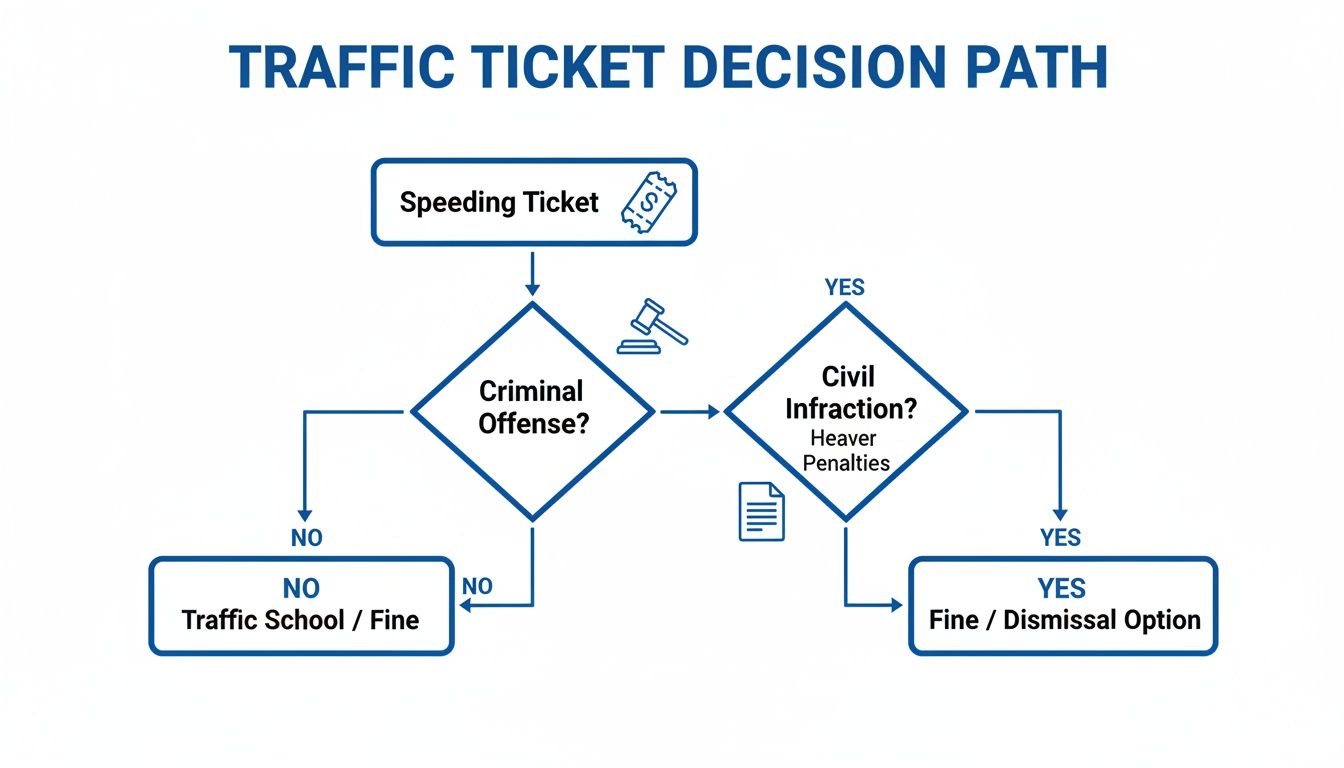
As you can see, because a standard speeding ticket is a civil infraction, the legal system channels it away from criminal remedies like expungement from the very start.
Negotiating for a Lesser Violation
If a complete dismissal isn't in the cards, the next strategy is often negotiation. A skilled attorney can frequently work with the prosecutor or judge to amend the charge from a moving violation to a non-moving violation.
This is like changing a speeding ticket into a citation for something like a broken taillight. It’s a critical difference for two huge reasons:
No Points: Non-moving violations don’t add any points to your license, keeping you away from a potential suspension.
No Insurance Impact: Because they aren't considered moving violations, they typically aren't reported to your insurance company. This helps you avoid those costly premium increases.
You'll still have to pay a fine, but this outcome effectively neutralizes the most damaging long-term consequences of a speeding ticket. It protects both your driving privileges and your wallet.
Obtaining a Withhold of Adjudication
Another powerful alternative is to secure a "withhold of adjudication." In this scenario, the court agrees not to formally convict you of the speeding violation. While you might still need to pay court costs or complete traffic school, the crucial takeaway is that no conviction is entered onto your record.
A withhold of adjudication is a legal mechanism that stops a traffic violation from becoming a formal conviction. This means no points are assessed against your driver's license, which is a key objective in protecting your driving record.
This is a far better outcome than just paying the ticket, which is an automatic admission of guilt and results in a conviction. Getting a withhold of adjudication often depends on your driving history and the specifics of your case, which is why having legal representation is so important.
Some drivers may also be interested in other ways to keep tickets off their record, like learning more about traffic ticket deferral programs and their specific requirements.
The True Cost of a Speeding Ticket Conviction

Most drivers look at a speeding ticket and see one number: the fine. That's a huge mistake.
Paying that fine is the legal equivalent of walking into court and pleading guilty. It’s an instant conviction on your Florida driving record, and that conviction—not the initial fine—is what kicks off a chain reaction of costly consequences that can follow you for years.
While you can't get Florida speeding tickets expunged, you can prevent the conviction from ever hitting your record in the first place. Once you see the hidden costs, you'll understand why that's so critical.
The Financial Sting Beyond the Fine
The first and most painful hit comes from your insurance company. As soon as a speeding conviction lands on your record, your insurer sees you as a bigger risk. In their eyes, you’ve gone from a safe driver to a liability.
And they’ll make you pay for it. A single speeding ticket can easily cause your insurance rates to jump by 20-30% or more. Think about that. If you're paying $2,000 a year for insurance, that’s an extra $400 to $600 out of your pocket, every single year.
This isn't a one-time penalty. Those higher rates stick around for three to five years. So, that one "simple" ticket could end up costing you an extra $1,200 to $1,800 in insurance surcharges alone—often way more than the original fine.
Attorney Advertisement: This content is for informational purposes only. Past results do not guarantee future outcomes. Our goal is to protect your license and record. Office in Broward.
Insurers across the country look back 3-5 years from the conviction date when setting your rates. The points that lead to a license suspension often have a shorter shelf life, but the financial damage from the conviction itself can linger for years.
Florida's Point System and Your License
Beyond the hit to your wallet, a conviction also adds demerit points to your Florida driver's license. The state uses this system to track drivers who repeatedly break the rules, and if you rack up too many points in a short time, you’ll lose your license. It's that simple.
Here’s a quick look at how points can stack up for speeding:
15 mph or less over the limit: 3 points
16 mph or more over the limit: 4 points
Speeding that causes an accident: 6 points
These points add up faster than you think. The Florida Department of Highway Safety and Motor Vehicles (FLHSMV) does not take this lightly; once you hit a certain number of points, they will automatically suspend your license.
To put this in perspective, let’s look at how Florida's point system works and what it takes to lose your driving privileges.
Florida Driver's License Point System At a Glance
Violation Type | Points Assigned | Suspension Threshold | Suspension Duration |
|---|---|---|---|
Speeding (1-15 mph over) | 3 points | 12 points in 12 months | 30 days |
Speeding (16+ mph over) | 4 points | 18 points in 18 months | 3 months |
Speeding causing a crash | 6 points | 24 points in 36 months | 1 year |
Seeing the numbers laid out like this makes it clear how just a few tickets can lead to a suspension, taking away your ability to get to work, school, or anywhere else you need to go.
The consequences are real and expensive. Understanding these long-term impacts makes it obvious why fighting a ticket from the very beginning is so important. Preventing the conviction is the only way to sidestep all of these negative effects. You can find more information by reading our guide on the various court costs associated with traffic tickets.
How a Traffic Attorney Can Protect Your Driving Record
Alright, so we've established that you can't get Florida speeding tickets expunged. That's the bad news. The good news? You have the power to stop a conviction from ever hitting your record in the first place. This is exactly where a traffic law firm becomes your biggest asset. Instead of trying to navigate the stressful, confusing court system by yourself, you can hand the whole issue over to a professional.
The process is designed to be as simple and hands-off for you as possible. It all starts with a free, no-pressure consultation where you can explain what happened. From that moment on, an experienced attorney takes the wheel, representing you in court and working towards a positive outcome. For the vast majority of our clients, this means they never have to miss a day of work or even see the inside of a courtroom.
Your Advocate in the Florida Court System
Dealing with the legal system can be intimidating, especially in a busy place like Broward County. A traffic attorney is your personal advocate, using their in-depth knowledge of local court procedures, judges, and prosecutors to build the strongest defense for your specific ticket.
Their number one job is to protect your driving record. This isn't just one strategy; it's a multi-pronged approach focused on getting you a favorable result, which could mean:
Challenging the Ticket's Validity: A good attorney dissects every piece of evidence. They scrutinize the officer’s report, check the calibration records for the radar or laser gun, and look for any procedural mistake that could get the whole thing thrown out.
Negotiating a Favorable Plea: Sometimes, a full dismissal isn't in the cards. That's when the focus shifts to negotiation. An experienced lawyer can often work out a deal to reduce the charge from a moving violation to a non-moving one. This is a huge win—it means no points on your license and nothing gets reported to your insurance company.
Seeking a Withhold of Adjudication: This is a key legal move. It prevents a formal conviction from ever being officially entered on your record, effectively stopping points and other penalties before they can even start.
This strategic approach is infinitely better than just throwing in the towel. It's about taking control of the situation to dodge those long-term consequences.
The Convenience of Professional Representation
One of the biggest perks of hiring a traffic law firm is pure convenience. The thought of going to court and trying to question a police officer is enough to stress anyone out. With a professional handling it, you can skip all of that.
Your attorney manages all the paperwork, court filings, and appearances for you. You're kept in the loop every step of the way, but you don't have to deal with any of the legal legwork. It lets you get on with your life while a professional works to safeguard your license and driving record.
Attorney Advertisement: This content is for informational purposes only and does not constitute legal advice. Our office is located in Broward, and we handle traffic matters across Florida. Past results do not guarantee future outcomes. Our primary objective is to protect your license and record.
We believe fighting a traffic ticket should be a straightforward and accessible process. We handle cases in all 67 Florida counties, so no matter where you got that ticket, you have access to experienced legal help. A citation doesn't have to end in a conviction, points, and sky-high insurance rates. With the right strategy, you can fight back and protect what matters.
Ready to take that first step? Let us take a look at your case and explain how we can help. For a deeper dive into the benefits of professional help, check out our article on why you should hire a traffic ticket lawyer in Florida.
Frequently Asked Questions About Florida Speeding Tickets
When you get a speeding ticket, your mind is probably racing with questions. It's a stressful situation, and most drivers wonder about the long-term damage and the smartest way to handle the citation. Let's cut through the confusion and get you some clear, straightforward answers to the questions we hear every day from Florida motorists.
How Long Does a Speeding Ticket Stay on My Florida Record?
This is the big one, and the official answer can be a bit of a shock. A speeding ticket conviction technically stays on your permanent Florida driving history forever. It doesn't just vanish after a few years.
But what really matters to most people are the points that come with that conviction. For insurance companies, the "look-back" period is usually three to five years. During that time, they can use the conviction to justify charging you significantly higher rates.
The whole goal of hiring a traffic attorney is to prevent the conviction and points from ever hitting your record in the first place. If the ticket is dismissed or a better outcome is negotiated, there’s no conviction to worry about, making the question of "how long it stays" a non-issue.
Is Going to Traffic School a Good Way to Handle My Ticket?
Choosing traffic school can feel like an easy option. And if you're eligible, it does let you avoid getting points slapped on your license for a conviction. But while it has its place, it's not always the best move, especially for a driver in a busy area like Broward County.
Think of traffic school as a limited lifeline. Under Florida law, you can only use it five times in your entire life, and no more than once in any 12-month period.
Using your traffic school option on a ticket that could have been dismissed is like spending your emergency savings on a non-emergency. Fighting the ticket first with legal help could lead to a complete dismissal—meaning no conviction, no points, and you get to keep that precious traffic school election for a time when you might truly need it.
What Happens If I Don't Fight the Ticket?
Not fighting the ticket and simply accepting the outcome is hands down the most damaging thing you can do. It feels like the fastest way to put the whole thing behind you, but what you're actually doing is kicking off a long and expensive chain of events.
When you accept the penalties, you are officially accepting guilt. That single action triggers an automatic tidal wave of consequences:
A Conviction Is Locked In: The court finds you guilty, and a conviction is permanently stamped onto your official Florida driving record.
Points Are Added: The Florida DHSMV will add the corresponding points to your license (usually 3 or 4 for speeding), pushing you closer to a potential suspension.
Your Insurance Company Gets the News: Insurers check driving records all the time, and this new conviction will flag you as a higher-risk driver.
The most painful part is the hit to your wallet. That conviction almost always leads to an immediate and painful spike in your insurance premiums that can last for years, making the original fine look like pocket change.
Can I Get a Misdemeanor Speeding Ticket Expunged?
Most speeding tickets in Florida are just civil infractions. But if you're clocked at an extremely high speed (typically 50 mph or more over the limit), the charge can be elevated to a criminal offense—a misdemeanor or even a felony.
Even in these serious criminal traffic cases, the rules for getting speeding tickets expunged are incredibly tough. In Florida, a conviction for a criminal traffic offense generally cannot be sealed or expunged. This means a criminal speeding conviction could impact both your driving and criminal record forever, popping up on background checks for jobs, housing, and professional licenses.
That raises the stakes dramatically and makes having a proactive legal defense absolutely essential from the moment you get the ticket.
Why Hire an Attorney If I Know I Was Speeding?
Even if you know you were speeding, hiring an attorney isn't about trying to deny what happened—it's about securing a better legal outcome. A lawyer's job is to work within the court system to minimize the damage.
An experienced attorney can often negotiate with the prosecutor to amend the charge to a lesser offense, like a non-moving violation that carries zero points. They can also argue for a "withhold of adjudication," a legal maneuver that stops a formal conviction from ever being entered on your record. These kinds of results are nearly impossible for a driver to get on their own but are the primary goals for a skilled traffic defense lawyer.
Don't let a speeding ticket control your driving future and your finances. The team at Ticket Shield, PLLC is here to take up the fight for you. We handle the court dates and the legal headaches so you can get on with your life. For a free, no-obligation consultation to talk about your case, visit us at https://www.ticketshield.com today.
