Speeding Ticket Lawyer Orlando: A Driver's Defense Guide
Got an Orlando speeding ticket? Don't just pay it. Our speeding ticket lawyer Orlando guide explains your options, the risks, and how to protect your record.

Hiring a speeding ticket lawyer in Orlando is usually the strategic move if you want to avoid points, insurance problems, and possible license trouble. Paying the fine is faster, but it often means accepting consequences that can follow you long after the ticket is closed.
In Florida, one in five moving violations was completely dismissed in 2024, and over half of all traffic tickets were challenged in court with successful outcomes. That alone tells you the answer. For a speeding ticket in Orlando, you should fight first and pay last.
You're probably reading this with the citation still sitting on your counter, or in your glove box, or open on your phone after getting stopped on I-4, the 408, or a surface road near downtown Orlando. You want the problem gone. Fast. That instinct is understandable. It's also how drivers make expensive mistakes.
A speeding ticket in Florida isn't just a bill. It's an allegation under Chapter 316, often tied to Florida's speed-related enforcement rules, including Fla. Stat. § 316.187. If you pay it, you may be doing more than ending the case. You may be locking in points, opening the door to insurance consequences, and using up options you may need later.
The bigger choice comes next. Not just whether to fight the ticket, but who handles it. A lawyer-led defense and an automated ticket service are not the same thing. One gives you legal judgment. The other gives you a process.
Table of Contents
An Orlando Speeding Ticket Is More Than Just a Fine
The moment the lights hit your mirror, the case starts. By the time the officer hands you the citation, you're already dealing with a legal problem, not a customer service issue.
Most drivers think the fine is the issue. It isn't. The true issue is what comes with the payment. Once you pay, you usually stop fighting. That may feel efficient, but it can become the most expensive “easy” choice you make.
Why paying quickly can hurt you
Under Florida traffic law, speeding allegations fall within Chapter 316, and Fla. Stat. § 316.187 is part of the legal framework tied to speed-related enforcement. That means your ticket sits inside a formal system with rules, deadlines, and consequences. It's not informal. It's not harmless.
If you're trying to figure out what the citation may cost in direct penalties, review how much Florida speeding tickets can cost. Then look past the fine, because that first number is rarely the full problem.
Practical rule: If your first plan is “I'll just pay it and move on,” slow down. In traffic court, the fastest option is often the least protective one.
Why Orlando drivers need to treat this seriously
Orlando isn't a light-enforcement city. It's a commuter city, a tourism city, and a court-heavy traffic environment. Drivers move through congested corridors every day, and enforcement is constant enough that traffic defense has become a substantial legal niche here.
That matters for one reason. If a city has a mature traffic-defense market, it means these cases are being contested every day by lawyers who know they're worth contesting. You should take that signal seriously.
The decision after a citation should be simple. Don't hand your record over to convenience. Protect it.
What Are the Real Consequences of a Florida Speeding Ticket
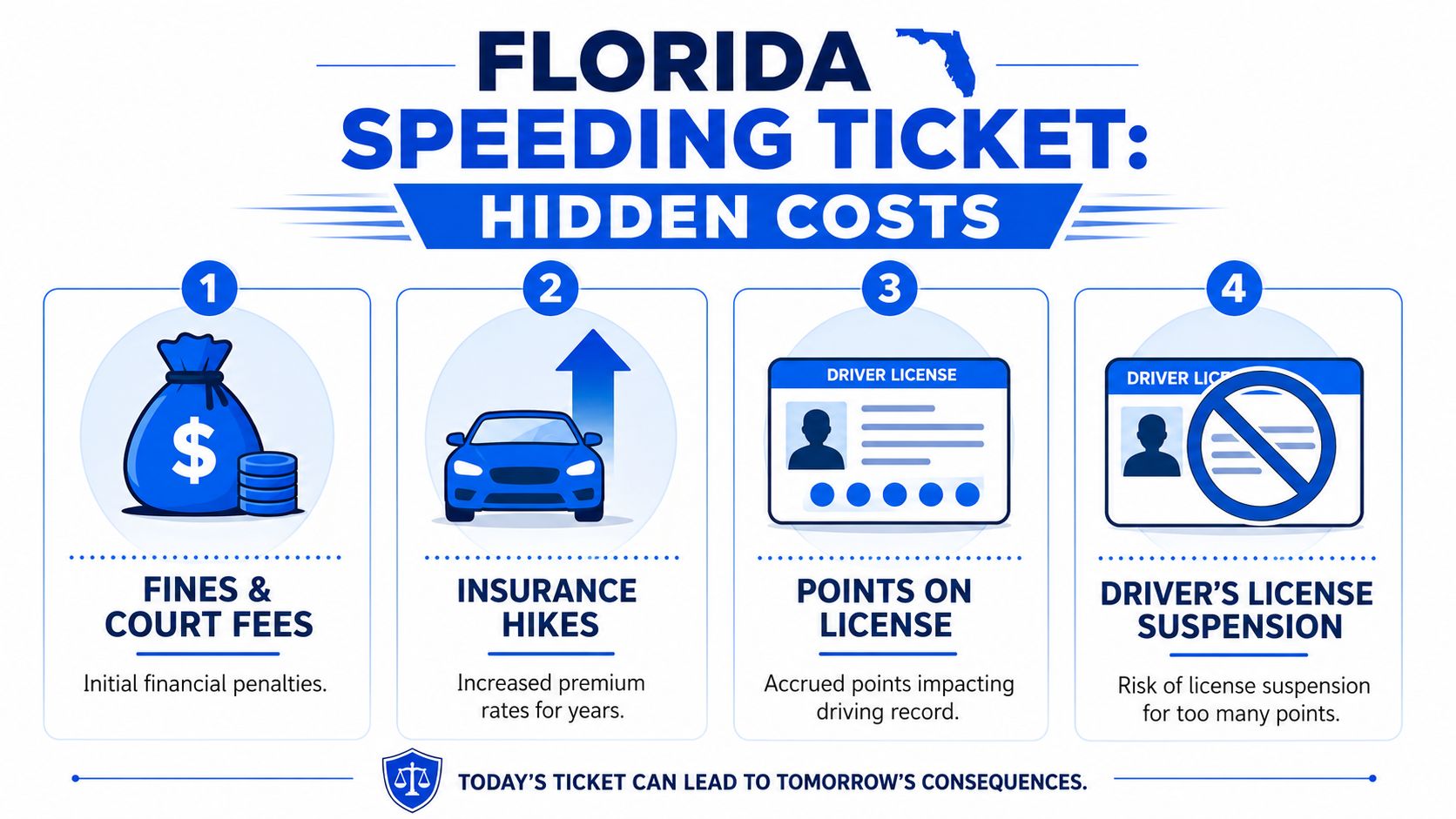
Florida drivers get into trouble when they focus only on the amount printed on the citation. The state's point system and the insurance fallout are what make a speeding ticket dangerous.
How many points are at stake
Florida's point system is strict. Speeding 1 to 9 mph over adds 3 points, 10 to 14 mph adds 4 points, and 15 mph or more also adds 4 points, according to this Orlando traffic ticket lawyer explanation of Florida points and traffic school limits.
That means even what many drivers call a “small” speeding ticket can still hit your record.
Here's the practical way to read it:
Lower-range speeding still matters: Even a citation for a few miles over the limit can put points on your license.
Moderate speeding isn't treated lightly: Once the speed climbs, the exposure gets worse fast.
Higher-speed allegations raise the pressure: At that point, you're no longer deciding about a fine. You're deciding how much record damage you're willing to accept.
For many drivers, the primary fear isn't the court date. It's what comes after. If you're worried about premiums, review the insurance impact of a Florida speeding ticket.
Why traffic school is not a universal fix
Traffic school helps some drivers. It does not solve every case.
Florida only allows a court-ordered driver improvement course to avoid points for an eligible citation once every 12 months and no more than five times in a lifetime, according to the same Florida traffic school and points overview. That limitation is more important than most drivers realize.
If you burn one of those opportunities on a case that might have been reduced or beaten, you've lost a tool you may need later.
Paying the ticket is often the decision that closes off options. Fighting the case is the decision that preserves them.
What drivers usually miss
Three groups need to be especially careful:
Gig drivers: A moving violation can create work problems even if the fine looks manageable.
Daily commuters: You may absorb the cost of a conviction for a long time after the court closes the file.
Out-of-state drivers: Florida may be the issuing state, but the consequences often don't stay in Florida.
The right question isn't “Can I just get this over with?” It's “What follows me after this is over?”
How Do You Navigate the Orange County Court System
Orange County traffic court is manageable when you know the system. It's risky when you don't. That's the point most drivers discover too late.
What happens after you receive the citation
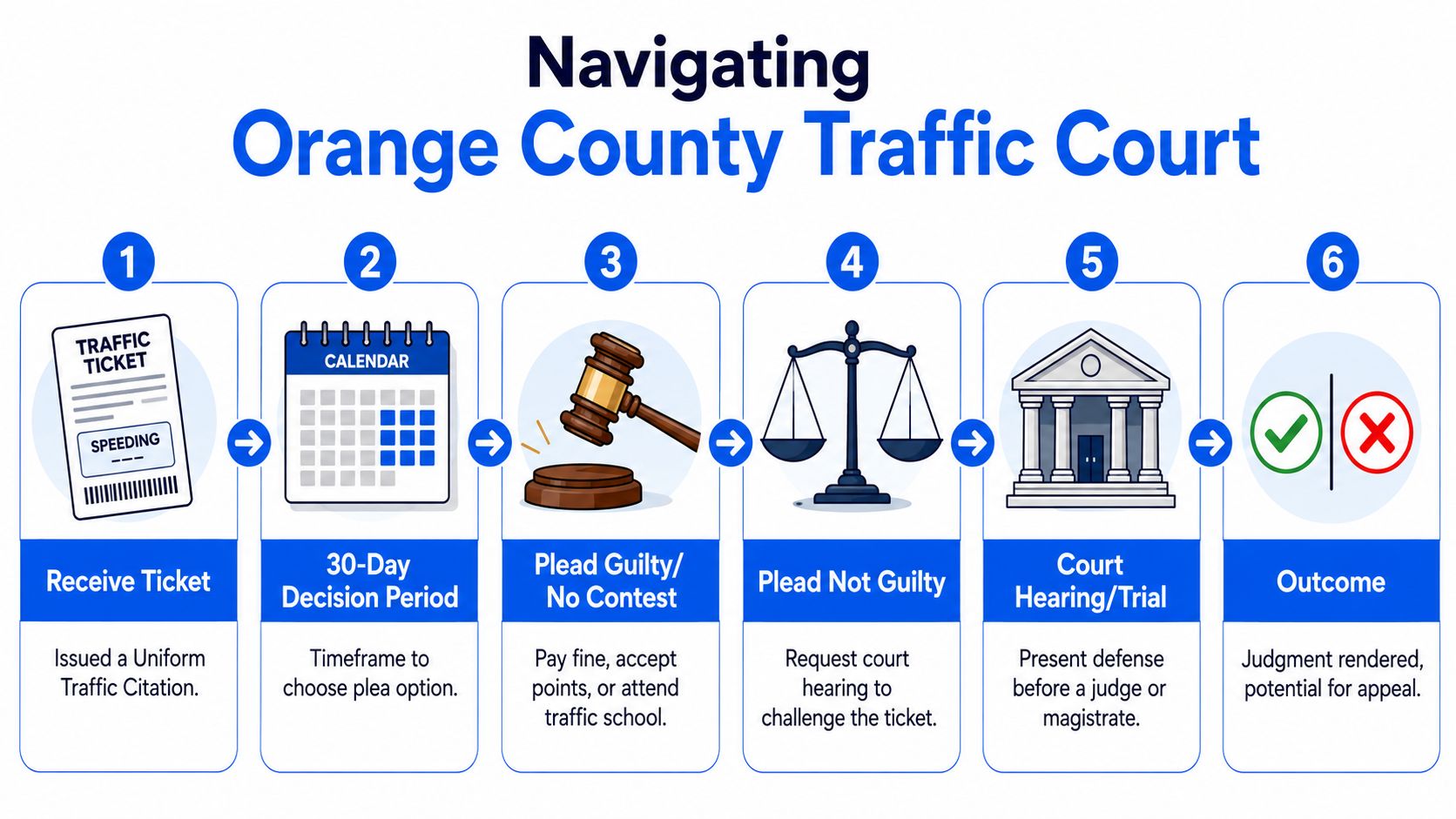
Once you get the ticket, the clock starts. You generally have to make a decision within the legal response period. That usually means choosing whether to resolve it, seek an eligible school option, or contest it.
Only one of those choices keeps the door open to a better outcome. Contesting the ticket.
Drivers often think setting a court date means they're committing to a dramatic courtroom fight. Not necessarily. It means you're preserving your ability to challenge the allegation instead of surrendering to it.
If your citation was issued in Orange County, review how Orange County traffic ticket cases are handled. Procedure matters. Deadlines matter. Filing mistakes matter.
Why the Orange County Courthouse matters
The local anchor here is the Orange County Courthouse. That's where process stops being abstract. Clerks, calendars, hearing officers, prosecutors, filing requirements, and courtroom expectations all become real.
Orlando also has a dense traffic-defense market. Legal directory listings show numerous lawyers focused on traffic ticket cases across the metro area, which underscores that this is a well-established field in the city, as reflected on Justia's Orlando traffic ticket attorney listings.
That should tell you two things:
These cases are common.
The local process is serious enough that many lawyers build practices around it.
What makes self-representation risky
Drivers who go alone usually run into the same problems:
They don't know the procedural pressure points: Missing a step can remove an advantage.
They speak too much about fairness and not enough about proof: Courts decide based on evidence and procedure.
They assume the officer's version is untouchable: It isn't.
You do not need to know every courtroom detail. You do need someone handling your case who does.
The court system rewards preparation. It doesn't reward panic, and it doesn't reward guesswork.
What Defense Strategies Can an Attorney Use to Fight Your Ticket
A real defense is not “I was only keeping up with traffic.” It is not “I didn't mean to speed.” It is not “I need a clean record.” Those are explanations. They are not legal attacks on the citation.

Why the evidence matters more than your explanation
In Florida speeding cases, the defense often turns on how speed was measured. Radar and LIDAR evidence can be challenged based on calibration, operator training, and conditions. Pacing can be challenged on credibility and observation issues. Reducing or suppressing weak evidence can be central to reducing a moving violation to a non-moving one, as discussed in this overview of Orlando speeding-ticket defense tactics.
That is where lawyers work. Not in excuses. In evidence.
If you want a practical overview of common methods, review ways lawyers fight speeding tickets in Florida.
Where speeding cases often break down
A strategic attorney looks for flaws the average driver never sees:
Device problems: Was the radar or LIDAR unit properly calibrated and documented?
Training problems: Was the officer trained to use that specific method?
Condition problems: Did traffic, weather, distance, or line of sight affect the reading?
Observation problems: In pacing cases, did the officer maintain reliable visual continuity?
These issues matter because the state still has to prove the allegation with competent evidence.
Here's a helpful overview of the kinds of issues lawyers examine in traffic cases:
What a lawyer is actually trying to achieve
Not every good result is a full dismissal. Sometimes the target is a reduction that protects your record better than a straight conviction would. Sometimes the strongest path is attacking the speed reading itself. Sometimes it's exposing a proof problem that gives the other side a reason to resolve the case differently.
The strongest traffic defense is usually technical, not emotional.
That is why automated intake systems fail so often in meaningful cases. They collect facts. They don't analyze evidentiary weaknesses with judgment.
Why Is a Lawyer-Led Firm Better Than a Ticket App
This is the most important choice after the ticket itself. Not “fight or pay.” Who is defending you?
A lot of drivers hire what looks like legal help and get a workflow instead of a lawyer. They fill out a form, upload a citation, and then wait while a call center, middleman, or software pipeline pushes the file forward. That may feel modern. It is not the same as legal strategy.
What you lose when nobody knows your case
A traffic case can turn on a small detail. The officer's wording. The location. The method of speed measurement. Your prior use of school. Whether you're a commuter, rideshare driver, CDL holder, or out-of-state license holder.
Those details require judgment. Not automation.
Here's the blunt comparison.
Feature | Automated 'Ticket Mill' App | Ticket Shield Lawyer-Led Firm |
|---|---|---|
Case intake | Form-driven | Attorney review |
Communication | Often through support staff or systems | Direct phone or text access to your attorney |
Strategy | Standardized workflow | Case-specific legal analysis |
Evidence review | Limited or templated | Focused review of proof issues |
Client experience | Transactional | Lawyer-led representation |
Fit for nuanced cases | Weak | Stronger |
If you're weighing the difference between a local attorney and an app-style service, read why direct legal representation beats automated ticket platforms.
Why direct lawyer access matters
A lawyer-led firm does something apps cannot do. It lets you ask the one question that matters to your case and get a legal answer suited to your facts.
That's especially important when:
You drive for work: A generic approach may miss employment-related consequences.
You already used school before: Eligibility questions need immediate legal analysis.
You live outside Florida: Interstate record concerns aren't something to guess about.
Your citation has unusual facts: Standard scripts break down fast.
Ticket Shield, PLLC is one Florida option built around direct attorney communication by phone or text rather than middlemen or chatbot-style intake. That model matters because drivers facing a citation need legal judgment, not just status updates.
If you can't easily reach the lawyer handling your case, you should question who is really handling it.
A speeding ticket lawyer in Orlando should be someone who sees the actual citation, understands the local court environment, and gives you a concrete plan. Anything less is process management, not defense.
Is Hiring a Lawyer for a Speeding Ticket Worth the Cost
Yes. In most Orlando speeding cases, hiring a lawyer is the cost-conscious decision, not the expensive one.
People ask the wrong money question. They ask, “What does the lawyer cost?” They should ask, “What does a conviction cost me after the fine is gone?”
What the numbers actually support
Florida traffic cases are contested because contesting them works often enough to justify the effort. In 2024, one in five moving violations was completely dismissed, and over half of all traffic tickets were challenged in court with successful outcomes, according to reported Florida traffic court outcome data discussed here.
That doesn't guarantee your result. It does support a firm recommendation. Don't assume the citation is fixed and unavoidable. It isn't.
What you should compare before deciding
When you compare options, use the right checklist:
Immediate fine: That's the smallest part of the decision.
Point exposure: A conviction can affect your record in ways you'll care about later.
Insurance consequences: Drivers usually feel this after the case, not during it.
Work risk: If you drive for income, a moving violation can create business problems.
Stress and time: Handling a case yourself has a real cost even before the result.
The better question is whether you can afford not to fight.
A lawyer fee is usually a one-time legal expense. The effects of a bad outcome can last much longer. If the choice is between spending money once to protect your record or accepting a conviction because it feels easier today, the long-term math usually favors defense.
When paying the ticket makes the least sense
You should be especially reluctant to just pay if:
You already have points
You drive for work
You have a prior traffic history
You may need traffic school later
You can't afford insurance trouble
That's not overreacting. That's making a rational decision with your license in mind.
Frequently Asked Questions for Orlando Drivers
Will I have to go to court
Often, drivers hire counsel because they want the matter handled without personally navigating traffic court. Whether an appearance is required depends on the citation and the court's requirements. The right first move is to have a lawyer review the ticket itself, not guess based on what the officer said roadside.
What if I have an out-of-state license
You still need to take the Florida ticket seriously. The safest approach is to assume the citation can affect your record beyond Orlando and address it as a legal matter, not a local inconvenience.
How long does this take
Traffic cases move on court time, not your schedule. Some resolve faster than others depending on the county calendar, the charge, and how the case is handled. What matters most at the start is preserving your options and meeting the deadline to respond.
What if my ticket says criminal traffic
That is different. A criminal traffic allegation is not the same as a standard civil speeding ticket, and you should treat it as urgent. If the citation suggests mandatory court, criminal exposure, or a more serious Chapter 316 issue, get legal help immediately.
Can I just use traffic school and be done with it
Sometimes. Sometimes that's the wrong move. School is limited, and using it casually can waste an option you may need later for a different citation.
Do I really need a speeding ticket lawyer in Orlando for one ticket
If all you care about is closing the file today, maybe not. If you care about no points, insurance protection, and keeping your record as clean as possible, then yes, legal help is the smarter move.
What should I do right now
Take these steps immediately:
Check the deadline: Don't miss the response window on the citation.
Do not pay yet: Payment can end your options.
Gather the ticket and basic facts: Location, time, road, and anything unusual about the stop.
Avoid casual admissions: Don't post about the stop or explain it away in writing.
Get legal advice fast: Early review creates more options than late damage control.
A traffic ticket is easiest to protect against at the beginning. It gets harder after you've already made a damaging choice.
If your goal is simple, no points and no unnecessary damage to your record, act now. Visit Ticket Shield, PLLC for a free consultation and get a lawyer-led plan built to protect your license, your insurance, and your driving future.