Florida Seat Belt Law: Defend Your Ticket
Understand the Florida seat belt law. Get expert help with your ticket, penalties, and defenses. A Ticket Shield attorney can fight to avoid points.
TL;DR: A Florida seat belt ticket is not minor. Under Florida Statute 316.614, paying it can damage your record, insurance, and income. Because adult seat belt enforcement is secondary, these cases often turn on legal nuance. Lawyer-led defense matters.
You just got a seat belt ticket. You are likely looking at the citation, seeing a small fine, and thinking this is easier to pay than fight.
That instinct can cost you.
A seat belt law case in Florida is not just about compliance. It is about what the officer saw, why the stop happened, how the ticket was written, and what gets attached to your driving record if you handle it the wrong way. If you drive for work, the stakes are even higher. A single citation can turn into account trouble, insurance pain, and a record problem that follows you longer than the stop itself.
Seat belt laws exist for a reason. The modern push started decades ago, and nationwide use remained low until mandatory use laws spread. Since 1975, seat belts have saved 374,276 lives in the United States, according to the AAA seat belt history timeline. Safety matters. But safety policy and courtroom strategy are not the same thing. If you received a ticket, your job now is to protect your record.
What Happens If You Get a Florida Seat Belt Ticket
The first thing that happens is simple. You face a legal decision.
Under Florida Statute 316.614, a seat belt citation is not something you should treat like a parking receipt. If you just pay it, you are usually choosing the fastest path to a conviction outcome instead of a defense outcome. Drivers do this every day because the ticket looks small. That is why they get blindsided later.
Why paying fast is often the wrong move
Most drivers focus on the amount listed on the citation. That is short-term thinking.
A conviction can affect:
Your driving record: Once the ticket is resolved the wrong way, the record issue is already created.
Your insurance: Carriers do not care that you thought it was “just a seat belt ticket.”
Your work: If you use your license to earn money, any blemish matters more.
Your advantage: You lose it the moment you admit the violation without examining the stop.
Key point: A traffic ticket is easiest to fight before you pay it. After that, your options narrow fast.
Why this seat belt law issue deserves immediate attention
Florida drivers assume a seat belt violation is too small to justify legal help. I disagree.
Seat belt cases are exactly where legal detail matters. The officer’s observation matters. The basis for the stop matters. The wording of the citation matters. If another violation led to the stop, that first allegation matters too. A careful defense can expose weak facts that a rushed online payment never even tests.
This is especially important if you are already carrying risk on your record from prior citations, commercial driving exposure, or constant road time for work. A “small” mistake lands harder on drivers who cannot afford another issue.
What you should do immediately
Do this in order:
Read the citation carefully: Confirm the statute listed, the court information, and the deadline.
Write down what happened: Time of day, where the officer was positioned, what the officer said, and why you were stopped.
Preserve vehicle details: Dark tint, headrest position, clothing color, weather, and lighting can matter in visibility disputes.
Do not assume the officer is automatically right: The state still has to prove its case.
Get legal review before paying: That is how you protect your options.
If your case ends up in a courthouse like the Orange County Courthouse in Orlando, nobody there will care that you thought the ticket seemed minor. They will care whether the citation stands or gets beaten, reduced, or dismissed.
Can Police Stop You Just for a Seat Belt Violation
For most adults in Florida, no. That is one of the most important parts of the seat belt law, and most drivers misunderstand it.
Florida treats adult seat belt enforcement as secondary under Chapter 316. That means the officer cannot lawfully stop you only because the officer believes you were not wearing a seat belt. The officer needs another valid reason to stop the car first. Then the seat belt citation gets added during that stop.

What secondary enforcement means
Use this simple analogy.
The first alleged violation opens the door. The seat belt allegation walks in after it.
If the officer stopped you for speeding, a tag issue, lane use, equipment, or another traffic matter, the officer can then claim you were also not properly restrained. But if the first reason for the stop is weak, unsupported, or legally defective, that creates a defense opportunity.
That is why seat belt tickets are not “open and shut.” They are often attached to another allegation. Challenge the foundation, and the attached citation may not survive.
Why this matters in a defense
Automated systems fail in this scenario. A generic app cannot cross-examine an officer’s basis for the stop. It cannot test line-of-sight issues. It cannot spot contradictions between the narrative, road layout, and body position inside the vehicle.
A lawyer can.
That matters because enforcement type changes outcomes. In 2024, states with primary seat belt laws reported 92% usage, while secondary-law states like Florida reported 89% usage, according to this PMC seat belt enforcement analysis. The policy takeaway is obvious. Officers in primary states have broader direct enforcement power. Florida does not give them that same shortcut in adult cases.
Questions that can break the state’s case
An experienced attorney starts with practical questions, not assumptions:
What was the original reason for the stop?
Was that reason legally sufficient?
Could the officer clearly see your shoulder and torso?
Did window tint, angle, weather, or traffic block the view?
Did the officer describe the seat belt position correctly?
Practical takeaway: If the stop itself is weak, the seat belt ticket may be weaker than it looks.
One mistake drivers make during the stop
Drivers often make things worse by talking too much, signing without understanding, or treating the interaction casually. If you are unsure about signatures and what they mean, review whether you have to sign traffic tickets in Florida. That issue comes up more often than people think.
The bottom line is direct. In an adult Florida seat belt law case, the stop is the battlefield. If nobody reviews that first step carefully, you may give up a defense that was there from the start.
What Are the Penalties for a Seat Belt Ticket
The number printed on the citation does not tell the full story.
Under Florida Statute 316.614, an adult seat belt violation commonly starts with a $30 fine plus court costs, based on the verified Florida-specific penalty summary in the GHSA seat belt law overview. That looks manageable.
The true cost is what follows the ticket.
The fine is only the front end
A seat belt citation can create problems in layers:
Court costs get added: The listed fine is not the whole amount due.
Record exposure increases: Once resolved poorly, the ticket becomes harder to unwind.
Insurance consequences begin: A carrier may treat any moving-related record issue as a reason to charge more.
Employment risk appears: If you drive for a platform, your account may be reviewed.
If the case involves a child passenger or another related restraint issue, the exposure becomes more serious. Florida drivers often do not realize that not every seat belt-related citation is treated the same way.
Florida seat belt violation penalties at a glance
Violation Type | Responsible Party | Base Fine | Points Added | Enforcement Type |
|---|---|---|---|---|
Adult seat belt violation under Florida Statute 316.614 | Driver or adult occupant context | $30 | Qualitatively, record consequences may follow depending on the citation context | Secondary |
Child restraint or minor passenger restraint issue | Driver | Qualitatively more serious than an adult-only citation | 0-3 points depending on the context | Qualitatively stricter enforcement |
This table is intentionally conservative. Florida traffic outcomes depend on the exact citation, age of passenger, court handling, and whether another charge is tied to the stop.
Why points matter even when drivers focus on cash
Drivers hate fines. They should fear points more.
Points threaten your license status over time. They also tell insurers that you are now a higher-risk customer. Once that happens, the ticket stops being a one-day annoyance and becomes a recurring expense. You pay again and again through premium increases.
That is why “I’ll just pay it” is often the most expensive decision in the entire case.
Attorney view: The right comparison is not “fine versus lawyer.” It is “one-time defense cost versus long-tail damage to your record and insurance.”
The hidden issue for working drivers
If you drive in Tampa every day and your matter is set around the Edgecomb Courthouse, you are not dealing with an abstract legal problem. You are dealing with something local judges and prosecutors process constantly. They know the difference between drivers who show up unprepared and drivers who come in with a strategy.
Gig drivers are at risk. Platforms review driving records aggressively. A seat belt-related citation can become more than a court issue if your income depends on your account staying active.
If you want a clearer breakdown of the financial side, review how much seat belt tickets can really cost.
What a smart driver does instead
A smart driver does not measure the case by the fine alone.
A smart driver asks:
Is this citation tied to another stop issue?
Is there any point exposure here?
Will this hit my insurance?
Will this threaten my job, platform access, or commercial reputation?
Can a lawyer get this dismissed, reduced, or resolved without record damage?
Those are the right questions. They are also the questions automated ticket services usually do not answer with the depth your case requires.
Are Your Children Properly Secured Under Florida Law
If a child was in the car, stop treating this like a routine seat belt law issue. Florida takes child restraint violations more seriously.
For parents, guardians, grandparents, and rideshare drivers, mistakes get expensive fast. The legal analysis changes because child restraint requirements are stricter than adult seat belt rules, and officers take those cases seriously on the roadside and in court.
What Florida expects from drivers carrying children
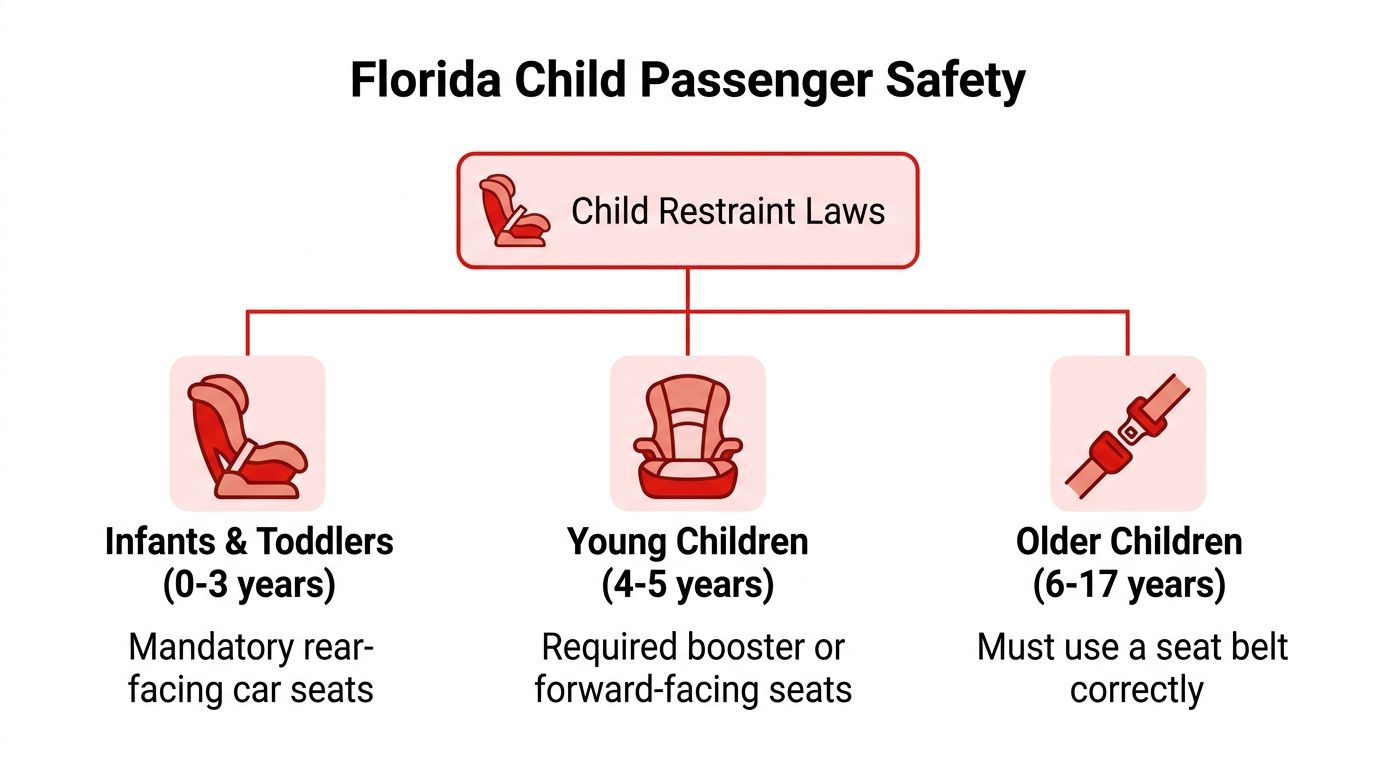
Florida law requires you to secure children appropriately based on age. The practical framework is straightforward:
Infants and toddlers ages 0 through 3: They must be in a crash-tested, federally approved child restraint device.
Children ages 4 through 5: They must be in a separate carrier, an integrated child seat, or a booster seat.
Older children through age 17: They must use a seat belt correctly.
Those basic rules sound simple until real life gets involved. Parents swap vehicles. Grandparents install seats incorrectly. A rideshare driver assumes the passenger is responsible. None of those explanations fixes the citation.
Why child cases create more danger than adult cases
Adult seat belt citations are often fought by examining the stop and the officer’s observations. Child restraint cases add another layer. The officer may claim the child was improperly restrained, in the wrong device, or using the vehicle belt incorrectly.
That means the defense may turn on facts like:
the child’s age,
where the child was seated,
what type of restraint was installed,
whether the device was used properly,
and whether the officer identified the issue correctly.
A bad assumption by the officer should still be challenged. But you should not expect the state to treat this casually.
Protective advice: If the citation involves a child, get legal review immediately. These cases carry more emotional weight and less room for error.
Gig drivers should pay special attention
This point gets ignored in generic articles, and it should not.
For Uber, Lyft, and DoorDash drivers, a single seat belt-related ticket can threaten your ability to keep working. The verified GHSA summary states that a single seat belt ticket can be a career-ender, risking immediate account deactivation for gig economy drivers. That is why “I’ll handle it later” is dangerous in this context.
If your income depends on driving, a child-restraint citation is not just about compliance. It is about account survival.
Common mistakes
Drivers get cited in child restraint cases for reasons that sound minor but are not:
Using the wrong restraint for age: The seat may be approved, but not for that child’s current age group.
Moving too early to a seat belt: Convenience does not control the statute.
Assuming the back seat issue is optional: It is not optional if the law requires a restraint system.
Letting another adult install the seat without checking it: You still answer for the violation if you are the driver.
When legal nuance matters most
These cases often need fact gathering, not excuses. The restraint model, child age, seating position, and officer notes all matter. A lawyer can force the case to rest on proof instead of assumption.
That is especially important if the stop happened in a busy urban area where officers make quick visual judgments under imperfect conditions. In a courthouse setting, those details become the difference between a clean record and a moving violation problem.
How Can You Legally Defend Against a Seat Belt Ticket
You defend it the same way strong traffic cases are defended. You test the state’s proof, challenge weak observations, and use the law with precision.
A seat belt citation is still the state making an accusation. The officer is not the final decision-maker. The court is.
The first defense is the stop itself
In adult Florida seat belt law cases, the stop matters because the officer needed a valid separate reason to pull you over.
If that original allegation falls apart, the seat belt citation may become much harder for the state to sustain. Lawyers examine dispatch timing, officer notes, road conditions, sight lines, and whether the officer’s explanation matches the citation.
A weak stop is not a technical trick. It is a constitutional problem for the state.
Officer visibility is not automatic proof
Officers often claim they could see that the shoulder belt was not across your body. Officers could sometimes, and sometimes they could not.
A defense may focus on:
Vehicle angle: Side view versus rear approach matters.
Lighting: Glare, darkness, and shadows affect visibility.
Interior conditions: Seat position, dark clothing, and pillar placement can obscure details.
Window issues: Tint and reflection can distort what an officer thinks was visible.
That is one reason cookie-cutter defenses fail. These cases depend on facts.
Medical and factual defenses can apply
Not every seat belt citation is fought the same way.
Some drivers may have a valid medical basis that affects seat belt use. Others may have been wearing the restraint but were misidentified. In some cases, the citation language itself creates a defense issue. In others, the officer’s account conflicts with what the vehicle design makes possible.
The right strategy starts with the facts, not with a prewritten script.
Important: A defense is not “looking for loopholes.” A defense is requiring the state to prove what it accused you of doing.
Technical seat belt issues can matter
Modern seat belts are safety systems, not simple straps. According to the IIHS seat belt research page, seat belts reduce fatal injury risk by 45% in cars and 60% in SUVs, and modern systems include pretensioners and force limiters built to specific safety standards. In the right case, a knowledgeable attorney can examine whether belt functionality, replacement equipment, or technical compliance issues affected what happened or how the citation should be viewed.
That does not apply in every case. But when it applies, it matters.
Here is a short explainer on broader ticket defense strategy in Florida: how to beat a traffic ticket in Florida.
What your lawyer should be doing
A serious lawyer should be doing more than filing paperwork.
Your lawyer should be:
Reviewing the basis for the stop.
Examining the officer’s description line by line.
Looking for factual inconsistencies.
Identifying dismissal or reduction opportunities.
Negotiating from a position of preparation, not convenience.
That is how a seat belt ticket gets handled properly.
Why Choose a Ticket Shield Attorney Over an Automated App
Drivers make the second big mistake at this point. The first mistake is paying too fast. The second is handing the case to an app or ticket mill that treats your citation like a barcode.
A seat belt law case is not a subscription problem. It is a legal problem.

What automated services usually miss
An automated platform can intake your citation. It can collect payment. It can send updates. None of that is legal strategy.
What it often cannot do well is:
analyze a questionable stop under Florida’s secondary enforcement structure,
identify line-of-sight weaknesses in the officer’s observation,
tailor a response to your work-related risk,
or communicate with the judgment and urgency your case deserves.
That matters in a live courthouse environment. If your case is moving through a major venue like the Richard E. Gerstein Justice Building in Miami, local process and negotiation judgment matter. A chatbot does not stand next to you in that reality.
What a lawyer-led defense looks like
A dedicated lawyer-led defense gives you things an app cannot replicate:
Automated app or ticket mill | Dedicated lawyer-led defense |
|---|---|
Intake automation | Fact-specific legal review |
Standardized workflows | Strategy based on your citation and stop |
Limited direct access | Direct attorney communication by phone or text |
Volume handling | Judgment, negotiation, and accountability |
Generic updates | Advice tied to your license, insurance, and work risk |
This is the primary distinction. One model processes tickets. The other defends drivers.
Why direct attorney access changes the result
When you can speak directly with your lawyer, your case gets better facts sooner.
You can explain what the officer said. You can clarify whether a child was in the car. You can mention that you drive for Uber or DoorDash. You can identify whether another citation was issued during the same stop. Those details are often what turn a routine handling into a strategic defense.
Middlemen lose facts. Apps flatten facts. Lawyers use facts.
My opinion: Secondary enforcement citations are exactly the kind of cases that suffer when they are pushed through an automated system.
The risk of choosing convenience over defense
Convenience is seductive. So is a low-friction checkout page.
But if the service handling your ticket does not give you direct lawyer access, does not think through the stop, and does not account for your livelihood, you are not buying defense. You are buying administrative comfort.
If you want a fuller comparison, review why choosing a local lawyer over apps matters.
The right choice is simple. Use a lawyer when the outcome affects your license, insurance, and income. A seat belt ticket can do all three.
What Is Your Next Step to Protect Your Driving Record
Your next step is not complicated. Do not pay the ticket before a lawyer reviews it.
That one move preserves your negotiating power.
You now know the core problem. A Florida seat belt law case under Statute 316.614 is not just about a small fine. It can affect your record. It can affect your insurance. If you drive for a living, it can affect your ability to keep earning. And because adult enforcement is secondary, these cases often contain legal angles that drivers completely miss.
Immediate steps to take
Check the deadline: Missing it makes every option worse.
Save everything: Citation, notes, photos, and any related paperwork.
Pull your record: If you already have points or prior tickets, the risk is higher. You can start by learning how to check your Florida driving record for points.
Do not explain the case to the court on your own: Casual statements can lock you into bad facts.
Get legal help quickly: Delay helps the state, not you.
The practical decision
If your goal is convenience, paying the ticket is the fastest option.
If your goal is protecting your license, avoiding record damage, and keeping insurance from getting worse, you fight it. That is the grown-up answer. That is the financially smart answer. And for many working drivers, that is the only answer that makes sense.
At the courthouse, nobody gives you extra credit for handling it alone. Results come from strategy, timing, and pressure applied in the right place.
Bottom line: The only way to effectively handle a seat belt ticket is to treat it like a legal case from day one.
Do not minimize it. Do not outsource judgment to an app. Do not plead it away just because the fine looks small.
If you want a defense focused on No Points, visit Ticket Shield, PLLC for a free consultation. You will work with a lawyer-led Florida traffic defense firm, not an automated app, and you can speak directly with your attorney by phone or text.