Florida Red Light Tickets: Get Expert Defense
Got Florida red light tickets? Understand penalties, points, & defense. Our lawyers protect your record. Get a free consultation today.

If you got a Florida red light ticket, don't just pay it. First find out whether it's a camera notice or an officer-issued citation. That difference controls your risk, your deadlines, and your defense strategy. The wrong move can cost you points, insurance money, and your license.
You open your mail and see a notice with photos of your car. Or an officer handed you a citation at the intersection and drove away while your stomach dropped. Either way, you're probably asking the same question. How bad is this, and what do I do now?
Here's the straight answer. A red light ticket in Florida is never “just a ticket.” It's a legal problem with a clock running.
Florida treats these cases seriously under Chapter 316, especially Florida Statute 316.075, because red light running causes real harm. In 2023, 1,086 people were killed in crashes involving red light runners, and more than 135,000 were injured, according to the IIHS red light running research page. That same source notes a motorist was observed running a red light every 20 minutes on average at some busy intersections. Judges, hearing officers, and prosecutors know that. So should you.
If your case is in Miami-Dade, the people deciding what happens next work in places like the Richard E. Gerstein Justice Building. They aren't interested in excuses. They look for procedure, evidence, credibility, and whether your lawyer knows the difference between a weak case and a defensible one.
Practical rule: Never assume a red light ticket should be handled the same way every time. It shouldn't.
A mailed notice and a roadside citation may involve the same allegation, but they do not create the same legal exposure. That's where many drivers make their first mistake. They panic, pay, and lock in consequences they could have avoided.
Table of Contents
That Sinking Feeling a Red Light Ticket Causes
That sinking feeling is your brain telling you this matters. It does.
A red light ticket can affect your driving record, your insurance, your work, and your freedom to drive without constant stress. If you're a rideshare driver, delivery driver, military service member, or professional who can't waste a morning in court, the problem gets bigger fast.
Most drivers make one of two bad choices. They ignore the ticket because they're overwhelmed. Or they pay it because they want it over with. Both can backfire.
Why this hits harder than most drivers expect
Florida traffic law isn't casual about signal violations. Under Chapter 316, the state separates civil camera enforcement from moving violations, but both demand attention. One can put your record at risk right away. The other can become much worse if you miss the deadline.
The emotional part is real too. You replay the intersection in your head. Was the light yellow? Did the car behind you make it unsafe to stop? Did the camera catch the full sequence or only the part that hurts you? Those questions matter. They're not excuses. They're defense issues.
You don't need to guess what the ticket means. You need to identify what kind of ticket it is and respond before the deadline controls you.
What worried drivers should do first
Start with the paperwork. Read every line.
Look for whether you received a Notice of Violation in the mail or a roadside citation written by an officer. Check the date. Check the location. Check the statute listed. If you already tossed the envelope aside, pull it back out today.
Then stop talking yourself into paying it “just to move on.” That shortcut often becomes the expensive choice later.
Are All Florida Red Light Tickets the Same?
No. And if you treat them the same, you can hurt your case.
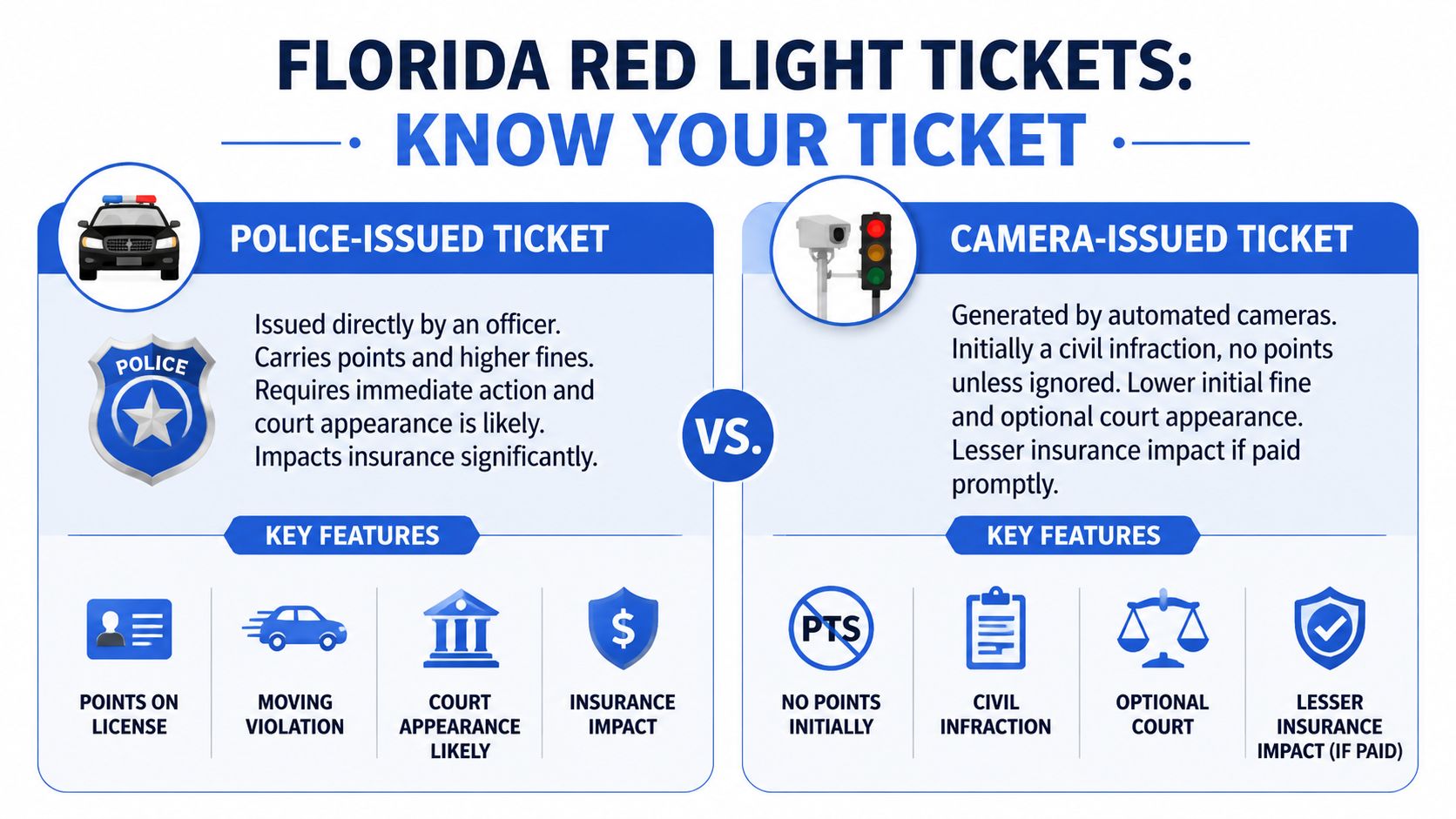
Florida red light tickets usually fall into two very different categories. One comes from an officer. The other comes from a camera system. They may sound similar, but they operate under different rules, different procedures, and different defense strategies.
As of early 2022, 338 communities across the U.S. were using red light cameras, and studies in large cities with camera programs found a 21% reduction in the rate of fatal red light running crashes, according to the U.S. DOT ITS knowledge resource summary. That explains why automated enforcement is common enough that Florida drivers keep running into it.
Why the ticket type changes everything
An officer-issued ticket is about what a police officer says happened and what the officer can prove. The defense often turns on observation, angle, timing, traffic conditions, and whether stopping safely was possible.
A camera-issued ticket is different. The case depends on the images, the video, the system trigger, the notice, and the municipality's compliance with required process. That's why a canned response from an app or ticket mill is risky. They often treat every red light ticket like the same administrative nuisance. It isn't.
If you want a deeper breakdown of mailed notices and how they work, review this guide on Florida red light camera tickets.
Camera ticket vs officer-issued ticket
Factor | Red Light Camera Ticket (Notice of Violation) | Officer-Issued Ticket (Uniform Traffic Citation) |
|---|---|---|
Legal nature | Civil infraction | Moving violation |
Who issues it | Automated enforcement system | Law enforcement officer |
Points | No points initially | Points can apply |
Driver identification | Usually tied to the vehicle owner | Tied to the driver stopped by the officer |
Hearing path | Administrative or civil contest route | Court appearance or election process |
Typical defense focus | Camera evidence, timing, notice defects, system reliability | Officer observation, line of sight, traffic conditions, necessity |
That table is the first decision point in your case. If you misread the type of ticket, you can miss the right defense entirely.
What Are the Real Penalties and Insurance Costs?
A red light ticket can look cheap on paper. Then it starts costing you in places the fine never mentions.
An officer-issued citation can put points on your license. A camera notice starts as a civil penalty with no points. That difference matters, but do not stop your analysis there. The wrong response to either one can cost far more than the amount printed on the ticket.

The fine is usually the smallest problem
With an officer-issued ticket, the immediate risk is obvious. Points. Insurance increases. A worse driving record the next time your carrier reviews your file. Paying too fast can turn a defendable case into a lasting expense.
A camera ticket creates a different trap. Drivers see "no points" and assume it is harmless. That is a mistake. If you miss the deadline, ignore the notice, or handle the challenge the wrong way, the case can escalate and become harder to contain.
If you want a fuller picture before deciding whether to pay or fight, review this breakdown of the cost of a ticket for running a red light.
Key takeaway: The cheapest-looking option can be the most expensive one.
Insurance is only part of the problem
Your insurer is not the only audience that matters.
Employers check motor vehicle records. Delivery and rideshare platforms review driving history. Security-sensitive jobs care about repeated traffic issues. If driving is part of how you earn a living, a red light ticket is a work problem, not just a court problem.
That is why strategy must match the ticket type. An officer-issued case calls for a defense built around the officer's observations and the driving conditions. A camera case calls for a close review of the images, timing, notice, and video quality. If the footage is unclear, lawyers may even compare forensic video software to assess whether the recording is strong enough to support the allegation.
Why payment can be the expensive choice
Payment closes doors.
For an officer-issued ticket, it can mean accepting points and the insurance consequences that follow. For a camera ticket, it can mean giving up defenses tied to notice defects, timing issues, or weak image evidence. These are not the same cases, and they should not be handled with the same canned response.
That is where lawyer-led representation beats a ticket app. A ticket mill pushes volume. A lawyer studies what kind of ticket you received, what proof exists, what deadlines control, and which outcome protects your license and record. That is how you cut the risk before it spreads.
How Can You Defend Against a Red Light Ticket?
You defend it by attacking the weak point in the specific case you received. Not by using a generic script.
That means the defense for a camera notice should not look like the defense for an officer-issued citation. Different proof. Different pressure points. Different mistakes by the government.

Officer-issued tickets require a factual defense
When an officer writes the ticket, start with the human side of the evidence.
Was the officer in a position to see your tires cross the stop line after the red phase began? Was another vehicle blocking the view? Did weather, traffic, or the angle of the intersection affect what the officer could observe? Was it unsafe to stop suddenly because of a vehicle behind you?
Those are real defense themes. So is identifying inconsistency between the officer's notes and the roadway layout. A lawyer can also look at whether the allegation matches the statute cited and whether the driving pattern supports a lesser or non-moving resolution.
Camera tickets require a technical defense
Camera cases turn on system reliability and process. The technology can be challenged.
The verified data allows this point clearly. Red light cameras use sensor-camera integration that can be challenged, and a defense can demand raw sensor logs and signal timing diagrams. Malfunctions such as a truncated yellow-light phase under 3.5 seconds or sensor drift can invalidate a citation under Florida law, based on the verified summary linked to Direct Auto's explanation of red light camera operation.
That matters because camera evidence looks polished. Polished is not the same as infallible.
If you want examples of practical defense angles drivers raise in these cases, this guide on how to beat a red light ticket is a useful starting point.
A camera case should be treated like evidence review, not customer service. Ask what triggered the system, what the video actually shows, and whether the notice matches the required procedure.
Evidence wins these cases
Bring proof. Don't rely on memory alone.
Useful evidence can include:
Dashcam footage that shows the light phase, traffic flow, or emergency conditions.
Intersection photographs taken from the driver's approach, especially if signs, lane markings, or sight lines are poor.
Maintenance and timing records obtained through formal requests.
Witness information from passengers or nearby drivers.
Video analysis tools when the footage quality becomes the central issue. If you're trying to understand how professionals examine frame sequence, motion, and authenticity, you can compare forensic video software before deciding what kind of expert review may help.
A short video overview can also help you understand how these defenses are built in real life.
What Is Your Step-by-Step Plan to Contest a Ticket?
If you've got the ticket in front of you right now, follow a sequence. Don't improvise.
Under the verified data tied to Florida Statute 316.075 and 316.0083, an officer-issued red light ticket is a moving violation that carries 3 points and requires a court appearance or election, while camera tickets are civil infractions with no points, but failure to pay within 30 days can lead to a uniform traffic citation and license suspension, as stated in the verified summary connected to this red light ticket classification reference.
Immediate steps to take
Identify the ticket type: Is it a mailed notice or an officer-issued citation? This controls the process.
Check the deadline immediately: A camera notice can become much worse if you miss the response window.
Do not pay before reviewing defenses: Payment can close off options.
Save every document: Keep the envelope, notice, citation, and any online access instructions.
Preserve your evidence: Download dashcam footage before it overwrites. Save app trip logs if you were working.
Document the intersection: Go back safely and photograph lane markings, signage, view obstructions, and signal placement.
Look up the citation correctly: If you need help finding the case details, use a Florida-specific guide for citation number lookup.
Missed deadlines ruin good defenses. Fast action protects leverage.
What the process looks like in Florida
For an officer-issued ticket, you're dealing with a moving violation path. That usually means making an election, preparing for court, and deciding whether to contest the charge, seek a reduction, or pursue another record-protective outcome.
For a camera ticket, the first stage is usually civil and document-driven. You review the notice, inspect the images and video if available, and decide whether to pay, challenge, or contest based on the facts and technical issues.
The important point is simple. The process is not one-size-fits-all.
What to gather before you speak to counsel
Build a small file. It doesn't need to be fancy.
Include the ticket, photos of the approach to the intersection, your own written memory of what happened, screenshots of any available online evidence, and any work-related context if your livelihood is affected. If you were driving for an app, note the trip status and timing. If someone else was using the vehicle, document that carefully.
A clean, organized file helps your lawyer spot defenses faster and keeps you from missing details later.
Why Is a Lawyer-Led Firm Your Strongest Shield?
Because these cases turn on judgment. Not automation.
Red light tickets look simple from the outside. They aren't. The paperwork may be short, but the strategy isn't. Someone has to decide whether your case should be attacked on proof, procedure, calibration, notice defects, local practice, or negotiated resolution. A chatbot can't do that well. Neither can a ticket mill built around intake staff and scripts.

You need strategy, not automation
A lawyer-led model matters because a real attorney sees the split between camera and officer-issued cases immediately. That changes the defense plan from the first review.
It also matters locally. Procedure and expectations can vary by courthouse and county. A case in Miami-Dade isn't handled in a vacuum. It lives in a real Florida system with real clerks, hearing officers, judges, calendars, and habits. That local awareness helps.
One available option for drivers dealing with either kind of citation is Ticket Shield's red light ticket lawyer service, which is structured around attorney handling rather than middlemen.
Direct access to your lawyer matters
When you're worried about points, insurance, or losing driving privileges, you shouldn't be stuck explaining the facts over and over to non-lawyers.
You should be able to text or call your attorney, ask whether the evidence is worth challenging, and get a direct answer. That's especially important when the facts are unusual. Maybe the stop was unsafe. Maybe the image doesn't clearly identify the event. Maybe the notice arrived late enough to create procedural questions. Those aren't things you want filtered through three layers of intake.
Real defense starts when a lawyer reads the ticket, studies the evidence, and chooses a plan that fits your exact facts.
That's the difference between legal representation and ticket processing.
Protecting Your License Is Not a DIY Project
You can change your own oil. You can't casually outmaneuver a traffic case that affects your record, insurance, and job.
Red light tickets push drivers into bad decisions because the paperwork looks manageable. It isn't. One type of ticket threatens points and insurance exposure. The other looks lighter at first, then becomes dangerous when the deadline passes or the case escalates. Both require fast, informed choices.
If you're a gig driver, a service member, a commuter with a professional license, or just someone who can't afford another mark on your record, this is not the moment to gamble on a quick click, a chatbot, or a one-size-fits-all app.
Get the ticket reviewed. Get the right strategy. Protect the record before the damage is locked in.
If your goal is No Points, don't wait and don't pay blindly. Visit Ticket Shield, PLLC for a free consultation and find out the right way to fight your Florida red light ticket before it costs you more than the fine.