Reckless Driving Lawyer Florida: Defense That Protects
Reckless Driving Lawyer Florida. Need a reckless driving lawyer in Florida? Learn the statutes, penalties, and defenses that protect your license, record

The lights flash behind you, your hands tighten on the wheel, and an officer walks back to the window with a citation. You may be thinking about points, insurance, and whether paying the fine will make the problem disappear. Then you search for a “reckless driving lawyer Florida” drivers can trust because the citation says something far more serious than speeding.
That reaction is justified. Under Florida Statute § 316.192, reckless driving is a criminal offense, not an ordinary civil traffic infraction. You shouldn't send payment before a Florida lawyer reviews the charge, the officer's observations, the alleged conduct, and the court handling your case.
Table of Contents
The Moment the Ticket Becomes a Criminal Case
The citation is in your hand. You're still sitting in the car, but the consequences have already moved beyond the roadside. A routine traffic ticket usually triggers a decision about payment, traffic school, or a contest. A reckless driving charge demands a different question: what can the State prove in criminal court?
Florida treats reckless driving as driving with willful or wanton disregard for the safety of persons or property under Florida Statute § 316.192. The charge is prosecuted as a criminal misdemeanor unless aggravating facts raise it to a felony. That classification affects your record, your negotiations, and the way you should respond.
You may have been accused of excessive speed, weaving, racing, abrupt braking, or another maneuver the officer viewed as consciously dangerous. The label on the citation doesn't establish guilt. The State still has to prove the required mental state and the surrounding facts beyond a reasonable doubt.
Practical rule: Don't treat a criminal charge like a pay-by-mail ticket. Paying can surrender an opportunity to challenge the accusation or negotiate a result that protects your license.
A criminal case also creates practical pressure. The prosecutor may review the officer's report, video, witness statements, roadway conditions, traffic density, and any crash information. A lawyer needs time to examine those materials before the first meaningful court decision, not after you've already accepted the charge.
Your first call should be to a Florida traffic defense attorney who handles the actual court where the case was filed. A ticket mill or automated app may collect your information efficiently, but collection isn't defense. You need someone who can evaluate evidence, negotiate with the assigned prosecutor, and make a deliberate decision about trial strategy.
What Florida Statute 316.192 Actually Says
Section 316.192 uses a demanding phrase, “willful or wanton disregard for the safety of persons or property.” In practical terms, prosecutors try to connect the driver's conduct to a conscious disregard of a known safety risk. Speed may be part of that argument, but the surrounding circumstances matter.
An officer may point to weaving through traffic, racing, fleeing, repeated dangerous lane changes, abrupt braking, or a street takeover maneuver. The question isn't whether the driving looked poor. The question is whether the evidence supports criminal recklessness rather than ordinary carelessness.
The charge has escalating tiers
Florida law separates the offense according to prior convictions and consequences:
Charge Level | Statutory Trigger | Classification | Maximum Penalty |
|---|---|---|---|
First conviction | Reckless driving without the listed aggravating result | Second-degree misdemeanor | Up to 90 days in jail and a $25 to $500 fine |
Second or subsequent conviction | A later reckless driving conviction | Exposure increases under the statute | Up to 6 months in jail and a $50 to $1,000 fine |
Property damage or injury | Reckless driving causes property damage or any injury | First-degree misdemeanor | Up to 1 year in jail and a $1,000 fine |
Serious bodily injury | Reckless driving causes serious bodily injury | Third-degree felony | Up to 5 years in prison and a $5,000 fine |
These classifications come from the statutory text governing Florida reckless driving. The clerk's docket won't treat every case identically. A first conviction without injury is not the same case as one involving property damage, and a serious-bodily-injury allegation can change the case from a misdemeanor to a felony.
The statute also includes a $5 surcharge on any fine imposed under the section, with the money directed to the Emergency Medical Services Trust Fund, as stated in § 316.192's surcharge provision. That amount isn't the central defense issue, but it illustrates why you need to examine the complete financial consequence instead of focusing only on the headline fine.
Penalty Exposure Beyond the Headline Fine
A reckless driving conviction is a criminal record problem, a license problem, and an insurance problem. The fine on the citation may be the smallest part of what you pay over time. Your defense must protect the outcome you carry after court, not just the amount due at disposition.
Criminal record and sentence exposure
A conviction can appear in employment screening, raise professional licensing questions, complicate rental applications, and influence how a judge views a later case. A prior reckless driving conviction can also increase the statutory exposure attached to a subsequent case.
The charge becomes more serious when the alleged conduct caused property damage, injury, or serious bodily injury. Those classifications affect the possible sentence and the prosecutor's negotiating position. County practice matters too. The way a prosecutor evaluates a first case can differ from one courtroom to another across Florida's 67 counties, so a ticket-mill promise of a standard result is not a defense plan.
Fines and statutory additions
For a first conviction, the base fine range is $25 to $500. A second or subsequent conviction carries a $50 to $1,000 range under Florida's reckless driving statute. Review the full Florida reckless driving penalty guide before treating the printed fine as the complete cost.
The statute also adds the EMS surcharge described earlier. Court costs and other financial obligations can depend on the charge and final disposition. Paying quickly may close the citation, but it can leave the conviction, points, and insurance consequences in place. A lawyer should evaluate whether a negotiated result protects more than your immediate wallet.
License points
Florida assigns 4 points to a reckless driving conviction. The Florida Department of Highway Safety and Motor Vehicles points schedule explains the administrative consequences separately from the criminal sentence.
That separation matters. Avoiding jail does not erase license exposure. Points remain relevant during the applicable driving-record period, combine with other violations, and can push you toward suspension problems if recent citations are already on your record. Your lawyer should review the timing and history, not treat this charge as an isolated ticket.
Insurance classification
An insurer may treat a reckless driving conviction as a serious risk marker. One insurance industry analysis reports an average increase of about $981 per year for a Florida reckless driving citation, with higher premiums potentially continuing beyond the court case, as discussed in this Florida insurance analysis.
Penalty Column | What It Costs You | Typical Range |
|---|---|---|
Criminal exposure | Record and sentencing consequences | Depends on the charge tier |
Fine and surcharge | Base fine plus statutory EMS surcharge | $25 to $500 for a first conviction, plus the surcharge |
License points | Administrative points on your Florida record | 4 points |
Insurance impact | Premium and risk-classification consequences | About $981 per year on average, according to the cited analysis |
A lawyer-led defense addresses these connected costs. A ticket mill usually sells a transaction.
Defense Strategies a Skilled Lawyer Brings
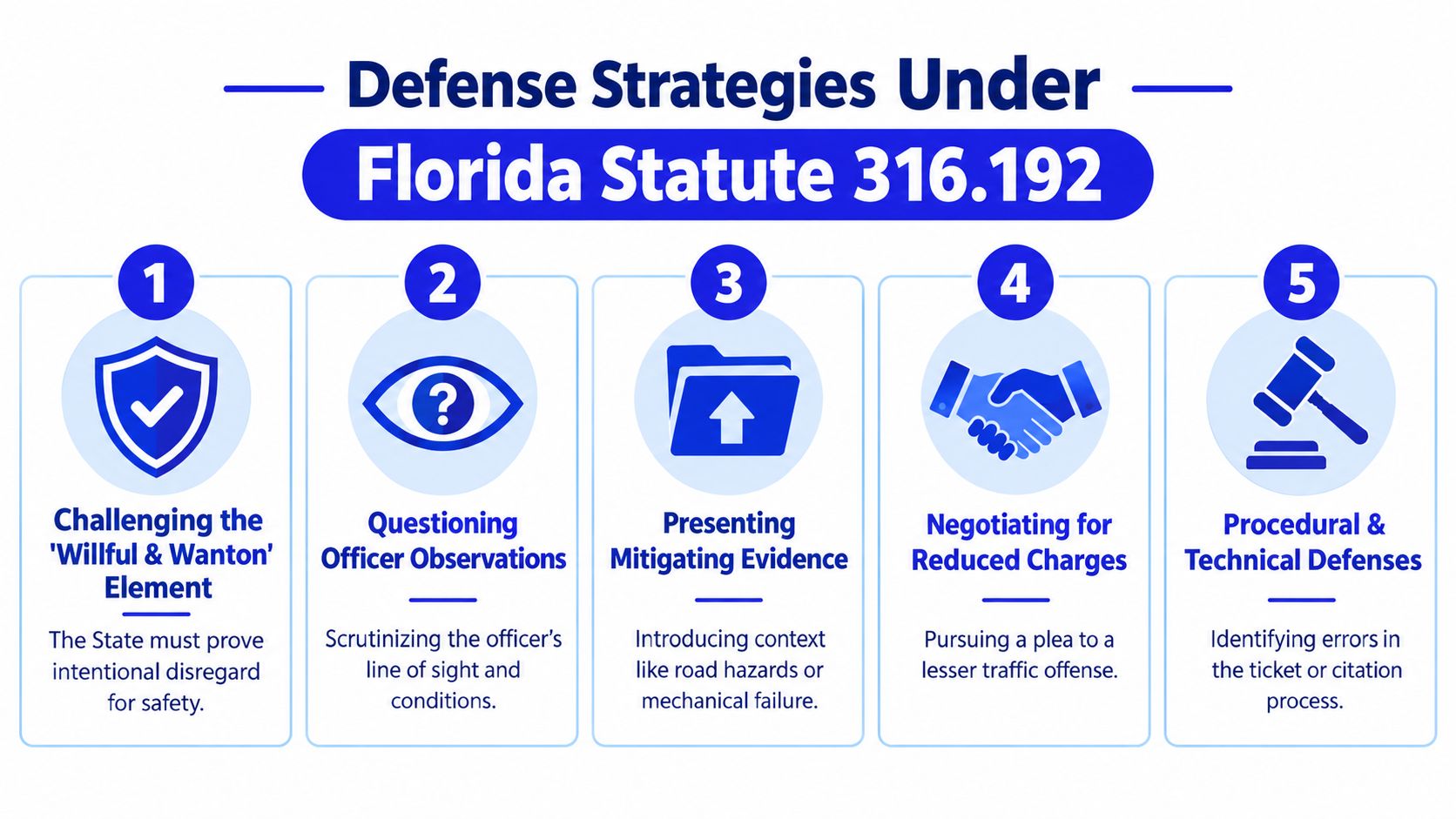
The first defense question is whether the State can prove willful and wanton disregard, not merely poor judgment. The officer's conclusion is evidence to examine, not a substitute for proof beyond a reasonable doubt.
Attack the mental-state element
Your attorney can separate careless driving from criminal recklessness. A momentary mistake, confusing roadway design, sudden hazard, or isolated maneuver may not prove conscious disregard. The defense should focus on what happened, what you could see, the road conditions, and whether the evidence supports the required state of mind.
Test the officer's observations
Speed estimates, pacing, radar or LIDAR use, lighting, traffic density, sight lines, and distance all matter. Video from a dashboard camera, nearby business, or passenger can contradict the report or provide context the report leaves out.
A lawyer should also examine whether the alleged speed was measured correctly and whether the officer's description accurately reflects the sequence of events. Small inconsistencies can matter when the State's case depends on interpretation.
Challenge the stop and procedure
The legality of the stop, the basis for the citation, and the handling of evidence may create separate issues. Your lawyer can review the citation, reports, recordings, and available documentation for procedural errors or weaknesses.
Negotiate a result that protects the license
A reduction to a lesser traffic offense, a withhold of adjudication where legally available, or dismissal after negotiated conditions may be more valuable than just minimizing the fine. The right option depends on the evidence, your record, the county, and your priorities.
The discussion of ticket dismissal representation reflects the central point: negotiation works only when counsel understands the facts and can present a credible reason for the prosecutor to change course.
Prepare for trial when settlement isn't enough
Trial may be appropriate when the evidence is weak, the charge is materially overstated, or the proposed resolution creates unacceptable license or record consequences. A lawyer should explain the risks plainly, then let you make the final decision with a complete understanding of the alternatives.
Why Direct Attorney Access Changes the Outcome
You shouldn't have to explain a criminal charge to a chatbot, a call-center employee, and then an unknown lawyer who receives the file later. Direct attorney access changes the quality of the information exchanged, especially when the facts depend on roadway conditions, video, witness accounts, or an officer's exact words.
A lawyer-led service lets you communicate with the attorney handling the case by phone or text. You can send the citation, identify the court, explain your priorities, and ask who is negotiating the resolution. That direct line also makes it easier to correct a misunderstanding before it affects strategy.
Feature | Direct Attorney, Ticket Shield | App or Ticket Mill |
|---|---|---|
Case communication | Direct phone or text access to the attorney | Often routed through staff, automated chat, or a call center |
Court knowledge | Attorney can work with the assigned county court and prosecutor | Service may refer or assign the case without meaningful local continuity |
Plea decisions | Attorney evaluates reductions, withholds, dismissal, or trial | Client may receive standardized updates or limited strategic explanation |
Evidence review | Attorney can discuss reports, video, witnesses, and context | Intake may focus on citation data rather than defense theory |
Trial decision | You make the decision after legal advice from counsel | The person communicating with you may not be the lawyer appearing |
Local familiarity matters across Florida's counties. The attorney who knows the courthouse, assigned prosecutor, and available resolutions can make a more informed recommendation than an automated workflow.
A comparison of local lawyer representation and app-based services makes the operational distinction clear. This isn't merely a pricing issue. It concerns who understands your facts, who advocates for you, and who answers when the case changes.
How Representation Works From Call to Closure
Your first conversation should produce clarity, not a sales script. You provide the citation, the county, the court information, and what matters most to you. That may be avoiding a conviction, protecting your license, limiting insurance consequences, or pursuing a dismissal.
The first review
A lawyer can review a photograph of the citation by phone or text, confirm the charge, identify the court, and discuss the response requirements. You should also preserve dashcam footage, photographs, witness information, and any messages or documents connected to the event.
The next step is legal analysis. Counsel reviews the driving history and relevant recent points, then develops a defense theory based on the report, available recordings, roadway context, and the statutory elements. You shouldn't make admissions to the prosecutor or try to negotiate the case yourself before that review.
Representation and negotiation
After you retain counsel, the attorney can file a written appearance, obtain available discovery, and communicate with the prosecutor. The lawyer may pursue dismissal, reduction, a withhold where available, or another resolution that addresses your stated priorities.
Ticket Shield states that over 99% of its clients avoid appearing in court, according to the publisher information provided for this service. That doesn't guarantee a result in your case, and it doesn't eliminate the need for preparation. It means the attorney often handles routine appearances while you receive updates and guidance.
Cases commonly move through a period of review, discovery, negotiation, and court action rather than resolving instantly. A practical planning range is 30 to 120 days, but the actual schedule depends on the county, court availability, discovery, prosecutor response, and whether litigation becomes necessary.
If trial is required, your attorney should prepare you for testimony issues, exhibits, witness examination, and the State's proof. The goal isn't to rush closure. The goal is to reach a defensible result without sacrificing your license or record just because the process is inconvenient.
The Florida criminal defense consultation process should give you a clear explanation of what happens next, who handles each task, and what decisions remain yours.
County Considerations Across Florida's Busiest Courts
Florida doesn't operate as one uniform courtroom. The legal standard comes from state law, but practical negotiations occur in local courts with different calendars, prosecutors, diversion practices, and judicial expectations.
A lawyer should confirm the actual venue before promising a strategy. The same charge can require a different negotiation plan in Miami-Dade than in Hillsborough or Duval because the assigned prosecutor and local process may differ.
County | Main Court | Common Reduction | Diversion Available | Typical Outcome |
|---|---|---|---|---|
Miami-Dade | Richard E. Gerstein Justice Building | Depends on the evidence and prosecutor review | Must be confirmed for the specific case | County-specific negotiation or litigation |
Broward | Broward County Judicial Complex | May depend on driving facts and record | Must be confirmed with the assigned court | Resolution shaped by local procedure |
Palm Beach | Main Judicial Center in West Palm | Depends on charge details and prior history | Must be evaluated individually | Negotiated disposition or contested case |
Hillsborough | Edgecomb Courthouse in Tampa | Evidence-based reduction may be pursued | Availability depends on eligibility and local practice | Counsel negotiates with the assigned prosecutor |
Orange | Orange County Courthouse in Orlando | Depends on the citation, report, and record | Must be confirmed locally | Local court resolution or trial preparation |
Duval | Duval County Courthouse in Jacksonville | Depends on facts and prosecutorial position | Must be evaluated for the individual case | Negotiated or litigated disposition |
Don't rely on a generic online promise that a particular county always offers traffic school, a withhold, or a reduction. Eligibility can depend on the charge, prior history, alleged damage or injury, and the prosecutor's position. A Florida-licensed attorney with active work in the venue can tell you what is realistic after reviewing the file.
A ticket mill's standardized workflow becomes a liability. A referral service may forward the case to someone else, while a local lawyer can identify the courthouse, track the assigned prosecutor, and adapt the negotiation to local practice.
Protect Your License With a Florida Reckless Driving Lawyer
You already know the citation is serious. The State may treat it as a criminal case, Florida assigns 4 license points to a reckless driving conviction, and insurance guidance identifies a potential average increase of about $981 per year. Those consequences can matter long after the court date.
Act before the response deadline. Gather the citation, save dashcam or witness evidence, write down what happened while your memory is fresh, and avoid discussing the facts with anyone who may later become a witness or adverse source. Then speak with a Florida reckless driving lawyer who handles the specific county where the case is pending.
You need direct communication with the attorney, not a corporate answering service. You need counsel who can review the evidence, appear in the actual court, negotiate a reduction or dismissal when appropriate, and tell you when trial is worth the risk. Ticket Shield, PLLC describes a lawyer-led model with attorney communication by phone or text and representation across Florida's 67 counties, but your case still requires an individual review.
Don't assume paying is the easiest path. It may be the fastest way to accept consequences you haven't measured, including a criminal record, license points, and higher insurance classification. Every day without counsel gives the prosecution more time to organize its file while you remain exposed.
Visit Ticket Shield, PLLC for a free consultation about your Florida reckless driving charge. You'll communicate directly with a lawyer who can evaluate your case, pursue the strongest available resolution, and work toward the ultimate goal of achieving “No Points” on your license.