
Reckless Driving in Florida: A 2026 Defense Guide
Charged with reckless driving in Florida? Understand the criminal penalties, fines, and license risks. Ticket Shield's lawyers can protect your record.
You got pulled over. The officer didn't hand you a routine citation. He wrote reckless driving.
That changes everything.
In Florida, this charge puts you in criminal traffic court. You're suddenly dealing with exposure that can affect your record, your license, your insurance, and your job. If you drive for Uber, Lyft, DoorDash, or any company that checks motor vehicle history, the risk is immediate. If you're a professional, a student, in the military, or applying for housing, a criminal traffic conviction can follow you far beyond the stop itself.
Nationally, reckless driving contributes to a serious safety problem. Approximately 1.2 million people are injured every year in the United States in connection with reckless driving behavior, according to ZipDo's reckless driving statistics summary. That broader context matters because prosecutors and judges don't treat this charge lightly.
Table of Contents
Your Reckless Driving Charge Is a Crime Not a Ticket
You may still be telling yourself it was just a bad stop, a misunderstanding, or an officer who overreacted. That instinct is common. It's also dangerous.
A reckless driving charge in Florida is not the same as a speeding citation you can pay and forget. It's a criminal allegation. That means the wrong move early can make the case harder to fix later. Paying the wrong thing, missing court, speaking too freely, or trusting a generic app can create damage that a lawyer then has to spend time undoing.
What makes this different
A standard infraction usually turns on a narrow issue. A criminal traffic charge is broader. The prosecutor reviews conduct, statements, officer observations, video, crash details if any exist, and whether the facts support a misdemeanor offense under Chapter 316.
If you want a plain-English explanation of why criminal traffic charges are different from ordinary citations, read this breakdown of criminal traffic violations in Florida.
Practical rule: Treat the paper you received like a court case from day one, because that's exactly what it is.
What you should do right now
Your first steps matter more than most drivers realize.
Stop talking about the facts casually: Don't post about it. Don't text admissions. Don't try to explain it to anyone who isn't helping defend you.
Preserve what exists: Save dash cam footage, location history, photos, witness names, and the citation itself.
Check the court date immediately: Missing a criminal traffic hearing can create a separate problem.
Get legal review early: The best defense work often starts before the first appearance, not after a conviction risk has hardened.
Florida courts see reckless driving as a public safety issue. In 2021, the United States recorded nearly 43,000 traffic deaths, the highest number in 16 years, and 3,522 people were killed in crashes involving at least one distracted motorist, according to this discussion of the national traffic fatality spike. That atmosphere affects how seriously these cases are charged and prosecuted.
You need a defense strategy, not a payment portal.
What Legally Defines Reckless Driving in Florida
Florida doesn't convict people of reckless driving just because an officer thought the driving looked bad. The legal standard is tighter than that. That's where real defense work begins.
The Statutory Standard Matters
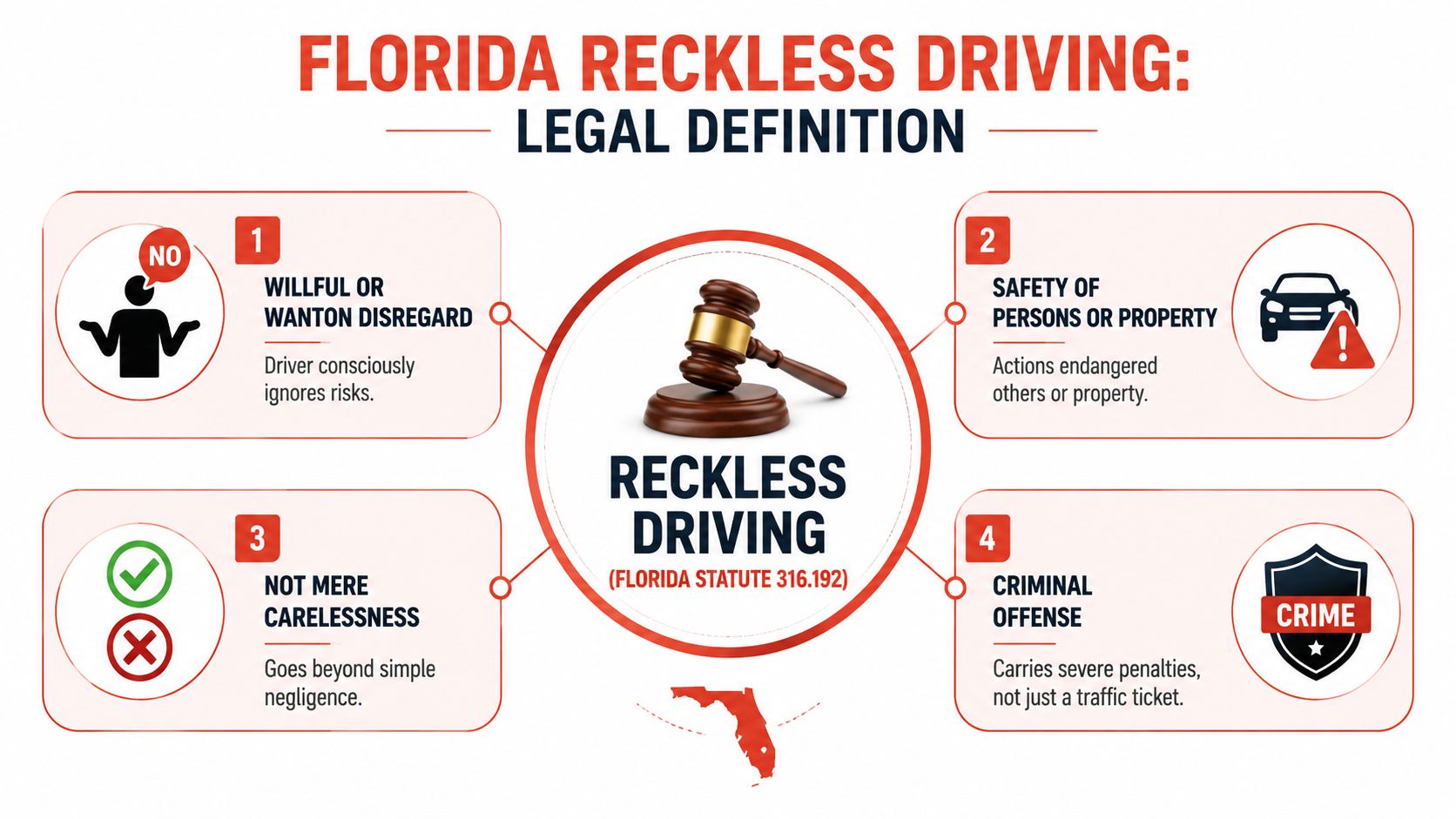
Under Florida Statute § 316.192, reckless driving means driving in “willful or wanton disregard for the safety of persons or property.” The same statute makes the point even sharper. “Willful” means intentionally and purposely. “Wanton” means conscious indifference to consequences while knowing damage is likely.
That language is your opening, not your defeat.
Why? Because the state has to prove more than a mistake. More than poor judgment. More than a moment of inattention. The prosecutor has to show conduct that crosses into conscious disregard.
For a deeper look at how that statute works in real cases, review this explanation of Florida's reckless driving statute.
Why Intent Is the Battlefield
Here's the simplest analogy. Carelessness is spilling coffee because you hit a bump. Recklessness is swinging a full cup around near someone's face and ignoring the obvious risk.
That distinction matters in court. The officer may describe your driving with loaded words. The prosecutor may repeat those words. But labels don't prove statutory intent. Facts do.
A defense lawyer looks closely at issues like these:
Driving context: Was traffic light, visibility clear, and the road open, or does the officer's description exaggerate the danger?
Duration of the conduct: Was this a sustained pattern, or a brief event interpreted in the worst possible way?
Video and body cam review: Does the footage match the report?
Statements: Did the driver say anything that the state will try to frame as an admission?
A reckless driving case often turns on whether the state can prove mindset from limited observations in a stressful, fast-moving event.
That's why drivers hurt themselves when they assume the charge is automatic. It isn't. The statute is serious, but it also creates a clear legal target for the defense. If the state can't prove intentional or consciously indifferent conduct, the charge is vulnerable.
Common Examples of Reckless Driving vs Careless Driving
Police officers and prosecutors usually build a reckless driving case around behavior they believe shows deliberate danger. Some fact patterns get charged more aggressively than others, especially when the report describes erratic movement, high speed combined with other conduct, or danger to nearby drivers.
Conduct That Often Triggers a Criminal Charge
Common examples include:
Aggressive weaving: Cutting across lanes without adequate space, especially in traffic.
Street-racing type behavior: Rapid acceleration, competitive driving, or obvious show-off driving.
Ignoring traffic control devices dangerously: Running lights or signs in a way that allegedly endangers others.
Hostile road behavior: Tailgating, brake-checking, or forcing another vehicle off line.
Fleeing police: Under Florida's reckless driving provision as reproduced by Justia, fleeing a law enforcement officer in a motor vehicle is reckless driving per se, which means the state doesn't need extra proof of dangerous driving once the act of fleeing is established.
That last category is especially important. It removes one of the arguments a prosecutor would otherwise have to build.
If you want a straightforward explanation of how Florida separates the two offenses, read this comparison of careless and reckless driving.
Reckless Driving vs Careless Driving in Florida
The charge many drivers hope to reach is careless driving, because it's a civil infraction rather than a criminal offense. That difference can change the outcome of your record and the advantage in your case.
Factor | Reckless Driving (Criminal) | Careless Driving (Civil) |
|---|---|---|
Legal nature | Criminal traffic offense | Non-criminal traffic infraction |
Required proof | Conduct alleged to show willful or wanton disregard | Driving that falls below ordinary safe care |
Court exposure | Misdemeanor penalties can apply | Typically handled as a civil citation |
Record impact | Criminal consequences can follow the case | Lower long-term stigma than a criminal conviction |
Defense focus | Attack intent, observations, legal sufficiency, and negotiations | Contest citation facts or seek ordinary traffic resolution |
Getting a reckless charge reduced to a civil offense is often the difference between damage control and lasting fallout.
Drivers lose sight of that. They focus on whether they were “really reckless” in a personal sense. The court focuses on whether the state can prove the criminal elements. Your lawyer focuses on how to stop a criminal outcome.
That is the correct framing.
The Immediate Court Penalties for a Conviction
Many people finally understand the stakes with a reckless driving conviction. Criminal penalties arrive first. The bill comes later.
Early in the case, you need to know what the judge has authority to impose.
What the Judge Can Do
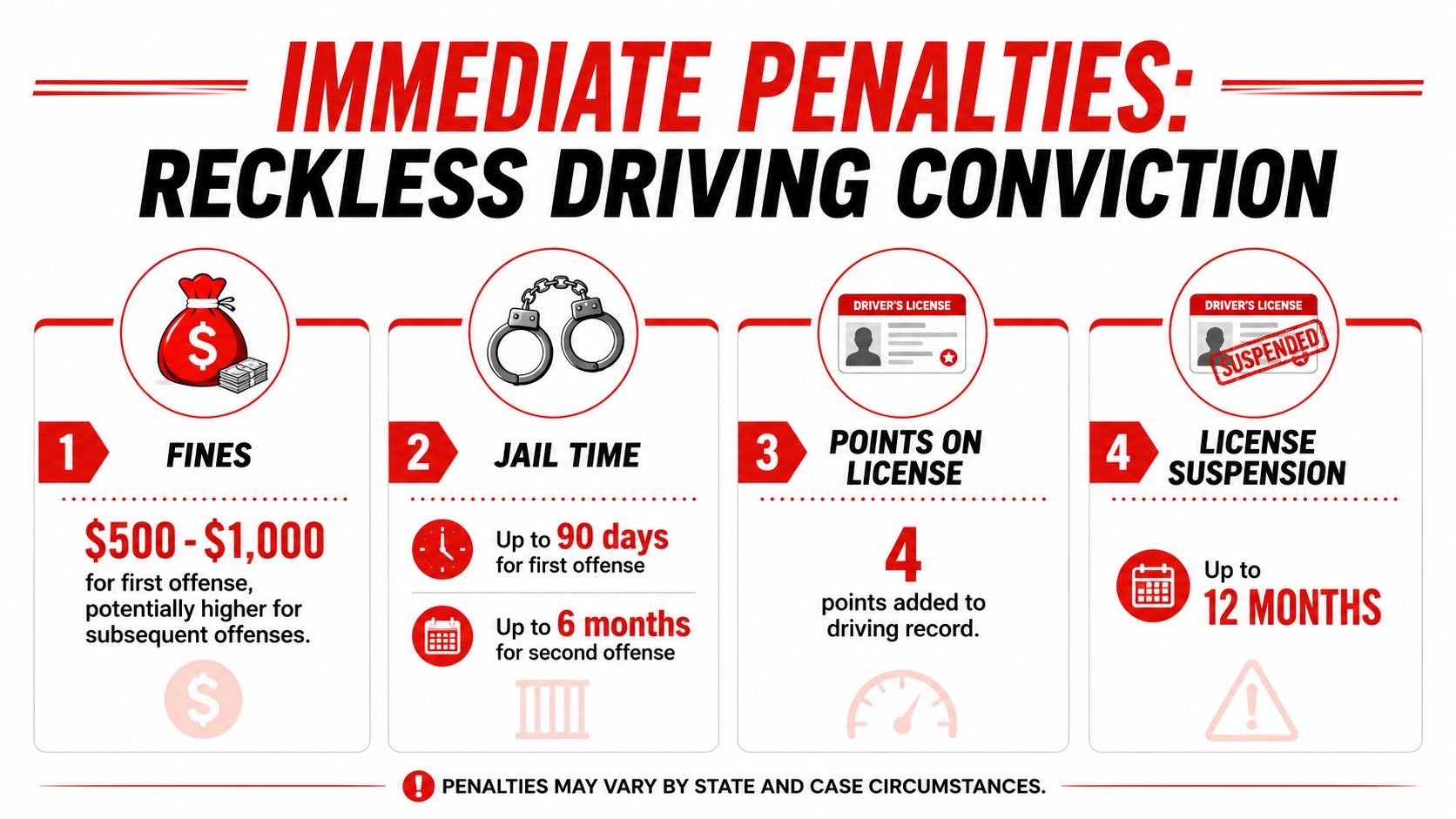
According to this summary of Florida reckless driving penalties, a first-time reckless driving conviction in Florida is a second-degree misdemeanor with up to 90 days in jail and a fine up to $500. If the conduct causes property damage, it becomes a first-degree misdemeanor with up to 1 year in jail and a $1,000 fine.
Those numbers are enough to reset how you should think about the case.
The same verified penalty framework also recognizes that a later reckless driving conviction can expose a driver to more severe punishment, and the court's discretion matters. Once a judge sees aggravating facts in the file, the conversation changes quickly.
For a dedicated breakdown of the penalties involved, see this Ticket Shield article on reckless driving conviction penalties.
Why Court Without Counsel Is Risky
A prosecutor reads these files all day. A judge sees defendants who minimize the facts all day. If you walk in alone and talk like this is “basically speeding,” you hand the state credibility you haven't earned.
Use this video as a starting point for understanding why these cases need a defense plan:
The legal system doesn't reward panic, but it also doesn't reward passivity. You need preparation.
Court records matter: What gets entered can affect future background checks.
Your words matter: Explanations that feel harmless often sound like admissions.
Negotiation posture matters: Prosecutors make different offers when a prepared defense lawyer is involved.
Florida also has traffic crimes with bright-line statutory triggers. For example, in Virginia, reckless driving can be defined by specific speed thresholds under Virginia Code §46.2-862. Florida's reckless driving law works differently. It focuses on willful or wanton disregard. That means the prosecution's proof in your case must match Florida's actual statute, not just an officer's conclusion.
Long-Term Damage to Your Insurance and Career
The court sentence is only one part of the damage. The longer problem is what happens after the case closes.
The Financial Hit Doesn't End in Court
A reckless driving conviction in Florida is a criminal offense, and it can increase annual insurance premiums by 40 to 60 percent, according to Shouse Law's discussion of reckless driving consequences. That same source notes that for gig economy drivers, a single reckless ticket can lead to platform deactivation, and the financial impact can exceed the legal defense cost by thousands of dollars over three years.
That's why I tell drivers to stop comparing a lawyer's fee to the fine on the citation. That's the wrong comparison. The right comparison is legal defense versus years of increased insurance, employment friction, and lost driving-based income.
Background Checks See More Than You Think
Employers, landlords, licensing bodies, and contracting platforms don't evaluate traffic cases the way drivers do. They often see a criminal traffic offense and move on to the next applicant.
If you're wondering how online searches and public records shape first impressions, Digital Footprint Check's online guide is a useful resource. It helps explain why a record issue can become a reputation issue even outside the courthouse.
Hard truth: a reckless driving conviction can cost more after court than in court.
This hits working drivers hardest. Delivery drivers, rideshare operators, sales professionals, field technicians, military personnel, and anyone with employer driving standards can feel the impact fast. Even when a company doesn't terminate immediately, a criminal driving offense can affect promotions, internal approvals, and trust.
That's why reducing or defeating the charge is not a vanity goal. It's practical protection.
How an Experienced Attorney Defends Your Case
A reckless driving case is defendable. But this is not a self-help project, and it is not something you hand to a form-based app.
The defense depends on facts, statute, courtroom judgment, and negotiating power.
The Defense Starts With the Facts
An experienced lawyer begins by testing the state's version of events instead of accepting the officer's narrative as final.
That often includes:
Reviewing reports line by line: Officers sometimes use broad conclusions that aren't fully supported by specific facts.
Comparing narrative to video: Dash cam and body cam footage can weaken exaggerated descriptions.
Examining witness reliability: Civilian observations are often incomplete or reactive.
Challenging the intent theory: The state still has to connect behavior to willful or wanton disregard.
Florida's statutory language is critical here. Under the Florida Senate's text of Chapter 316.192, the offense centers on willful or wanton disregard for safety. That gives the defense room to argue that the evidence shows poor driving, not criminal recklessness.
Negotiation Is a Legal Skill Not a Form Submission
A strong defense doesn't end with motions and objections. It also uses pressure points.
Some cases are won by exposing weak proof. Others are resolved by showing the prosecutor why a reduction makes sense. In the right case, counsel may push for a non-criminal resolution based on evidentiary gaps, lack of harmful driving details, clean history, mitigation, or practical weaknesses in the state's proof.
That's where lawyer-led representation matters. A firm such as Ticket Shield, PLLC handles Florida traffic defense statewide and allows clients to communicate directly with their attorney by phone or text, which is materially different from a system built around intake staff or automated responses.
The goal is simple. Protect your license, avoid criminal damage where possible, and drive the case toward a result you can live with.
No serious reckless driving case should be approached with guesswork. Strategy changes by county, judge, facts, and prosecutor. Human judgment matters at every step.
Your Shield A Real Lawyer Not an Automated App
A criminal traffic charge needs legal analysis. It needs someone to read the report skeptically, identify weaknesses, speak with you directly, and make decisions based on the facts of your case. An automated app can't do that.
A Criminal Charge Needs Human Judgment
Ticket mills are built for volume. They rely on middlemen, generic workflows, corporate answering services, and automated chat systems. That model may feel efficient. It is not protective when you're facing a criminal allegation under Chapter 316.
Reckless driving cases require judgment calls. Should you speak now or stay silent? Is the officer's wording legally sufficient? Does the video help or hurt? Is this a case to push hard early, or negotiate from a position of documented weakness? Those decisions don't come from a chatbot.
If you're weighing the difference between direct legal representation and a tech-driven service, read why a local lawyer can be a better choice than apps.
Direct Attorney Access Changes the Outcome
This is the standard you should demand:
Direct communication: You should be able to talk to your lawyer by phone or text.
Case-specific strategy: Your defense should fit your county, your judge, your facts, and your goals.
Criminal-charge seriousness: The person handling the matter should treat it like a criminal case from the start.
No points as a concrete objective: That goal changes how the case is approached and negotiated.
You don't need a script. You need a lawyer who can protect your record and your license with a strategy built for Florida courtrooms.
If you've been charged with reckless driving, act now. Visit TicketShield.com for a free consultation and make the goal clear from the first call: No Points on your license, no unnecessary criminal damage, and a real Florida attorney defending you directly.
