New Florida Driving Law: What It Means for You in Miami-Dade
Understand the new florida driving law: key changes, penalties, and practical steps to stay compliant.
Florida's driving laws have been updated, and the biggest change you need to know about is the expansion of the 'Move Over' law. This new Florida driving law now requires you to move over or slow down for any disabled vehicle on the roadside with its hazard lights on—not just police cars or ambulances. It’s a major shift designed to make our roads safer for everyone, especially on the busy expressways of Miami-Dade County.
A Clear Guide To Florida's Latest Driving Law Changes
Keeping up with traffic laws is something every driver in the Sunshine State has to do. Recent changes from the legislature have rolled out important new rules that affect pretty much everyone—daily commuters, commercial drivers, and even teens just getting behind the wheel. Knowing what these changes are is the first step to protecting your driving record and staying safe.
The main reason for these new rules is simple: to cut down on roadside accidents and make our roads safer for all of us. Whether you're navigating the packed highways of Miami-Dade or cruising down a quiet country road, these laws apply everywhere and come with serious penalties if you ignore them.
What Has Changed For Florida Drivers
The updates touch on a few key areas of traffic safety and what’s expected of you as a driver. While some of these changes just tweak existing rules, others are brand-new requirements. The most important ones include:
An Expanded 'Move Over' Law: This is the big one. It seriously broadens the types of vehicles you have to give space to on the road.
New Requirements for Teen Drivers: The state has tightened up its Graduated Driver Licensing (GDL) program, adding tougher educational and supervised driving rules.
Driver's License Exam Policies: There’s a new policy in place for the language used in all written and oral driver's license exams.
These aren't just minor adjustments; they're a real shift in what's expected from Florida drivers. That expanded 'Move Over' law, for example, now protects regular people pulled over on the shoulder with their flashers on. You now have to move over for them just like you would for a police car or an ambulance. You can find more details in our comprehensive guide to Florida state traffic laws. Slip up, and you could be looking at fines, fees, and points on your license.
To give you a quick summary of what's different, this table breaks down the old rules versus the new requirements.
Key Changes To Florida Driving Laws At A Glance
Area Of Law | What The Old Rule Was | What The New Rule Is |
|---|---|---|
'Move Over' Law | Drivers were required to move over or slow down only for stopped emergency, law enforcement, sanitation, and utility service vehicles. | The law now includes any disabled vehicle on the roadside displaying hazard warning lights, in addition to the previously covered vehicles. |
Teen Driver Licensing (GDL) | Previous requirements focused on a set number of supervised driving hours and basic driver education courses. | The GDL program now has more stringent educational prerequisites and may require more extensive supervised driving hours before a license is granted. |
Driver's License Exams | Language options for written and oral exams were more limited and varied by location. | A new, uniform policy has been implemented statewide regarding the languages in which driver's license exams can be administered. |
This table shows that the changes are significant, especially the 'Move Over' law, which now covers a much wider range of situations you’ll encounter every day in a bustling area like Miami-Dade County.
Staying informed about these changes is not just about avoiding a ticket—it's about contributing to a safer driving culture for everyone on Florida's roads. Our goal is to protect your license and record by providing clear, accurate information.
This guide will walk you through each new law, explaining exactly what it means for you and what you need to do to stay on the right side of it. Getting a handle on these changes is crucial because "I didn't know" won't get you very far in traffic court. Past results do not guarantee future outcomes.
Decoding The Expanded 'Move Over' Law In Florida
Florida's roadways, especially busy arteries like the Palmetto Expressway in Miami-Dade, demand constant awareness from drivers. A huge part of this new law is a major expansion of the well-known 'Move Over' law—a change designed to protect everyone on the roadside, not just emergency personnel.
Previously, you had to move over for police, fire rescue, and other official emergency vehicles. Now, the law has been broadened to include any disabled vehicle stopped on the shoulder with its hazard lights flashing. This means if you see a car, truck, or motorcycle pulled over with its blinkers on, you have the same legal duty to move over one lane. If you can't move over safely, you must slow down to 20 mph below the posted speed limit.
Who You Must Move Over For Now
The list of vehicles you have to give space to has grown quite a bit. Just to be crystal clear, you now have to change lanes or slow down for:
Law enforcement vehicles with flashing lights.
Ambulances and fire trucks with flashing lights.
Tow trucks (wreckers) helping someone out.
Sanitation and utility service vehicles.
And now, any stranded motorist in a disabled vehicle with their hazard lights activated.
This change finally acknowledges that a breakdown can happen to anyone, and the shoulder of a busy highway is an incredibly dangerous place to be. The whole point is to create a safety buffer around every single stopped vehicle.
The core idea is simple: if you see flashing lights of any kind on the shoulder—be it red and blue or the yellow of hazard lights—your first instinct should be to safely create space. This simple action can prevent a tragic accident.
To make the decision-making process on the road even easier, this flowchart breaks down exactly when you need to act under the new 'Move Over' law.
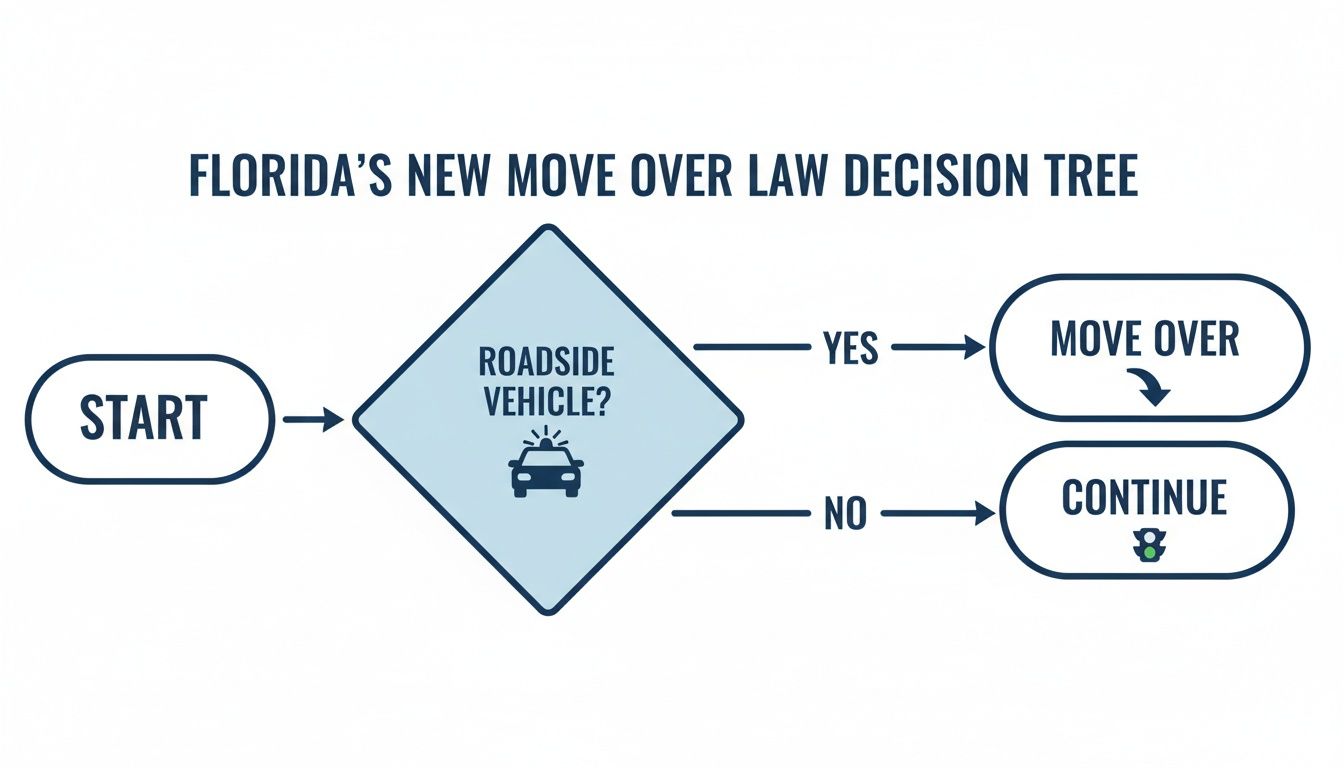
This visual guide confirms it: the presence of any vehicle on the roadside with hazard lights now triggers the requirement to move over or slow way down.
Penalties For A 'Move Over' Violation
Ignoring this expanded law comes with some serious consequences. A violation is a moving violation that will slam you with fines, court costs, and, critically, 3 points on your driver's license. The Florida Department of Highway Safety and Motor Vehicles has already ramped up enforcement, and they're writing more of these tickets than ever before.
Beyond the initial fine, which can easily top $100 plus court fees, those 3 points can cause your insurance rates to spike for years. It's a penalty that keeps on costing you.
Understanding your responsibilities after any roadside incident, whether it's a breakdown or a crash, is crucial. For a deeper dive, check out our guide on what the legal obligations are after a car accident in Florida. Our goal is to protect your license and record by making sure you have the information you need. Past results do not guarantee future outcomes.
Navigating New Rules For Teen Drivers And Learner's Permits
Florida’s Graduated Driver Licensing (GDL) program has always been about easing young drivers onto the road safely. But a new Florida driving law just raised the bar, making the path to that first taste of freedom a bit more rigorous for teens. For parents and new drivers in places like Miami-Dade County, understanding these changes is the first step to getting that learner's permit.
The updates are all about building a stronger foundation of skill and real-world experience before a teen gets to drive solo. If you're gearing up for this milestone, knowing the new rules is essential to making sure your teen isn't just following the law, but is a safer, more confident driver from day one.
Stricter Educational And Supervised Driving Hours
At its core, the new law for teen drivers demands more time in the classroom and more supervised practice behind the wheel. The idea is to better equip them to handle the unexpected hazards they'll eventually face on their own.
As of July 1, Florida's new rules require anyone 15 or older to complete a six-hour driver education course before they can even get their learner's permit. This is now paired with a mandatory 50 hours of supervised driving, with a critical 10 of those hours happening at night. This isn't a random change; it's a direct response to a slight uptick in crash rates for drivers under 21, with teens still involved in 12% of fatal crashes despite making up just 8% of licensed drivers.
What this means for families is that tracking and logging those driving hours is more important than ever to meet the state's new, tougher standards.
A clean driving record is never more important than in the first few years behind the wheel. A single ticket can disrupt the GDL process, delay getting a full license, and lead to significant insurance rate increases.
Why Early Driving Habits Matter
These new requirements directly target the kinds of mistakes that get teens in trouble, like speeding or breaking curfew rules. By forcing more supervised driving in low-visibility conditions, the law aims to build the skills needed to handle the challenges of night driving. A single violation can trigger consequences that go far beyond a simple fine.
Keeping that record clean right from the start is absolutely vital. Piling up points as a teen can lead to a license suspension and other penalties that can haunt their driving privileges for years to come. In tough situations, some drivers might need a special permit to get by. You can read our guide on the requirements for a hardship license in Florida to learn more about restricted licenses. Our goal is to protect your license and record. Past results do not guarantee future outcomes.
What About Changes to the Driver's License Exam?
It's not just the rules on the road that have changed. A new Florida driving law has also shaken up the process of getting a license in the first place, creating a new challenge for many prospective drivers.
The state recently rolled out a significant policy change affecting how all driver's license exams are administered. The new rule is simple on the surface, but its impact is massive in a state as diverse as Florida.
The English-Only Exam Mandate
As of February 6, Florida now requires all written and oral driver’s license exams to be conducted exclusively in English. This applies to every type of license, from a standard Class E for your car all the way to a commercial CDL for a truck.
This change is a major departure from how things used to be. The state has eliminated the option for applicants to use translators or interpreters during the test. The official reason is to ensure every licensed driver can read and understand critical road signs and traffic signals, which are almost entirely in English.
This is a particularly big deal here in Florida, where nearly 30% of residents speak a language other than English at home. For many people, this policy introduces a brand new hurdle to becoming a licensed driver. You can learn more about the reasoning behind Florida's English-only exam policy and its potential impact.
The bottom line is that English proficiency is no longer just a good skill to have—it's now a requirement for passing the driver's test. Applicants now have to prepare for the language of the exam just as much as the content.
What This Means for You at the DMV
The practical effect of this law is immediate and clear: if you aren't a native English speaker, you now have to prove you can handle the language well enough to pass the test without any help.
This means that if you're planning to take your driver's test, you need to start studying the official English-language driving manuals and practice tests right away.
For many communities across the state, this changes everything. People now have to prepare differently, focusing not only on traffic laws but also on the specific English vocabulary used in the exam. This preparation is a critical new step to avoid being turned away or failing the test at the DMV. It's a key piece of information for anyone aspiring to become a licensed driver in Florida. Our practice focuses on traffic and DUI defense matters. Our office is in Broward.
How This Law Impacts Different Florida Drivers
This new Florida driving law isn’t a one-size-fits-all update. Its impact lands differently depending on who you are and why you’re on the road. From professional truck drivers to families with newly licensed teens, everyone needs to understand their specific risks and responsibilities.
For the average daily commuter, the biggest change is the expanded ‘Move Over’ law. One moment of distraction on a packed highway could now lead to a costly ticket for not moving over for a disabled car. That mistake quickly turns into points on your license and a nasty surprise on your next insurance bill.
Commercial Driver's License (CDL) Holders
For anyone who drives for a living, the stakes are sky-high. A CDL isn't just a license—it's your livelihood. Under these new rules, a ‘Move Over’ violation isn't just a fine; it’s a serious red flag on a professional driving record.
CDL holders are held to a much stricter standard. Racking up points from moving violations can spiral into serious trouble, leading to:
Suspension or even revocation of your CDL.
Trouble finding or keeping a job.
Massive hikes in commercial insurance rates.
For a CDL holder, a single ticket for violating this new Florida driving law can have immediate and severe career consequences, making it absolutely essential to fight any citation. Our practice focuses on traffic and DUI defense, and we handle criminal traffic matters across Florida.
What’s a minor headache for a regular driver can be a career-ending event for someone with a CDL. The goal is always to protect your license and your record, making sure you can keep earning a living without interruption.
Out-of-State Drivers and Tourists
Florida welcomes millions of visitors every year, and many of them will be navigating busy areas like Miami-Dade County. If you're an out-of-state driver and get a ticket here, don't make the mistake of thinking it disappears once you cross the state line.
Most states share driver information through something called the Driver License Compact. In plain English, this means points from a Florida ticket can follow you home and get added to your home state's driving record. This can trigger unexpected insurance hikes and other penalties based on your own state's laws. Just paying the fine is often the worst thing you can do, as it’s a direct admission of guilt.
Parents of Teen Drivers
For parents, the new teen driver rules mean more responsibility and oversight. You are now required to make sure your child completes the supervised driving hours, especially the new nighttime driving component. It's mandatory.
A ticket for a teen driver can delay their ability to get a full license and cause the family's auto insurance rates to skyrocket. Understanding how points impact a license is a critical part of this process. To learn more, check out our detailed article on how the Florida points on license system works. Past results do not guarantee future outcomes.
Attorney Advertisement. Office in Broward.
What To Do After A Traffic Stop Under The New Law
That little piece of paper an officer hands you can be confusing and stressful, especially under Florida's new driving law. Your first instinct might be to just pay the fine and put it all behind you. But that's usually a mistake.
Simply paying the ticket is the same as pleading guilty. That admission automatically puts points on your license, which can trigger years of higher insurance premiums. The smartest move is to focus on protecting your driving record from the very beginning.
Immediate Steps To Consider
After getting cited, don't rush. The first thing you should do is document everything you remember about the traffic stop—road conditions, the time of day, exactly what was said. You also have a strict deadline to respond to the ticket, so don't just toss it in your glove compartment and forget about it.
It's critical to understand your rights at this stage, including what's required of you during the stop itself. You can learn more by reading our guide explaining if you have to sign traffic tickets in Florida.
An admission of guilt by paying a fine can have long-lasting consequences. Exploring your options is a wise first step toward protecting your driving privileges and financial well-being.
Trying to navigate the court system, especially in a place like Miami-Dade, can feel overwhelming. A lawyer whose practice focuses on traffic defense can represent you in court. Their goal is to get the ticket dismissed or reduced to a lesser charge, keeping those points off your record.
Our goal is to protect your license and record. Here is a simple checklist to guide you through the immediate aftermath of receiving a ticket.
Your Action Plan After Receiving A Florida Traffic Ticket
Step | Recommended Action | Common Mistake To Avoid |
|---|---|---|
1. Stay Calm and Polite | Remain respectful during the traffic stop. Accept the citation without arguing. | Getting into a debate with the officer on the roadside. It never helps. |
2. Document Everything | As soon as you can, write down every detail about the stop: location, time, weather, what the officer said. | Forgetting key details that could be crucial for your defense later. |
3. Read the Citation Carefully | Find the deadline for when you must respond. Mark this date on your calendar immediately. | Missing the response deadline, which leads to a default conviction and license suspension. |
4. Do NOT Pay the Fine | Paying the fine is a guilty plea. It guarantees a conviction and points on your license. | Rushing to pay the ticket just to "get it over with." This is the costliest mistake. |
5. Consult a Traffic Attorney | Contact a lawyer for a free consultation to understand your options and potential outcomes. | Trying to handle it yourself without knowing the local court procedures or legal defenses. |
Following these steps puts you in control and gives you the best shot at protecting your driving record from the long-term damage of a conviction.
Attorney Advertisement. Office in Broward. Past results do not guarantee future outcomes.
Frequently Asked Questions About Florida's New Laws
Even after breaking down the new rules, it's natural to have a few lingering questions. New laws always bring a bit of confusion, and we hear the same concerns from drivers all the time. Here are some quick, direct answers to the most common questions we're getting about the new Florida driving law.
Think of this as a starting point. This is general information, not legal advice for your specific ticket. The only way to get a real handle on your options is to talk with an attorney about the details of your situation.
What Is The Biggest Change In The New Law
The single biggest update is the massive expansion of the 'Move Over' law. It's no longer just about police cars or tow trucks. You are now legally required to move over or slow down for any disabled vehicle on the shoulder that has its hazard lights blinking. This completely changes the game, adding countless more scenarios where you must act to create a safe zone on the road.
Do These Laws Apply To Out-of-State Drivers
Yes, 100%. The moment your wheels hit a Florida road, you're expected to follow Florida's laws. It doesn't matter where your car is registered or where your license was issued.
And don't think a ticket you get here won't follow you home. Thanks to interstate agreements, that Florida citation can easily pop up on your home state's driving record, bringing points and insurance hikes right along with it.
Are There New Penalties For Extreme Speeding
While this wasn't part of the same legislative package, Florida law has definitely gotten much tougher on extreme speeding. Driving 50 mph or more over the speed limit is no longer just a pricey ticket—it's now a criminal offense that can land you in jail, even on a first offense. This is all part of a larger statewide push to crack down on seriously dangerous driving.
It's pretty common for drivers to wonder about the gray areas of traffic rules, from the major changes down to the small details, like the legality of drinking non-alcoholic beer while driving. This just shows how important it is to be clear on every aspect of road safety.
Important Notice: Submitting information via this site's forms does not create an attorney-client relationship. All communications are held in confidence, but an attorney-client relationship is not formed until a retainer agreement is signed.
Our goal is simple: to protect your license and your record. An experienced traffic defense attorney can give you personalized advice after reviewing your citation. Keep in mind that past results don't guarantee future outcomes.
If a police officer handed you a ticket under one of Florida's new laws, don't just give up and pay it. Contact Ticket Shield, PLLC for a free consultation to figure out your rights and your best next steps. Our team has experience handling traffic cases in all 67 counties across Florida. Head over to https://www.ticketshield.com to get started.
Attorney Advertisement. Office in Broward.