Florida License Suspended Indefinitely? Reinstate Now
License suspended indefinitely in Florida? Get expert help. Understand causes, consequences, and steps to reinstate your license. Contact an attorney today.

If your Florida license is suspended indefinitely, stop driving, identify every hold on your record, and clear the exact court or DMV requirement causing it. “Indefinite” does not mean forever. It means the suspension stays active until you fix the underlying problem properly.
You open your mail. Or you get pulled over and find out on the roadside. Or Uber, Lyft, or DoorDash locks your account and you learn the hard way that your driving privilege is gone.
That panic is real. So is the damage.
When your license suspended indefinitely notice hits, your job, school schedule, family logistics, insurance situation, and criminal exposure can unravel fast. Florida’s system is not built to walk you through this clearly. It is administrative, fragmented, and unforgiving. One old ticket in one county can trigger a statewide problem.
This is still manageable.
The key is to stop treating it like a routine traffic ticket. An indefinite suspension is a legal hold. It stays in place until someone fixes the exact cause the right way, in the right place, with the right paperwork. If you guess, you waste time. If you drive anyway, you risk turning a fixable administrative mess into a criminal case.

This is not rare. Nearly 11 million Americans face indefinite license suspensions for debt-related reasons, and Florida alone accounts for approximately 1.2 million suspension notices according to the University of Michigan Law Review research on debt-based license suspensions.
If you are reading this in your car, at work, outside a courthouse, or after searching your record late at night, focus on three things right now:
Do not drive blindly: If you know you are suspended, every mile creates more risk.
Do not assume one payment fixes everything: Many drivers have more than one hold.
Do not rely on an automated app to untangle this: Suspension cases require judgment, sequencing, and legal follow-through.
Table of Contents
What Are the Immediate Consequences of Driving on a Suspended License
Frequently Asked Questions About Indefinite Suspensions in Florida
Your License Was Suspended Indefinitely What Happens Now
You do not need vague reassurance. You need a plan.
An indefinite suspension usually means Florida blocked your driving privilege until you complete a required step. That step may be simple. It may be buried in old court records. It may involve more than one county. But there is always a reason, and once you identify the reason, you can build a route back.
Why the word indefinite scares people
“Indefinite” sounds permanent. In Florida traffic practice, it usually is not.
It means there is no automatic end date. Time alone does not solve it. Waiting does not solve it. Ignoring it makes it worse because you can forget the originating case, miss notices, lose documents, and create new violations if you keep driving.
Key takeaway: An indefinite suspension ends when you satisfy the legal condition attached to it, not when enough time passes.
Consequently, drivers lose months. They call one clerk, pay one balance, and assume the problem is gone. Then they learn another county still has a hold, or the court cleared the case but the state record was never updated, or a reinstatement step was skipped.
How Florida treats the suspension
Florida handles license suspensions through a mix of court action and statewide administrative enforcement. Your ticket may have started in a local courtroom. If you were cited in Miami, for example, the matter may trace back to the Richard E. Gerstein Justice Building. But once the hold reaches the state system, your driving privilege is affected across Florida.
Florida also gives the state broad authority over driving privileges through the licensing statutes, while the traffic behavior underneath many of these cases comes from Chapter 316. That matters because the original problem might be a moving violation under Chapter 316, but the suspension problem becomes an entirely different legal issue once compliance fails.
A fixed-term suspension is easier to understand. You serve the period, complete any required steps, and seek reinstatement. An indefinite suspension is different. It remains active until the hold is cleared.
Use that distinction to guide your next move:
Type of issue | What ends it |
|---|---|
Time-based suspension | Serving the suspension period and completing required conditions |
Indefinite suspension | Clearing the exact hold, court default, payment issue, or filing requirement |
The practical rule is simple. Do not guess which one you have. Verify it.
What Does an Indefinite Suspension Mean in Florida
Florida law allows the state to suspend a license when a driver fails to comply with legal requirements tied to traffic cases, court orders, and related obligations. One statute lawyers look at in this area is Florida Statute 322.251, because suspension problems often become administrative review problems once the state enters the hold.
Why the word indefinite scares people
A lot of drivers hear “indefinite” and think “revoked for life.” That is wrong.
An indefinite suspension is better understood as a hold. The state is saying you are not getting your valid status back until you do something specific. That could be paying a court obligation, fixing an insurance filing, resolving an old failure to appear, or obtaining a release.
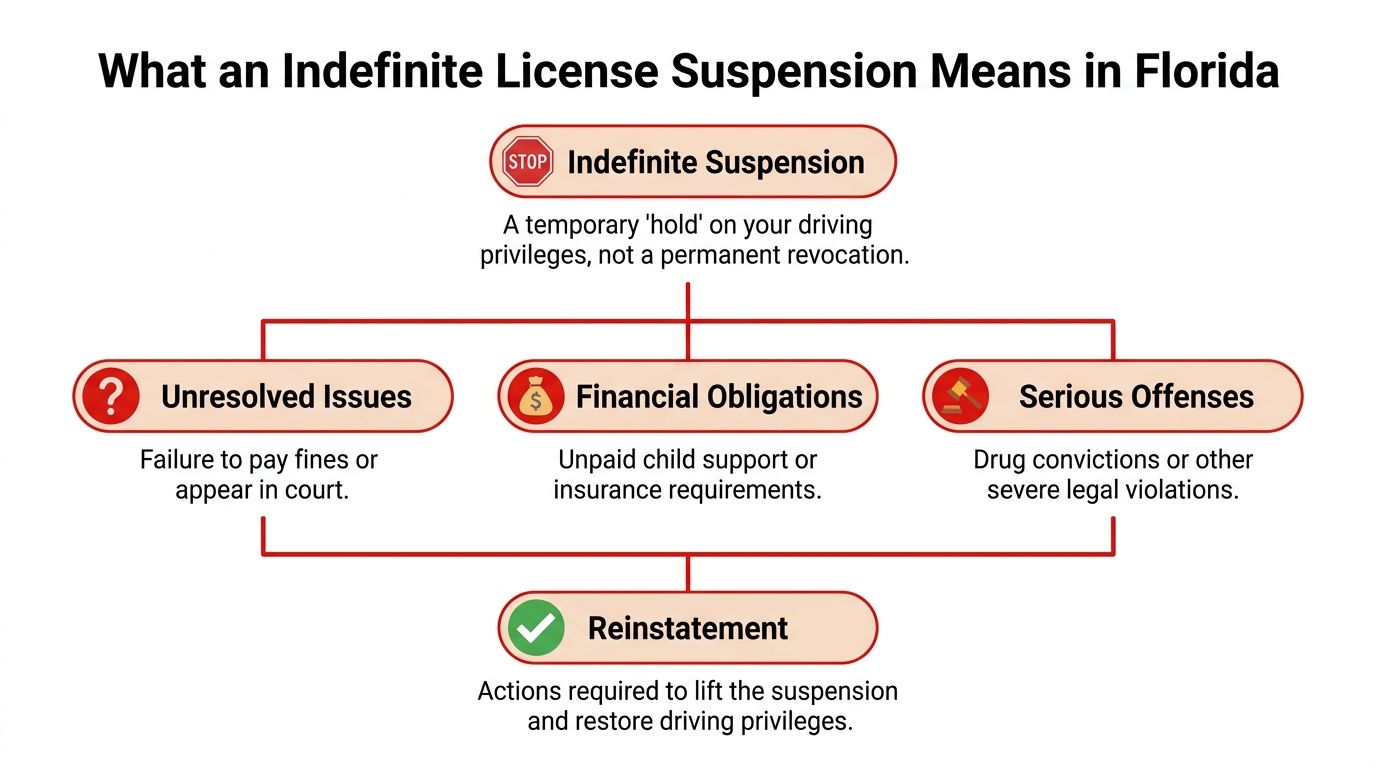
The dangerous part is not just the hold itself. It is the confusion. Drivers often search their county clerk record, see one case, and assume that is the full story. It rarely is. The Florida Department of Highway Safety and Motor Vehicles tracks statewide status, and that record can reflect multiple barriers.
How Florida treats the suspension
Consider this distinction:
A temporary suspension has an expiration structure.
An indefinite suspension stays open until a missing condition is satisfied.
A revocation is a more severe loss of driving privilege and usually requires a different reinstatement process.
If your status came from a local court, that local court may still control part of the solution. But the ability to drive again depends on the state record being corrected and reinstated.
That is why drivers need both sides checked:
Court side: Was the case reopened, paid, dismissed, or otherwise resolved?
State side: Did the hold clear, and have all reinstatement requirements been met?
If you want a broader breakdown of the statewide process, this guide on driver license suspension in Florida is a useful starting point.
Practical tip: If a clerk tells you a case is “closed,” ask whether the suspension notice, compliance default, or clearance was transmitted and processed. “Closed” and “cleared for reinstatement” are not the same thing.
What Are the Common Triggers for an Indefinite Suspension
Most indefinite suspensions come from a small group of recurring problems. The facts vary. The pattern does not.
Failure to appear or failure to comply
This is one of the most common traps.
You get a citation under Chapter 316, miss a court date, miss an election deadline, or fail to complete what the court ordered. The original violation may have been minor. The compliance failure is what causes the statewide damage.
That is why a driver can go from a manageable ticket to a suspended license without realizing how fast the case changed. The issue is no longer whether the underlying stop was fair. The issue is that the court system now shows noncompliance.
If you are trying to understand point exposure connected to old violations while sorting this out, review how many points suspend a license. Points are not the only problem, but they often sit in the background of a larger suspension history.
Unpaid fines and court costs
Unpaid traffic debt causes enormous harm. Some drivers cannot pay in full. Others thought they already paid. Others paid part of the balance and assumed they were safe.
Florida’s indefinite-suspension framework for failures tied to traffic debt is especially punishing because it often blocks the exact tool you need to earn the money to resolve it. For drivers who depend on a vehicle for work, the hold can destabilize everything.
The impact is especially brutal for app-based drivers. For the over 200,000 gig economy drivers in Florida, an indefinite suspension for unpaid fines or child support can mean immediate account deactivation on platforms like Uber or Lyft according to the ACS discussion of debt-based suspension practices.
Insurance and filing problems
Some suspensions are not about court debt at all. They are about proof.
A driver may need an SR-22 or FR-44. A policy may have lapsed. A filing may not have reached the state system. A driver may have bought insurance but still lacks the exact compliance document the state requires.
This category frustrates people because they say, “But I have insurance.” Sometimes that is true and still not enough. The state may require a specific filing, not just an active card in your glove box.
Use this checklist if insurance is part of your problem:
Confirm the exact filing type: SR-22 and FR-44 are not interchangeable.
Check effective dates: A gap on paper can keep the hold active.
Verify transmission: Your insurer’s filing has to reach the state correctly.
Ask about reinstatement steps: Coverage alone may not restore valid status.
Child support holds and income shocks
This category creates some of the harshest real-life fallout because it often hits people who are already under financial pressure.
A child support hold is not a traffic-safety issue. It is an enforcement mechanism tied to financial compliance. If you fall behind and the hold is entered, your license can remain suspended until the required release is issued.
For a working parent, that can produce a damaging loop. You need to drive to work. You lose the license. Income gets harder to maintain. Compliance gets even harder.
Bottom line: If your license suspended indefinitely status involves child support, do not treat it like a courthouse payment problem. It usually requires action with the enforcing agency and a proper release.
What Are the Immediate Consequences of Driving on a Suspended License
A lot of drivers make the same mistake. They tell themselves they will “just drive carefully” until they sort it out.
That is how a fixable suspension turns into a criminal record.

A traffic stop gets serious fast
Driving while license suspended is not a paperwork inconvenience. In Florida, it can be prosecuted criminally. The penalties and exposure depend on the facts, your knowledge, and your record, but the point is simple. You should not gamble on this.
If you are stopped in Broward and your case lands at the Broward County Judicial Complex, the judge is not going to care that you were “just going to work.” That explanation may be humanly understandable. It is not a legal defense by itself.
The underlying indefinite hold can also stay active far longer than drivers expect. Under Florida Statute 322.091, a failure to appear or unpaid civil penalty triggers an indefinite suspension that can persist for months or years, as discussed in this explanation of suspension-triggering compliance failures.
If you need a clearer overview of the charge itself, read this page on the penalties for driving with a suspended license.
Here is the practical danger list:
A simple stop can become an arrest: Especially if the officer believes you knew you were suspended.
Your vehicle problems grow: Towing, storage, missed work, and missed court dates start stacking.
Your record gets harder to clean up: New charges complicate reinstatement and negotiation.
A short video can help you understand how fast these cases escalate:
A suspended license can trigger other financial damage
If you crash while suspended, the insurance fallout can spread beyond the traffic case. Even where coverage exists, claim handling can become more complicated. If you are dealing with accident issues alongside a suspension, this walkthrough on filing an auto insurance claim gives a useful basic framework for the insurance side.
Protective advice: Do not drive to “fix it later.” The later case is always worse, and it is often more expensive, more public, and harder to negotiate.
How Can You Challenge or Resolve an Indefinite Suspension
You wake up thinking you are one payment or one phone call away from getting your license back. Then you pull the record and find multiple holds from different agencies, different counties, and different dates. That is how Florida traps drivers. The system is automated, fragmented, and indifferent to the fact that you still need to get to work, pick up your kids, and avoid another arrest.
Treat this like a file-closing project, not a customer-service errand. Indefinite suspensions end when every hold is identified, matched to the correct fix, and cleared in the right order.
Immediate steps to take
Start with proof. Your memory is not proof. An old notice is not proof. A clerk's guess over the phone is not proof.
Pull your Florida driving record and build a clean list of every active suspension or hold. Then sort each item by county, case number, agency, and cause. You need to know which problems belong to a court, which belong to the Department of Highway Safety and Motor Vehicles, and which require action from a third party such as an insurer or child support enforcement office.
Do this next:
Get the current driving record: Use the live record, not an outdated copy.
Create a case map: List each hold by county and date so nothing gets missed.
Separate the decision-makers: Courts clear court defaults. State agencies process state holds. One office cannot fix everything.
Stop driving until you are legally cleared: A new charge turns a fixable suspension into a harder, more expensive case.
Save every document: Court notices, receipts, insurance filings, child support letters, and prior orders can all matter.
That last step saves cases. Florida's system often keeps bad data longer than it should, and you may be the only person holding the paper trail needed to force a correction.
Match the remedy to the reason
Indefinite does not mean permanent. It means unresolved.
The fix depends on the trigger. If you miss the trigger, you waste time, money, and credibility. Random payments are one of the biggest mistakes drivers make. Paying the wrong office does not remove the hold, and it can make later corrections harder.
Here is the practical breakdown:
Cause of hold | Usual path to fix it |
|---|---|
Failure to appear | Reopen or address the case, resolve the default, and obtain the proper clearance |
Unpaid fine or costs | Pay, negotiate, or satisfy the obligation, then confirm reporting to the correct agency |
Insurance filing issue | Get the exact filing the state requires and complete reinstatement steps |
Child support hold | Work with the enforcing authority and secure a formal release |
Some cases require more than one move. A missed court date may need a motion, a hearing, a compliance order, and then state processing after the court acts. If your case sits in a place like the Edgecomb Courthouse in Tampa, the legal step is only part of the job. The administrative follow-through matters just as much. One missing transmission, one unfiled release, or one stale database entry can leave the suspension in place even after you did what you were told.
If you need the mechanics of reinstatement explained step by step, review this guide on how to reinstate a suspended license in Florida.
Fix the underlying case, not just the hold
Many drivers focus on the suspension and ignore the case that created it. That is backwards.
If the original ticket was defaulted, mishandled, or still legally attackable, fixing that case can improve both the court result and the license result. In some situations, the smartest move is to reopen the old matter first, correct the procedural problem, and then force the reporting chain to catch up. That is how you stop an indefinite suspension from dragging on for months.
Florida does not make this simple. The state treats your record like a queue of codes. You live with the human cost. Lost wages, missed medical appointments, family strain, and the constant fear of another stop are real consequences. Handle the file accordingly.
When a hardship license may help
A hardship license, also called a Business Purpose Only privilege, can give some drivers limited legal mobility while the underlying issue is being resolved. It is useful in the right case. It is a waste of time in the wrong one.
Do not file for hardship relief just because you are desperate to drive again. Check whether the type of hold allows it, whether all prerequisite steps are complete, and whether the paperwork supports the request. If unresolved holds still block eligibility, an early application only creates delay.
Use this approach:
Confirm that your hold type allows hardship consideration.
Complete all required preliminary steps first.
Prepare records showing the lawful need to drive for limited purposes.
Assume restrictions will be enforced.
The right sequence matters. In some cases, clearing the underlying case first is faster than filing a weak hardship application that gets denied and leaves you stuck in the same place.
Why a Lawyer Is Your Strongest Ally in This Fight
People get into the worst trouble when they assume this is a customer-service problem. It is not. It is a legal sequencing problem.
The system is bureaucratic, not logical
Many suspensions have nothing to do with dangerous driving. A study of one state’s system found that over 91% of license suspensions were for non-driving-related issues like unpaid fines, according to this report on non-driving-related suspensions. That matters because it shows the fight is often about paperwork, procedure, and clearance mechanics.

A lawyer adds value by doing the work drivers usually cannot do efficiently on their own:
Diagnose all active holds: Not just the first one you found.
Choose the right filing path: Motion, payment compliance, hearing request, or agency release.
Prevent self-inflicted damage: Especially unnecessary admissions or mistaken payments.
Coordinate state and court action: Because one side often lags behind the other.
Direct attorney access matters
You should not hand a license crisis to a chatbot, intake funnel, or ticket mill.
You want a real lawyer reviewing your driving record, your county cases, your notice history, and your deadlines. You want someone who understands that a suspended-license issue tied to a Chapter 316 case can become a criminal exposure if mishandled. You want fast answers by phone or text, not canned updates.
If you are comparing your options, start with a lawyer-led service that focuses on this exact issue, such as a Florida suspended license lawyer.
My view: DIY works only when the record is clean, the cause is obvious, and the court process is simple. Indefinite suspensions are often none of those things.
Frequently Asked Questions About Indefinite Suspensions in Florida
Can an old indefinite suspension still be fixed
Yes.
A suspension does not become harmless just because it has been sitting on your record for years. It can still block a new license, a renewal, a job requirement, or an out of state transfer. Old cases are harder for one reason. Records get messy. Files are buried, addresses are outdated, and the original court event is easy to misread.
Start with the current Florida driving record. Then trace every active hold back to the court, agency, or support order that caused it. That is how you stop guessing and start fixing the right problem.
What if I moved out of Florida
Florida can still control your driving privilege after you leave.
Drivers usually find out the hard way. They apply for a license in another state, the system checks Florida, and the hold follows them. The new state will not clean up Florida's record for you. Florida has to release the suspension first.
This is one of the biggest procedural traps in these cases. The system treats you like a file number, even if you moved years ago and never got the old notices. You still have to clear the source of the hold in Florida.
Does clearing the suspension erase the original case
No.
Reinstating your license and fixing the underlying case are two different jobs. A release may restore your driving privilege while the old ticket, conviction, points issue, or criminal traffic case still sits on your record. If you ignore that distinction, you can solve one problem and leave the next one waiting for you.
Read the case outcome separately from the suspension status. If the original matter still affects insurance, employment screening, or future penalties, deal with it directly.
What if I am military or a veteran
Service members and veterans have more at stake than a simple DMV inconvenience.
A suspension can interfere with reporting, transportation, reliability reviews, and jobs that depend on clean records and steady access. If the hold involves child support, missed court dates, or an old administrative default, the problem can spill far beyond driving.
Veterans may qualify for federal protections under the SCRA, as noted in this discussion touching on suspension consequences and service-member considerations.
If you are stationed near MacDill AFB or anywhere else in Florida, say that early and clearly when your case is being handled. The same goes for veterans balancing treatment, VA appointments, and benefit paperwork. Your legal strategy should reflect the true cost of delay.
Can I just pay everything online and be done
Sometimes, but random online payments cause a lot of damage.
Payment does not always equal resolution. You may pay the wrong case, pay a balance that does not trigger a release, or make an admission that closes off a better option. Automated portals do not warn you about strategy. They just take the money.
Check what each payment does before you submit it. If the record is old, spread across counties, or tied to more than one hold, get legal guidance first.
How do I know when I am legal to drive again
You are legal to drive again when the state record shows valid status and every reinstatement step is complete.
Do not trust assumptions. Do not trust a casual phone answer. Do not drive because someone said the update should hit soon. Verify the record first.
If your license suspended indefinitely problem is putting your job, family routine, or record at risk, get real legal help now. Ticket Shield, PLLC is a Florida traffic defense firm where you speak directly with your attorney by phone or text, not middlemen or automated apps. The goal is simple. Fix the suspension correctly, protect your record, and pursue the strongest No Points outcome available. Visit TicketShield.com for a free consultation.