Lee County Traffic Ticket Response Guide for Drivers
Handle a Lee County traffic ticket with confidence. Learn deadlines, pay vs contest options, court details, and how to protect your license and record.

You just got a Lee County traffic ticket, and now the clock is running whether you feel ready or not. Don't treat it like a piece of paper you can deal with later. In Lee County, the core issue is the 30-day response window, because once that closes, the risk shifts from inconvenience to suspension exposure and a much uglier record problem.
Florida gives the state the legal authority to issue and classify these citations under Chapter 316, including Section 316.650, which governs standardized traffic citations statewide (Florida Statutes § 316.650). That matters because your Lee County case isn't some informal warning. It's a formal legal process with deadlines, point consequences, and a paper trail that can outlive the fine by years.
Table of Contents
What to Do in the First 30 Days After a Lee County Citation
A Lee County ticket is a deadline problem before it is a defense problem. Count the days from the citation date, not from the day you feel ready to deal with it. The Lee County Clerk says you generally have 30 calendar days to pay, elect traffic school, or submit a no-contest election or affidavit, and a mailed election has to arrive by the deadline, not just get postmarked by it (Lee County Clerk traffic FAQ).
Start with the paper in your hand
Read every line on the citation the same day. Check the violation code, location, issuing agency, and any court instructions. If something looks wrong, keep the ticket anyway. You may need it when you compare it with the clerk's online record.
Practical rule: do not wait for the portal to catch up before you act. The deadline keeps running even if the case is not fully visible yet.
Use the first day to set the response
On day one, mark the 30-day date on your calendar, photograph the citation, and decide whether you are paying, choosing traffic school, or contesting the ticket. If you mail anything, give yourself extra time so the clerk receives it before the deadline. A late-arriving election can still fail even if you mailed it earlier.
The Lee County Clerk warns that failing to pay or appear within 30 days can suspend your driving privileges. That is why I tell drivers to stop thinking, “I'll get to it soon,” and start asking, “What gets filed first, and what proof do I have that it was received?”
If you are unsure which path helps you most, get the citation reviewed before you mail or pay anything. A bad first move is hard to undo.
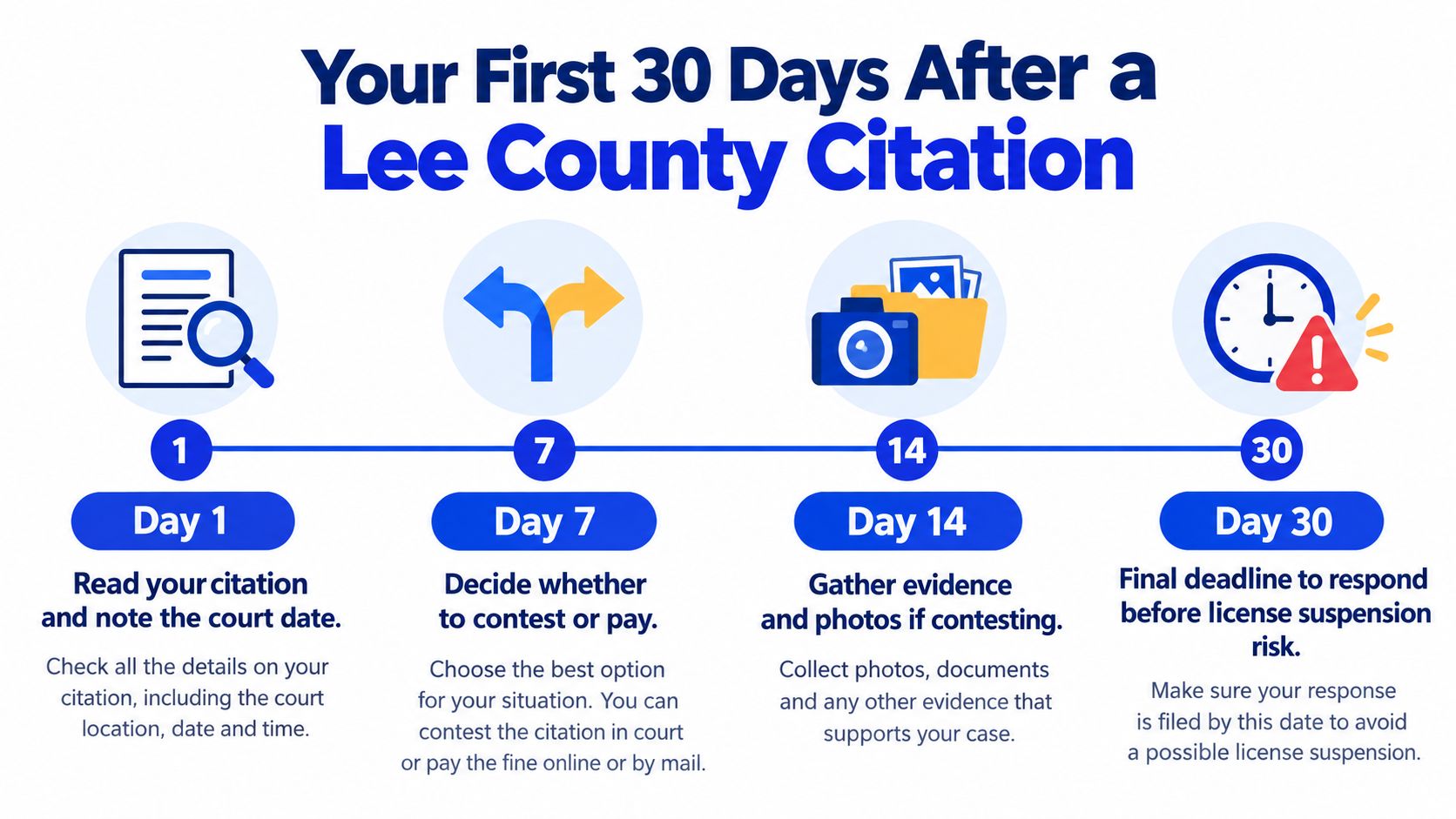
For a step-by-step checklist for the first days after a Florida citation, use this early-response guide for a ticket. Act early, document everything, and keep the case from turning into a suspension problem.
Reading Your Citation and the Clerk's Online Record
Your Lee County citation is not a scrap of paper to toss in the glove box. Section 316.650 requires prenumbered citations, a notice to appear, compliance with Chapter 316, and a statewide infraction reference guide that ties the violation to the penalty and points classification. Read the statute printed on the ticket, because that entry tells you what the officer charged and what the case can become.
Decode the citation before you trust the portal
Lee County traffic cases are often searchable by citation number, case number, name, or attorney, but only records that are not confidential or purged stay visible in the clerk's system (Lee County Clerk court case records). The Clerk classifies civil-traffic matters as TR and parking matters as PT. It also limits how long traffic records stay online after the case closes, reaches final action, satisfies financial obligations, and goes a full period without a new docket entry.
The retention cutoff is the part drivers miss. The Clerk describes the practical limit as 14 months, or 426 days, made up of a one-year audit period plus 60 days. After that, an online search is no longer a complete history of every Lee County ticket.
Don't confuse delayed visibility with relief
The portal can lag at the front end too. The Clerk says citations may take up to seven days to become payable online, and the payment system tells drivers they may need to wait five days before trying again (Lee County Clerk traffic FAQ). That delay does not extend your 30-day deadline. It only means the website is behind.
If you cannot find the case, keep the paper citation, document the failed searches, and contact the Traffic Department. That is the right move if you are out of state, you recently moved, or the online record looks wrong. The clerk's system can lag, and a missing case on a screen does not protect you from a missed deadline.
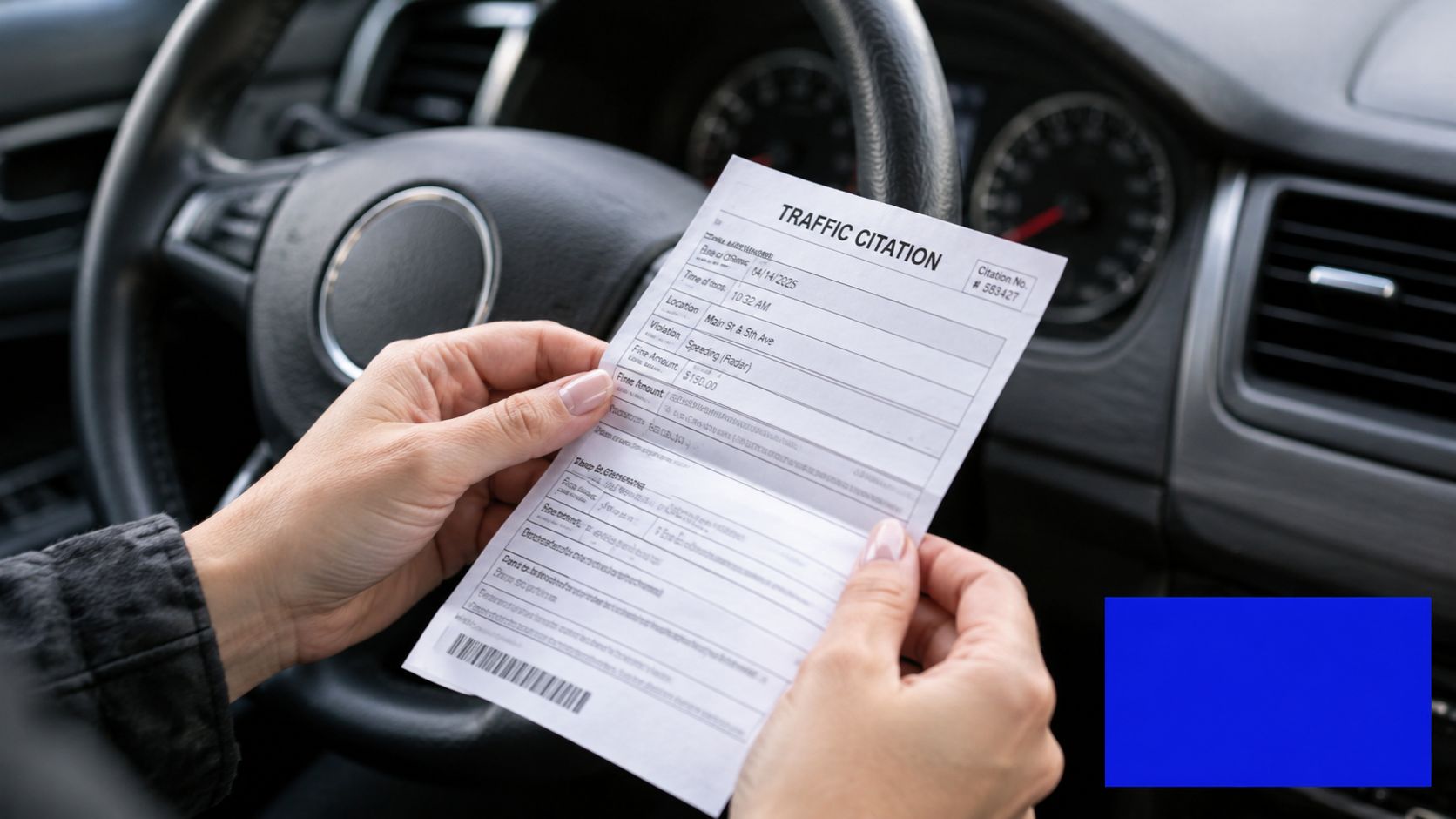
For a practical walkthrough of the paper ticket and the online file, use a guide to comparing your paper ticket with the online record. If the two do not match, treat that as a reason to investigate, not a reason to relax.
Pay, Traffic School, or Contest the Ticket
You have three paths after a Lee County citation. Paying is the fastest way to close the case, but it usually leaves you with a conviction and the risk of points. Traffic school can keep the ticket from hitting your record the same way if you handle the election and completion deadlines correctly. Contesting takes more work, but it gives you the best chance to protect your license and avoid a bad entry on your record.
What each choice costs you
Disposition Option | Effect on Driving Record | Key Deadline | Insurance Impact |
|---|---|---|---|
Pay | Usually becomes a conviction and can trigger points under Florida's point schedule | Within 30 calendar days of issuance | Can raise your premium because the conviction stays visible on the record |
Traffic School | Can keep the citation from creating the same point outcome if completed properly | Election within 30 days, proof generally within 60 days, or 90 days if court-ordered | Usually better than a straight conviction because it can avoid the point event |
Contest | Opens the door to dismissal, reduction, or another negotiated result | Response must still be made on time | Best chance to avoid the long-tail insurance hit if the defense works |
Florida assigns 3 points for ordinary speeding, 4 points for speeding more than 50 mph over the limit under the listed statutes, 3 points for many traffic-control-device violations, and 4 points for violations such as specified red-signal offenses. Those points stay on the record for at least five years from disposition (Florida DHSMV points and point suspensions). Paying without checking the statute is how drivers turn a manageable ticket into a long-term problem.
Choose the lane that protects your license, not the one that feels easiest in the moment.
If the citation is minor and traffic school is available, that is often the cleanest route. If the facts are weak, the officer's allegation is sloppy, or the statute on the ticket does not fit the road or the speed, contest it. If you are only paying because you want the stress gone, stop and think about the record you are leaving behind.
Use the Clerk's payment and election rules as your baseline, then compare the case against your driving record before you commit. A quick payment can solve today's annoyance and create tomorrow's point problem.
For a focused breakdown of payment risk, review Florida traffic ticket payment choices before you send money to the court. If you choose the wrong lane, the fine is the smallest part of the bill.
Long-Term Costs Your Ticket Can Quietly Trigger
The citation amount on the paper is usually not the actual cost. The true cost shows up after the case hits your record, through points, insurance treatment, and possible suspension exposure.
Know the point thresholds before you pay
Florida suspends at 12 points in 12 months, 18 in 18, and 24 in 36. Once you cross those lines, the problem stops being a simple ticket and becomes a license problem fast.
The question that matters is whether this conviction pushes your record closer to a suspension tier.
Why the fine is rarely the biggest problem
A Lee County ticket can follow you well past the courthouse. A report on county roadway deaths said Lee County saw 136 fatalities in 2022, a 30% increase since 2018, and hit-and-run crashes caused 12 deaths and 796 injuries that same year (WGCU report on Lee County roadway fatalities). That is the backdrop for why traffic enforcement is taken seriously here.
The legal fallout is more personal than the crash numbers. If the conviction adds points, repeats a pattern, or creates a bad driving record, the ticket can make later cases harder and push your license closer to trouble.
Insurance is where many drivers get hit again. A Florida speeding ticket can raise premiums long after the fine is paid, and the increase often costs more than the citation itself. Review the insurance cost of a Florida speeding ticket before you decide this is just a one-time expense.
Don't ignore your license type or home state
Out-of-state drivers and commercial drivers need a tighter review. A Florida conviction does not stay trapped in Lee County, and the consequences can follow the record into other systems. If you drive for work, the wrong outcome can reach far beyond the courthouse window.
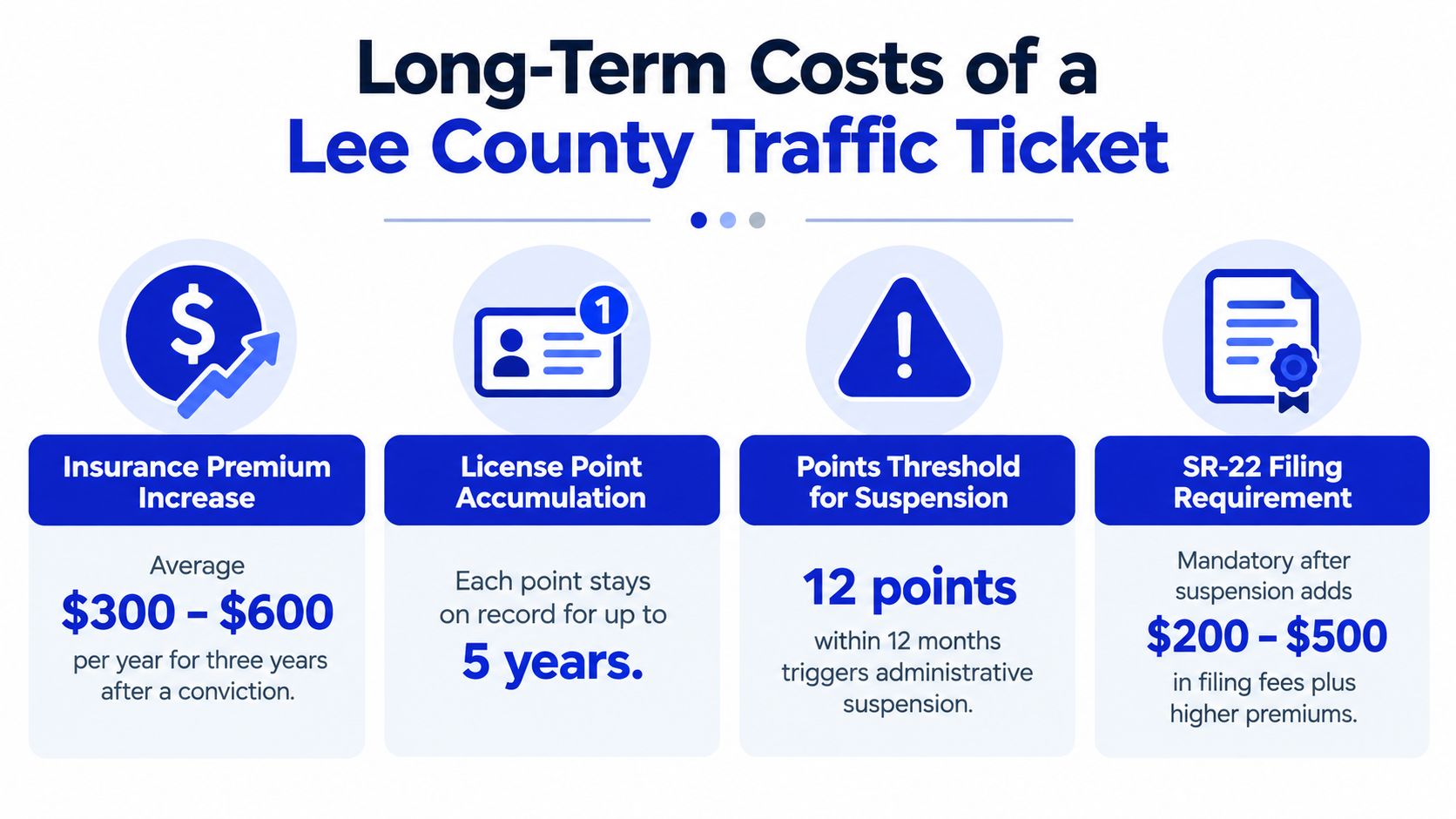
The safest move is to treat the ticket as a record problem first and a fine second.
Hiring a Lawyer for a Lee County Traffic Ticket
Most drivers don't need more anxiety. They need a lawyer who reads the ticket, checks the statute, and tells them the truth. That's especially important in Lee County, where you can lose valuable time just waiting for the online record to catch up.
What direct attorney help changes
A lawyer-led defense changes the process because you're not stuck dealing with a call center, a chatbot, or a middleman who can't make judgment calls. With Ticket Shield, PLLC, clients communicate directly with their attorney by phone or text, which matters when a deadline is moving and a courtroom issue pops up unexpectedly. That direct contact is worth more than polished automation when the case turns technical.
Practical rule: if your defense depends on timing, paper proof, or a hearing strategy, you want a lawyer who can answer the phone and make the call, not a script.
What the engagement should look like
A smart traffic defense setup starts with the citation, the deadline, and the document trail. You send in the ticket, share the basic facts, and get a strategy that matches the charge instead of a canned response. If the case needs a hearing, the lawyer handles the court work so you're not guessing what to say in front of a judge.
Fee clarity matters too. Ticket Shield, PLLC starts at $39.99, which is useful when you want a cost-controlled decision instead of gambling on a pay-now-and-hope-later approach. I'd rather see a driver spend a little on real review than pay the court first and discover the mistake afterward.
What to expect at court
Many people want to know whether they'll have to show up in person. In many non-criminal traffic cases, that's often avoidable when the lawyer appears for the client and manages the filing and negotiation work. The point is not to make the case dramatic. The point is to keep it contained.
If you need a more detailed look at representation, see how hiring a traffic lawyer changes the case. The right lawyer should be focused on keeping the result clean, efficient, and as close to No Points as the facts allow.
Your Next Step Toward No Points on Your License
Stop thinking of this as a ticket and start treating it like a deadline-driven record problem. First, lock the 30-day response date on your calendar. Second, compare pay, traffic school, and contesting based on points and insurance exposure, not just the size of the fine. Third, get the case pressure-tested before you mail money or paperwork to the Clerk.
Bring the citation, the date you received it, any photos, and any online search results that didn't show the case. Ask what statute controls the charge, whether traffic school is available, and whether the facts support a real defense. Don't make the mistake of assuming the court's first version of the case is the final version.
The goal is simple, keep the ticket from becoming a long-term record problem and push the result toward No Points whenever the law and facts allow it. Visit Ticket Shield, PLLC for a free consultation, and let's work toward a No Points outcome on your license.