Leaving the Scene of an Accident in Florida
Understand Florida's penalties for leaving the scene of an accident. Learn your legal duties after a crash and how to protect your rights. Free consultation.
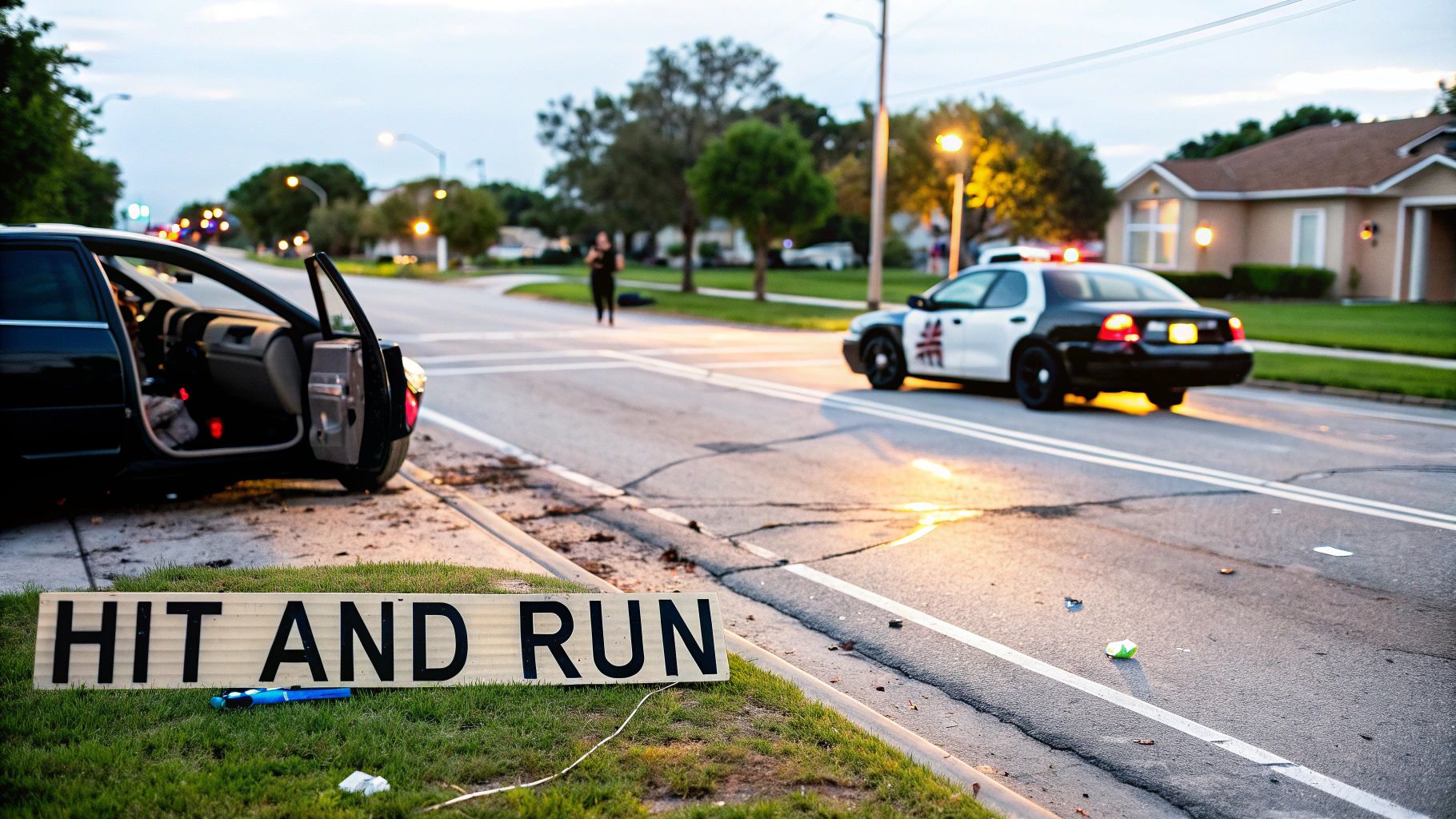
In the chaotic moments after a car crash, your instincts might scream "panic," but Florida law demands a clear, deliberate response. Every driver involved, no matter who was at fault, has a strict set of legal duties.
Failing to follow these rules isn't just a minor mistake; it's the very definition of leaving the scene of an accident. This single act can turn a simple accident into a serious criminal matter. Knowing what the law expects of you is the best way to protect yourself.
Your Legal Duties After a Florida Car Accident
Think of these requirements not as a complicated legal maze, but as a commonsense framework designed to ensure safety and accountability. The law, specifically Florida Statutes § 316.061 and § 316.027, lays out a clear path for what to do.
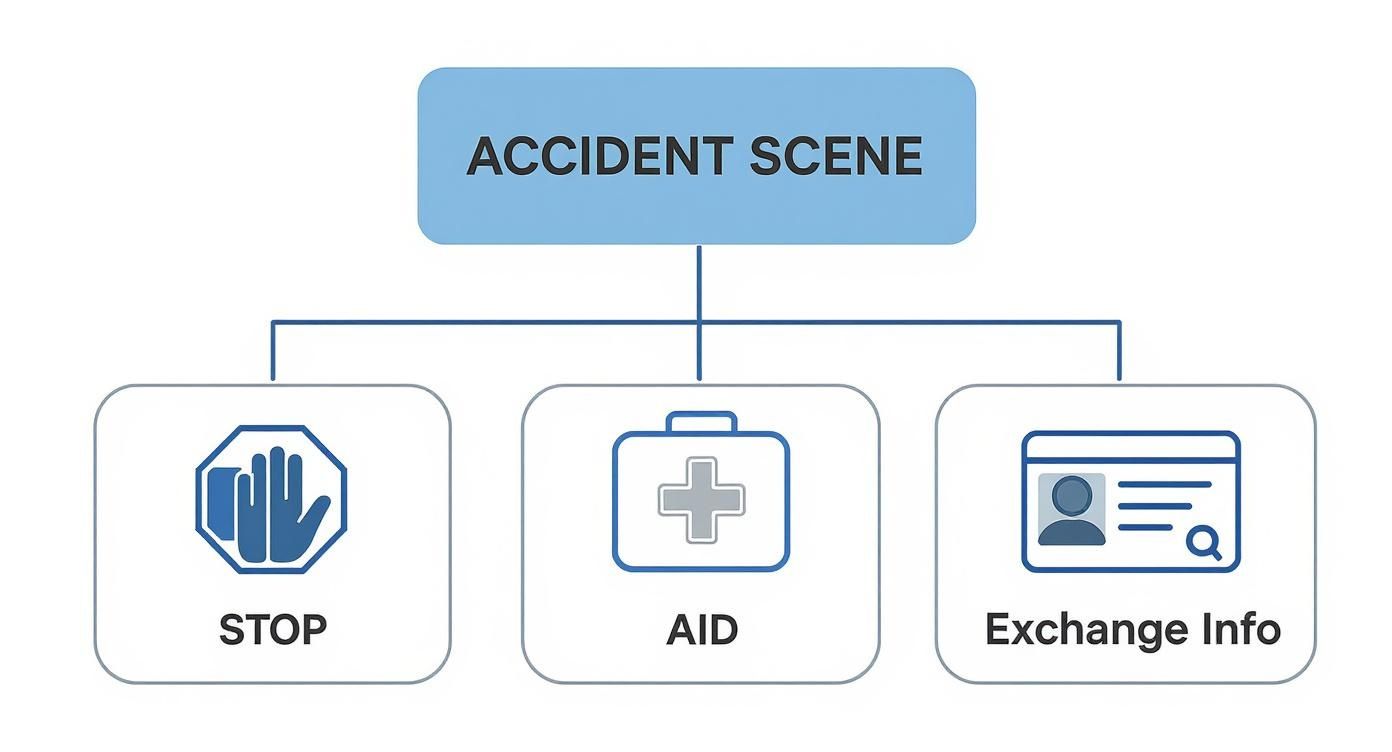
It all boils down to three core responsibilities.
Stop Your Vehicle Immediately
This is the absolute first thing you must do. Bring your vehicle to a stop as close to the crash site as you can without creating a bigger hazard for other drivers.
Hitting the brakes and staying put shows your intent to handle the situation responsibly. Driving away—even just a short distance—can be seen as an attempt to flee the scene.
Render Reasonable Assistance
Next, your focus shifts to the well-being of others. The law requires you to provide "reasonable assistance" to anyone who might be hurt. This isn't about being a medical expert; it's about basic human decency and taking responsible action.
This includes:
Calling 911 if anyone is injured or even just complaining of pain.
Helping arrange for an ambulance or personally transporting an injured person to a hospital if it's clearly necessary and they can't do it themselves.
Exchange Essential Information
Finally, you have to share key information with the other driver(s) and any responding police officer. This exchange is vital for sorting things out with insurance companies and handling any legal follow-up.
You must be ready to provide:
Your name and current address
Your vehicle's registration number
Your driver's license (which you must show if asked)
To help clarify these crucial steps, here is a quick summary of what the law requires at the scene of any accident in Florida.
Driver's Legal Duties at an Accident Scene in Florida
Required Action | What This Means | Governing Florida Statute |
|---|---|---|
Immediately Stop | Pull over as safely and closely to the scene as possible without causing further obstruction. | F.S. § 316.061 |
Render Aid | Check for injuries and call 911. Offer reasonable assistance to anyone hurt. | F.S. § 316.062 |
Exchange Information | Provide your name, address, vehicle registration, and driver's license to the other party and police. | F.S. § 316.062 |
Fulfilling these three duties isn't just good advice—it's the law. With traffic cameras and smartphones everywhere, trying to evade responsibility is harder than ever. Yet, hit-and-run accidents remain a serious problem, which is exactly why Florida enforces these rules so strictly.
For a more comprehensive look at your responsibilities, you can learn more about the legal obligations after a car accident in our guide.
Penalties for a Hit and Run in Florida
When it comes to leaving the scene of an accident, Florida law is very strict. The penalties aren't a simple, one-size-fits-all fine. Instead, they operate on a sliding scale, and the consequences get incredibly steep depending on the damage done. What starts as a misdemeanor for a scraped bumper can quickly spiral into a life-altering felony if a person is hurt.
This system isn't designed to punish you for the accident itself—things happen. The penalties are for the choice to flee, to abandon your responsibility to stop, help, and provide information. Understanding how quickly the stakes are raised is the first step to grasping just how serious a hit and run charge really is.
Florida Penalties for Leaving the Scene of an Accident
The law escalates the charges based on one critical factor: the outcome of the crash. The table below breaks down exactly how a driver's decision to leave the scene can transform a traffic incident into a serious criminal matter.
Accident Outcome | Crime Classification | Maximum Incarceration | Maximum Fine | Florida Statute |
|---|---|---|---|---|
Property Damage Only | Second-Degree Misdemeanor | 60 days in county jail | $500 | § 316.061 |
Non-Serious Injury | Third-Degree Felony | 5 years in state prison | $5,000 | § 316.027 |
Serious Bodily Injury | Second-Degree Felony | 15 years in state prison | $10,000 | § 316.027 |
Fatality (Death) | First-Degree Felony | 30 years in state prison | $10,000 | § 316.027 |
As you can see, the jump from a misdemeanor to a felony is triggered the moment an injury is involved, demonstrating the state's absolute focus on protecting people over property.
When Only Property Damage Is Involved
This is the most common scenario. Think hitting a parked car in a grocery store lot or a minor fender-bender at a red light where everyone is okay. It might seem harmless to just drive off, but the law sees it differently.
Under Florida Statute § 316.061, leaving the scene when there's only property damage is a second-degree misdemeanor. Even though it's the lowest-level offense, a conviction still carries consequences:
Up to 60 days in county jail
A fine of up to $500
Up to six months of probation
A permanent criminal record that can follow you
Making the choice to drive away turns a simple insurance matter into a criminal problem. The law is clear: you have to find the owner or leave a note with your information and then report the crash.
The bottom line of Florida's hit and run laws is all about accountability. The penalties exist to make sure drivers don't evade their legal and moral duties after a crash, no matter who was at fault for the accident in the first place.
These three steps are the bare minimum required by law. They are non-negotiable.
When the Accident Involves an Injury
The second someone is hurt, the entire situation changes. The law's focus immediately pivots from damaged metal to a human being's well-being, and the penalties skyrocket to match.
If you leave an accident where someone has suffered any non-serious injury, the charge jumps to a third-degree felony under Florida Statute § 316.027. The potential consequences are severe:
Up to five years in state prison
A fine of up to $5,000
Driver's license revocation for at least three years
This leap from misdemeanor to felony is a bright red line in hit and run cases. It sends a clear message: the state will take strong action against anyone who leaves an injured person without helping. For a closer look at the specifics, you can dig deeper into the details of hit and run charges in Florida.
When the Accident Causes Serious Bodily Injury
The law goes a step further, drawing a distinction for accidents causing "serious bodily injury." This isn't just a bump or a bruise; we're talking about an injury that creates a substantial risk of death, causes major disfigurement, or results in the long-term loss of a limb or organ.
Leaving the scene of a crash this severe is a second-degree felony. This is a very serious crime with penalties that can change the course of your life:
Up to 15 years in state prison
A fine of up to $10,000
Mandatory driver's license revocation for at least three years
Prosecutors pursue these cases aggressively. In these situations, stopping to call 911 and render aid could literally be the difference between life and death for the victim.
When a Fatality Occurs
It doesn’t get any more serious than this. When a crash results in a death, a driver's decision to flee is treated as one of the most reprehensible traffic crimes on the books.
Leaving the scene of an accident where someone has died is a first-degree felony. This charge carries a mandatory minimum prison sentence of four years—that’s the starting point.
The maximum penalties are staggering:
Up to 30 years in state prison
A fine of up to $10,000
Permanent loss of your driving privileges
The legal framework makes one thing crystal clear: what you do after an accident is every bit as important as what caused it. Fleeing the scene turns a tragedy into a major felony, bringing on consequences that will stick with you for the rest of your life.
Navigating the Criminal Justice Process
Being accused of leaving the scene of an accident is stressful. Suddenly, you're thrown into a legal world with its own rules, language, and timelines that can make anyone feel lost and powerless. But understanding the road ahead is the first step to taking back control.
Let's walk through what actually happens when someone is accused of a hit and run in Florida. Think of this as your guide to the legal journey, breaking down each step in plain English so you know exactly what to expect.
The Initial Investigation
It all begins with an investigation. As soon as an accident is reported, police get to work trying to piece together what happened and who was involved.
Their playbook usually includes:
Talking to People: They'll interview the other driver, passengers, and anyone on the street who might have seen the crash or the car driving away.
Searching for Clues: Investigators look for physical evidence like paint chips, broken car parts, or even tire tracks left behind.
Checking Cameras: They'll pull footage from traffic cams, nearby businesses, or even Ring doorbells in the area.
If they believe they’ve identified a suspect, they'll try to get in touch. This is a critical moment. Remember, you always have the right to remain silent and to speak with an attorney.
Arrest and the Filing of Charges
If the police feel they have enough evidence—what the law calls "probable cause"—they can make an arrest. From there, your case file lands on a prosecutor’s desk at the State Attorney’s Office. They will comb through the police reports and evidence to decide what formal charges to file, if any.
This is a huge decision point. It determines whether you’re facing a misdemeanor or a felony, which completely changes the potential penalties and even which courthouse your case will be heard in. A common mistake is thinking an arrest equals a guilty verdict. It doesn't. It's just the official start of the case against you.
Arraignment: Your First Court Appearance
Your arraignment is usually your first time in front of a judge. It’s a pretty quick hearing where the court officially tells you what you're being charged with and asks for your plea.
You have three main options:
Guilty: You admit to the charge.
No Contest (Nolo Contendere): You don't admit guilt, but you're not fighting the punishment.
Not Guilty: You deny the charge and tell the court you plan to fight it.
Pleading "not guilty" is a standard first step. It keeps all your options open and gives your attorney time to dig into the evidence and start building your defense. Keep in mind, this is a very different legal path than a fleeing and eluding case, which involves its own unique set of circumstances. You can learn more about the differences in a fleeing and eluding charge here.
The legal process is intentionally methodical. It’s built to make sure every piece of evidence gets a hard look and both sides get a fair chance to make their case. Every single step, from the first interview to the final verdict, matters.
Discovery and Pre-Trial Motions
After the arraignment, the case enters the "discovery" phase. This is where your attorney formally requests and receives every piece of evidence the prosecution has—police reports, witness statements, videos, you name it. Your legal team will then go through everything with a fine-tooth comb, searching for weak spots in the state's argument.
What they find can lead to pre-trial motions. For example, if evidence was collected illegally, your attorney can file a "motion to suppress" to have it thrown out. These motions are powerful and can change the entire course of your case long before a trial ever begins.
Building a Defense Strategy for Your Case
Facing a charge for leaving the scene of an accident can feel discouraging, but it’s really just the beginning of the legal process. In Florida, the State carries the entire burden of proving its case against you beyond a reasonable doubt. This is the toughest standard in our justice system, and it’s where a focused attorney can start building a strong defense.
Every case has its own unique twists and turns, but a solid defense almost always focuses on picking apart the specific facts and legal requirements of the charge. The prosecutor has to do more than just prove you were in a crash—they have to prove you knowingly and willfully failed to stop and do what the law requires. That’s a high bar, and it’s often where their case can be challenged.
Did You Even Know an Accident Happened?
One of the most effective defense angles comes down to a simple question: did you actually know you were in an accident? In the heat of the moment, things aren't always so clear.
Imagine you're driving a big work truck down a busy highway. The engine is roaring, the radio is on, and one of your tires kicks up a piece of debris that cracks the windshield of a car behind you. You likely wouldn't hear or feel a thing. In that case, you couldn't have known an accident involving property damage even occurred.
The same logic applies in a crowded parking lot, where a tiny scrape might be so minor the driver is completely unaware it happened. If you didn't know about the impact, you couldn't possibly have the criminal intent to flee. Our goal is to dig into these details and show that the prosecutor's assumption of "knowledge" is just that—an assumption.
The Florida Supreme Court has made it clear: just being in a collision isn't enough to convict someone. Prosecutors have to prove the driver knew, or at least reasonably should have known, that a crash took place. Past results do not guarantee future outcomes.
Questioning the Evidence of Damage or Injury
Another key strategy is putting the alleged damage or injury under a microscope. To charge you with a felony, the State must prove you knew or should have known someone was hurt. But what happens when the other driver says, "I'm fine!" at the scene, only to claim a neck injury days later?
An attorney can build a defense by examining:
The Initial Police Report: We look at exactly what the officer wrote down about injuries (or lack thereof) right after the crash.
Witness Statements: We analyze what other people at the scene actually saw and heard. Did anyone mention an injury?
Your Side of the Story: We work to establish that there were no visible signs or complaints of injury that would have legally required you to do anything more than exchange information.
The goal here is to demonstrate that even if you knew a fender-bender happened, you had no reasonable way of knowing it was a serious, injury-related event.
Was It Really an "Intent to Flee"?
Prosecutors also have to prove you left the scene specifically to avoid your legal duties. But people leave accident scenes for all sorts of legitimate reasons that have nothing to do with breaking the law.
For instance, a driver might pull their car into a nearby parking lot to get out of a dangerous, high-traffic intersection and prevent a second, more serious crash. Or maybe a driver leaves to get immediate medical attention for themselves or a passenger. When explained properly and backed by evidence, these actions show there was no criminal intent—just a responsible reaction to a stressful situation. While we see traffic incidents all the time, solid data on a driver's specific motivations for leaving a scene is often hard to come by. You can learn more about national traffic safety data from the NHTSA's recent reports.
Ultimately, a strong defense is about systematically deconstructing the State’s case, one piece at a time. A traffic law attorney who focuses on these cases knows exactly where to look for weaknesses in the evidence and how to build a strategy that protects your rights, your freedom, and your driver's license.
The Hidden Costs: Civil and Insurance Impacts
The trouble with a leaving the scene charge doesn't just stop with the criminal court's decision. Even after the case is closed, the ripple effects can impact your life for years. We're talking about a whole separate layer of financial and administrative penalties that often catch people completely off guard.
Think of the criminal case as just the first wave. The second, and often more impactful, wave involves your insurance company, the other party, and the Florida DHSMV.

Your Insurance Premiums Will Likely Increase
To an auto insurance company, a conviction for leaving an accident scene is a major red flag for "HIGH RISK." They see it as a serious breach of responsible driving, and they’ll either make you pay for it or may choose to not renew your policy.
Here's what you can expect:
Skyrocketing Rates: It's not uncommon for premiums to increase significantly after a hit and run conviction.
Policy Non-Renewal: Many insurance carriers will simply drop you. This forces you into the high-risk insurance market, where coverage is expensive and hard to find.
SR-22 Requirement: Florida will likely require you to file an SR-22. This is a special form that proves you have insurance, but it also officially labels you a high-risk driver, keeping your rates high for years.
After any accident, understanding the insurance side is critical. Getting a handle on how to file an auto insurance claim is a good first step to prepare for what's ahead.
Bracing for a Civil Lawsuit
The criminal case is about breaking the law. The civil case is about paying for the damage you caused. The other driver has every right to sue you personally to recover their losses.
A civil lawsuit can be filed to cover a whole host of expenses, such as:
Medical bills from their injuries
Lost income if they couldn't work
The cost to repair or replace their car
Compensation for their pain and suffering
And here’s the kicker: the fact that you fled the scene can be used as powerful evidence against you in that civil trial. A jury is likely to see your leaving as an indication that you knew you were at fault, which can make it much easier for the other side to win their case.
The DHSMV Has Its Own Penalties
Don't forget about the Florida Department of Highway Safety and Motor Vehicles (DHSMV). They have their own set of rules and can take action against your license regardless of what happens in criminal court. A conviction for leaving an accident, especially one with injuries, will trigger an automatic license suspension.
This administrative suspension is a completely separate process. You could technically be found not guilty in your criminal case and still have the DHSMV suspend your license based on the details of the incident.
The standards of proof are different for the DHSMV. On top of that, the violation will add points to your license, which can lead to another suspension. Our guide to the Florida points on license system breaks down just how quickly those points can pile up.
When you flee an accident, you're not just running from the immediate problem—you're running straight into a web of long-term financial and legal headaches. Dealing with these hidden costs requires a strategy that tackles the criminal charges, the civil liability, and the administrative penalties head-on.
How a Traffic Defense Attorney Can Assist You
Being accused of leaving the scene of an accident in Florida can make you feel like the walls are closing in. It’s a serious charge, and the legal system can be bewildering. Trying to navigate it on your own isn't just stressful—it's a risk.
This is where having an attorney whose practice focuses on criminal traffic defense becomes so critical. They can act as your guide through the entire process. Our goal is to protect your license and record.
It all starts with a professional, confidential review of your case. We’ll break down exactly where you stand and what your options are, giving you the clarity you need to make smart decisions moving forward.
Analyzing the State's Case Against You
A strong defense begins with taking a magnifying glass to the prosecution's evidence. Remember, the State carries the burden of proving every single element of its case beyond a reasonable doubt. A deep dive into their file often reveals cracks in their argument.
An attorney will tear down the case piece by piece, looking at everything:
Police Reports: Are there inconsistencies? Procedural mistakes? Vague or missing details? These are often the first things to fall apart under scrutiny.
Witness Statements: How credible are the witnesses? Were they in a position to see what they claim? Their testimony may not be as solid as the prosecution wants you to believe.
Physical Evidence: We’ll closely examine any photos, surveillance videos, or damage reports the State plans to use against you.
This isn’t just about glancing over paperwork. It’s about finding the weak links that can unravel the prosecutor’s entire narrative. While past results do not guarantee future outcomes, this meticulous investigation is the bedrock of a solid defense strategy.
Building Your Defense and Negotiation
Once we have a clear picture of the evidence, we can build a defense strategy that fits your unique situation. This might mean challenging the idea that you even knew an accident happened, or arguing that there was no way to know someone was injured.
With a solid defense in hand, an attorney can then go to the negotiating table. This is where we can often work with the prosecutor to get charges reduced or find an alternative solution that prevents one mistake from derailing your future.
To see how this plays out in real-world scenarios, take a look at our detailed guide on how a hit and run defense attorney builds a case from the ground up.
Attorney Advertisement. Office in Broward. Submitting information via our forms does not create an attorney-client relationship.
Got Questions About Hit and Run? We've Got Answers.
When you're dealing with the fallout from an accident, things get confusing fast. Add a charge for leaving the scene, and it can feel overwhelming. We get these questions all the time, so let's clear up a few common points. Keep in mind, this is for your information—it’s not a substitute for legal advice on your specific case.
What If I Just Tapped a Parked Car?
It might seem minor, but Florida law doesn't see it that way. You absolutely have to try and find the owner of the car or property you hit.
If you can't track them down, you're required to leave a note somewhere they can't miss it. It has to include your name, address, and vehicle registration number. On top of that, you must immediately report the crash to the local police department. If you skip these steps, you’re looking at a criminal charge for leaving the scene.
Does It Matter If the Accident Wasn’t My Fault?
No, not one bit. When it comes to a "leaving the scene" charge, fault is completely off the table. The law requires every single driver in a crash to stop, offer help if needed, and exchange information. It doesn't matter who caused the collision.
The crime isn't the accident itself—it's the act of driving away and failing to do what the law requires. A prosecutor doesn’t need to prove you were at fault for the crash to convict you of hit and run.
I Already Left the Scene. Is It Too Late?
If you've already driven away, your very next move should be to call a criminal traffic defense attorney. Do not call the police, and do not try to contact the other driver yourself.
An attorney can give you confidential advice on how to handle the situation and may be able to contact the authorities for you in a way that protects your rights. Time is critical, but moving forward with professional legal guidance is even more so.
What you do in the hours and days after the incident can make or break your case. Speaking with a lawyer before you say anything to anyone else is the single best way to protect yourself. Past results do not guarantee future outcomes.
Can I Lose My License for a Hit and Run?
Absolutely. A conviction for leaving the scene often comes with a driver's license suspension or revocation. The Florida DHSMV can and will take your license, and how long you lose it for depends on how serious the accident was. For example, if someone was injured, a conviction means a mandatory license revocation for at least three years. Our goal is to protect your license and your record.
If you’re facing a charge for leaving the scene of an accident, you don’t have to go through this alone. The attorneys at Ticket Shield, PLLC handle criminal traffic matters across Florida and know how to defend your rights. Reach out for a free, confidential chat about your case.