
Leaving Scene of Accident Florida: A Practical Legal Guide
Facing charges for leaving scene of accident florida? Learn Florida laws, penalties, and defenses to protect your record.

In Florida, leaving the scene of an accident isn't just a traffic ticket—it's a serious criminal offense. A conviction can flip your life upside down, leading to jail time, steep fines, and the loss of your license. What starts as a simple collision in a busy Miami-Dade County intersection can quickly become a life-altering event.
What a Florida Hit and Run Charge Means for You
Being accused of leaving the scene of an accident in Florida is a stressful and confusing spot to be in. Most drivers don't realize how fast a car accident can escalate from a civil matter into a full-blown criminal investigation. The law, specifically Florida Statute 316.027, is crystal clear: if you're in a crash, you have a legal duty to stop, help anyone who's hurt, and exchange your information.
The term "hit and run" might make you think of a high-speed chase, but the reality is much broader. You could be charged for anything from a minor paint scrape in a bustling South Beach parking garage to a major impact on the Dolphin Expressway. The critical factor isn't how bad the crash was, but whether you failed to stick around and do what the law requires.
Understanding the Different Levels of Offenses
Florida law sorts hit-and-run charges into three different tiers based on the damage done. This structure directly determines the penalties you could be up against.
To give you a clearer picture, here’s a quick breakdown of how these charges are categorized.
Quick Guide to Florida Hit-and-Run Charges
Type of Accident | Potential Criminal Charge | Governing Florida Statute |
|---|---|---|
Damage to Property or Vehicle Only | Second-Degree Misdemeanor | F.S. § 316.061 |
Injury to a Person | Third-Degree Felony | F.S. § 316.027(2)(a) |
Death of a Person | First-Degree Felony | F.S. § 316.027(2)(c) |
As you can see, the severity of the consequences escalates dramatically when a person is involved.
These incidents happen a lot more than you might think. In a single recent year, Florida saw 362,063 car accidents. Incredibly, 91,164 of those were hit-and-runs—that’s over 25% of all crashes. This data shows just how often drivers flee, especially in packed areas like Miami-Dade County, where the constant traffic and chaotic roads just add to the risk.
Why You Need to Act Quickly
The second you're accused of leaving an accident scene, a clock starts ticking. The police immediately begin building their case, collecting witness statements and hunting for surveillance footage.
But an accusation is not a conviction. You have strategic legal options, but the window to use them is small. An experienced attorney can dive into the details of your case and start building a defense right away. For a deeper look at what's possible, you might want to check out our guide on how to build a strong hit-and-run defense.
Our goal is to protect your license and your record by carefully picking apart every detail of the accusation against you. Past results do not guarantee future outcomes, but a proactive approach is always a sound choice.
Attorney Advertisement. Office in Broward.
What You're Up Against: The Penalties for Leaving an Accident Scene
That moment of panic after a crash can lead to a decision with life-altering consequences. Choosing to leave the scene of an accident in Florida isn't just a traffic violation; it's a criminal act with penalties that escalate dramatically based on what happened.
The penalties are tiered, meaning the severity climbs with the level of harm caused. What might have been a simple fender-bender can spiral into a serious felony if you don't stay and fulfill your legal duties. Let's break down exactly what's at stake.
Property Damage Only: Still a Criminal Charge
If you leave the scene of a crash that only involves damage to another car or property—even just a mailbox—you're looking at a second-degree misdemeanor. Don't let the "misdemeanor" label fool you; this is a criminal offense, not just a ticket.
A conviction can bring:
Up to 60 days in jail
A fine of up to $500
Up to 6 months of probation
6 points added to your driver's license
Even if you avoid jail, that misdemeanor conviction creates a permanent criminal record. It's the kind of thing that can complicate background checks for jobs, housing, and professional licenses for years to come.
This flowchart shows just how quickly the legal consequences can change based on the outcome of a single collision.
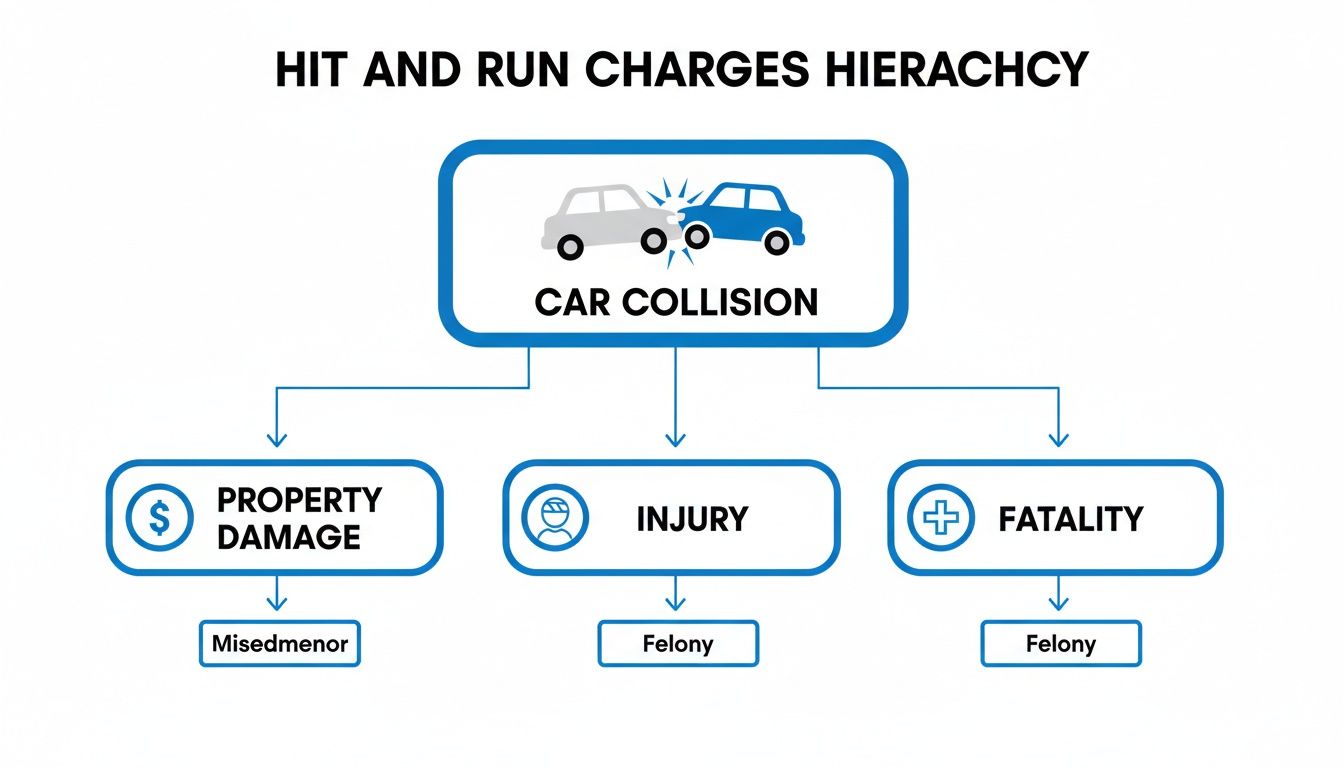
As you can see, the moment someone gets hurt, the situation escalates from a misdemeanor to a serious felony.
Injury Crashes: Now It's a Felony
Things get much more serious if anyone is injured in the accident. If you leave the scene of a crash where someone has been hurt—no matter how minor the injury seems—the charge jumps to a third-degree felony.
The potential penalties skyrocket to:
Up to 5 years in prison
A fine of up to $5,000
Up to 5 years of probation
A mandatory driver's license revocation for at least 3 years
A felony conviction is a life-changing event. Beyond the threat of prison, it can strip you of fundamental rights, like the right to vote or own a firearm, and create permanent barriers to your career.
It's critical to understand that these charges apply even if you weren't at fault for the crash itself. The crime isn't causing the accident; it's the act of leaving without stopping, helping, and providing your information. The legal distinction between these actions is a key part of how these cases are prosecuted. To learn more, check out our guide on the differences between leaving the scene and what is fleeing and eluding.
Fatal Crashes: The Harshest Consequences
The most severe penalties are reserved for hit-and-run accidents that result in a person's death. Leaving the scene of a crash involving a fatality is a first-degree felony, one of the most serious crimes a driver can face in Florida.
A conviction carries a mandatory minimum prison sentence and can lead to:
Up to 30 years in prison
A mandatory minimum of 4 years in prison
A fine of up to $10,000
Permanent revocation of your driver's license
The state prosecutes these cases aggressively, and for good reason. Florida sees a staggering number of hit-and-run incidents every year. This isn't a minor issue; it's a major public safety concern, and prosecutors are under immense pressure to secure convictions.
To give you a clearer picture, the table below compares the penalties side-by-side.
Florida's Penalties for Leaving the Scene of an Accident
This table provides a clear, at-a-glance comparison of the criminal charges and potential penalties you could face for a hit-and-run in Florida. Notice how dramatically the consequences escalate with the severity of the crash.
Offense Level | Crime Classification | Maximum Incarceration | Maximum Fine | License Points |
|---|---|---|---|---|
Property Damage | Second-Degree Misdemeanor | 60 days in jail | $500 | 6 points |
Injury | Third-Degree Felony | 5 years in prison | $5,000 | Mandatory revocation |
Fatality | First-Degree Felony | 30 years in prison | $10,000 | Mandatory revocation |
Seeing the penalties laid out like this makes it obvious why a moment of panic can turn into a lifetime of regret. Facing these charges requires a focused legal strategy. Our practice focuses on traffic and DUI defense, and our goal is to protect your license and record. Past results do not guarantee future outcomes, but a thorough defense is essential.
Your Legal Duties After a Florida Car Accident
Knowing what you’re legally required to do after a Florida car accident is the single most important thing that can keep a simple traffic incident from blowing up into a serious criminal matter. The law is designed to ensure safety and accountability. Failing to follow these steps is exactly how you end up charged with leaving the scene.
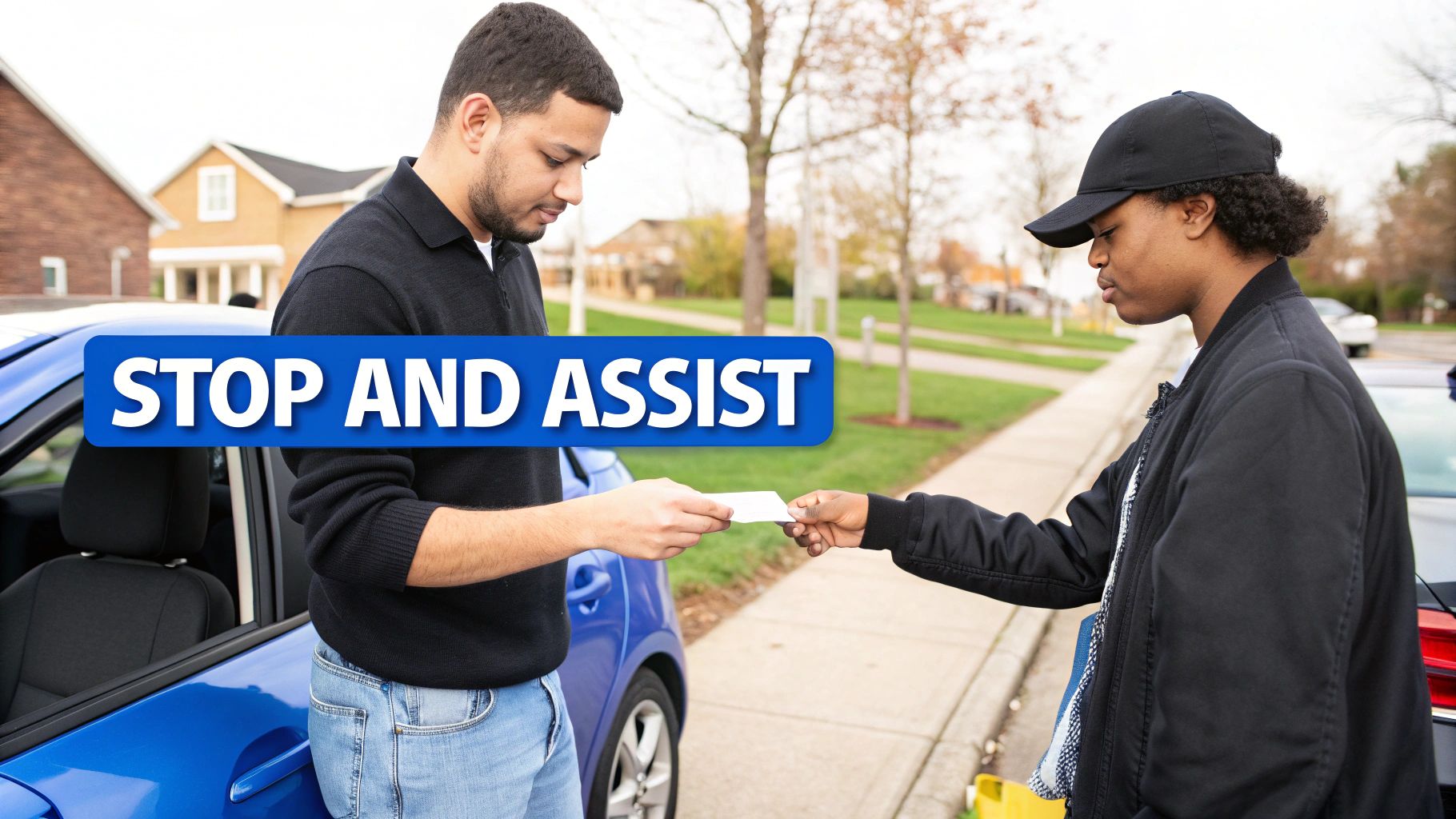
Picture a minor fender-bender in a chaotic Miami-Dade tourist district. It's easy to get overwhelmed by the confusion, but your actions in the next few minutes are dictated by very specific legal rules. Florida law doesn't care whose fault the accident was; it only cares that you, as a driver involved in a crash, do what you're supposed to do.
Your Immediate Responsibilities at the Scene
The second a collision happens, Florida Statutes § 316.027 and § 316.061 kick in, placing several non-negotiable duties on every driver. These aren't just suggestions—they are legal commands designed to protect everyone involved.
Your primary duties are:
Stop Immediately: You have to stop your car as close to the scene as you safely can, without blocking traffic more than necessary. Driving away, even just a little, can be seen as an attempt to flee.
Provide Reasonable Assistance: If anyone is hurt, you have a legal duty to render "reasonable assistance." This usually means calling 911 for medical help or, if you're able and it's necessary, helping transport the injured person to a hospital.
Exchange Information: You must give your name, address, and vehicle registration number to the other driver, anyone who was injured, or any police officer on the scene. You also have to show your driver's license if asked.
These obligations are the foundation of responsible driving in Florida. Failing to meet them is the very definition of leaving the scene of an accident.
Providing Information and Rendering Aid
The duty to exchange information is straightforward but absolutely critical. This simple act ensures that everyone can handle insurance claims and other follow-ups without law enforcement having to launch an investigation to track down a missing driver.
Rendering aid, on the other hand, can feel a bit more vague. "Reasonable assistance" doesn't mean you're expected to perform advanced medical procedures on the side of the road. In most cases, the most reasonable—and effective—assistance you can give is to call for emergency services right away.
For example, after a collision on a quiet residential street, checking on the other driver and asking if they need medical help is a crucial first step. If they do, calling 911 fulfills your duty to render reasonable assistance. Ignoring a request for help or simply driving off could turn a simple accident into a felony.
Understanding these legal duties is essential. For a more detailed breakdown, learn more about the legal obligations after a car accident in Florida in our comprehensive guide.
What if You Hit an Unattended Vehicle or Property?
The rules are a little different if you hit a parked car or stationary property, like a fence or a mailbox. If you can't find the owner, you aren't free to just drive away.
In this situation, you have to:
Leave a Written Note: Securely attach a note in a visible spot on the vehicle or property.
Include Your Information: The note must clearly state your name, address, and your vehicle's registration number.
Report the Accident: You must then report the accident to the nearest police department without delay.
Just leaving a note without calling the police is not enough and can still get you charged with leaving the scene. To make sure you fully understand your responsibilities and the immediate actions to take, you might want to explore some essential steps and legal guidance after an accident. Taking these proactive steps can protect you from a criminal charge.
How Prosecutors Build a Hit and Run Case in Miami-Dade County
To build a strong defense against a charge for leaving the scene of an accident in Florida, you first need to understand how prosecutors in places like Miami-Dade County build their case against you, piece by piece. The state's attorney carries the entire burden of proof, meaning they have to convince a judge or jury that you are guilty beyond a reasonable doubt. That’s a high bar, and it’s not always as easy as it sounds.
Think of the prosecutor's case like a four-legged stool. If even one of those legs is weak or missing, the whole thing comes crashing down. They have to prove every single element to have a shot at a conviction.
The Four Pillars of the Prosecution's Case
Florida courts have been crystal clear on this: simply being in a crash isn’t enough to prove you’re guilty of a hit and run. The prosecutor has to meticulously prove four key facts.
You Were the Driver: The state must prove you were the one behind the wheel when the accident happened. This can get tricky fast if no one actually saw you driving, especially if the car was borrowed or had multiple occupants.
A Crash Occurred: This one is usually straightforward. They have to show that a real collision took place, causing either property damage or, more seriously, an injury to someone.
You Knew About the Crash: This is often the biggest battleground. The prosecution has to demonstrate that you knew—or that any reasonable person should have known—that an accident just happened. A minor scrape in a loud, busy area that you couldn't possibly feel might not meet this standard.
You Willfully Failed to Stop: Finally, they must prove that your failure to stay at the scene and do what the law requires was a conscious, intentional choice—not an accident or an oversight.
If the state’s evidence is shaky on any one of these points, a defense attorney has a clear opening to challenge the very foundation of their case. For a deeper dive, you can learn more about Florida's hit and run charges and how they work.
Gathering the Evidence
To prop up these four pillars, prosecutors lean heavily on the evidence collected by police during the initial investigation. Their job is to weave all that information into a story that leaves no room for reasonable doubt.
Here’s what they typically rely on:
Eyewitness Testimony: Statements from the other driver, passengers, or people on the sidewalk who say they saw you leave. But let's be honest—memories get fuzzy, especially in a stressful, split-second event like a car crash.
Surveillance Footage: This is a big one. Video from traffic cameras at Miami-Dade intersections, security systems on nearby businesses, or even a Ring doorbell can be incredibly powerful. The footage might capture the crash itself or just your vehicle speeding away from the area.
Paint Transfer and Debris: Forensic work is common. Crime scene investigators will analyze paint chips left on the other car or pieces of your vehicle found at the scene to physically link your car to the accident.
Digital Forensics: In some cases, investigators might try to use cell phone location data or your car's own telematics (GPS data) to prove you were at the scene at the exact time of the incident.
The State of Florida has the entire burden of proof. This means your defense attorney's job is not to prove your innocence, but to show that the prosecution has failed to prove its case beyond a reasonable doubt.
The Role of "Knowledge" in Miami-Dade Cases
That "knowledge" element is where so many hit and run cases are won or lost.
Imagine you're driving a big truck down a busy Miami road with the radio blasting, and you make minor contact with a small sedan in your blind spot. Is it plausible you didn't feel or hear the impact? Absolutely.
The prosecution has to present evidence showing that a reasonable person in your shoes would have known about the collision. They'll point to the amount of damage or what witnesses claim they heard. On the flip side, your attorney can build a case showing that your lack of awareness was perfectly reasonable given the circumstances. This single point is often the key to a successful defense.
Developing a Defense Against Hit and Run Charges
Getting accused of leaving the scene of an accident in Florida is a serious situation, but an accusation is not a conviction. Every case is different, and a close look at the details can often reveal strong defense strategies. The prosecutor has the entire burden of proof, meaning they have to prove every element of their case, and there are specific legal arguments that can dismantle it.
An attorney won't just talk about hypotheticals; they'll dig into the evidence and build a strategy that fits your unique situation. This means meticulously reviewing every report and statement to find the weak spots in the state's story. Our goal is always to protect your license and your record by building the strongest defense possible.

Lack of Knowledge a Common Defense
One of the most powerful defenses is a lack of knowledge. The state has to prove you knew—or at least should have known—that a collision happened. If you were genuinely unaware of any impact, you can't be guilty of intentionally leaving the scene.
Think about these real-world scenarios:
Minor Impact: You're driving a big truck or SUV with the radio on. A smaller car lightly scrapes your bumper in a blind spot. It’s completely believable that you never felt or heard a thing.
Inclement Weather: Driving through a classic Florida downpour can easily mask the sound and feel of a minor bump.
Pre-existing Damage: If the other car already had a dented fender, it becomes much harder for the state to prove the new contact was significant enough for any reasonable driver to notice.
In situations like these, an attorney can argue that the key element of "knowledge" is missing, which is often enough to have the charge reviewed for dismissal.
The Mistaken Identity Argument
Another cornerstone defense is mistaken identity. The prosecution must prove beyond a reasonable doubt that you were the one driving when the accident occurred. This can be a surprisingly high bar for them to clear, especially when the evidence is thin.
This defense might be the right fit if:
The vehicle was borrowed: If a friend or family member was behind the wheel of your car, you can't be held criminally liable for what they did.
Witness descriptions are vague: Eyewitness testimony is notoriously unreliable, particularly when someone only gets a quick glance from a distance.
There is no direct evidence: If there's no video footage or a clear witness ID putting you in the driver's seat, the state's case is likely just circumstantial.
Challenging the state’s ability to prove who was actually driving is a fundamental part of a solid defense strategy.
The Necessity Defense
In some rare but critical situations, the necessity defense can come into play. This argument claims that you had no other choice but to leave the scene to avoid a greater, more immediate danger.
A valid necessity defense requires showing that you were facing an imminent threat and had no reasonable alternative but to drive away. The act of leaving must be directly related to escaping that danger.
For instance, imagine a collision on a dark, remote road late at night. If the other driver gets out of their car and becomes aggressive or threatening, leaving to get to a safe, well-lit place to call 911 could be justified as a necessary act of self-preservation.
Likewise, if you or a passenger had a sudden medical emergency (unrelated to the crash) that required an immediate trip to the hospital, this could potentially form the basis of a necessity defense. Be warned, though—this is a complex argument that needs to be presented carefully by a skilled attorney to have a chance at succeeding.
Ultimately, facing a charge for leaving the scene means you need a defense that examines every angle. Whether it's challenging the state on knowledge, identity, or necessity, there are often multiple paths to a favorable outcome. Past results do not guarantee future outcomes, but a proactive and skilled defense is your best asset.
How a Traffic Defense Firm Can Help Your Case
Getting a notice about leaving the scene of an accident in Florida can be an incredibly isolating experience, but you absolutely do not have to go through it alone. Bringing in a traffic defense firm gives you the legal support needed to push back against the state’s case and start working toward a better outcome. It all starts with a careful, detailed look at your specific situation.
From our office in Broward, we handle criminal traffic cases in all 67 counties across Florida, including numerous cases in Miami-Dade County. Our process kicks off with a free, confidential consultation where we listen to your side of the story. From there, we dig into the police report, witness statements, and every shred of evidence to find the strengths—and more importantly, the weaknesses—in the prosecutor's case against you.
Crafting a Strategic Defense
Our firm’s background, which includes valuable time spent as prosecutors, gives us a critical perspective. We know how the state builds these cases from the inside out, which lets us anticipate their moves and counter them. That insight shapes every decision we make for you, from the first investigation all the way to the courtroom.
Our mission is to protect your license and your record. We get there by meticulously preparing your defense:
Challenging Evidence: We put every piece of evidence under a microscope. We scrutinize surveillance footage, question the reliability of shaky witness testimony, and make sure law enforcement followed every procedure to the letter.
Negotiating with Prosecutors: Many of these cases are resolved through smart negotiation. We can often work with the state’s attorney to get charges reduced or even dismissed, helping you sidestep the harshest penalties.
Exploring All Legal Avenues: We look at every possible defense angle, from a simple lack of knowledge that an accident occurred to cases of mistaken identity or necessity. We turn over every stone to build the strongest possible argument for you.
Attorney Advertisement: Please be aware that this is an attorney advertisement. Past results do not guarantee future outcomes, but our commitment is to provide a diligent and thorough defense for every client we represent.
A Client-Centered Approach to Your Case
We know how frustrating it is to be left in the dark, which is why clear communication is at the core of everything we do. We keep you plugged in on the status of your case and break down your options in plain English. You'll always have direct access to your attorney to ask questions and get updates.
Facing a charge for leaving the scene is stressful. The potential consequences can threaten your job, your finances, and even your freedom. Our firm is here to shoulder that legal burden for you. To get a better feel for how we handle these specific charges, you can learn more about leaving the scene defense strategies right on our website.
Ultimately, our job is to minimize the impact this charge has on your life. Whether that means fighting for a complete dismissal, negotiating a lesser charge, or working to reduce the penalties, we are committed to protecting your rights and your future.
FAQ About Leaving the Scene of an Accident in Florida
The chaos after an accident can leave you with a ton of questions. Here are some of the most common ones we hear about leaving the scene in Florida. Keep in mind, this is for general information, not legal advice for your specific case.
I Only Hit a Parked Car and Left a Note. Is That Enough?
Leaving a note is a good start, but it's not where your legal duty ends in Florida. The law expects you to make a real, reasonable effort to find the owner of that car or property right then and there.
If you can't find them, the law is crystal clear: you have to report the accident to the nearest police department immediately. Just leaving a note and driving off could still get you charged with leaving the scene with property damage, which is a second-degree misdemeanor.
What Should I Do if I Panicked and Drove Away?
The first thing to do is take a breath. The second thing is to call a traffic defense attorney before you talk to anyone else—especially the police. Anything you say to law enforcement can be used against you, plain and simple.
An attorney can give you confidential advice on how to handle the situation, protect your rights, and work to minimize the legal fallout. Calling a lawyer right away is the single most important step you can take to protect yourself after the fact.
Can I Be Charged if I Genuinely Did Not Know I Hit Something?
Yes, but whether you knew about the accident is often the most critical part of the case. The prosecutor has to prove, beyond a reasonable doubt, that you either knew or should have reasonably known that an accident happened. This is a huge point of contention in many leaving the scene of an accident in Florida cases.
If the impact was incredibly minor—say, a slight tap in a loud Miami-Dade County parking garage—it might be completely believable that you were unaware. An attorney can look at the evidence, like the amount of damage, road noise, and what witnesses say, to see if this is a strong defense for your situation.
If you're facing an accusation of leaving the scene of an accident, the time to act is now. The attorneys at Ticket Shield, PLLC are ready to analyze your case and build a strong defense to protect your rights and your future. We handle criminal traffic matters across Florida. Call us 24/7 for a free, confidential consultation. https://www.ticketshield.com
