
How to Avoid License Suspension After DUI: 2026 Guide
Arrested for DUI in Florida? Learn how to avoid license suspension after dui in 2026. Our guide covers the 10-day rule, hardship licenses, & defense

Act within 10 calendar days. In Florida, the fastest way to avoid license suspension after a DUI is to challenge the administrative suspension or waive into a hardship path immediately. If you wait, the suspension starts on day 11 and can stay on your record for 75 years.
You were likely released with paperwork in your hand, your phone blowing up, and no clear idea what matters first. That's normal. What matters now is simple. Your DUI case didn't just start in criminal court. A second fight started with the Florida Department of Highway Safety and Motor Vehicles, and that fight can cost you your license fast.
If you want to know how to avoid license suspension after DUI in Florida, stop thinking about your arraignment first. Focus on the deadline already running against you. At the Richard E. Gerstein Justice Building in Miami and courthouses across Florida, drivers learn this too late every week. The people who protect their license are the ones who move immediately, not the ones who wait for the system to slow down.
For a broader overview of the first steps after arrest, read what happens after a DUI arrest in Florida.
Table of Contents
Your License Is at Risk Right Now
This is not just about whether you'll be convicted later. It's about whether you'll still be able to drive next week.
Florida treats a DUI arrest as the start of an administrative license problem and a criminal case at the same time. Those are different tracks. If you handle only the court side and ignore the licensing side, you can lose your driving privilege before your case is even meaningfully underway.
That's why the first question isn't, “When is my court date?” It's, “What do I need to file right now?”
Why immediate action matters
Florida's DUI process is driven in part by Florida Statute §316.1932, the state's implied consent law. That statute is part of Chapter 316, and it carries real consequences when an arrest leads to a breath, blood, or urine testing issue. The state doesn't wait for a verdict to start interfering with your license.
Practical rule: After a DUI arrest, treat your license like it's already under attack. Because it is.
Drivers lose advantage when they delay. They rely on advice from friends. They assume the court will sort it out. They think a lawyer can “fix it later.” That mindset is how suspensions become automatic.
What you should do first
Your first moves need to be organized and fast:
Read every page from the arrest packet: The documents you received matter immediately.
Find the arrest date: Your deadline runs from that date, not from when you calm down or get legal advice.
Stop guessing about eligibility: Whether you tested over the limit or refused changes strategy.
Get legal advice from a real Florida DUI attorney: Not a chatbot, not a call center, not a case intake middleman.
A DUI arrest is where automated apps and ticket mills fail people. They treat urgent license defense like paperwork. It isn't. This process requires legal judgment, timing, and someone who knows how Florida administrative suspensions work.
What Is the 10-Day Rule and Why Does It Matter
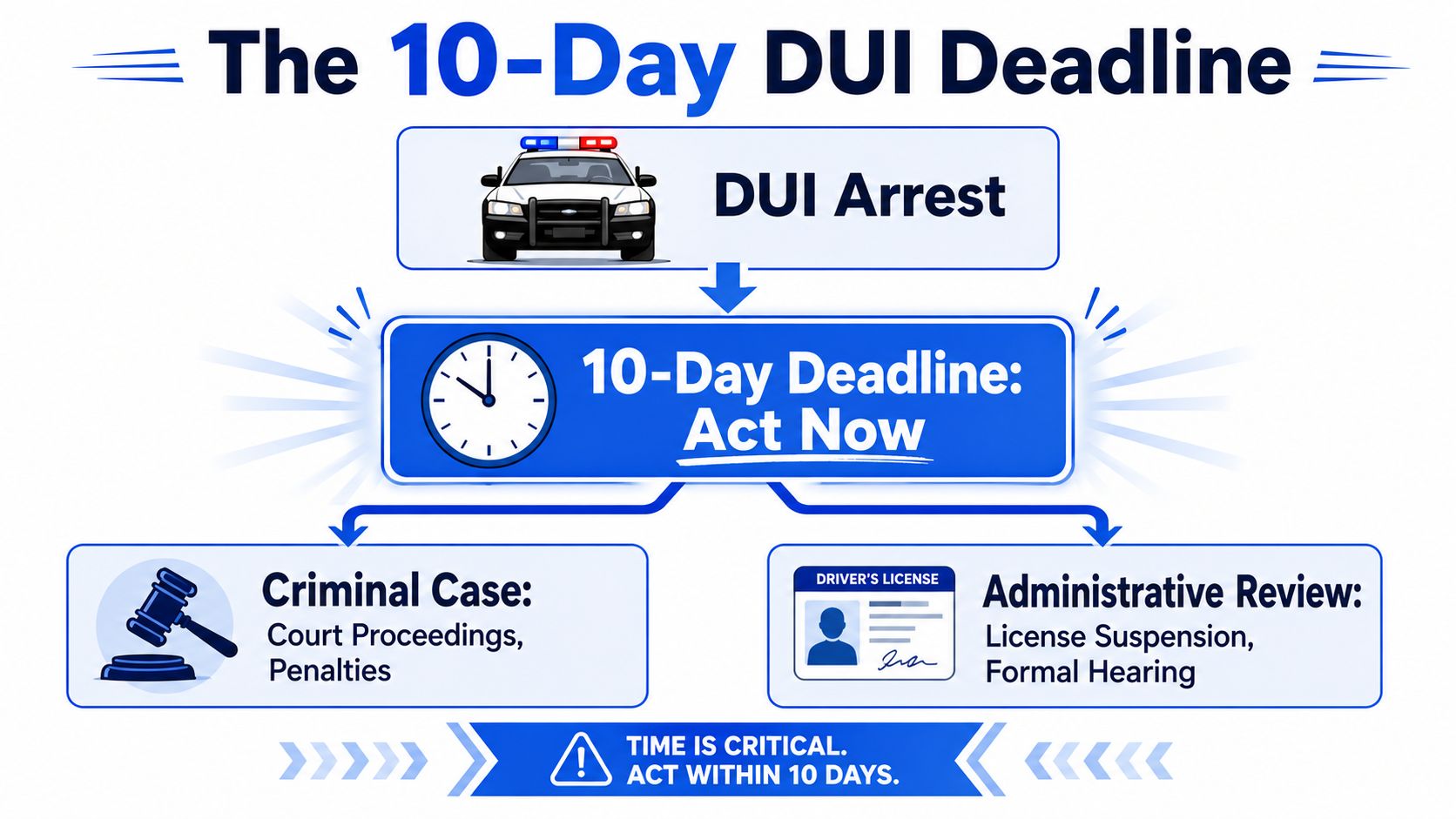
The 10-day rule is the deadline that controls whether you have any real chance to stop the automatic administrative suspension.
In Florida, drivers arrested for DUI have a critical 10-calendar-day window to request a formal review hearing with the FLHSMV. If you miss it, the suspension automatically activates on day 11, and it remains on your driving record for 75 years, even if the criminal charge is later dismissed, according to this Florida DUI license suspension explanation.
Here is the process in one view:
Why the deadline is separate from your court case
Most drivers make the same mistake. They assume the DUI charge and the license issue are one problem. They aren't.
One track is the criminal prosecution in court. The other is the administrative action against your license. You can fight the criminal case later and still lose the license issue now if you don't act within the deadline.
That's why this deadline is the center of any serious plan for how to avoid license suspension after DUI.
For a focused breakdown of the state process, review Florida DUI license suspension rules.
A quick visual explanation also helps if you're sorting this out under pressure:
What happens if you miss it
If you do nothing, the state does not wait. The suspension starts automatically. You lose the chance to challenge it through that administrative hearing path.
The countdown started when you were arrested, not when you hired counsel, got back to work, or decided to deal with it.
That's the trap. The deadline feels short because it is short.
Here's the practical effect:
Issue | What it means for you |
|---|---|
10 calendar days | Your window to request the hearing |
Day 11 | Automatic activation of the suspension if no hearing request is filed |
75-year record impact | The administrative suspension can remain on your driving record even if the criminal case later improves |
If you're still deciding what to do, decide fast. Delay is a decision in Florida, and it's usually the wrong one.
Should You Request a Formal Review Hearing or Waive It
Florida gives you two primary paths, and choosing the wrong one can cost you time, driving access, or both.
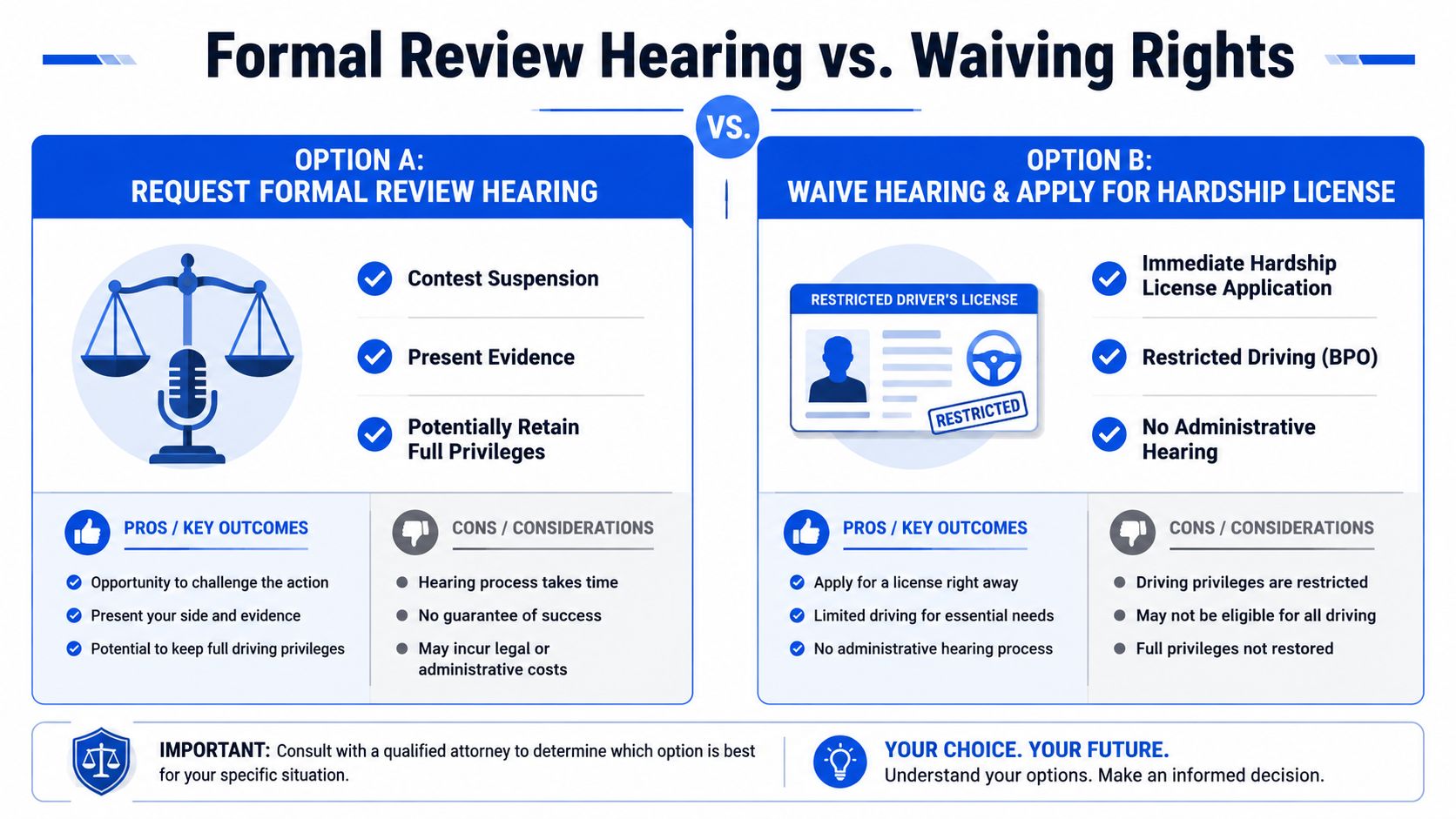
Drivers have two paths: demand a Formal Review Hearing to challenge the suspension and get a 42-day hardship permit, or waive the hearing to immediately apply for a hardship license by enrolling in Level I DUI School. Choosing the waiver often helps first-time offenders avoid the 30 or 90-day hard suspension period, according to this explanation of Florida administrative DUI options.
When a formal review hearing makes sense
A Formal Review Hearing is the aggressive option. You use it when there is something worth attacking in the stop, arrest, or suspension process.
This route can make sense if:
The stop looks questionable: Maybe the officer lacked a solid basis to pull you over.
The arrest procedure looks weak: Maybe the probable cause issue is stronger than you first thought.
You need immediate legal breathing room: The 42-day permit matters if you need to keep driving while the challenge is pending.
This isn't just a technical filing. It's a chance to pressure the suspension itself.
Strategic advice: If there is a real defense to the stop or arrest, preserving the hearing can be the strongest move because it creates a direct challenge to the administrative action.
For more on that process, see how a Florida administrative license suspension hearing works.
When waiving may be the smarter move
Waiving the hearing can be the smarter call when the facts are not friendly and the immediate goal is restricted driving as fast as possible.
That often happens when the evidence is straightforward and you need to protect your ability to work, care for family, or keep a commercial routine together. In those cases, trying to fight everything can backfire if it delays the only realistic path back to lawful driving.
A waiver route usually fits drivers who need practicality over combat.
Side-by-side comparison
Option | Main benefit | Main downside | Best for |
|---|---|---|---|
Formal Review Hearing | Challenge the suspension and obtain a 42-day permit | You still need a real legal basis to attack the case | Drivers with viable stop or arrest issues |
Waive and seek hardship | Faster path toward restricted driving eligibility | You give up the administrative challenge | Drivers focused on getting back on the road for essential needs |
What I tell clients is simple. Don't choose based on hope. Choose based on facts.
If your case has legal defects, preserve the fight. If it doesn't, stop pretending it does and move toward lawful restricted driving. Good DUI defense is strategic, not emotional.
How Do You Get a Florida Hardship License
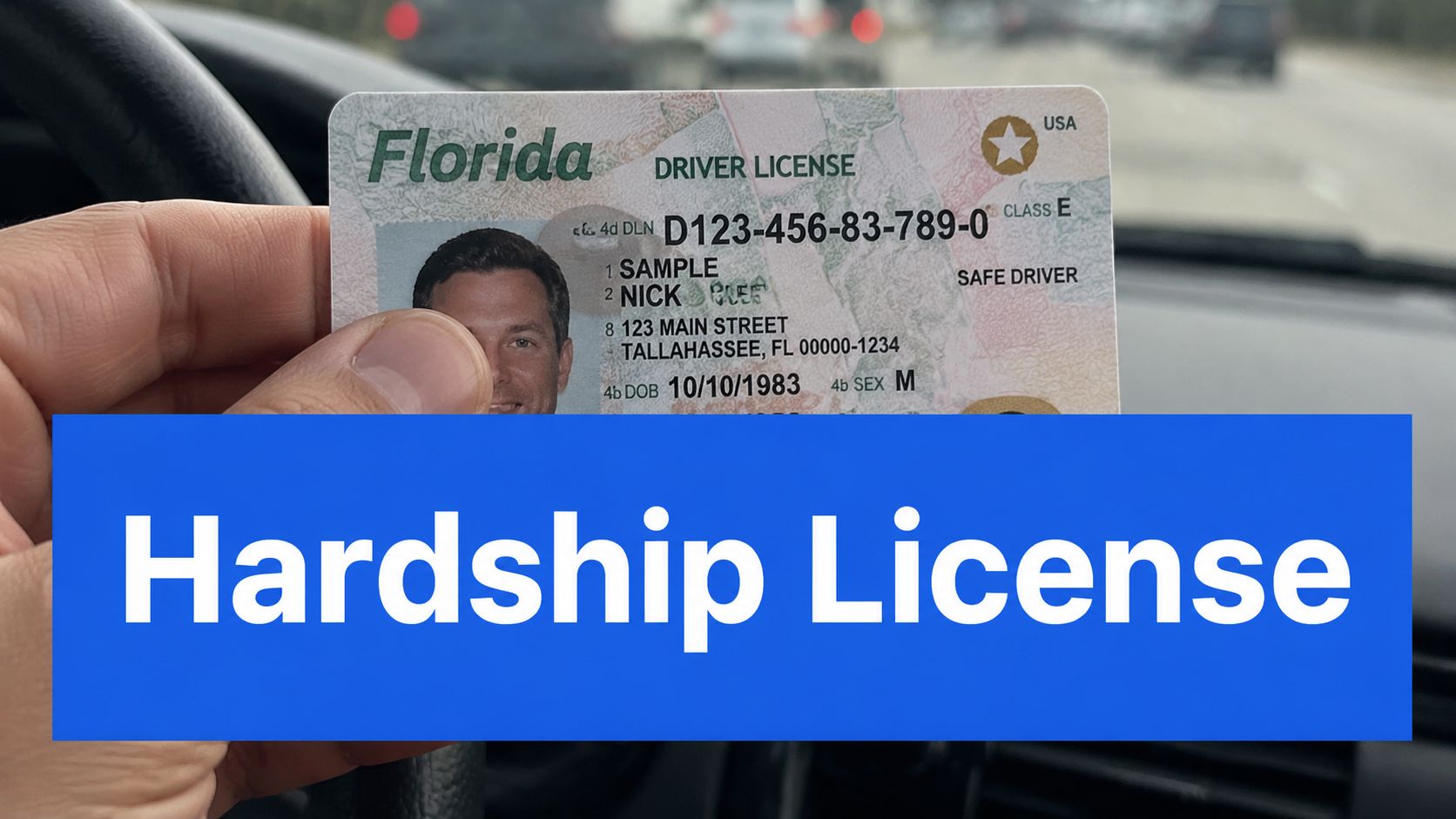
A hardship license is the fallback that keeps many drivers employed. It is not full freedom. It is restricted driving for business purposes only, and you need to respect that limitation.
In Florida, a first-time DUI arrest with a breath or blood test result of 0.08% or higher triggers an immediate administrative license suspension of 6 months, including a mandatory 30-day hard suspension where no driving privileges are allowed under Florida Statute §316.1932, as outlined by this summary of Florida DUI law.
What business purposes only really means
Business purposes only usually means driving that is essential, not convenient. Work travel. Driving to maintain your livelihood. Necessary obligations like school or medical needs can also become part of the analysis depending on your status and approval.
It does not mean open-ended personal driving. It does not mean “I needed groceries at midnight.” If your license is restricted, act like it.
That's especially important around busy court systems like the Edgecomb Courthouse in Tampa, where judges and agencies see the same avoidable violations over and over. Drivers get relief, then lose it by treating a hardship license like a normal license.
Immediate steps to take
If hardship relief is your route, keep it simple and disciplined:
Enroll in DUI school promptly: Florida requires DUI school as part of the hardship path.
Gather your paperwork early: Incomplete submissions slow everything down.
Know your restriction before you drive: If the license says business purposes only, follow that exactly.
Carry proof with you: If your status depends on enrollment or restricted privilege, keep the documentation in the vehicle.
Finish required coursework on time: If the Department requires completion within a stated period, missing that deadline can put you right back in trouble.
You can review more on the process through this guide to Florida hardship licenses.
Where drivers get into trouble
The hardship license helps only if you treat it like a legal lifeline. Drivers lose it by improvising, skipping school requirements, or driving outside the restriction.
A restricted license is a narrow privilege. Respect the limits and it can keep your job intact while your case moves forward.
What Common Mistakes Guarantee a Suspension
Some drivers lose their license because the facts are bad. Many lose it because they make bad decisions after the arrest.
The fastest way to wreck your position is to believe common DUI folklore. Florida punishes certain mistakes hard, and one of the worst is thinking a refusal is automatically safer than taking the test.

The refusal myth hurts drivers
If a driver in Florida refuses a lawful breath test, they face an automatic 12-month administrative license suspension with a 90-day hard suspension. A second refusal can be charged as a first-degree misdemeanor under Florida Statute §316.1932, according to this discussion of Florida implied consent penalties.
That is why refusal is not some magic defense move. In many cases, it creates a harsher administrative problem.
Don't rely on roadside myths. Refusal can create damage that lasts far beyond the arrest night.
The errors that cost people their license
These are the mistakes that repeatedly sink drivers:
Missing the filing deadline: Once that window closes, your options shrink fast.
Assuming the criminal case controls everything: It doesn't. The license issue has its own life.
Driving as if a hardship license has no restrictions: That can trigger immediate trouble.
Ignoring paperwork from the state: Administrative cases punish inattention.
Waiting for an app or intake team to “process” your case: Delay is deadly in DUI license defense.
The mindset that causes most problems
A lot of people want reassurance more than strategy. They want someone to tell them, “It'll probably be fine.” That's not legal protection. That's emotional anesthesia.
The right move is to treat every post-arrest decision as if it affects your driving privilege, because it does. If your goal is to avoid license suspension after DUI, discipline matters as much as defense.
Why Your Choice of Attorney Is Your Most Powerful Defense
A DUI is not a routine ticket. It's not something you should hand to an automated app, a chatbot, or a volume-based ticket mill that routes your questions through staff. Your license, your record, and your criminal exposure require actual legal judgment.
That matters even more because the administrative suspension remains on a driver's record for 75 years even if the criminal DUI charge is reduced or dismissed. The administrative review hearing is the only procedural mechanism to invalidate the suspension and prevent that permanent record marker, according to this analysis of Florida DUI license suspension consequences.
A DUI case is not an app problem
Technology can help with reminders. It can't make legal decisions for you.
A real Florida DUI defense lawyer should know how to evaluate the stop, the arrest, the testing sequence, and the timing of every administrative filing under Chapter 316, including §316.1932. That lawyer should also be accessible when your situation changes, not after a support queue gets around to you.
The value of lawyer-led representation is evident. You need direct answers, fast. You need someone who can tell you whether to fight the suspension, waive into hardship, or attack the case on both fronts.
What real Florida DUI defense should look like
Strong DUI representation should be direct and hands-on:
You speak with your attorney, not a middleman: That matters when your deadline is immediate.
The administrative issue gets addressed first: Because losing your license early changes everything.
The criminal defense is built at the same time: The two tracks are different, but they affect each other strategically.
You get practical guidance, not canned reassurance: You need decisions, not scripts.
If you're evaluating counsel, start with experienced Florida DUI attorneys who focus on license protection. Then ask the question that matters most. “Will I speak directly with my lawyer by phone or text when my driving privilege is on the line?”
That answer tells you a lot.
If you were just arrested, move now. Ticket Shield, PLLC is a lawyer-led Florida defense firm where you speak directly with your attorney by phone or text, not a chatbot, not a middleman, and not a ticket mill. When your license and record are in danger, speed and legal judgment matter. Visit TicketShield.com for a free consultation and fight for the No Points goal.
