How to Avoid License Suspension in Florida: A 2026 Guide
Learn how to avoid license suspension in Florida. Our guide covers DUI, points, and HSMV hearings. Protect your driving privileges with expert legal defense.

You saw the lights. Your stomach dropped. Now you're worried about one thing: can you keep your license?
Yes, sometimes you can. But only if you move fast, stop making “easy” mistakes, and treat this like a legal deadline problem, not just a ticket problem.
Table of Contents
What Are Your Immediate First Steps After a Citation or DUI?
What Are Your Defense Strategies to Avoid Points and Conviction?
What If Suspension Is Unavoidable? Understanding Hardship Licenses and SR-22s
How Do Special Rules Affect Commercial, Gig, and Military Drivers?
Your Florida License Is at Risk. What Happens Now?
TL;DR: To avoid license suspension in Florida, act immediately. Don't pay the ticket blindly, don't miss notices, and don't ignore administrative deadlines. Fast, documented legal action gives you the strongest chance to protect your driving privilege and keep points off your record.
A Florida traffic stop can turn into a license problem fast. A speeding citation under Florida Statute 316.187 may look routine. It isn't. The moment you get cited, you are inside a system with deadlines, notices, and consequences that can end with a suspended license if you handle it casually.
That risk gets worse when drivers treat the ticket like a nuisance instead of a file that needs immediate attention. A national review found that 43 states, including Florida, use license suspension to enforce payment of government debt, and in 2017, over 11.1 million suspensions were issued nationwide, with 42.3% tied to failure to appear in court and 22.4% for failure to pay fines, according to the Driven by Dollars national review.
If your case is headed to a serious courthouse like the Edgecomb Courthouse in Tampa, you don't need an app sending canned updates. You need a real defense plan. Automated ticket platforms and ticket mills process volume. They rely on middlemen, scripts, and chat-style communication. That is the wrong model when your license is on the line.
Why drivers lose their license by mistake
Most suspensions don't start with reckless behavior. They start with inaction.
Practical rule: The first danger usually isn't the allegation itself. It's the missed response, the missed notice, or the missed court date that follows.
That means your first job is to control the procedure. Save every paper. Confirm every date. Find out whether you're dealing with a civil citation, a criminal charge, or an administrative license issue that runs separately from court.
If your stop involved phone use, it also helps to understand how Florida traffic enforcement has changed. This guide to Florida's 2026 cell phone rules gives useful context on how common roadside scenarios can create citation exposure.
Why a lawyer-led response matters immediately
You should be able to text or call the lawyer handling your case. That should be standard. It isn't.
A lawyer-led defense means someone reviews the citation, identifies the suspension path, and tells you what needs to happen first. That may include preserving a hearing right, challenging the stop, fixing an address issue, or stopping you from making the mistake that hurts more than the original ticket. If you want a fuller breakdown of common suspension triggers, review this Florida driver license suspension overview.
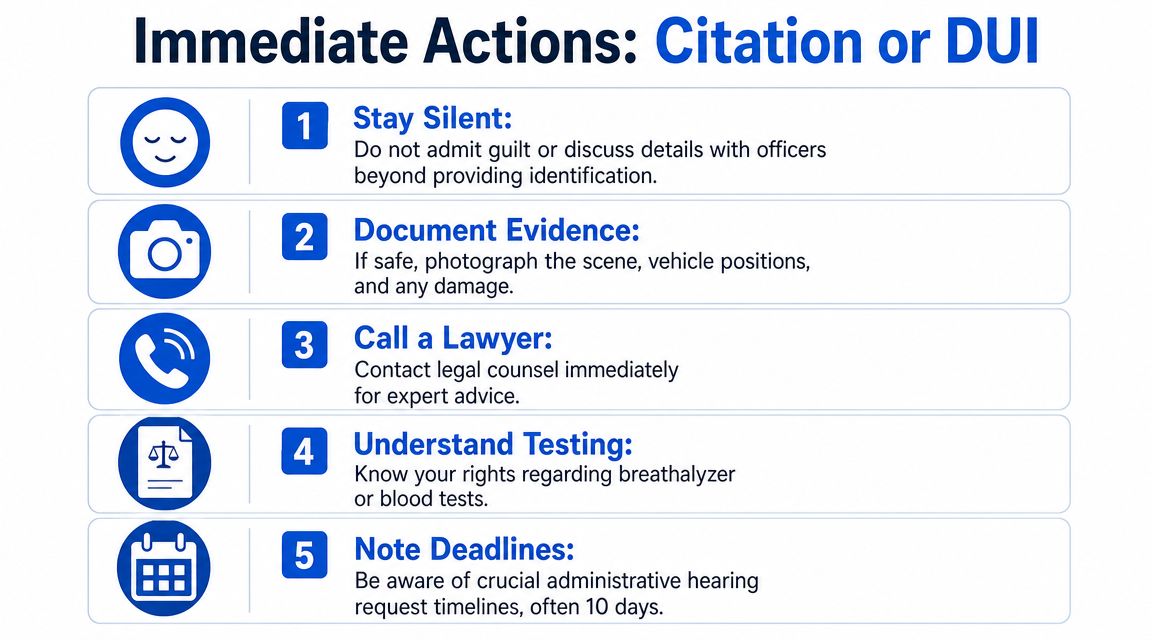
What Are Your Immediate First Steps After a Citation or DUI?
Your first 48 hours matter more than most drivers realize. During this time, people either protect the case or damage it.
What should you do right away
Start with discipline. Not panic.
Read every line of the citation: Look for the charge, hearing instructions, response deadline, and whether the matter is traffic-only or tied to a criminal allegation.
Secure your documents: Keep the ticket, any bond paperwork, tow paperwork, insurance card, and your driver information together in one place.
Write down what happened: Do it while the details are still fresh. Include where you were, what the officer said, road conditions, witnesses, and anything unusual.
Preserve physical proof: Save dashcam footage, phone records if relevant, repair receipts, registration proof, and photos of the scene if you can safely get them.
Check your address on file: A common failure point is an incorrect address with the licensing authority. Missed mail can become missed hearings, and missed hearings become suspension problems.
One legal guidance source emphasizes that the most effective way to prevent a points-based suspension is to act before it's imposed, and that an incorrect address on file can cause you to miss important notices. It also warns that the administrative clock matters more than the allegation, because a missed hearing can turn a contestable ticket into an automatic suspension trigger, as explained in this license reinstatement process discussion.
What should you avoid doing
These mistakes are expensive.
Don't pay the ticket just to get it over with: In many situations, payment functions like a guilty resolution. That can affect points and your record.
Don't explain the case to everyone: Friends, employers, and online forums don't protect your privilege to drive.
Don't rely on memory: Documentation beats verbal explanations.
Don't assume court notices will sort themselves out: If your address is wrong, the system won't pause for you.
Don't wait to get legal advice: Delay is how drivers lose options they could have preserved.
If you're trying to figure out whether paying now will hurt you later, stop and get the answer before you click anything.
What should your next call be
Your next call should be to a traffic defense attorney who handles Florida license-risk cases every day. Not a chatbot. Not a call center. Not a platform that treats your case like a support ticket.
A lawyer can identify whether the primary danger is points, a default, an administrative suspension, or a related charge that changes the whole strategy. If you need a practical starting point, this what to do when you get a ticket guide lays out the first response issues Florida drivers should check.
How Do You Navigate the HSMV Administrative Hearing?
Drivers often get blindsided by what lies beyond the courtroom. They think the court case is the whole fight. It isn't.
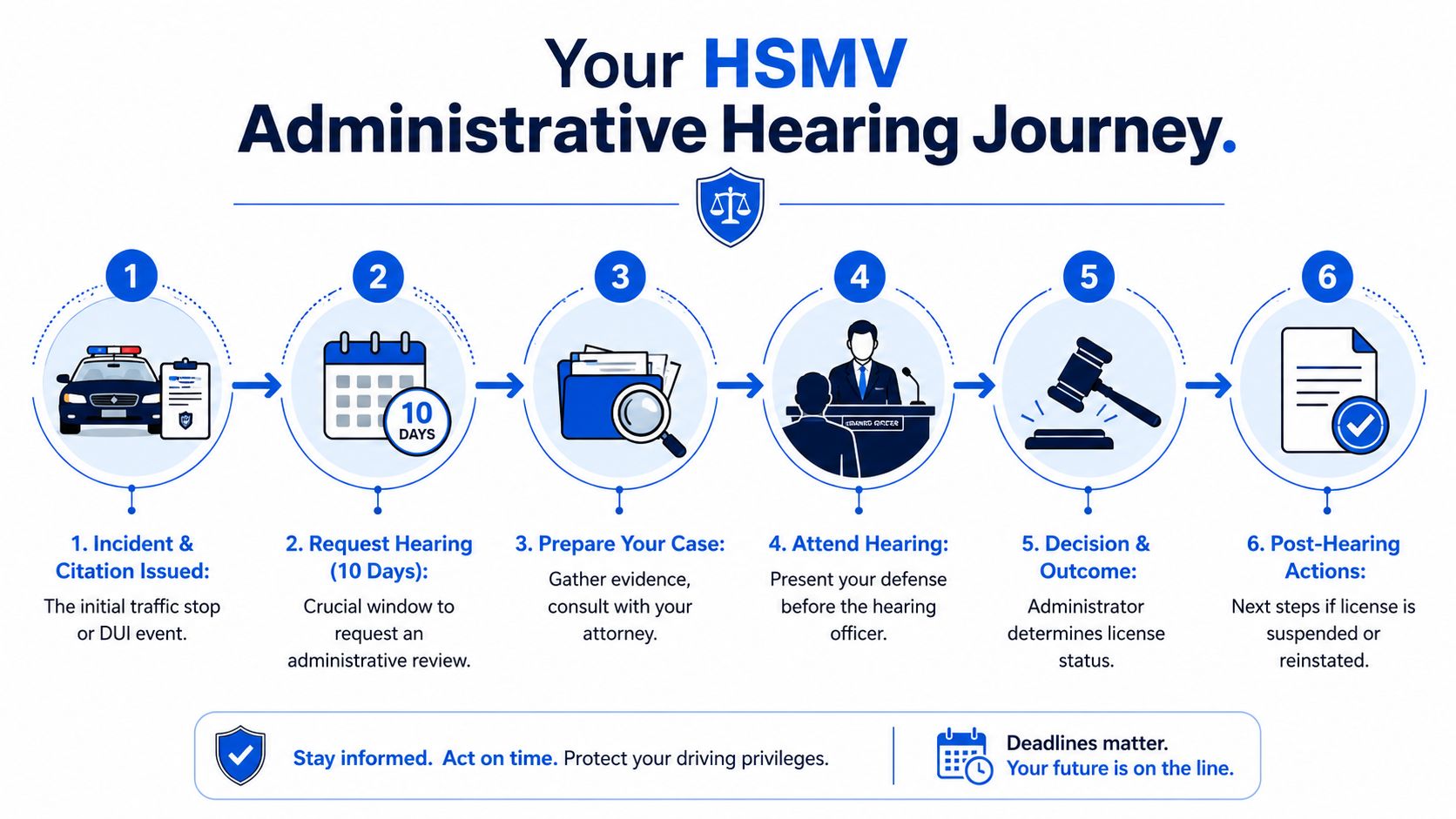
For many Florida drivers, the administrative process with the licensing authority is a separate battle over your ability to drive. That issue can move on its own timeline, and it can punish delay faster than the courtroom does.
Why the hearing deadline matters more than most drivers think
For DUI-related suspension avoidance, the most important variable is often not the criminal case. It's the administrative hearing deadline. One legal source explains that a hearing request with payment must often be postmarked within 10 days of arrest to preserve driving privileges, and that the hearing is typically scheduled about 4 to 6 weeks later, as outlined in this license suspension FAQ.
That short filing window changes everything. If you miss it, the issue may stop being “How do I defend this?” and become “How do I survive the suspension?”
Your license can be lost on paperwork timing alone. That's why speed matters even when the facts are still being investigated.
What is the hearing actually about
The administrative hearing is about your driving privilege. It is not the full criminal trial. That distinction matters because drivers often wait to “see what happens in court” and lose the separate right to challenge the suspension path.
A careful lawyer uses this stage to examine procedure. Was the stop lawful? Was notice handled correctly? Were required steps followed? Was there a basis to trigger the administrative action in the first place? Those are not app-level questions. They are file-specific legal questions.
How should you approach the timeline
Treat it like a controlled sequence.
Confirm the trigger date: The clock starts from the event that created the administrative risk.
Request the hearing immediately if available: Waiting to gather every fact first is often the wrong move.
Collect supporting records: This can include the citation, probable cause materials, witness information, and any relevant documents tied to the stop.
Separate the two tracks: Your court defense and your license defense may overlap, but they aren't identical.
Prepare for the post-hearing result: Even a strong challenge needs a backup plan.
The reason this process defeats so many drivers is simple. It rewards organization, not optimism.
What does lawyer-led handling change
A lawyer who works these deadlines regularly doesn't just argue the hearing. That lawyer protects the timeline, preserves your rights, and keeps your case from drifting into avoidable default. If you need a Florida-focused breakdown of that process, review this administrative license suspension hearing guide.
What Are Your Defense Strategies to Avoid Points and Conviction?
Avoiding suspension isn't only about beating back paperwork. It's also about attacking the underlying charge in the right way.

A real defense is strategic. It doesn't mean chasing magic loopholes. It means examining evidence, forcing the state to prove its case, and finding outcomes that protect your record from points and conviction damage.
One major lesson from policy research is that suspension risk often has little to do with dangerous driving. In a multi-state analysis, 91% of suspensions were for non-driving-related issues, and failure to pay accounted for 55% of them, according to this multi-state suspension analysis. That means your defense may need to address court compliance and financial issues, not just the allegation on the ticket.
How do you fight the charge itself
A strong defense usually starts with pressure points in the file:
Challenge the stop: If the officer lacked a valid basis, the case may weaken immediately.
Challenge the proof: Radar issues, observation issues, paperwork defects, and witness problems all matter.
Challenge the narrative: Officers summarize events. They don't own the truth of them.
Use documentation: Photos, repair records, registration proof, insurance proof, and timeline notes can make a difference.
What does a no-points strategy look like
In practical terms, a no-points strategy often means working toward an outcome that avoids a formal adjudication with points attached, or gets the case reduced or dismissed where the facts support it. That is not automatic. It takes review, negotiation, and judgment about what result protects you long term.
Automated services struggle in these situations. They can intake a citation, but they cannot think like a lawyer. They cannot make strategic decisions about whether to contest aggressively, negotiate discreetly, or solve a court-compliance issue first because that's the primary suspension threat.
One Florida option drivers use is Ticket Shield, PLLC, a lawyer-led traffic defense firm that handles citations and related license-risk issues with direct attorney communication by phone or text. That direct access matters when deadlines are short and the facts keep changing.
A processed ticket is not the same thing as a defended case.
When is negotiation the right move
Not every case should be tried to the edge. Some cases should be positioned for reduction. Some should be set for dismissal arguments. Some should focus on avoiding points because the driver's record, insurance exposure, or employment risk makes that the smarter target.
This short video gives a useful overview of traffic defense issues that can affect your record and driving privilege.
The right strategy depends on what threatens you most. For one driver, that's points. For another, it's a pending suspension trigger. For a third, it's the job consequences that follow a conviction. The point is simple. You need a defense built around your risk, not a one-size-fits-all workflow.
What If Suspension Is Unavoidable? Understanding Hardship Licenses and SR-22s
Sometimes the goal shifts. Instead of stopping every consequence, you focus on preserving legal driving for essential needs and clearing the path back to full reinstatement.
That doesn't mean giving up. It means acting intelligently.
What is a hardship license in Florida
A hardship license is limited driving authority. It allows certain restricted driving after a suspension, depending on the basis of the suspension and your eligibility.
Florida drivers usually hear two labels:
Florida Hardship License Comparison | Permitted Driving Activities |
|---|---|
Business Purposes Only | Driving necessary for work, school, church, medical care, and other essential household obligations |
Employment Purposes Only | Driving necessary to and from work, and driving required as part of work duties |
The exact scope matters. If your job depends on broad daytime travel, the distinction is not minor. You need the restriction category that fits your life.
What should you do if a hardship path is available
Move carefully and document everything.
Confirm the suspension basis: Different suspensions create different barriers and conditions.
Check whether your license is otherwise valid: Some systems won't grant limited privileges cleanly if the license has also expired.
Gather hardship proof: Employment letters, school schedules, medical records, treatment compliance records, and proof of residence all help.
Follow every reinstatement condition: If a course, filing, insurance document, or fee requirement applies, complete it correctly and keep proof.
Avoid informal driving assumptions: “I only drove to work” doesn't protect you if the privilege wasn't formally granted.
One recurring issue in limited-privilege systems is expiration during suspension. Administrative guidance from another state notes that limited privileges may require the license not be expired and that added court action may be needed if expiration happens during the suspension period. The practical lesson for Florida drivers is simple: don't let a separate renewal problem stack on top of the suspension problem.
What is an SR-22
An SR-22 is not insurance itself. It is a certificate of financial responsibility that an insurance company files to show required coverage is in place.
Drivers often get this wrong and lose time. They shop for “SR-22 insurance” without confirming whether an SR-22 filing is required in their situation, when it must be filed, and how it fits with reinstatement.
If you're facing a limited-license route, this Florida hardship license application guide can help you understand the process and the paperwork issues that usually slow drivers down.
How Do Special Rules Affect Commercial, Gig, and Military Drivers?
If you drive for a living, a “small” case can become a career problem fast. That includes commercial drivers, rideshare and delivery workers, and military personnel whose records affect clearance or command issues.
Generic advice fails these drivers because it treats suspension like an inconvenience. It isn't. It can shut off income, trigger deactivation, or create professional fallout that lasts longer than the traffic case.
Administrative guidance on limited-driving privileges highlights an issue many drivers miss: for a lot of people, suspension is primarily about work. It also notes that documenting hardship and obtaining employer letters are critical steps often missed in generic advice, as discussed on the Ohio BMV limited driving privileges page.
What should commercial and gig drivers do differently
Protect the employment record from day one.
Get an employer letter early: Don't wait until after a suspension notice hardens your options.
Identify platform consequences: Rideshare and delivery drivers should review their platform status rules immediately.
Separate personal convenience from legal necessity: Work-related driving needs should be documented, not just described.
Preserve income records: If hardship relief becomes possible, proof of work patterns can matter.
Don't assume a traffic school style fix solves everything: For work drivers, the issue is often the record impact, not just the fine.
For working drivers, the right question isn't “Can I live with this ticket?” It's “What does this do to my income next month?”
Why military drivers need a more careful response
Military drivers face extra pressure because the fallout can reach beyond court. A conviction or unresolved suspension issue can raise questions that affect duty status, driving-related assignments, base access, or security-sensitive roles.
If your case has any military-justice overlap, chain-of-command implications, or related service concerns, a directory like the UCMJ Lawyer Directory can help you identify military-focused legal support for that separate layer.
When should you act
Immediately. Not after the first missed court date. Not after account deactivation. Not after command asks questions.
Drivers in these categories need a defense that accounts for the traffic case and the work consequences together. That's how you avoid making a “fine-only” decision that costs far more than the citation itself.
If your goal is No Points, don't guess and don't wait. Get a real Florida lawyer to review the citation, protect the deadlines, and build a strategy around your license, your record, and your job. Visit Ticket Shield, PLLC for a free consultation.