How Much Is the Ticket for Driving Without a License
Wondering how much is the ticket for driving without a license? In Florida, it is a crime, not a fine. Learn the 2026 penalties and how to protect your record.

You got pulled over. The officer handed you a citation. Now you're searching one thing: how much is the ticket for driving without a license.
That question makes sense. It's also the wrong way to think about this in Florida.
If you were cited for driving without a valid license, you may be dealing with a criminal case rather than a routine traffic payment. That changes everything. It changes what happens next, where you go to court, how a prosecutor views you, and what can end up on your record. If your case is in Orlando, that may mean dealing with the Orange County Courthouse instead of paying a fine and moving on.
Florida traffic law often starts in Chapter 316, but this specific issue also turns on Florida's driver-license laws. The legal detail matters. Your defense has to match the exact charge, not the shorthand people use online.
Table of Contents
Your "Ticket" Is More Than Just a Fine
In Florida, the ‘ticket' for driving without a license is a criminal charge, not a simple fine. A first offense is a misdemeanor with penalties up to a $500 fine and 60 days in jail, plus a permanent criminal record.
If you're asking how much is the ticket for driving without a license, you're probably assuming you can just pay it and move on. In many Florida cases, that assumption is dangerous.
This charge is often treated as a criminal misdemeanor, not a basic civil infraction. Florida sources addressing driving without a valid license explain that a first offense is generally a second-degree misdemeanor, punishable by up to 60 days in jail and a fine of up to $500 according to this Florida explanation of driving without a license penalties.
That means your exposure isn't limited to the number printed on the citation. It can include court costs, time in court, and the consequences of a criminal conviction showing up later when an employer or licensing board looks at your history.
Practical rule: If the charge can create a criminal record, you should not treat it like a payable ticket.
Many drivers make the same mistake. They focus on the immediate fine and ignore the long-term damage. That's backwards. The primary threat is the record, not just the payment window.
If you're worried about what a case like this can look like later, review how traffic tickets can affect background checks. That issue becomes far more serious when the citation is tied to a criminal offense instead of a routine moving violation.
What Are the Legal Penalties for Driving Without a License
If you were handed a citation and want to know the price tag, start with the actual answer. In Florida, the penalty is not just a fine. It is exposure to a criminal misdemeanor case, possible jail, court costs, and a record that can follow you long after the stop is over.
Florida usually prosecutes these cases under Florida Statute §322.03. The traffic stop may begin on the road under the broader rules in Chapter 316, but the charge itself can land you in criminal court.
What the statute punishes
A first offense for driving without a valid license is generally charged as a second-degree misdemeanor. That means up to 60 days in jail and a fine of up to $500, as described in this Florida discussion of §322.03 penalties.
That number answers only part of the question.
The bigger problem is the type of case. A misdemeanor charge is different from a routine payable traffic citation. You may have to appear in court, answer a criminal charge, and deal with the fallout of a conviction instead of paying a clerk and forgetting about it. If you want a focused explanation of the offense itself, review Florida charges for driving without a license.
How the penalties escalate
Repeat cases get more dangerous fast.
Offense | Criminal Classification | Maximum Jail Time | Maximum Fine |
|---|---|---|---|
First offense | Second-degree misdemeanor | Up to 60 days | Up to $500 |
Second offense | First-degree misdemeanor | Up to 1 year | Up to $1,000 |
Third or subsequent offense | Repeat-offender exposure with mandatory jail consequences | Includes mandatory minimum jail exposure | Fine exposure escalates |
Florida changed the law in 2024 to punish repeat offenders more aggressively. A second offense can be charged as a first-degree misdemeanor with up to 1 year in jail and up to a $1,000 fine. A third or later offense can trigger a mandatory minimum jail term.
That is why calling this a ticket is a mistake. The first case is serious. A repeat case is worse. If you have prior history, the State may treat this as a much higher-stakes criminal matter than you expect.
Does It Matter If My License Was Expired vs Never Issued
Yes. It matters a lot.
A driver with an expired license is not in the same position as a driver who was never issued a license. And neither situation should be confused with a more serious suspended-or-revoked matter. Courts, prosecutors, and defense attorneys all look at those categories differently.
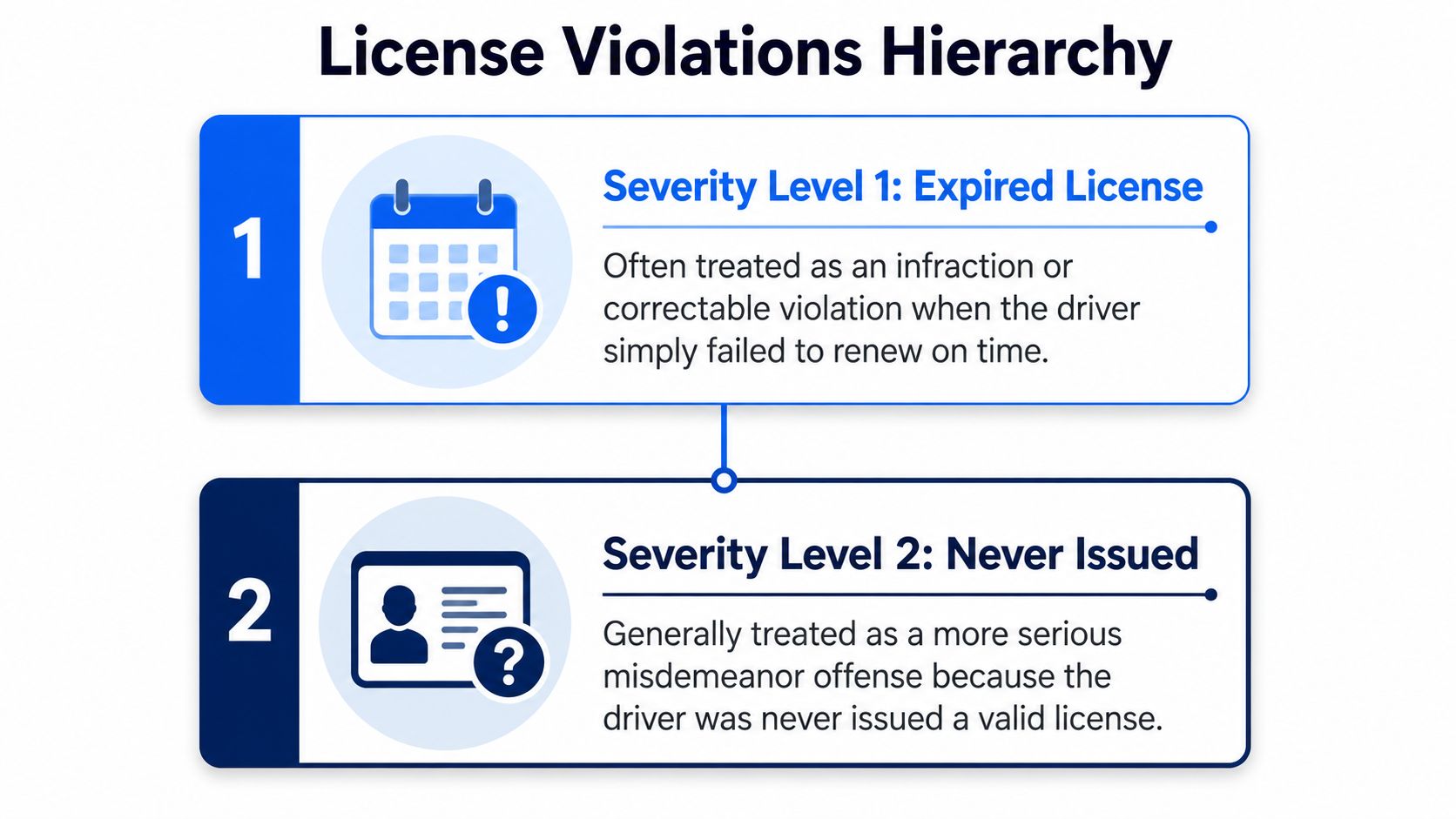
Why the exact charge controls the outcome
When people search how much is the ticket for driving without a license, they usually collapse several different situations into one. That's a problem because the legal exposure can change fast depending on what happened.
An expired license often presents as a compliance issue. A never-issued license can be treated as a more serious failure to meet the legal requirement to drive. A suspended or revoked status is more serious still and usually calls for a more aggressive defense.
One legal summary of the issue notes that the penalty exposure changes dramatically based on the specific charge. It explains that a simple expired license may be resolved more easily than a charge for never having been licensed, while driving with a suspended or revoked license is often treated much more harshly with enhanced penalties and greater jail exposure, as discussed in this overview of how charge type affects severity.
The Florida takeaway is simple. Do not assume your case is minor just because the officer used casual language at the roadside.
If your issue is expiration rather than never having been licensed, review what happens when you drive with an expired license in Florida. That's often a very different conversation than a true no-license case.
What to do right away
Your first move should be practical, not emotional.
Read the citation carefully. The wording matters. “No valid driver license,” “expired,” and suspended-license language do not mean the same thing.
Fix what can be fixed quickly. Some Florida sources note that in certain situations a clerk may dismiss the charge if you obtain a valid license before the court date. Timing matters.
Do not plead blind. If you don't know what the State can prove, you don't know whether a plea helps you or hurts you.
Protect your record first. The right result isn't always the fastest result.
If you had a fixable licensing problem, correcting it before court can change the conversation.
What Factors Increase the Penalties
The court looks at one question first. Is this a one-time licensing problem, or are you starting to look like someone who ignores Florida driving laws?
That distinction changes everything.
Repeat offenses changed in 2024
Repeat history is the biggest penalty driver. Florida got tougher in 2024 on repeat no-license cases, and if this is your third or later case, jail is no longer an abstract risk. It becomes part of the exposure the judge has to consider.
That is why calling this a "ticket" is a mistake. A repeat case can put you in a position where the actual cost is your record, your time, your job stability, and the insurance fallout that often follows any driving-related conviction. If you are worried about the insurance side, read how to fight Florida tickets to keep lower insurance rates.
Other facts that make the case worse
Some facts make prosecutors less willing to cut a break, and judges less interested in excuses.
A prior record: Prior traffic crimes or a pattern of driving violations makes your case look deliberate, not accidental.
No fix before court: If you still have not gotten valid driving privileges by the court date, you lose one of the strongest arguments for leniency.
A bad stop fact pattern: If the officer stopped you for speeding, a crash, reckless driving, or another violation, the no-license charge gets harder to minimize.
Poor handling after the citation: Missing court, failing to respond, or showing up unprepared tells the court you are still not taking the charge seriously.
Prosecutors judge these cases fast. If your record is messy, the stop was tied to another problem, and you still have not fixed the license issue, the case stops looking like a simple mistake.
Act early. Get the license problem addressed if you can. Then have a lawyer build the case around mitigation before the State builds the case around punishment.
What Are the Hidden Costs of a Conviction
Most drivers fixate on the fine. That's understandable. It's also shortsighted.

The fine is only the front-end cost
The full financial damage of a conviction goes well beyond the statutory fine. One legal resource explaining these cases notes that the total impact can include court costs, potential vehicle impoundment fees, significant long-term insurance surcharges, and lost income from being unable to drive for work. It also explains that this is a must appear offense in court, which adds time and legal-cost exposure, as discussed in this breakdown of the real costs of a no-license case.
That's the part many drivers miss. The court penalty is only the first invoice. Insurance can get worse. Work gets harder. Transportation gets unstable. A criminal record can keep costing you long after the case closes.
If your goal is to protect premiums, review how fighting Florida tickets can help keep lower insurance rates.
Bottom line: The cheapest-looking outcome in court can become the most expensive outcome in real life.
Why drivers who rely on a car get hit harder
If you drive for work, this kind of case can hit fast. Gig drivers, sales professionals, field techs, home-health workers, and anyone commuting long distances feel the damage first.
A court date means missed work. A licensing problem means driving interruptions. An insurance problem means a higher monthly burden. A criminal record can create another layer of pressure when you apply for a new job or try to keep the one you have.
This short video helps frame why traffic cases should be handled strategically, not casually.
The smart question isn't just “how much is the ticket for driving without a license.” It's “what will this conviction cost me over the next few years if I handle it badly?”
How an Attorney Protects You from a Criminal Record
A good defense starts with one priority. Keep this from becoming a conviction if there is a lawful path to do that.
At the Orange County Courthouse and across Florida, that usually means looking hard at your license history, the wording of the citation, whether the issue was corrected quickly, and whether the charge can be reduced or resolved without leaving you with a criminal record.

What a lawyer actually does in these cases
An attorney doesn't just “show up in court.” A strategic lawyer does specific work.
Verifies the exact charge. That sounds basic, but it's where many defenses begin.
Reviews whether the license issue was cured. If you became valid before court, that can matter.
Pushes for dismissal or reduction when the facts support it. The goal is to avoid a criminal outcome whenever possible.
Protects against avoidable admissions. Drivers often say too much early and hurt their own case.
If you need help understanding what dismissal work can look like, review how a traffic ticket dismissal lawyer approaches Florida cases.
Why direct attorney access matters
This is not a case for an automated app, a chatbot workflow, or a ticket mill where you never know who is handling your file.
You need a lawyer-led defense. You need to be able to ask direct questions and get direct answers. That's especially true in a criminal traffic case, where small facts can change the outcome. Ticket Shield, PLLC handles Florida traffic defense with direct attorney communication by phone or text, rather than routing clients through middlemen or automated support.
When you're trying to avoid points, protect your record, and keep your ability to drive, that kind of direct access matters.
If you've been charged and want a No Points strategy that protects your record, your license, and your insurance, visit Ticket Shield, PLLC for a free consultation.