How Much Is a Ticket for Driving Without a License
Wondering how much is a ticket for driving without a license? Discover the true 2026 Florida fines, penalties, and how to protect your driving record.
If you're asking how much is a ticket for driving without a license in Florida, start with this: it may not be a simple ticket at all. A first charge can be a criminal offense with up to 60 days in jail and up to a $500 fine.
You got pulled over. The officer ran your information. Then the stop got more serious than you expected.
That's where many drivers make the worst mistake. They assume this is just another traffic citation they can pay and forget. In Florida, that assumption can leave you with a criminal record, court costs, insurance problems, and a much harder case than you needed to have.
If you're holding a citation right now, stop treating it like a routine fine. Start treating it like a legal problem that needs a strategy. A good first step is learning what to do when you get a ticket in Florida.
Table of Contents
Your Guide to a Driving Without a License Charge
If you searched “how much is a ticket for driving without a license,” you're probably looking for a dollar amount. That's understandable. But in Florida, the better question is whether you were given a civil infraction or a criminal charge.
That distinction controls everything. It affects whether you're walking into a clerk's office problem or a courtroom problem. It affects your risk, your options, and how aggressively you need to respond.
You also need to know that traffic law in Florida doesn't live in one box. Drivers often hear about Chapter 316 because that chapter covers many moving violations, including provisions like Florida Statute 316.187 for speed-related offenses. But license-related charges can also fall under separate driver licensing statutes, and that's why people get blindsided. They think “traffic ticket.” The court may see “criminal case.”
Practical rule: Before you think about paying anything, find out exactly what statute is listed on your citation and whether you were ordered to appear in court.
The right response depends on the exact wording of the charge, not what the officer called it on the roadside.
Is Driving Without a License a Crime in Florida?
You get stopped, the officer asks for your license, and a few minutes later you leave believing you got a ticket. Then you read the citation and see a court date.
That is the moment many Florida drivers realize they are not dealing with a routine infraction.
Under Florida Statute §322.03, driving without a valid driver's license can be charged as a criminal offense, not just a traffic violation. A first offense is generally a second-degree misdemeanor, with exposure that can include jail and a criminal record, as explained in this review of Florida driving without a license penalties under §322.03.
Treat that distinction seriously. If the citation requires a court appearance, you need to approach it as a defense case, not a payment problem.
You should also understand how Florida classifies criminal traffic violations in Florida, because that label changes how the court handles your case and what is at stake if you plead guilty.
Why the exact charge matters
Florida does not treat every license-related stop the same way.
A driver who has a valid license but failed to carry it is in a very different position from a driver who never had a valid license, let it expire too long, or was otherwise not legally licensed to drive. One may be a fixable citation. The other can put you in criminal court.
That is why I tell clients to stop calling every one of these cases a ticket. Some are tickets. Some are misdemeanor prosecutions dressed up to look like tickets.
Before you pay anything, confirm the statute on the citation and whether the case is civil or criminal.
That one step can keep you from handing the court a conviction.
Where Florida law gives you a narrow opening
Some first-time drivers do have a path to get out of this cleanly. If you were otherwise eligible and get properly licensed before court, §322.03(7) may allow dismissal through the clerk in the right case.
Do not assume that option applies automatically. It depends on the charge, your history, and whether you act quickly.
Speed matters here because delay shrinks your options. If your case is the kind that can be fixed, fix it fast. If it is charged as a criminal driving offense, build a defense before your court date.
What Are the Fines and Jail Time
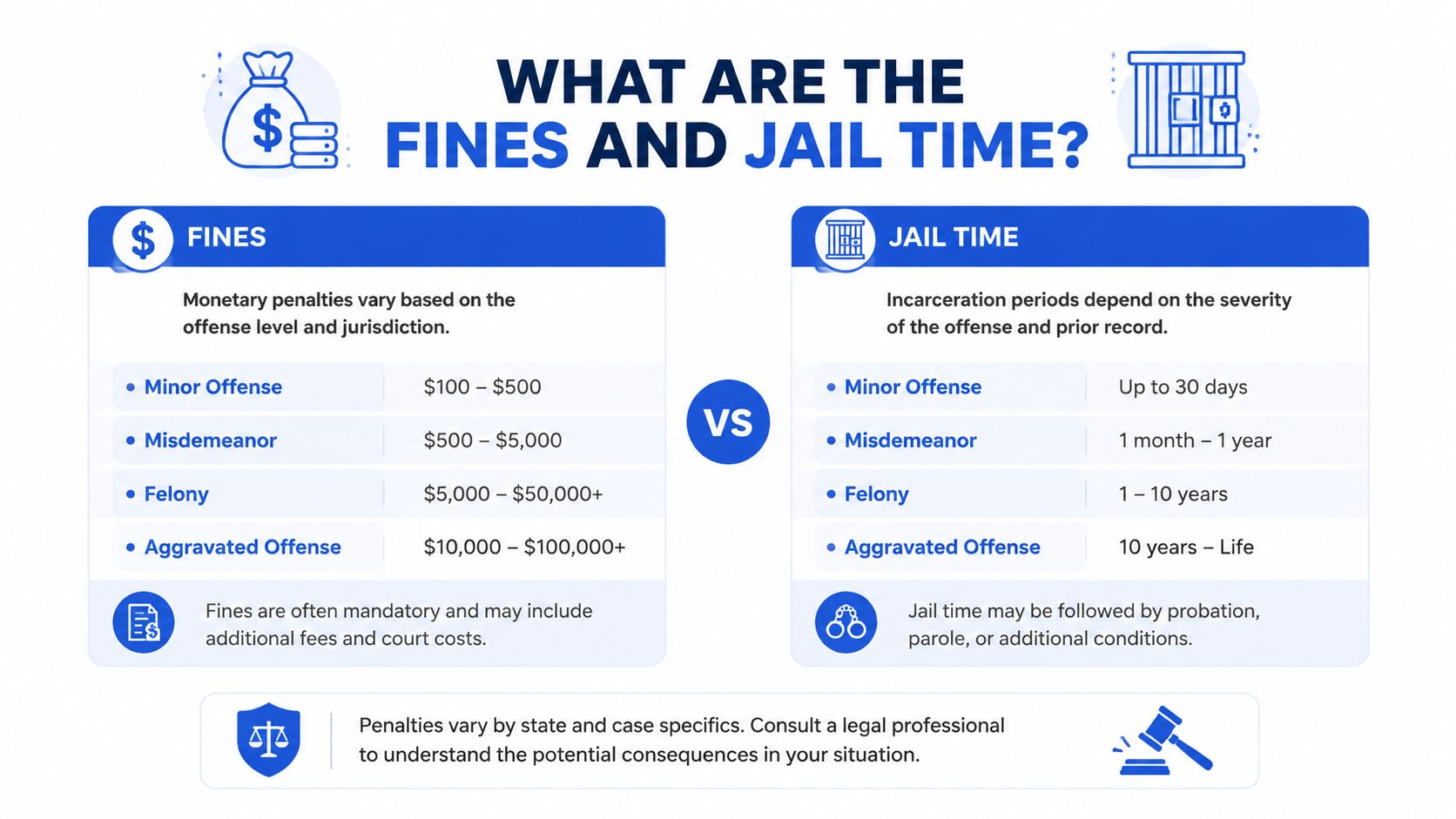
You get stopped, the officer hands you a citation, and you assume you can pay it online. That assumption is how drivers walk themselves into a criminal conviction.
For many Florida no-license cases, the primary exposure is not the amount on a piece of paper. It is jail, a misdemeanor record, and a plea that can make the next stop much worse.
The penalty chart you need to understand
Charge level | Exposure |
|---|---|
First offense | Up to 60 days in jail and up to a $500 fine under the first-offense framework discussed above |
Second conviction | First-degree misdemeanor, up to 1 year in jail and a $1,000 fine under Florida's updated repeat-offender law after House Bill 1589 |
Third or subsequent conviction | Mandatory minimum of 10 days in jail, with the same maximum misdemeanor exposure under the current repeat-offender framework |
That is a criminal penalty structure. Treat it that way.
The fine gets attention because it is easy to understand. Jail exposure is the part that changes how you should handle the case. If the charge is criminal, paying it can function like pleading guilty. That is the mistake to avoid.
Why the first conviction matters so much
A first case can look minor. It is not.
If it ends in a conviction, you may be giving the state the prior it needs to increase pressure and punishment later. That is why I push clients to stop asking only, “How much is the ticket?” The better question is, “What happens if I let this become a conviction?”
Repeat cases carry more danger, more prosecutor attention, and less room to clean things up informally.
Do not confuse this with every other license-related stop. Florida handles these charges differently from other license offenses, including suspended-license cases. If you need that comparison, review Florida penalties for driving with a suspended license so you can see why the statute on your citation matters.
If your case can put you in criminal court, your job is not to “pay the ticket.” Your job is to keep a conviction off your record.
If this is charged as a first offense, act fast and protect the record. If it is charged as a repeat offense, assume jail is in play and build a defense before your court date.
What Are the Hidden Costs of This Ticket

The court fine is only the visible part of the damage.
The practical cost of a driving-without-a-valid-license case often exceeds the statutory fine because courts may add costs and surcharges, and the fallout can include a criminal record and insurance rate increases, as noted in this discussion of the real-world cost of a Florida no-license case.
That's the part many drivers miss. They focus on the face amount of the citation. They ignore what happens after the case is entered, reported, and priced into the rest of their lives.
The court fine is rarely the real price
A criminal traffic case can trigger expenses that don't show up in the officer's hand.
You may face:
Court-added charges: Costs and surcharges can increase the total amount you owe beyond the base fine.
Insurance consequences: Insurers may treat a conviction as a higher-risk event and raise your rates.
Defense costs: The longer a case sits unresolved, the more expensive mistakes become.
If your case is being handled in Miami at the Richard E. Gerstein Justice Building, or in any busy Florida courthouse, the pressure to “just dispose of it” is real. Don't confuse speed with a good result.
A strategic response is often more cost-effective than a fast plea. If you're deciding whether to challenge the charge, start with practical guidance on how to fight Florida tickets without making the problem worse.
A criminal record changes other parts of your life
Some consequences aren't billed by the clerk, but they still cost you.
A criminal traffic conviction can affect work, background checks, professional licensing, and any situation where someone asks whether you've been charged or convicted.
That matters if you drive for a living. It matters if you hold a clearance. It matters if your employer watches your record. It matters if you do not want one bad stop to stay attached to your name.
How Can You Fight a Driving Without a License Charge
You fight this charge by refusing to treat every license case as the same.
A major mistake in online advice is failing to separate “no license on person” from driving unlicensed. That distinction is critical because the financial exposure can range from a small administrative issue to mandatory jail time, license suspension, and reinstatement fees, as discussed in this analysis of why license-charge categories matter.
That is the first decision point in your defense. What exactly were you charged with?
Paying it is often the wrong move
If you pay without understanding the charge, you may be accepting consequences you could have avoided.
A better approach is to compare your options:
Approach | Likely effect |
|---|---|
Pay first and ask questions later | Fast closure, but you may lock in a criminal result |
Gather documents and review the statute | Gives you a chance to identify dismissal or reduction options |
Use a lawyer-led defense | Puts someone between you and a preventable conviction |
If you had a valid basis to cure the problem, that needs to be raised properly. If the officer charged the wrong category, that needs to be challenged. If the case can be reduced, somebody has to push for it.
What a real defense looks like
At the Broward County Judicial Complex, and in courthouses across Florida, the work is practical.
A real defense often includes:
Checking the citation line by line: The statute, the wording, and the court date all matter.
Fixing what can be fixed quickly: If you can obtain valid licensing documentation before court, that may improve your position.
Pushing for dismissal or reduction: The target is to avoid a criminal conviction if the facts and court procedures allow it.
Keeping your record clean if possible: That is usually more important than shaving a small amount off a fine.
You also need to know who is handling your case. Some services run like automated apps or ticket mills. You upload a citation, then a middleman or chatbot stands between you and the lawyer. That is not how a criminal traffic issue should be managed.
Ticket Shield, PLLC is a Florida law firm where clients communicate directly with their attorney by phone or text, and you can review your options for fighting a Florida traffic ticket. That lawyer-led model makes more sense when the charge can affect your record and your right to drive.
The right outcome in these cases usually comes from precision, not speed.
What Should You Do Immediately After Getting This Ticket
Do these things now. Not next week.
Read the citation carefully: Look for the statute number, court date, and whether the case requires a court appearance.
Do not admit guilt by paying too fast: Payment can function like a plea in the wrong kind of case.
Figure out what you were accused of: There is a major difference between not carrying your license and driving without a valid one.
Gather your documents: Bring your identification, any current or newly obtained license documents, your citation, and anything showing your licensing status.
Save every deadline: Missing court creates a second problem you do not need.
Get legal advice before your first appearance: A quick review can tell you whether dismissal, reduction, or a non-criminal outcome is realistic.
If your case is set at the Orange County Courthouse in Orlando, or anywhere else in Florida, the rule is the same. Move quickly. Delay helps the court, not you.
If your goal is No Points, protection of your record, and a clear plan before court, visit Ticket Shield, PLLC for a free consultation.