
How Much Is a DUI Fine in Florida? the Real Costs
Asking how much is a DUI fine in Florida? Learn the base fines, hidden costs, and total financial impact. A defense attorney can help reduce penalties.

You're probably reading this after a bad night, a sleepless morning, or a call from jail release. You want one straight answer. How much is a DUI fine in Florida?
The short answer is that a first-time Florida DUI carries a minimum fine of $500 under Florida law, but if you stop there, you're missing the broader dangers. A DUI is rarely just a fine. It's a criminal case, a license problem, an insurance problem, and often a work problem all at once.
That's why scared drivers make the same mistake. They search for the court fine, assume they can budget for it, and then get blindsided by everything attached to the case. If your case is headed to the Orange County Courthouse in Orlando or another Florida courthouse, you need to think bigger than the ticket amount on paper.
Table of Contents
What Happens After a DUI Arrest
TL;DR: In Florida, a first DUI fine starts at $500, but the actual cost is usually much higher because a DUI triggers court penalties, license consequences, and long-term financial damage.
After a DUI arrest, it's common to feel anything but calm. You're worried about your job, your license, your car, your insurance, and whether one bad decision is about to follow you for years. That fear is justified. A DUI charge in Florida is serious, and the costs start moving before you feel ready.
Florida follows the same general legal baseline used nationwide. Driving with a BAC of 0.08 or higher is illegal in all 50 states, including Florida, according to NHTSA's drunk driving overview. That's the threshold many drivers recognize, but the legal trouble after an arrest goes beyond the number on the breath test.
What usually hits you first
The first wave is confusion. You may have bond conditions. You may have a court date. You may already be hearing that your license is at risk. You may also be getting advice from too many people at once, including friends who don't know Florida DUI procedure.
Read this carefully:
Don't guess about deadlines: DUI cases move fast, especially when your driving privilege is on the line.
Don't assume the fine is the whole problem: It isn't.
Don't rely on chatbots or middlemen: A DUI case needs legal judgment, not canned responses.
If you want a clearer picture of the process right after arrest, review these steps after a Florida DUI arrest.
Practical rule: The first days after arrest matter more than most drivers realize. Early decisions affect your license, your defense, and the total cost of the case.
What you should do right now
Some drivers also need to reflect on their alcohol use, especially if the arrest wasn't an isolated event. If you're trying to understand evaluations or treatment expectations, this guide on first steps for addiction treatment is a useful starting point.
Take these immediate steps:
Write down the timeline: Where you were, what you drank, when you drove, when the stop happened, and what the officer asked.
Save paperwork: Keep the citation, bond papers, tow paperwork, and any hearing notices together.
Stop talking about the case publicly: Don't post about it. Don't text detailed explanations to friends.
Get legal advice fast: The sooner a lawyer reviews the stop, the better your chance of controlling damage.
You don't need an app. You need a plan.
What Is the Base Fine for a Florida DUI
You want a number. Florida law gives one. But if you focus only on that number, you miss the full risk.
Florida DUI fines come from Florida Statute 316.193. That statute sets the court's base fine range and the offense level. It is the starting point for the judge. It is not the full price tag of a DUI case.

What does Florida law say
For a first DUI in Florida, the base court fine starts at $500.
That is the minimum statutory fine many drivers find online. It is accurate, but it is incomplete. Florida law can raise that amount if the case involves facts that make the charge more serious, and repeat allegations usually bring harsher financial penalties than a first case.
The key point is simple. The base fine answers a narrow court question. It does not answer the bigger question most clients ask in my office, which is what this arrest is going to cost them.
What the base fine does and does not tell you
The base fine matters because it is part of the sentence exposure. Prosecutors use that exposure during negotiations, and judges can impose it if the case ends in a conviction.
It does not tell you the total financial impact of the case. It does not include the other money a DUI can pull out of you through license problems, compliance requirements, insurance consequences, and missed work. Those costs decide whether a DUI becomes a short-term problem or a long financial mess.
Here is the clean version:
DUI question | Direct answer |
|---|---|
What is the minimum base fine for a first Florida DUI? | $500 |
What law controls DUI fines and penalties in Florida? | Florida Statute 316.193 |
Does the base fine reflect the total cost of a DUI case? | No |
Can the fine increase based on the facts or prior record? | Yes |
A quoted fine range may calm you down for five minutes. It will not protect your license, your record, or your bank account.
Where smart drivers put their attention
Do not fixate on the minimum fine and assume you understand the case. That is how people get blindsided.
Focus on the parts that control cost:
The exact charge level: first offense, repeat offense, or a case with aggravating facts
The strength of the evidence: the stop, field sobriety exercises, breath test issues, and officer procedure
The defense plan: whether the case can be challenged, reduced, or resolved in a way that limits the financial fallout
That is where a lawyer-led defense earns its value. An impersonal service can quote the statute. A DUI defense attorney looks at the facts, finds pressure points in the State's case, and works to keep a base fine from turning into a far more expensive conviction.
Why Is the Court Fine Only the Beginning
Most DUI pages make the same mistake. They answer “how much is a DUI fine” with a court number and stop. That's not enough. For most drivers, the fine is the smallest part of the financial damage.
Think of the DUI fine like the tip of an iceberg. You can see it. You can quote it. You can panic over it. But most of the cost sits underneath, and that hidden part is what hurts people for months or years.
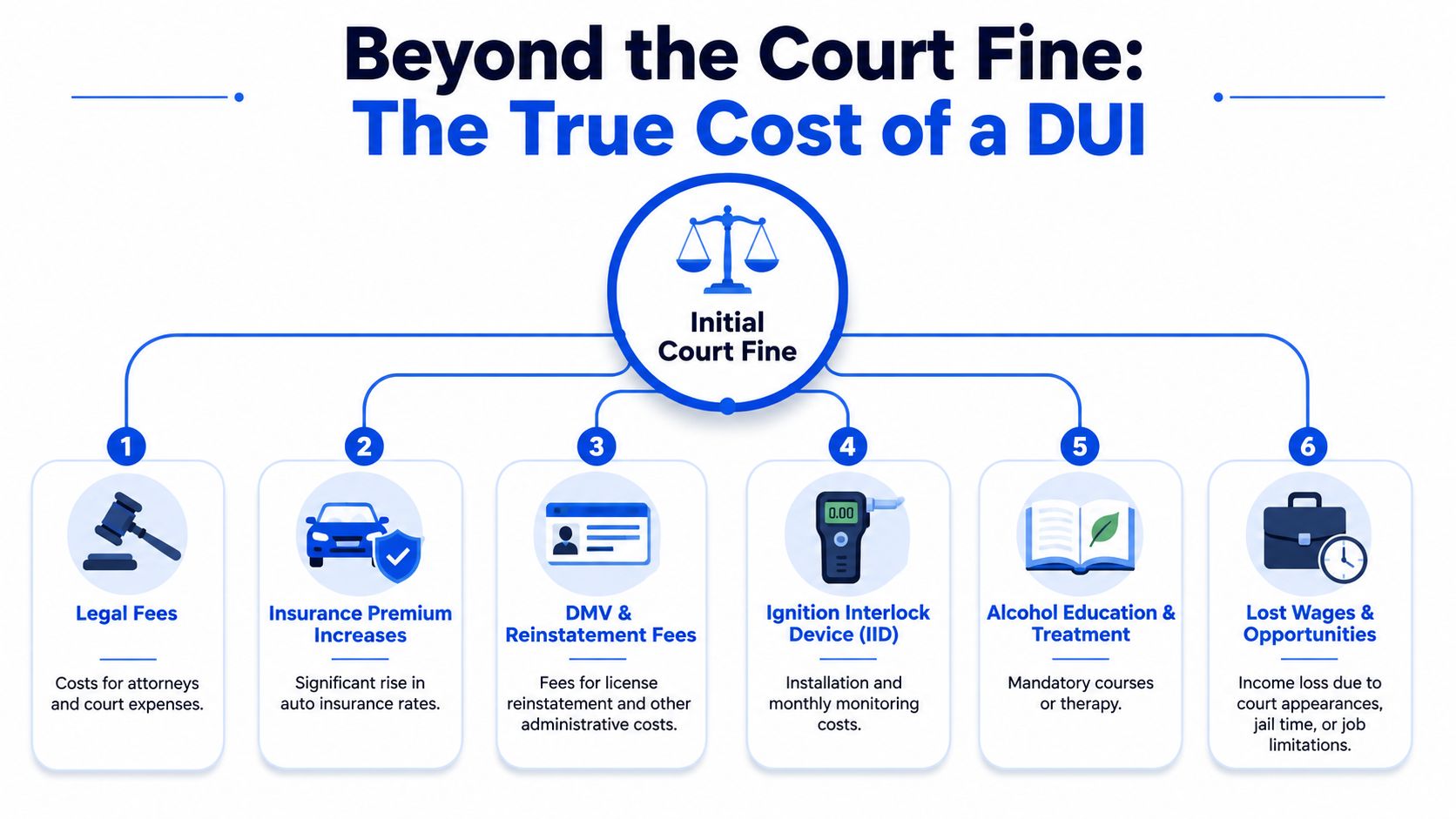
What sits below the surface
A DUI case usually creates several separate financial tracks at once. The court handles one part. Administrative agencies handle another. Your insurer has its own reaction. Your employer may react too.
Those costs can include:
License-related expenses: Suspension issues, reinstatement requirements, and related administrative obligations
Compliance costs: Education, treatment, and possible ignition interlock obligations
Insurance consequences: Higher premiums and added risk classification
Lost income: Missed work for court, classes, hearings, or transportation problems
Defense costs: The money required to properly fight the case
Independent cost breakdowns in other states show how big that gap can be. In Colorado, the total burden for a first DUI can be $13,500 or more, and the fine itself is often one of the smaller line items when compared to insurance increases, attorney fees, interlock devices, and other costs, according to Colorado's DUI law summary materials.
Why this matters in Florida
You shouldn't read that as a Florida price sheet. You should read it as a warning. The same pattern applies here. Drivers who only budget for the court fine usually underestimate the case by a wide margin.
A DUI conviction doesn't hit once. It keeps billing you.
That's why a lawyer-led defense matters. A real attorney looks at the whole chain of consequences. An automated app can't tell you how a charge affects your license strategy, your hearing decisions, your negotiation posture, and the total cost you're trying to avoid.
The bad assumption that costs people money
The bad assumption is simple: “If I just pay the fine and move on, this goes away.”
It usually doesn't.
A DUI can affect:
Cost category | Why it grows |
|---|---|
Court obligations | The judge can impose fines and additional conditions |
Administrative consequences | Separate steps may be required to restore driving privileges |
Insurance | A conviction can change your risk profile for years |
Daily life | Transportation problems create work and family disruption |
If you only ask how much is a DUI fine, you're asking the smallest question in the case.
What Are the Hidden Costs of a DUI Conviction
A first-time DUI in Florida carries a minimum fine of $500, but broader DUI cost estimates place the all-in financial impact between $10,000 and $30,000 once attorney fees, insurance surcharges, education, and ignition interlock costs are added, according to this DUI cost analysis discussing California and Florida figures. That's the number range many drivers should pay attention to.
The hidden costs aren't “extra” in any practical sense. They're the actual price of the case.
Where the money usually goes
A DUI conviction can drain money from several directions at once. Some expenses are immediate. Others show up later and keep repeating.
Hidden cost area | What it can involve |
|---|---|
Insurance surcharges | Higher premiums after a conviction |
Attorney fees | Cost of defending the case |
Education requirements | DUI school or related programs |
Ignition interlock | Installation and monitoring obligations |
Transportation disruption | Towing, alternative rides, missed work, and schedule changes |
License consequences | Reinstatement-related expenses and administrative hurdles |
The exact total depends on your facts, your record, and how the case resolves. But one truth stays consistent. The court fine is rarely the financial center of gravity.
The costs most people overlook
Insurance is where many drivers get blindsided. They prepare for court. They don't prepare for the long tail. A conviction can affect what you pay to stay on the road well after the courthouse part ends.
Then there's the compliance burden. Programs, evaluations, and treatment don't just take money. They take time off your calendar and control over your schedule.
If treatment becomes part of the picture, you should understand the financial side before you commit. This guide on understanding IOP program expenses can help you evaluate one common treatment format.
Some DUI costs arrive as bills. Others arrive as lost options.
Why the total cost depends on the case result
A driver who pleads early without examining the evidence may lock in expenses that a stronger defense could have reduced or avoided. That's why the legal strategy matters financially, not just legally.
If you want a Florida-specific overview of the bigger cost picture, review how much a DUI can cost in Florida.
Here's the practical takeaway:
A plea has a price tag: Not just in court, but in insurance and license impact.
A weak defense gets expensive fast: Especially if you accept every consequence as unavoidable.
Early legal analysis can reduce damage: Sometimes by attacking the basis for the stop, testing, or charge itself.
People ask how much is a DUI fine because they're trying to regain control. That's understandable. But control starts when you look at the full ledger, not one line.
What Factors Can Increase Your DUI Fines and Penalties
You can start with a base fine on paper and still end up facing a far more expensive case once the aggravating facts show up in the arrest report. That is where Florida DUI cases get financially dangerous. A higher allegation gives the prosecutor more room to push for tougher penalties, more conditions, and more pressure on you to plead before anyone has tested the evidence.
Which facts make the case worse
Florida law treats some DUI facts as penalty multipliers, not side details. If the state alleges a high breath or blood alcohol level, a child passenger, a crash, property damage, bodily injury, or a prior DUI, the case usually gets harder and more expensive fast.
You should know how those enhancements are built into the law before you make any decision about a plea. These Florida DUI statutes and penalty rules give you the legal framework, but your case will turn on how the facts were documented and whether the state can prove them.
Why these facts cost more than the fine itself
Aggravating facts do more than raise the number on the court receipt. They change how the prosecutor values the case, how a judge sees risk, and how much advantage you lose if you walk in unprepared.
That matters because each added allegation can trigger more spending and more restrictions:
Higher BAC allegations: These often bring steeper fines and stricter sentencing demands.
A child in the vehicle: Judges and prosecutors treat this harshly.
Crash allegations: Property damage or injury can push the case into a much more serious category.
Prior DUI history: Repeat cases face stronger punishment and less patience from the court.
One bad fact can reshape the whole case.
Why repeat DUI allegations are especially expensive
Repeat DUI cases carry the biggest financial risk because the penalties keep climbing and the margin for error gets smaller. Prosecutors use prior history to argue for tougher treatment. Judges often see a repeat allegation as a reason to impose more punishment, not less.
That does not mean every prior offense automatically holds up the way the state claims it does. It means you need a lawyer to verify the record, examine the dates, and challenge any enhancement the state cannot prove cleanly. That kind of review is not a luxury. It is often the difference between controlled damage and years of extra cost.
Do not treat an aggravated DUI like a routine case
If your case involves any enhancement, convenience is expensive. A quick plea may feel like relief for a day. Then the full bill shows up in higher fines, harsher penalties, and consequences that follow you long after court ends.
Get a lawyer who reads the reports, checks the testing, studies the video, and attacks weak enhancements early. That is how you protect your license, your advantage, and your money.
How Can You Fight to Reduce Fines and Protect Your License
A DUI case is not won by hoping the court goes easy on you. It's fought by examining every part of the state's case and forcing the prosecution to prove what it claims.
That starts with the evidence.
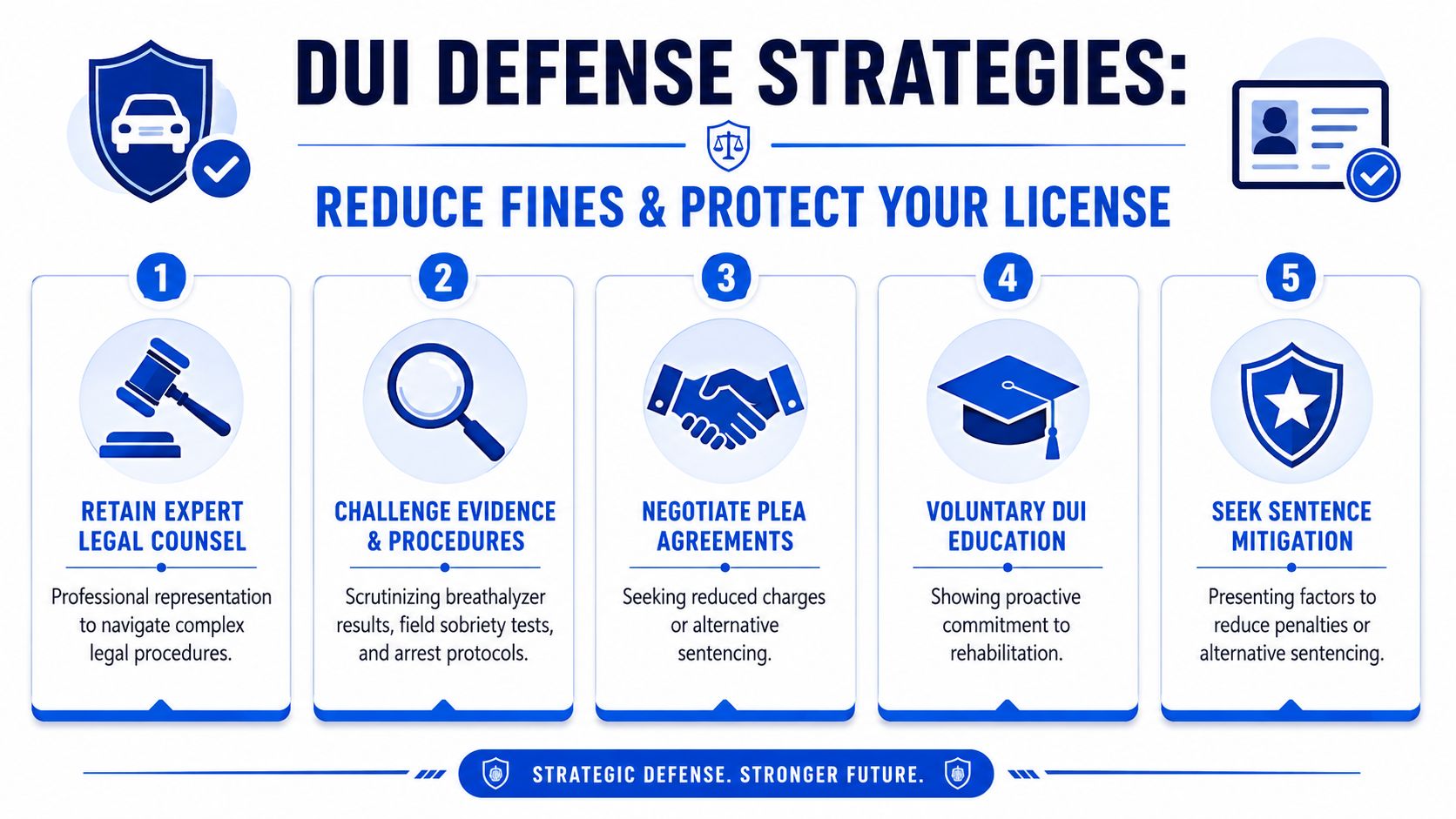
What a real DUI defense looks like
A serious defense usually asks questions like these:
Was the traffic stop lawful? If the stop was bad, the case may have problems from the start.
Were field sobriety exercises administered correctly? These tests are often presented as stronger than they really are.
Was breath testing handled properly? Procedure matters.
Do the reports match the video? Officers write narratives. Video sometimes tells a different story.
Can mitigation help if dismissal isn't available? Strategy includes both attack and damage control.
A lawyer should also look at license protection immediately, not as an afterthought. For many drivers, especially rideshare drivers, delivery drivers, and professionals who commute daily, the license issue matters as much as the criminal charge.
If you want to understand how defense challenges can dismantle a weak case, review how DUI charges can be dismissed.
Why lawyer access matters
Here's where people make another expensive mistake. They hire a system instead of a lawyer. They get routed through staff. They upload documents into a portal. They receive generic status updates. When panic hits, they can't reach the person making decisions.
That model is bad for DUI defense.
You need to talk directly with the attorney handling your case by phone or text. You need advice tied to your facts, your courthouse, your license risk, and your timeline. That's the difference between a lawyer-led defense and the automated apps or ticket mills that process volume.
Ticket Shield, PLLC is one Florida option built around that direct-attorney model. Clients communicate with their lawyer, not a chatbot or middleman. In a case that can affect your record, license, and insurance, that access matters.
A DUI defense should feel like legal representation, not customer support.
What you can do now to improve your position
Some actions help. Some hurt. If you want the most cost-effective path, focus on the steps that preserve defenses and reduce avoidable damage.
Get the documents together early. Citation, bond paperwork, tow information, and hearing notices all matter.
Write your memory down now. Details fade fast after an arrest.
Avoid self-damaging statements. Don't explain the case to friends, employers, or online audiences in a way that can be used against you.
Ask about both tracks of the case. A DUI often involves the criminal side and the driving privilege side.
Work with a lawyer who reviews evidence. Fast pleas can be costly pleas.
This video gives a helpful overview of the defense mindset you should expect from counsel:
What you are really trying to protect
You are not just trying to lower a fine. You are trying to protect:
What's at stake | Why it matters |
|---|---|
Your license | Without it, work and family life get harder fast |
Your record | A conviction can follow you into future screenings |
Your insurance costs | Financial consequences can outlast the case |
Your time | Court, classes, and compliance obligations take control of your schedule |
That is why hiring a DUI lawyer is not just another expense line. It is often the only rational way to control a problem that otherwise keeps expanding.
If you've been charged with DUI in Florida, don't treat it like a simple fine and don't hand your case to an automated app or a ticket mill. Visit Ticket Shield, PLLC for a free consultation and a lawyer-led plan focused on protecting your license, reducing fallout, and pursuing the No Points goal.
