Following Too Close in Florida: A Guide to Your Ticket
Got a following too close ticket in Florida? See what Statute 316.0895 actually says, the 3-point risk, and when a defense is realistic.
A ticket for following too close is one of those frustrating citations that can feel entirely based on an officer's opinion. That's because, in many ways, it is. In Florida, an officer can write you this ticket if they believe you were driving behind another car more closely than is "reasonable and prudent," leaving you with little room to stop safely.
There's no magic number here. The law doesn't specify a required distance in feet or seconds. It's a judgment call based on speed, traffic, and the conditions at that exact moment.
If you're looking at the citation itself, the law behind it is Florida Statute 316.0895. You may also see people refer to it as FSS 316.0895; in this context, FSS means Florida Statutes. That matters because the wording of the statute—not a driving-school slogan—is what controls whether the ticket holds up.
How We Evaluate a Following Too Close Ticket Under Florida Statute 316.0895
The central question a judge will eventually have to answer is whether the facts show a distance that was unreasonable for the speed, traffic, and road conditions. Not every ticket is treated the same, because this statute is highly fact-specific.
The first things we look at are the citation details, the officer's stated observations, whether there was a crash, and the traffic environment at the time. A ticket issued on an open highway after a long observation period is a different case from one written in stop-and-go congestion after a sudden lane change. We also look at county procedure, prior record, and whether the driver holds a CDL, because those factors often change whether the smarter path is to contest the allegation aggressively or focus on damage control.
In our experience, the strongest review points are usually: where the officer was positioned, how long they observed the vehicles, whether another driver cut into the gap, whether weather or traffic compressed spacing, and whether the ticket was written after a rear-end crash because officers often assume the trailing driver was too close. Facts that tend to weaken a defense include an admission of tailgating, clear dashcam footage showing a sustained short gap, or a crash sequence that leaves little room for an alternative explanation.
We also separate contestability from consequences. Even when a full defense is hard, the practical objective may still be avoiding points, protecting insurability, or limiting CDL fallout. The Florida Highway Safety and Motor Vehicles department explains that points for moving violations can lead to suspension once they accumulate, which is why strategy matters from the start; see the state's point system overview.
Unpacking a Florida Following Too Close Ticket
When an officer writes this citation, the legal basis is Florida Statute 316.0895. The operative rule is straightforward but flexible: a driver may not follow another vehicle "more closely than is reasonable and prudent," with regard to the speed of both vehicles, traffic, and highway conditions. The same statute also includes a separate rule for certain trucks and motor vehicles drawing another vehicle, generally requiring at least 300 feet outside business or residence districts, with listed exceptions.
That wording is the whole case. The law does not give officers or drivers a fixed statewide car-length formula for ordinary passenger vehicles. Instead, it asks whether the distance was reasonable under the actual conditions. That is why two cases that look similar at first glance can have very different outcomes.
What Each Part of the Statute Means in Plain English
The phrase "more closely than is reasonable and prudent" means the legal question is not whether your spacing looked tight in isolation. It is whether a careful driver would have left more room in that same situation.
"Having due regard for the speed of such vehicles" means the faster traffic is moving, the more stopping room Florida law expects you to leave. A short gap at neighborhood speed is judged differently from the same gap at interstate speed.
"And the traffic upon and the condition of the highway" means density, weather, visibility, surface conditions, construction, and road layout all matter. Rain, stop-and-go compression, downhill grades, and merging traffic can all change what is prudent.
For truck-related cases, the 300-foot provision matters because it shows the statute treats some following-distance issues differently depending on vehicle type and roadway setting. For most readers dealing with a regular passenger-car citation, though, the key issue remains the statute's flexible standard rather than a fixed number.
What FSS Means on This Kind of Ticket
If you have seen references to FSS 316.0895 or "following too closely" under FSS, FSS means Florida Statutes. It is shorthand for the codified laws of the state. On this ticket, it points you back to the statute above, the source a court will use to decide whether the officer's allegation is legally supported.
Quick Summary of a Florida Following Too Close Violation
Aspect | Details |
|---|---|
Statute | Florida Statute 316.0895 |
Standard | "Reasonable and prudent" distance, not a specific measurement. |
Violation Type | Moving Violation |
Penalties | Fines, court costs, and 3 points on your driving record. |
Key Factors | Speed, weather, road conditions, and traffic density. |
Defense Focus | Challenging the officer's subjective judgment of the situation. |
Practical outcomes depend on the details of how the law is applied on the road.
What Does "Reasonable and Prudent" Actually Mean?
Think of "reasonable and prudent" as a flexible ruler. A safe following distance in one scenario can be completely reckless in another. An officer is trained to size up a situation quickly, and they're looking at a few key things:
Current Speed: The faster you're going, the more asphalt you need to come to stop. A gap that feels fine at 25 mph is a recipe for disaster at 65 mph.
Traffic Density: In bumper-to-bumper rush hour traffic, everyone's following distance shrinks. But an officer can still write a ticket if they think you're being overly aggressive or tailgating someone.
Weather Conditions: This is a big one. Rain, fog, or slick roads dramatically increase how long it takes to stop. A gap that’s perfectly safe on a dry, sunny day becomes dangerously small on wet pavement.
Road Type: What's considered safe on a wide, multi-lane highway is judged differently than on a narrow, two-lane country road.
Because it all comes down to a judgment call, a following too close ticket is far from an open-and-shut case. The officer's perception is a powerful piece of evidence, but it's not the only piece.
A ticket is simply an allegation, not a conviction. The subjective nature of the "following too close" law means there are often valid points to raise in a defense. Our goal is to protect your license and record.
Getting this ticket is the start of a legal process, not the end of the road. It's a moving violation, and a conviction will lead to points on your license and a likely spike in your insurance premiums. Understanding the law's flexibility is the first step toward building a smart strategy. The Florida court system's civil traffic infraction information is also useful for understanding hearings and options after a citation. Past results do not guarantee future outcomes, but a knowledgeable approach can make a world of difference.
Attorney Advertisement. Office in Broward. Submitting information does not create an attorney-client relationship.
The True Cost of a Following Too Close Conviction

A ticket for following too close may seem like a minor annoyance, but the actual cost of a conviction goes far beyond the fine printed on that slip of paper. While the base fine varies from county to county in Florida, the domino effect of consequences can impact your wallet and your driving privileges for years.
Many drivers make the mistake of just paying the fine to get it over with. The problem is, paying the ticket is the same as pleading guilty. That guilty plea automatically puts a conviction on your driving record and kicks off a series of expensive penalties.
The Financial Hit: Fines and Insurance Hikes
The first hit is the fine itself, which is usually a base penalty plus a handful of court costs and administrative fees. Together, these can easily add up to a few hundred dollars. But that one-time payment is only the beginning of the financial pain.
The biggest long-term cost usually comes straight from your insurance provider. A conviction for following too close is a moving violation, and insurance companies see it as a bright red flag for risky driving. As a result, they may increase your premiums by a significant percentage when it’s time to renew your policy.
This insurance surcharge isn't a temporary slap on the wrist. It can stick with you for three to five years, potentially costing you hundreds or even thousands of dollars over the life of the policy—all from one single ticket.
License Points and the Risk of Suspension
On top of the financial penalties, a conviction for following too close adds three points to your Florida driver's license. These points aren't just a number; they're demerits that accumulate and can lead to serious trouble. The state keeps a running tab on these points to identify drivers who repeatedly break traffic laws.
Every Florida driver needs to know these thresholds:
12 points within a 12-month period leads to a 30-day suspension.
18 points within an 18-month period leads to a 3-month suspension.
24 points within a 36-month period leads to a 1-year suspension.
Each conviction pushes you closer to these limits, putting your ability to legally drive at risk. You can get a deeper understanding of how this works in our detailed guide to the Florida traffic ticket point system.
Severe Consequences for CDL Holders
For commercial drivers, the stakes are very high. Following too close is classified as a "serious traffic violation" by the Federal Motor Carrier Safety Administration (FMCSA), and a conviction can have a major impact on a professional career.
Just two serious violations within a three-year period will trigger a minimum 60-day disqualification of a Commercial Driver's License (CDL). If you get a third violation in that same timeframe, you’re looking at a 120-day disqualification. For a professional driver, losing a CDL for even a couple of months can mean losing a job and livelihood. This is why addressing every single ticket, especially for an offense like following too close, is critical.
Attorney Advertisement. Office in Broward. Protecting your record is our primary goal. Past results do not guarantee future outcomes.
Why Florida Law Takes Tailgating So Seriously
To effectively address a following too close ticket, it helps to understand the "why." Why does this law exist? Florida's statute wasn't created just to issue more tickets; it's a direct response to one of the most common—and preventable—causes of crashes: tailgating. The law is all about the simple physics of driving. It connects the gap you leave in front of you to your real-world ability to react and stop when things go wrong.
When you're behind the wheel, there's always a lag between when you see a problem and when your foot hits the brake. That's your reaction time. Even after you react, your car still needs a certain amount of road to come to a halt. Tailgating squeezes that safety buffer down to almost nothing, creating a high-stakes situation where a sudden stop by the car ahead almost guarantees a collision.
The Physics of Reaction and Braking
You've probably heard of the two-second rule. It’s a decent starting point, but it's often considered the bare minimum. That two-second gap is what a driver needs to see a hazard, process it, and start braking—and that's under ideal conditions.
Here’s what’s really happening in those few critical moments:
Perception Distance: The stretch of road your car covers from the instant your eyes spot a hazard to the moment your brain registers the danger.
Reaction Distance: The distance you travel in the split-second between your brain sending the "brake now" signal and your foot physically pushing the pedal down.
Braking Distance: The distance your car travels after the brakes are engaged until it finally stops.
Add those three up, and you get your total stopping distance. The kicker? As your speed increases, that distance doesn't just grow—it grows exponentially. A gap that feels perfectly safe at 30 mph can become very dangerous at 65 mph, because you cover so much more ground before you even start braking. This is exactly why officers are quick to pull people over for tailgating on the highway.
A Leading Cause of Collisions
The strict enforcement isn't just a hunch; it's backed by data. Florida's law is broader than many drivers realize because it does not set a fixed car-length rule for everyday traffic; the statute instead uses the "reasonable and prudent" standard discussed above, which gives officers substantial discretion in changing conditions like congestion or rain, as the official Florida Statutes text makes clear. For commercial vehicles, the safety concern is even more pronounced: the FMCSA says the Large Truck Crash Causation Study found that 5% of truck crashes occurred when the commercial motor vehicle was following the lead vehicle too closely, according to the agency's following-too-closely guidance.
A Florida-focused legal review also cited a Michelin survey reporting that almost 75% of drivers said they had been tailgated in the prior six months, while only 11% admitted tailgating someone else, a gap that helps explain why courts tend to view this behavior as widespread and risky; see the discussion in this tailgating review.
Prosecutors and judges view this as a public safety issue. In their eyes, tailgating is a choice that puts everyone on the road at risk.
Understanding that mindset is important. A solid defense doesn't pretend safety isn't a concern. Instead, it drills down into the specific facts of your situation to argue that your actions were not unreasonable or unsafe given the road, the traffic, and the conditions at that exact moment.
How to Build a Defense Against Your Following Too Close Ticket
Getting a ticket for following too close is not the moment to rely on vague memory. The strongest cases are built from specific facts gathered early, before the details blur. Because the statute turns on what was reasonable in that moment, your defense should do the same.
Step 1: Write Down the Facts Immediately
As soon as you can do so safely, make a detailed record of what happened. In our review process, this is often the first thing that changes the quality of a case because drivers remember far more in the first hour than they do a week later.
Write down:
the exact location, lane, and direction of travel
traffic speed and whether traffic was flowing, compressing, or stopping
weather, visibility, and road surface conditions
whether another vehicle cut into your lane
whether the lead vehicle braked suddenly or unpredictably
where the officer was positioned and when you first noticed them
whether the citation followed a crash or a near-miss
what you said to the officer, if anything
If there were passengers or independent witnesses, note their names and contact information. If there is dashcam footage, preserve it immediately.
Step 2: Gather the Evidence That Actually Matters
For this kind of ticket, not all evidence carries equal weight. The most useful proof usually goes to spacing, visibility, and sequence of events.
Helpful evidence can include:
dashcam or rear camera video
photos or video of roadway layout, merge areas, curves, hills, or sight obstructions
vehicle data or telematics, if available
witness statements
crash report documents if the ticket was written after an accident
any bodycam, patrol-car video, or notes that can be requested through the proper channel
We often look first for whether the alleged short gap was sustained or momentary. A brief compression caused by merging traffic is different from prolonged tailgating over distance.
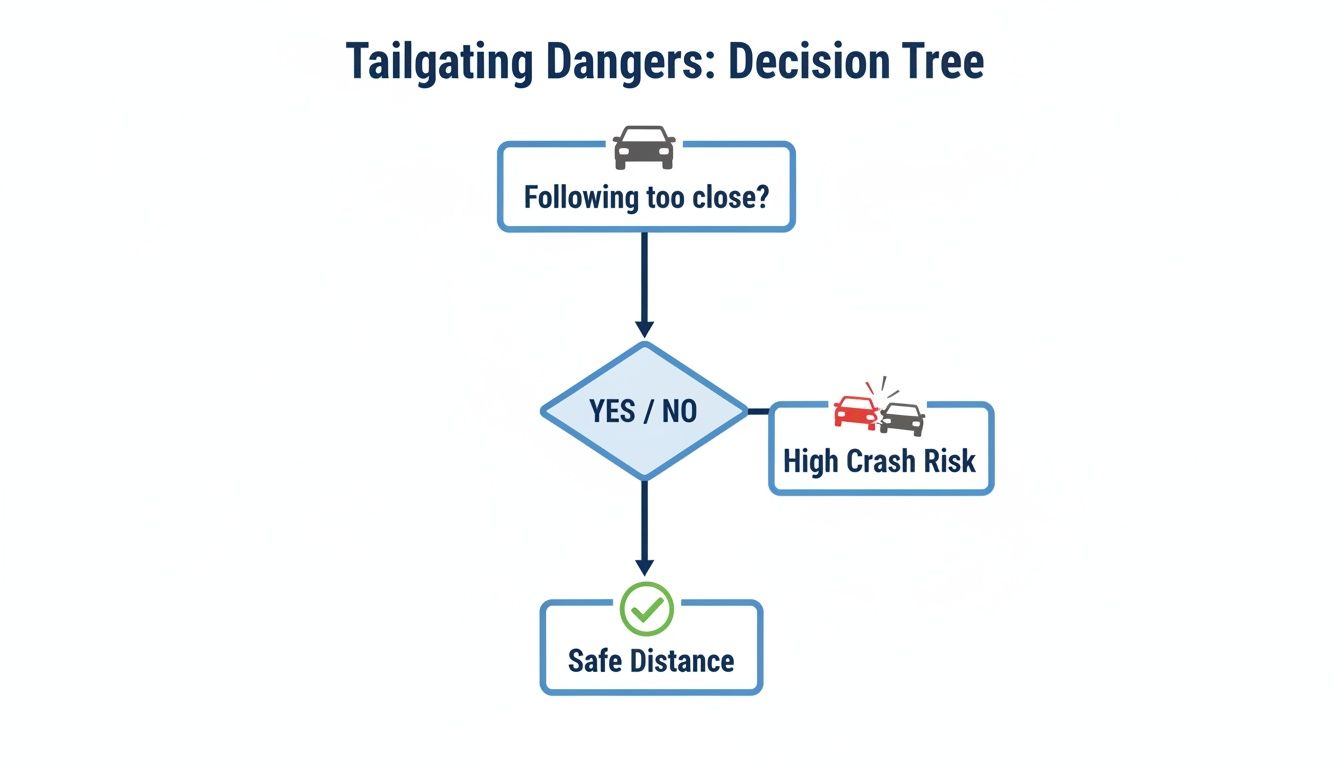
This infographic breaks down the simple but critical choice every driver makes—and why officers are trained to watch for it.
As the visual shows, maintaining a safe gap is the only way to avoid a high-risk situation. This is why officers take it seriously, but it also highlights why the context of your driving really matters.
Step 3: Request the Records and Learn the Procedure
A practical defense also means knowing what records exist and what hearing process applies in your county. Depending on the circumstances, that may include the citation, the officer's narrative, crash materials, and available video. The Florida courts provide a useful civil traffic infraction guide explaining hearings, elections, and what happens if you contest a noncriminal traffic citation.
If you hold a CDL, add one more layer of analysis right away. FMCSA identifies following too closely as a serious traffic violation for CDL purposes, and the federal serious traffic violations summary explains why even a single conviction can matter long before a standard driver would consider the case serious.
Step 4: Identify Whether You Have a Challenge Case or a Mitigation Case
Some fact patterns tend to support a direct challenge to the ticket:
Sudden cut-off: another vehicle entered the gap abruptly, leaving no realistic chance to restore spacing instantly.
Traffic compression: heavy traffic bunched up quickly, and the alleged distance was part of a chain reaction rather than aggressive tailgating.
Obstructed officer vantage point: the officer observed from an angle, through traffic, over distance, or while moving in a way that made distance judgment less reliable.
Post-crash assumption: the ticket was issued after a rear-end collision without strong independent proof that you had been following unreasonably before the impact.
Erratic lead vehicle behavior: the vehicle ahead braked sharply, changed speed without reason, or created a situation that distorted normal following distance.
Other cases are harder to win outright and may call for a mitigation-focused strategy instead:
clear video of a sustained short gap at speed
an admission that you were trying to pressure the lead driver
no witness support and no record contradicting the officer
a crash sequence with obvious insufficient stopping room
That distinction matters. In some files, what changes the outcome is not proving the officer was wrong about everything; it is showing enough uncertainty or enough favorable background to avoid the worst consequences.
Citing External Factors Beyond Your Control
Sometimes, a tight following distance isn't a choice you make; it's a reaction to something unexpected on the road. These external factors can become the foundation of a powerful defense because they can show you were driving reasonably in a situation you didn't create.
Here are a few common scenarios:
Sudden Cut-Off: Another driver abruptly swerves into your lane, instantly wiping out the safe cushion you were maintaining. In this case, you didn't choose to tailgate, the unsafe gap was forced on you.
Erratic Lead Driver: The car ahead of you was braking for no reason, or constantly speeding up and slowing down. Their unpredictable driving makes it nearly impossible to keep a consistent, safe distance and may be the primary cause of the problem.
Adverse Conditions: Maybe bad weather, road hazards, or poor visibility forced you to adjust your driving in a way an officer misinterpreted as aggressive.
These situations are never as simple as the ticket makes them seem. If you're trying to weigh the financial fallout of contesting a citation versus paying it, a basic resource on irregular costs can help frame the budgeting side; see Fintrack. When a driver's actions are aggressive, they can cross the line into a more serious offense. You can learn more in our guide on how to fight a reckless driving ticket.
The Limits of These Defenses
Not every explanation is a defense. Saying traffic was heavy does not automatically justify a dangerously short gap, and saying the officer "couldn't really know" will not carry much weight unless there is a concrete reason the observation was unreliable. In our experience, these cases become much tougher when the only evidence is a generalized denial and the officer has a clear, consistent account.
Ultimately, a defense is built on the specific facts. Documenting everything you remember—the traffic flow, other drivers' actions, and weather conditions—is vital. Past results do not guarantee future outcomes, but a well-prepared case can significantly improve your chances.
Attorney Advertisement. Office in Broward. Submitting information does not create an attorney-client relationship.
Why This Ticket Is a Bigger Problem for Young Drivers
While any driver can get a ticket for following too close, the fallout is often far more damaging for young and newly licensed drivers. Their limited experience behind the wheel can make it tough to judge a safe following distance, especially as speeds change, leaving them more vulnerable to this type of citation.
This isn’t just a theory; it’s a well-documented risk. The data is clear: young drivers are disproportionately involved in crashes where risky behavior like tailgating is a major factor. In fact, research shows that drivers under 20 have significantly higher crash rates per mile than the average adult. You can read more about these findings on risky driving behaviors in novice drivers.
Navigating Florida’s Graduated Licensing Rules
For a teen driver, what seems like a simple traffic ticket can create a major obstacle in their journey toward a full, unrestricted license. Florida's Graduated Driver Licensing (GDL) program is built on strict rules designed to ease new drivers onto the road safely.
A conviction for a moving violation like following too close can directly impact their progress:
Delayed Advancement: A conviction can prevent a driver from moving up from a Learner’s License to an Intermediate License, or from there to a full license.
Extended Restrictions: Depending on the details, it could mean more time with nighttime driving curfews or limits on who can be in the car with them.
License Suspension: Accumulating points quickly can trigger a suspension, pausing their driving independence.
A single ticket can derail the entire timeline for a young driver. It’s not just about a fine; it’s about protecting their path to becoming a fully licensed adult.
The Amplified Impact on Insurance Rates
Insurance companies already see teen drivers as high-risk, a fact that is reflected in their expensive premiums. Adding a moving violation conviction to their record can worsen the situation.
A conviction for following too close signals to insurers that the young driver may be engaging in unsafe habits, making a steep premium hike likely. This surcharge can stick around for years, adding thousands of dollars to the family’s insurance bill. For both parents and young drivers, addressing the ticket isn't just about avoiding points—it's a critical financial decision.
Attorney Advertisement. Office in Broward. Our goal is to protect your license and record. Past results do not guarantee future outcomes.
How a Traffic Defense Attorney Can Make a Difference

Trying to make your way through Florida’s traffic court system on your own after getting a ticket for following too close can be a confusing and intimidating experience. The statutes, procedures, and legal arguments are complex, and most drivers are at an immediate disadvantage. A law firm that focuses its practice on traffic defense can step in to handle the entire process for you.
An attorney’s first move is to meticulously analyze every detail of your citation. This means a careful review of the ticket itself, the officer’s report, and any other available evidence. The objective is to spot potential weaknesses in the state’s case or find procedural errors that could lead to a dismissal or a reduced charge.
Our practice focuses on traffic defense matters across Florida, giving us a deep understanding of local court procedures in all 67 counties. While past results don’t guarantee future outcomes, our goal is always to protect your driving record and minimize the financial hit from a conviction.
Strategic Case Analysis and Defense
A huge part of defending a "following too close" ticket involves challenging the subjective nature of the violation itself. We zero in on how the officer decided you were too close in the first place. Was it just a guess? A visual estimate?
For instance, the commonly cited “two-second rule” is just a bare minimum guideline. Many road safety experts recommend a three-second gap or more, especially at high speeds or in bad weather. This gray area is often a key point we can use in your defense.
An experienced attorney knows how to scrutinize the evidence and frame your case in a way that creates reasonable doubt. The objective is to seek a favorable outcome, whether that’s a complete dismissal, a reduced charge, or avoiding points on your license.
Our team explores every possible angle. We might challenge the officer’s line of sight or present evidence that another driver suddenly cut you off, forcing you to be closer than you intended. If your ticket was issued after a crash, knowing how to find a qualified car accident law firm can help when handling any related civil claims.
For many drivers, the big question is whether hiring a lawyer is really worth it. We break this down in detail in our guide on if you need a lawyer for a traffic ticket. We invite you to schedule a free consultation so we can discuss the specifics of your case and help you understand your options.
Attorney Advertisement. Office in Broward. Submitting information does not create an attorney-client relationship.
Common Questions About Following Too Close Tickets
What is the Florida statute for following too closely?
The statute is Florida Statute 316.0895. It says a driver may not follow another vehicle more closely than is reasonable and prudent, considering speed, traffic, and highway conditions. If you see FSS 316.0895, FSS means Florida Statutes.
What is the following distance rule in Florida?
Florida does not have a single statewide feet-or-seconds rule for ordinary passenger vehicles in the statute. Driving schools often teach a two-second or three-second guideline for safety, but the legal standard is broader: the distance must be reasonable and prudent for the conditions at that moment. That means the safe gap changes with speed, weather, visibility, traffic flow, and road surface.
What should I do if a vehicle is following too closely?
Do not brake-check the other driver. The safest response is usually to create space ahead of you, avoid sudden braking, signal early, and let the tailgater pass when you can do so safely. If the behavior feels threatening, move to a safer lane or location and avoid escalating. If the situation turns into a crash or dangerous road-rage event, document what you can safely remember and report it through the appropriate law-enforcement channel.
Don't let a subjective ticket damage your driving record. Ticket Shield, PLLC is here to handle your case from start to finish. For a free, no-obligation consultation, submit your ticket online at https://www.ticketshield.com.